

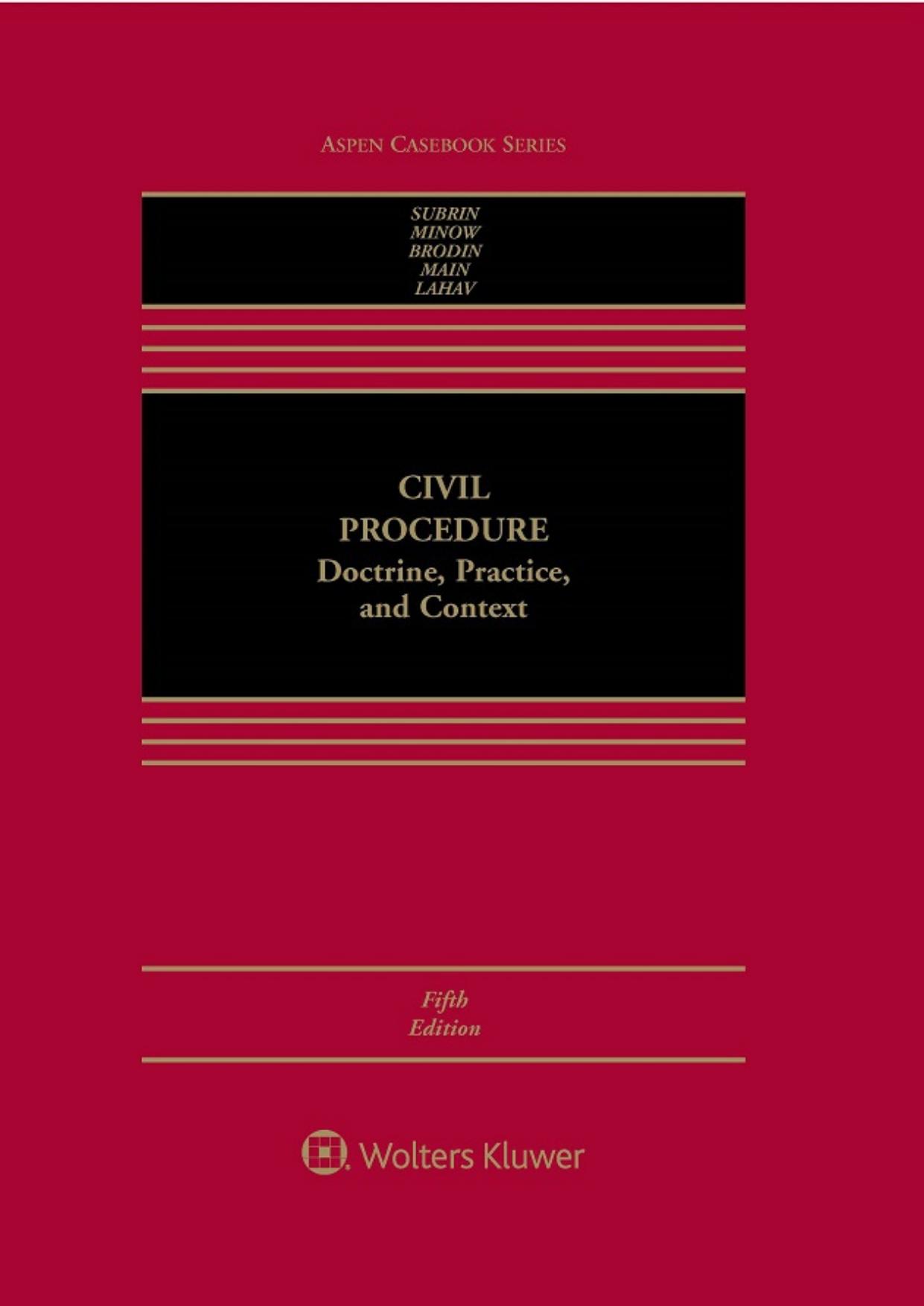
Civil Procedure Doctrine Practice and Content 5th edition by Stephen Subrin, Martha Minow, Mark Brodin, Thomas Main ISBN 1454868378 9781454868378
Original price was: $70.00.$35.00Current price is: $35.00.
Instant download Civil Procedure Doctrine Practice and Content (Aspen Casebook) Stephen N. Subrin & Martha L. Minow & Mark S. Brodin & Thomas O. Main & Alexandra D. Lahav after payment
Civil Procedure Doctrine Practice and Content 5th edition by Stephen Subrin, Martha Minow, Mark Brodin, Thomas Main – Ebook PDF Instant Download/Delivery: 1454868378 , 9781454868378
Full download Civil Procedure Doctrine Practice and Content 5th edition after payment
Product details:
ISBN 10: 1454868378
ISBN 13: 9781454868378
Author: Stephen Subrin, Martha Minow, Mark Brodin, Thomas Main
Written by respected scholars and experienced educators, this book showcases rules and doctrine of civil procedure at work in actual practice of law. The procedural and nonprocedural aspects of the cases are thought-provoking, to hold students’ interest. Each chapter contains a well-written introduction, cases, and clear explanations of the doctrine, supported by comments and questions which deepen students’ understanding and clarify key concepts. This book also includes more than forty well-crafted problems the can be used in or out of class to to help students solidify their understanding of the materials. In-class exercises and simulations based on two sample case files are integrated throughout. Pleadings, memoranda, transcripts, exhibits, motions, and more – all taken from real cases – appear in the Appendix.
Civil Procedure Doctrine Practice and Content 5th Table of contents:
1 An Introduction to Civil Procedure
A. What Students Should Know from the Start
1. Why Procedure Matters
2. What Is “Civil Procedure”?
3. Meeting the Players and the Institutions
a. Parties
b. Jurisdiction
c. Remedies
4. Sources for the Rules and Doctrines
5. How to Approach Studying
6. About This Book
7. Law as Theater
Milner S. Ball, The Promise of American Law: A Theological, Humanistic View of Legal Process
B. An Opening Case: The Power and Limits of Courts
1. Reading the Case
2. Reading a Federal Rule of Civil Procedure
3. Background of United States v. Hall
4. The Opinion
United States v. Hall
Comments and Questions
C. The Right to Be Heard: Elements and History of Due Process
1. Background of Goldberg v. Kelly
2. The Complaint
3. The Supreme Court’s Response
Goldberg v. Kelly
Comments and Questions
Frank L. Michelman, The Supreme Court and Litigation Access Fees: The Right to Protect One’s Rights
Tom R. Tyler and E. Allan Lind, A Relational Model of Authority in Groups
4. Costs of Process
Mathews, Secretary of Health, Education, and Welfare v. Eldridge
Comments and Questions
Jerry L. Mashaw, The Supreme Court’s Due Process Calculus for Administrative Adjudication: Three Factors in Search of a Theory of Value
Louis Kaplow, The Value of Accuracy in Adjudication: An Economic Analysis
Comments and Questions
5. Enemy Combatants and Due Process
Hamdi v. Rumsfeld
Comments and Questions
Practice Exercise No. 1: Designing a Sound Dispute Resolution Process
D. Access to Lawyers and to the Legal System
1. Access to Court
Boddie v. Connecticut
Comments and Questions
2. Access to a Lawyer
Lassiter v. Department of Social Services of Durham County, North Carolina
Comments and Questions
2 Remedies and Stakes
A. Introduction
B. Provisional Relief
1. Securing the Judgment: Attachments, Garnishments, and Sequestration
Fuentes v. Shevin
Comments and Questions
2. Preserving the Status Quo
Winter v. Natural Resources Defense Council, Inc.
Comments and Questions
Practice Exercise No. 2: Motion for a Preliminary Injunction
C. Final Relief
1. Equitable Relief
Walgreen Co. v. Sara Creek Property Co.
Comments and Questions
a. Equitable Relief and the Judicial Role
Brown v. Plata
Comments and Questions
Lon Fuller, The Forms and Limits of Adjudication
Abram Chayes, The Role of the Judge in Public Law Litigation
Practice Exercise No. 3: Equitable Relief in Carpenter and Warner
b. Enforcement of Equitable Relief
2. Declaratory Relief
3. Damages
Carey v. Piphus
Comments and Questions
a. Punitive Damages
Comments and Questions
Practice Exercise No. 4: Damages in Carpenter and Warner
b. Enforcement of Damages
D. Settlement
Steven Shavell, Foundations of Economic Analysis of Law
Comments and Questions
E. Financing Litigation
1. The “American Rule”
2. Fee-Shifting Statutes
3. The Effect of Rule 68 Settlement Offers on Attorneys’ Fees
Marek v. Chesny
Comments and Questions
Practice Exercise No. 5: Revising Fed. R. Civ. P. 68
4. Conditional Offer of Settlement
Comments and Questions
5. Frivolous Claims
6. Assessing the Value of Legal Services
City of Riverside v. Rivera
Comments and Questions
7. The Contingency Fee
8. Third-Party Litigation Financing
Jonathan T. Molot, Litigation Finance: A Market Solution to a Procedural Problem
Comments and Questions
Practice Exercise No. 6: Fee Arrangements in Carpenter and Warner
F. Contempt
David Luban, Legal Modernism
Walker v. City of Birmingham
Comments and Questions
Martin Luther King, Jr., Letter From Birmingham City Jail
3 Thinking Like a Trial Lawyer, Pleadings, and Joinder
A. Introduction
B. The Stages and Essential Concepts of a Civil Litigation
C. Claims, Causes of Action, and Elements
Practice Exercise No. 7: Initial Strategy Session in Carpenter
D. Pleadings and Amendments
1. The Purpose and Doctrine of Complaints
Conley v. Gibson
Comments and Questions
Ashcroft v. Iqbal
Comments and Questions
Bower v. Weisman
Comments and Questions
Practice Exercise No. 8: Analyzing 12(b)(6) and 12(e) Motions in Carpenter
2. Strategy Considerations
Practice Exercise No. 9: Considering the Warner Complaint
3. Technical Pleading Requirements
Comments and Questions
4. Anonymous Plaintiffs
Freedom From Religion Foundation, Inc. v. Emanuel County School System
Comments and Questions
5. Answers, Motions, and Affirmative Defenses
a. Preliminary Motions
b. Motions to Dismiss
c. Answers
d. Admissions and Denials
e. Affirmative Defenses
Practice Exercise No. 10: Analyzing the Answer in Carpenter
Review Exercise No. 1
6. Amendments
Singletary v. Pennsylvania Department of Corrections
Comments and Questions
Krupski v. Costa Crociere S.P.A.
Comments and Questions
Practice Exercise No. 11: Argument on Plaintiff’s Motion to Amend in Carpenter
Note: Tips on Arguing Motions
E. The Historical Background of Civil Procedure
1. The First Era: Common Law and Equity
a. Common Law Procedure
b. Equity Procedure
c. Coming to America
Comments and Questions
2. The Second Era: The Field Code
David Dudley Field, What Shall Be Done with the Practice of the Courts?
Comments and Questions
3. The Third Era: Federal Rules of Civil Procedure
a. The Rules of Decision Act, and the Process and Conformity Acts
b. The Rules Enabling Act and the Drafting of the Federal Rules of Civil Procedure
Comments and Questions
4. Are We Now in a Fourth Era?
Chief Justice Warren E. Burger, Agenda for 2000 A.D.—A Need for Systematic Anticipation
Simon H. Rifkind, Are We Asking Too Much of Our Courts?
Frank E. A. Sander, Varieties of Dispute Processing
Laura Nader, Commentary
Comments and Questions
F. Sanctions
Chaplin v. DuPont Advance Fiber Systems
Comments and Questions
Practice Exercise No. 12: Reviewing the Warner Answer Under Rule 11
G. Simple Joinder
Cooper v. Fitzgerald
Comments and Questions
H. Counterclaims and Cross-Claims
Podhorn v. Paragon Group, Inc.
Comments and Questions
Practice Exercise No. 13: Considering Counterclaims, Cross-Claims, and Rule 13(h) Additional Parties in Carpenter
I. Third-Party Practice
Gross v. Hanover Insurance Co.
Comments and Questions
Practice Exercise No. 14: Considering an Impleader in Warner
J. An Introduction to Necessary and Indispensable Parties
Temple v. Synthes Corporation, Ltd.
Comments and Questions
Daynard v. Ness, Motley, Loadholdt, Richardson & Poole, P.A.
Comments and Questions
K. Interpleader
L. Intervention
United States v. Northern Indiana Public Service Co., et al.
Comments and Questions
Review Exercise No. 2
Review Exercise No. 3
4 Discovery
A. Introduction
B. Discovery and Its Tensions
1. Discovery in an Adversary System
Hickman v. Taylor
Comments and Questions
Wayne Brazil, The Adversary Character of Civil Discovery
Stephen Landsman, Defense of the Adversarial Process
Comments and Questions
ABA Model Code of Professional Responsibility
ABA Model Rules of Professional Conduct
Comments and Questions
2. Efficiency, Effectuation Values, and Privacy
Loren Kieve, Discovery Reform
Comments and Questions
C. The Mechanics of Discovery
1. Discovery Techniques
a. A Brief Introduction to the Rules of Evidence
b. Depositions
c. Written Interrogatories
d. Production of Documents and Things
e. Physical and Mental Examinations
f. Requests for Admissions
g. Informal Discovery
h. Experts
2. The Scope of Discovery
Kubicki v. Medtronic
Comments and Questions
WWP, Inc. v. Wounded Warriors Family Support, Inc.
Comments and Questions
Trask v. Olin Corp.
Comments and Questions
Moore v. Miller
Comments and Questions
Silva v. Dick’s Sporting Goods
Comments and Questions
Kerwin v. Cage Fury Fighting Championships
Comments and Questions
Marfork Coal Co., Inc. v. Smith
Comments and Questions
Practice Exercise No. 15: Finding an Expert (and Expertise) in Carpenter
Practice Exercise No. 16: Analyzing the Scope of Discovery in Warner
3. Mandatory Initial Disclosures
Comments and Questions
Practice Exercise No. 17: Ethical Issues in Discovery
Practice Exercise No. 18: Discovery Planning in Warner
Practice Exercise No. 19: Evaluating Discovery in Carpenter
4. Foreign Discovery
D. Procedural Rulemaking
Catherine T. Struve, The Paradox of Delegation: Interpreting the Federal Rules of Civil Procedure
Stephen B. Burbank, Ignorance and Procedural Law Reform
Laurens Walker, Federal Civil Rulemaking
Letter of Transmittal from Chief Justice Rehnquist
Practice Exercise No. 20: Assessing the Rulemaking Process
5 The Right to Jury Trial and Judicial Control of Results
A. Values and Historical Background
1. Introduction
2. The Debate over the American Civil Jury
Jerome T. Frank, Courts on Trial
Harry Kalven, The Dignity of the Civil Jury
Valerie P. Hans and Neil Vidmar, Judging the Jury
Comments and Questions
3. The Historical Background of the Modern American Civil Jury
B. The Right to Jury Trial in Civil Cases in Federal Court
Chauffeurs, Teamsters and Helpers, Local No. 391 v. Terry
Comments and Questions
Practice Exercise No. 21: Legislative Exercise Regarding Right to Jury Trial
Practice Exercise No. 22: Law Firm Strategy Session Regarding Jury Trial in Warner
C. Jury Selection: Techniques and Purposes, Including Peremptory Challenges
1. Attorney Behavior
Comments and Questions
Valerie P. Hans and Neil Vidmar, Judging the Jury
Federal Jury Selection Statutes
Comments and Questions
2. Peremptory Challenges and Discrimination
Comments and Questions
D. Summary Judgment
1. An Extraordinary Remedy
Adickes v. S. H. Kress & Co.
Background of Adickes v. S. H. Kress & Co.
Comments and Questions
2. A Focal Point of Litigation
Celotex Corp. v. Catrett
Comments and Questions
3. The Fact-Law Distinction
William Schwarzer, Summary Judgment Under the Federal Rules: Defining Genuine Issues of Material Fact
4. Strategic Considerations
Practice Exercise No. 23: Summary Judgment Motion Session in Carpenter
Practice Exercise No. 24: Summary Judgment Motion Session in Warner
E. Dismissal, Directed Verdicts, Judgments Notwithstanding the Verdict, New Trial Motions, and Motions to Vacate Judgment
1. Voluntary Dismissal
2. Involuntary Dismissal
3. Directed Verdict (Judgment as a Matter of Law)
4. Judgment Notwithstanding the Verdict (JNOV/Renewed Judgment as a Matter of Law)
5. Motions for New Trial
6. Judgments as a Matter of Law and New Trial Motions in More Detail
Galloway v. United States
Comments and Questions
Review Exercise No. 4
7. Motion to Vacate Judgment
Brandon v. Chicago Board of Education
F. Types of Verdicts, Bifurcation, Trifurcation, Instructions, Remittitur, and Additur
1. Types of Verdicts
2. Bifurcation and Trifurcation
3. Jury Instructions
Practice Exercise No. 25: Jury Instructions in Carpenter
4. Remittitur and Additur
Comments and Questions
Practice Exercise No. 26: Motions to Challenge a Jury Verdict
G. Closing Arguments
Lloyd Paul Stryker, The Art of Advocacy
Practice Exercise No. 27: Closing Argument in Carpenter
Tips on Making a Closing Argument
H. Appeals
Review Exercise No. 5
6 Alternative Dispute Resolution
A. Introduction to Mediation and Arbitration
1. What Advocates Say About ADR
2. What Critics Say About ADR
3. The Contemporary Discourse
Practice Exercise No. 28: Alternative Dispute Resolution Under Local Rule
Practice Exercise No. 29: Alternative Dispute Resolution in Carpenter
4. An Alternative to ADR
Stephen B. Burbank and Stephen N. Subrin, Litigation and Democracy: Restoring a Realistic Prospect of Trial
B. Managerial Judging and the Role of Courts in an Era of Alternative Dispute Resolution
William W. Schwarzer, Managing Civil Litigation: The Trial Judge’s Role
Judith Resnik, Managerial Judges and Court Delay: The Unproven Assumptions
7 The Choice of an Appropriate Court: Personal Jurisdiction, Notice, and Venue
A. Introduction and Overview
B. Jurisdiction over the Person or Property of the Defendant
C. The Traditional Conception of Personal Jurisdiction
Pennoyer v. Neff
Comments and Questions
Harris v. Balk
Comments and Questions
Hess v. Pawloski
Comments and Questions
D. The Modern Conception of Personal Jurisdiction
International Shoe Co. v. State of Washington
Comments and Questions
E. Note on Long-Arm Statutes
F. Note on Specific as Compared to General Jurisdiction
G. Note on Personal Jurisdiction in Federal Court
H. Note on Personal Jurisdiction Under International Law
I. Minimum-Contacts Analysis in Operation
World-Wide Volkswagen Corp. v. Woodson
Comments and Questions
Calder v. Jones
Comments and Questions
Walden v. Fiore
Comments and Questions
Asahi Metal Industry Co., Ltd. v. Superior Court of California, Solano County
Comments and Questions
J. McIntyre Machinery, Ltd. v. Nicastro
Comments and Questions
Practice Exercise No. 30: Applying a Long-Arm Statute in Carpenter v. Dee
Massachusetts General Laws Jurisdiction of Courts over Persons in Other States and Countries
Burger King Corp. v. Rudzewicz
Comments and Questions
Practice Exercise No. 31: Ruling on a Rule 12(b)(2) Motion to Dismiss in a Contract Action
J. Personal Jurisdiction in Cyberspace
Rao v. Era Alaska Airlines
Comments and Questions
Practice Exercise No. 32: Electronic Contacts and Virtual Presence
Practice Exercise No. 33: A Twenty-First-Century Fish Story
K. Jurisdiction Based on the Presence of Defendant’s Property
Shaffer v. Heitner
Comments and Questions
L. Jurisdiction Based Solely on Personal Service Within the Forum State
Burnham v. Superior Court of California
Comments and Questions
M. General Jurisdiction
Goodyear Dunlop Tires Operations, S. A., et al. v. Brown et ux., Co-Administrators of the Estate of Brown, et al.
Comments and Questions
Daimler AG v. Bauman
Comments and Questions
N. Consent
Carnival Cruise Lines, Inc. v. Shute
Comments and Questions
O. Notice
Mullane v. Central Hanover Bank & Trust Co.
Comments and Questions
P. Venue and Forum Non Conveniens
Piper Aircraft Co. v. Reyno
Comments and Questions
Atlantic Marine Construction Company, Inc. v. U.S. District Court for the Western District of Texas
Practice Exercise No. 34: Location, Location, Location
Review Exercise No. 6
8 The Choice of an Appropriate Court: Subject Matter Jurisdiction and Removal
A. Introduction to Subject Matter Jurisdiction
B. Federal Question Jurisdiction
Louisville & Nashville Railroad Co. v. Mottley
Comments and Questions
Gunn v. Minton
Comments and Questions
C. Diversity Jurisdiction
1. Complete Diversity
McBride v. Karumanchi
Comments and Questions
2. Amount in Controversy
Comments and Questions
Review Exercise No. 7
D. Supplemental Jurisdiction
United Mine Workers of America v. Gibbs
Comments and Questions
Owen Equipment and Erection Co. v. Kroger
Comments and Questions
Finley v. United States
The Supplemental Jurisdiction Statute: 28 U.S.C. §1367
House Report No. 101-734
Comments and Questions
Practice Exercise No. 35: Challenging Subject Matter Jurisdiction in Warner
Practice Exercise No. 36: Challenging Subject Matter Jurisdiction in Carpenter
E. Removal
Comments and Questions
Review Exercise No. 8
9 Choice of Federal or State Law—The Erie Doctrine
Erie Railroad Co. v. Tompkins
Comments and Questions
Guaranty Trust Co. v. York
Comments and Questions
Byrd v. Blue Ridge Rural Electric Cooperative, Inc.
Comments and Questions
Hanna v. Plumer
Comments and Questions
Walker v. Armco Steel Corp.
Comments and Questions
Gasperini v. Center for Humanities, Inc.
Comments and Questions
The Last Words on Erie?
Shady Grove Orthopedic Associates v. Allstate Insurance Co.
Comments and Questions
Practice Exercise No. 37: Analyzing Vertical Choice of Law Issues in Carpenter
Review Exercise No. 9
“Reverse-Erie”
10 Finality and Preclusion
A. Introduction
Restatement (Second) of Judgments
B. Claim Preclusion (Res Judicata)—“Speak Now or Forever Hold Your Peace”
1. What Constitutes the “Same Claim”?
Restatement (Second) of Judgments
Car Carriers, Inc. v. Ford Motor Co.
Comments and Questions
2. What Constitutes a “Final Valid Judgment on the Merits”?
Restatement (Second) of Judgments
3. “The Parties Are the Same or Are in Privity”
Taylor v. Sturgell
Comments and Questions
Gonzalez v. Banco Central Corp.
Comments and Questions
Practice Exercise No. 38: Applying Claim Preclusion Doctrine in Carpenter
C. Issue Preclusion (Collateral Estoppel)
1. In Operation
David P. Hoult v. Jennifer Hoult
Comments and Questions
2. “Essential to the Judgment”
Jarosz v. Palmer
Comments and Questions
Practice Exercise No. 39: Applying Preclusion Doctrine in Warner
3. Nonmutual Issue Preclusion
Parklane Hosiery Co., Inc. v. Shore
Comments and Questions
4. Issue Preclusion in Mass Tort Litigation
Hardy v. Johns-Manville Sales Corp.
Comments and Questions
5. Issue Preclusion in Trademark Law
B & B Hardware, Inc. v. Hargis Industries, Inc.
D. The Counterweights to Finality
Federated Department Stores, Inc. v. Moitie
Comments and Questions
Practice Exercise No. 40: Preclusion and New Precedent in Carpenter
Allen v. McCurry
Comments and Questions
Summary Note on Cross-Jurisdictional Preclusion
Practice Exercise No. 41: Applying Preclusion Principles
Review Exercise No. 10
11 Class Actions: It All Comes Together
A. Introduction
B. Class Action Practice, Policy, and Context
C. Due Process Foundations
1. Adequacy of Representation
Allen R. Kamp, The History Behind Hansberry v. Lee
Hansberry v. Lee
Comments and Questions
2. Participation
Phillips Petroleum Co. v. Shutts
Comments and Questions
D. The Class Action Rule
1. The Contours of the Federal Rule
2. The Rule in Application
Wal-Mart Stores, Inc. v. Dukes
Comments and Questions
Practice Exercise No. 42: Class Certification in Warner
Note on Subject Matter Jurisdiction in Class Action and Other Complex Litigation
E. Revisiting the Judicial Role in Class Action Settlements
Martha Minow, Judge for the Situation: Judge Jack Weinstein, Creator of Temporary Administrative Agencies
Comments and Questions
F. Preclusion in Class Actions
Martin v. Wilks
Civil Rights Act of 1991
Comments and Questions
Practice Exercise No. 43: The Supreme Court Addresses the Constitutionality of Preclusion Under the Civil Rights Act
Case Files
Carpenter v. Dee
Warner v. City of New York
Table of Cases
Table of Statutes and Rules
Index
People also search for Civil Procedure Doctrine Practice and Content 5th:
civil procedure doctrine practice and context
civil procedure doctrine practice and context 6th edition
civil procedure doctrine practice and context sixth edition
civil procedure practice perfect
general civil practice
Tags: Stephen Subrin, Martha Minow, Mark Brodin, Thomas Main, Civil Procedure, Doctrine Practice