


Applied Survival Analysis Using R 1st edition by Dirk Moore – Ebook PDF Instant Download/Delivery: 3319312453 , 9783319312453
Full download Applied Survival Analysis Using R 1st edition after payment
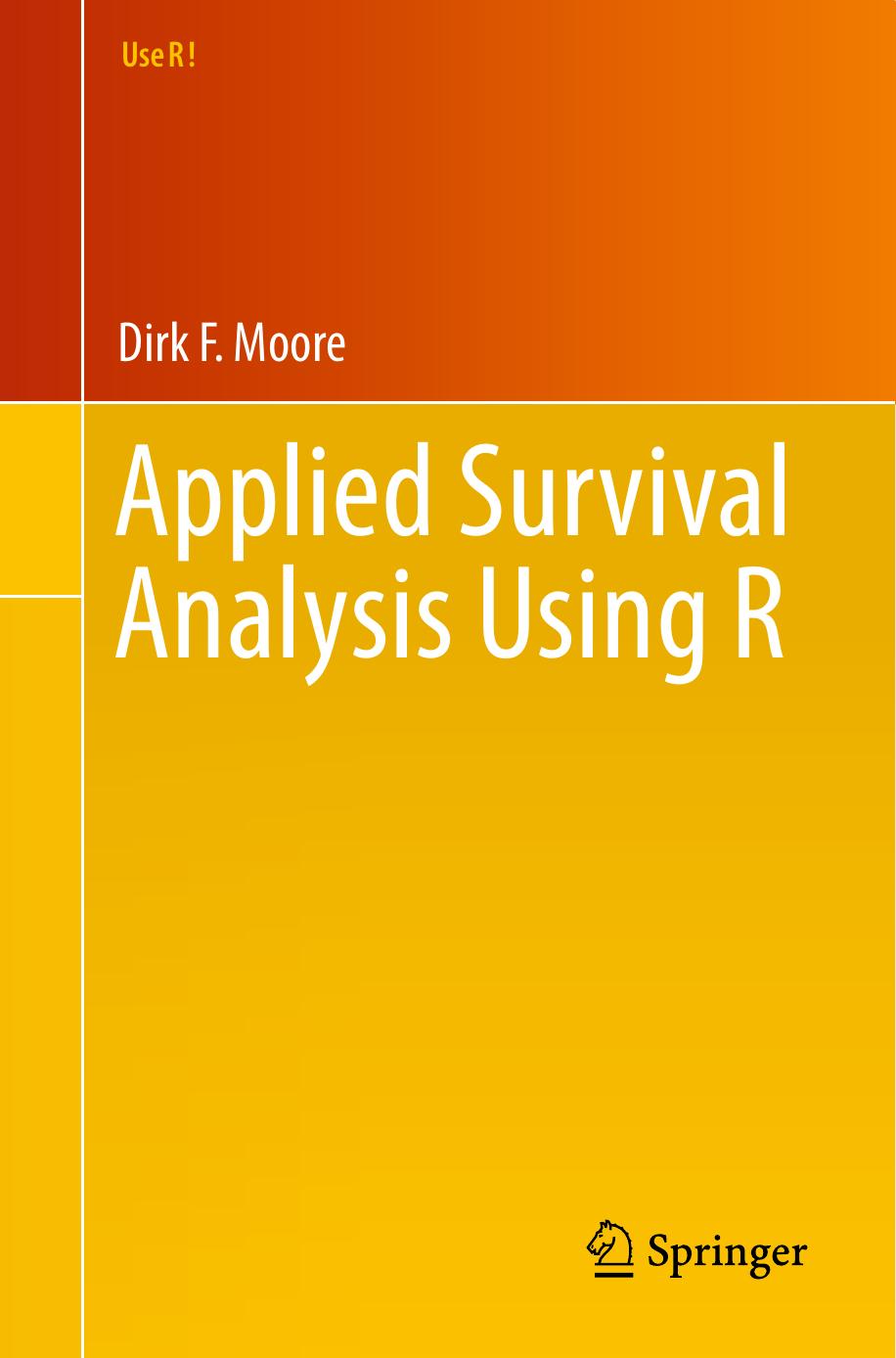
Product details:
ISBN 10: 3319312453
ISBN 13: 9783319312453
Author: Dirk Moore
Applied Survival Analysis Using R covers the main principles of survival analysis, gives examples of how it is applied, and teaches how to put those principles to use to analyze data using R as a vehicle. Survival data, where the primary outcome is time to a specific event, arise in many areas of biomedical research, including clinical trials, epidemiological studies, and studies of animals. Many survival methods are extensions of techniques used in linear regression and categorical data, while other aspects of this field are unique to survival data. This text employs numerous actual examples to illustrate survival curve estimation, comparison of survivals of different groups, proper accounting for censoring and truncation, model variable selection, and residual analysis. Because explaining survival analysis requires more advanced mathematics than many other statistical topics, this book is organized with basic concepts and most frequently used procedures covered in earlier chapters, with more advanced topics near the end and in the appendices. A background in basic linear regression and categorical data analysis, as well as a basic knowledge of calculus and the R system, will help the reader to fully appreciate the information presented. Examples are simple and straightforward while still illustrating key points, shedding light on the application of survival analysis in a way that is useful for graduate students, researchers, and practitioners in biostatistics.
Applied Survival Analysis Using R 1st Table of contents:
1 Introduction
1.1 What Is Survival Analysis?
1.2 What You Need to Know to Use This Book
1.3 Survival Data and Censoring
1.4 Some Examples of Survival Data Sets
1.5 Additional Notes
Exercises
2 Basic Principles of Survival Analysis
2.1 The Hazard and Survival Functions
2.2 Other Representations of a Survival Distribution
2.3 Mean and Median Survival Time
2.4 Parametric Survival Distributions
2.5 Computing the Survival Function from the Hazard Function
2.6 A Brief Introduction to Maximum Likelihood Estimation
2.7 Additional Notes
Exercises
3 Nonparametric Survival Curve Estimation
3.1 Nonparametric Estimation of the Survival Function
3.2 Finding the Median Survival and a Confidence Interval for the Median
3.3 Median Follow-Up Time
3.4 Obtaining a Smoothed Hazard and Survival Function Estimate
3.5 Left Truncation
3.6 Additional Notes
Exercises
4 Nonparametric Comparison of Survival Distributions
4.1 Comparing Two Groups of Survival Times
4.2 Stratified Tests
4.3 Additional Note
Exercises
5 Regression Analysis Using the Proportional Hazards Model
5.1 Covariates and Nonparametric Survival Models
5.2 Comparing Two Survival Distributions Using a Partial Likelihood Function
5.3 Partial Likelihood Hypothesis Tests
5.3.1 The Wald Test
5.3.2 The Score Test
5.3.3 The Likelihood Ratio Test
5.4 The Partial Likelihood with Multiple Covariates
5.5 Estimating the Baseline Survival Function
5.6 Handling of Tied Survival Times
5.7 Left Truncation
5.8 Additional Notes
Exercises
6 Model Selection and Interpretation
6.1 Covariate Adjustment
6.2 Categorical and Continuous Covariates
6.3 Hypothesis Testing for Nested Models
6.4 The Akaike Information Criterion for Comparing Non-nested Models
6.5 Including Smooth Estimates of Continuous Covariates in a Survival Model
6.6 Additional Note
Exercises
7 Model Diagnostics
7.1 Assessing Goodness of Fit Using Residuals
7.1.1 Martingale and Deviance Residuals
7.1.2 Case Deletion Residuals
7.2 Checking the Proportion Hazards Assumption
7.2.1 Log Cumulative Hazard Plots
7.2.2 Schoenfeld Residuals
7.3 Additional Note
Exercises
8 Time Dependent Covariates
8.1 Introduction
8.2 Predictable Time Dependent Variables
8.2.1 Using the Time Transfer Function
8.2.2 Time Dependent Variables That Increase Linearly with Time
8.3 Additional Note
Exercises
9 Multiple Survival Outcomes and Competing Risks
9.1 Clustered Survival Times and Frailty Models
9.1.1 Marginal Survival Models
9.1.2 Frailty Survival Models
9.1.3 Accounting for Family-Based Clusters in the “ashkenazi” Data
9.1.4 Accounting for Within-Person Pairing of Eye Observations in the Diabetes Data
9.2 Cause-Specific Hazards
9.2.1 Kaplan-Meier Estimation with Competing Risks
9.2.2 Cause-Specific Hazards and Cumulative Incidence Functions
9.2.3 Cumulative Incidence Functions for ProstateCancer Data
9.2.4 Regression Methods for Cause-Specific Hazards
9.2.5 Comparing the Effects of Covariates on Different Causes of Death
9.3 Additional Notes
Exercises
10 Parametric Models
10.1 Introduction
10.2 The Exponential Distribution
10.3 The Weibull Model
10.3.1 Assessing the Weibull Distribution as a Model for Survival Data in a Single Sample
10.3.2 Maximum Likelihood Estimation of Weibull Parameters for a Single Group of Survival Data
10.3.3 Profile Weibull Likelihood
10.3.4 Selecting a Weibull Distribution to Model Survival Data
10.3.5 Comparing Two Weibull Distributions Using the Accelerated Failure Time and Proportional Hazar
10.3.6 A Regression Approach to the Weibull Model
10.3.7 Using the Weibull Distribution to Model Survival Data with Multiple Covariates
10.3.8 Model Selection and Residual Analysis with Weibull Survival Data
10.4 Other Parametric Survival Distributions
10.5 Additional Note
Exercises
11 Sample Size Determination for Survival Studies
11.1 Power and Sample Size for a Single Arm Study
11.2 Determining the Probability of Death in a Clinical Trial
11.3 Sample Size for Comparing Two Exponential Survival Distributions
11.4 Sample Size for Comparing Two Survival Distributions Using the Log-Rank Test
11.5 Determining the Probability of Death from a Non-parametric Survival Curve Estimate
11.6 Example: Calculating the Required Number of Patients for a Randomized Study of Advanced Gastric
11.7 Example: Calculating the Required Number of Patients for a Randomized Study of Patients with Me
11.8 Using Simulations to Estimate Power
11.9 Additional Notes
Exercises
12 Additional Topics
12.1 Using Piecewise Constant Hazards to Model Survival Data
12.2 Interval Censoring
12.3 The Lasso Method for Selecting Predictive Biomarkers
Exercises
Erratum to
A A Basic Guide to Using R for Survival Analysis
A.1 The R System
A.1.1 A First R Session
A.1.2 Scatterplots and Fitting Linear Regression Models
A.1.3 Accommodating Non-linear Relationships
A.1.4 Data Frames and the Search Path for Variable Names
A.1.5 Defining Variables Within a Data Frame
A.1.6 Importing and Exporting Data Frames
A.2 Working with Dates in R
A.2.1 Dates and Leap Years
A.2.2 Using the “as.date” Function
A.3 Presenting Coefficient Estimates Using Forest Plots
A.4 Extracting the Log Partial Likelihood and Coefficient Estimates from a coxph Object
References
Index
People also search for Applied Survival Analysis Using R 1st:
applied survival analysis using r dirk moore springer 2016
applied survival analysis using r solutions
applied survival analysis using r pdf
applied survival analysis pdf
applied survival analysis
Tags: Dirk Moore, Applied Survival, Analysis Using