
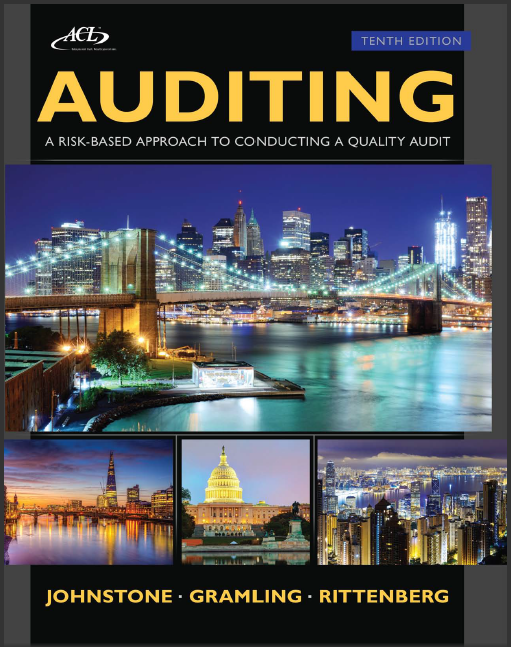
Test Bank for Auditing A Risk Based Approach to Conducting a Quality Audit 10th Edition by Karla Johnstone Zehms ISBN 8214337869 9798214337869
Original price was: $70.00.$35.00Current price is: $35.00.
Instant download (Test Bank) Auditing A Risk Based Approach to Conducting a Quality Audit 10th Edition by Johnstone after payment
Test Bank for Auditing A Risk Based Approach to Conducting a Quality Audit 10th Edition by Karla Johnstone Zehms – Ebook PDF Instant Download/Delivery: 8214337869 , 9798214337869
Full download Auditing A Risk Based Approach to Conducting a Quality Audit 10th edition after payment
Product details:
ISBN 10: 8214337869
ISBN 13: 9798214337869
Author: Karla Johnstone Zehms
AUDITING: A RISK-BASED APPROACH TO CONDUCTING QUALITY AUDITS integrates the latest updates, fraud risks and ethical challenges−whether it’s the AICPA and IAASB’s clarified standards to harmonize auditing standards in the U.S. and abroad, the Committee of Sponsoring Organizations (COSO) of the Treadway Commission’s updated Internal Control–Integrated Framework or the AICPA’s recently issued new audit sampling guidance. Give your students valuable hands-on experience with their reasoning and auditing skills.
Auditing A Risk Based Approach to Conducting a Quality Audit 10th Table of contents:
Chapter 1. Auditing: Integral to the Economy
Overview of the External Auditing Profession
Introduction to the External Auditing Profession
External Auditing: A Special Function
The Need for Unbiased Reporting and Independent Assurance
Overall Objectives in Conducting an Audit
Overview of the Audit Opinion Formulation Process
Parties Involved in Preparing and Auditing Financial Statements
Providers of External Auditing Services
Skills and Knowledge Needed to Enter the External Auditing Profession
Organizations Affecting the External Auditing Profession
Audit Quality
Audit Firm Culture
Skills and Qualities of the Engagement Team
Effectiveness of the Audit Process
Reliability and Usefulness of Audit Reporting
Factors Outside the Control of Auditors That Affect Audit Quality
Achieving Audit Quality and Minimizing Lawsuits
Auditor Independence Requirements
Review Programs
Engagement Letters
Audit Firm Limitations
Audit Documentation
Client Acceptance and Continuance Decisions
Client Acceptance and Continuance-Related Risks
Summary and Next Steps.
Significant Terms.
True/False Questions.
Multiple-Choice Questions.
Review and Short Case Questions.
Fraud Focus: Contemporary and Historical Cases.
Application Activities.
Academic Research Cases.
Chapter 2. The Auditor’s Responsibilities Regarding Fraud and Mechanisms to Address Fraud: Regulation and Corporate Governance
Fraud Defined
Misstatements Arising from Misappropriation of Assets
Misstatements Arising from Fraudulent Financial Reporting
The Fraud Triangle
Incentives or Pressures to Commit Fraud
Opportunities to Commit Fraud
Rationalizing the Fraud
Recent History of Fraudulent Financial Reporting
Examples of Recent Frauds and Implications for External Auditors
The 2010 COSO Report
The Enron Fraud: A Key Driver of Regulatory Change
An Overview of the Auditor’s Fraud-Related Responsibilities and Users’ Expectations
Fraud-Related Requirements in Professional Auditing Standards
The Sarbanes-Oxley Act of 2002 as a Regulatory Response to Fraud
The Post Sarbanes-Oxley World: A Time of Improved Corporate Governance
What Is Corporate Governance?
Principles of Effective Corporate Governance
Responsibilities of Audit Committees
Summary and Next Steps.
Significant Terms.
True/False Questions.
Multiple-Choice Questions.
Review and Short Case Questions.
Fraud Focus: Contemporary and Historical Cases
Application Activities.
Academic Research Cases.
Ford and Toyota
Chapter 3. Internal Control Over Financial Reporting: Responsibilities of Management and the External Auditors
Importance of Internal Control Over Financial Reporting
Defining Internal Control
Terminology: Entity-Wide Controls and Transaction Controls
Components and Principles of Internal Control
COSO Component: Control Environment
COSO Component: Risk Assessment
COSO Component: Control Activities
COSO Component: Information and Communication
COSO Component: Monitoring
Management’s Responsibilities Related to Internal Control Over Financial Reporting
Management’s Documentation of Internal Control
Management Reporting on Internal Control Over Financial Reporting
Evaluating Internal Control Over Financial Reporting
Assessing Deficiencies in Internal Control Over Financial Reporting
Importance of Internal Control to the External Audit
Example: Assessing Control Design Effectiveness, Implementation, and Operating Effectiveness
Summary and Next Steps.
Significant Terms.
True/False Questions.
Multiple-Choice Questions.
Review and Short Case Questions.
Fraud Focus: Contemporary and Historical Cases
Application Activities.
Academic Research Cases.
Ford and Toyota
Chapter 4. Professional Liability, Auditor Judgment Frameworks, and Professional Responsibilities
The Legal Environment and the Effects of Lawsuits on Audit Firms
Liability Doctrines
Class Action Lawsuits
Contingent-Fee Compensation for Lawyers
Audits Viewed as an Insurance Policy: The Expectations Gap
Applicable Laws and Causes of Legal Action
Laws from Which Auditor Liability Is Derived and Causes of Legal Action
Parties that May Bring Suit Against Auditors
Auditor Liability under Contract Law, Common Law, and Statutory Law
Common-Law Liability to Clients: Breach of Contract
Common-Law Liability to Third Parties
Auditor Liability under Statutory Law
Securities Act of 1933
Securities Exchange Act of 1934
Auditor Defenses and Possible Sanctions
Summary of Auditor Liability to Third Parties under Common and Statutory Law
A Framework for Professional Decision Making
Importance of Professional Skepticism in Making Professional Judgments
A Framework for Ethical Decision Making
Resolving Ethical Dilemmas
Applying the Ethical Decision Making Framework
Guidance on Professional Responsibilities and the Impact on Auditors’ Decisions
IESBA’s Code of Ethics
AICPA’s Code of Professional Conduct
Other Guidance on Professional Responsibilities: Sarbanes-Oxley Act, PCAOB, and SEC
Summary and Next Steps.
Significant Terms.
True/False Questions.
Multiple-Choice Questions.
Review and Short Case Questions.
Fraud Focus: Contemporary and Historical Cases.
Application Activities.
Academic Research Cases.
Chapter 5. Professional Auditing Standards and the Audit Opinion Formulation Process
Professional Auditing Standards
Auditing Standards Issued by the AICPA
Auditing Standards Issued by the IAASB
Auditing Standards Issued by the PCAOB
Comparison of the Auditing Standards
Principles Underlying the Auditing Standards
The Audit Opinion Formulation Process
An Overview of the Phases in the Audit Opinion Formulation Process
Important Concepts Pervasive Throughout the Audit Opinion Formulation Process
Phase I—Making Client Acceptance and Continuance Decisions
Phase II—Performing Risk Assessment
Phase III—Obtaining Evidence about Internal Control Operating Effectiveness
Summary of Audit Decisions Prior to Determining Substantive Procedures
Phase IV—Obtaining Substantive Evidence about Accounts, Disclosures, and Assertions
Phase V—Completing the Audit and Making Reporting Decisions
Summary and Next Steps.
Significant Terms.
True/False Questions.
Multiple-Choice Questions.
Review and Short Case Questions.
Fraud Focus: Contemporary and Historical Cases.
Application Activities.
Academic Research Case.
Chapter 6. A Framework for Audit Evidence
Obtaining Sufficient Appropriate Audit Evidence
Appropriateness of Audit Evidence
Relevance of Audit Evidence
Reliability of Audit Evidence
Type and Timing of Audit Procedures
Type of Audit Procedures
Timing of Procedures
Performing Substantive Analytical Procedures
Sufficiency of Audit Evidence
Sample Sizes
Additional Evidence Considerations
Evidence Needed for Auditing Management Estimates
Using a Specialist/Expert to Assist with Obtaining Evidence
Evidence Needed for Related-Party Transactions
Documenting Audit Evidence
Documenting Planning and Risk Assessment Procedures
Documenting Audit Work Performed
Documenting Significant Issues and Their Resolution
Characteristics of Quality Audit Documentation
Revisions and Retention of Audit Documentation
Audit Programs
Summary and Next Steps.
Significant Terms.
True/False Questions.
Multiple-Choice Questions.
Review and Short Case Questions.
Fraud Focus: Contemporary and Historical Cases.
Application Activities.
Academic Research Cases.
Ford and Toyota
ACL.
Chapter 7. Planning the Audit: Identifying and Responding to the Risks of Material Misstatement
The Concept of Materiality
Definitions of Materiality
A Process for Making Materiality Judgments
Levels of Materiality
Qualitative Considerations
Identifying and Assessing Risks of Material Misstatement
Assessing Factors Affecting Inherent Risk
Assessing Factors Affecting Control Risk
Using Planning Analytical Procedures to Assess the Risk of Material Misstatement
Responding to Identified Risks of Material Misstatement
Determining Audit Risk and Detection Risk
Planning Audit Procedures to Respond to the Assessed Risks of Material Misstatement
Summary and Next Steps.
Significant Terms.
True/False Questions.
Multiple-Choice Questions.
Review and Short Case Questions.
Fraud Focus: Contemporary and Historical Cases
Application Activities.
Academic Research Cases.
Ford and Toyota
Chapter 8. Specialized Audit Tools: Sampling and Generalized Audit Software
Overview of Sampling and GAS as Tools for Gathering Audit Evidence
Objectives of Sampling and Risks Associated with Sampling
Nonsampling and Sampling Risks
Nonstatistical and Statistical Sampling
Attributes Sampling
Steps in Attributes Sampling
Nonstatistical Sampling Approach to Testing Controls
Using Sampling to Gather Evidence about Misstatements in Account Balances and Associated Assertions
Steps in Sampling Account Balances and Associated Assertions
Nonstatistical Sampling for Substantive Tests of Account Balances and Associated Assertions
Statistical Sampling for Substantive Tests of Account Balances and Associated Assertions: Monetary Unit Sampling (MUS)
Using GAS to Obtain Evidence
Tasks Performed by GAS
Benefits of Using GAS
Summary and Next Steps.
Significant Terms.
True/False Questions.
Multiple-Choice Questions.
Review and Short Case Questions.
Application Activities.
Academic Research Cases.
Chapter 9. Auditing the Revenue Cycle
Significant Accounts, Disclosures, and Relevant Assertions
Processing Revenue Transactions
Performing Risk Assessment Procedures in the Revenue Cycle
Identifying Inherent Risks
Identifying Control Risks
Performing Planning Analytical Procedures
Responding to Identified Risks of Material Misstatement
Obtaining Evidence about Internal Control Operating Effectiveness in the Revenue Cycle
Selecting Controls to Test and Performing Tests of Controls
Considering the Results of Tests of Controls
Obtaining Substantive Evidence about Accounts, Disclosures, and Assertions in the Revenue Cycle
Revenue and Accounts Receivable: Performing Substantive Analytical Procedures
Revenue: Substantive Tests of Details
Accounts Receivable: Substantive Procedures Based on the Aged Trial Balance
Accounts Receivable: Substantive Tests of Details—Confirmations
Accounts Receivable: Substantive Procedures for the Allowance Account
Accounts Receivable: Other Substantive Procedures
Performing Substantive Fraud-Related Procedures
Documenting Substantive Procedures
Summary and Next Steps.
Significant Terms.
True/False Questions.
Multiple-Choice Questions.
Review and Short Case Questions.
Fraud Focus: Contemporary and Historical Cases
Application Activities.
Analytical Procedures: A Case in the Context of the Pharmaceutical Industry
Academic Research Cases.
Ford and Toyota
ACL.
Chapter 10. Auditing Cash and Marketable Securities
Significant Accounts, Disclosures, and Relevant Assertions
Overview of Cash Accounts
Cash Management Techniques
Relevant Financial Statement Assertions
Performing Risk Assessment Procedures for Cash Accounts
Identifying Inherent Risks
Identifying Control Risks
Performing Planning Analytical Procedures
Responding to Identified Risks of Material Misstatement
Obtaining Evidence about Internal Control Operating Effectiveness for Cash
Selecting Controls to Test and Performing Tests of Controls
Considering the Results of Tests of Controls
Obtaining Substantive Evidence about Cash Accounts, Disclosures, and Assertions
Substantive Analytics for Cash Accounts
Substantive Tests of Details for Cash Accounts
Auditing Marketable Securities
Significant Accounts, Disclosures, and Relevant Assertions
Performing Risk Assessment Procedures
Obtaining Evidence about Internal Control Operating Effectiveness and Substantive Evidence about Marketable Securities Accounts, Disclosures, and Assertions
Summary and Next Steps.
Significant Terms.
True/False Questions.
Multiple-Choice Questions.
Review and Short Case Questions.
Fraud Focus: Contemporary and Historical Cases
Application Activities.
Academic Research Case.
Ford and Toyota
Chapter 11. Auditing Inventory, Goods and Services, and Accounts Payable: The Acquisition and Payment Cycle
Significant Accounts, Disclosures, and Relevant Assertions
Activities Involved in the Acquisition and Payment Cycle
Relevant Financial Statement Assertions
Performing Risk Assessment Procedures in the Acquisition and Payment Cycle
Identifying Inherent Risks
Identifying Control Risks
Performing Planning Analytical Procedures
Responding to Identified Risks of Material Misstatement
Obtaining Evidence about Internal Control Operating Effectiveness in the Acquisition and Payment Cycle
Selecting Controls to Test and Performing Tests of Controls
Considering the Results of Tests of Controls
Obtaining Substantive Evidence about Accounts, Disclosures, and Assertions in the Acquisition and Payment Cycle
Substantive Tests of Inventory and Cost of Goods Sold
Substantive Tests of Accounts Payable and Related Expense Accounts
Summary and Next Steps.
Significant Terms.
True/False Questions.
Multiple-Choice Questions.
Review and Short Case Questions.
Fraud Focus: Contemporary and Historical Cases
Application Activities.
Analytical Procedures: A Case in the Context of the Pharmaceutical Industry
Academic Research Cases.
Ford and Toyota
ACL.
Chapter 12. Auditing Long-Lived Assets: Acquisition, Use, Impairment, and Disposal
Significant Accounts, Disclosures, and Relevant Assertions
Activities in the Long-Lived Asset Acquisition and Payment Cycle
Relevant Financial Statement Assertions
Performing Risk Assessment Procedures for Long-Lived Assets
Identifying Inherent Risks
Identifying Control Risks
Performing Planning Analytical Procedures
Responding to Identified Risks of Material Misstatement
Obtaining Evidence about Internal Control Operating Effectiveness for Long-Lived Asset Accounts and Related Expenses
Selecting Controls to Test and Performing Tests of Controls
Considering the Results of Tests of Controls
Obtaining Substantive Evidence about Accounts, Disclosures, and Assertions for Long-Lived Asset Accounts and Related Expenses
Substantive Analytical Procedures
Substantive Tests of Details for Tangible Assets—Testing Current-Period Additions
Substantive Tests of Details for Tangible Assets—Testing Current-Period Deletions
Substantive Procedures Related to Depreciation Expense and Accumulated Depreciation for Tangible Assets
Substantive Tests of Details for Natural Resources and the Related Expense Accounts
Substantive Tests of Details for Intangible Assets and the Related Expense Accounts
Substantive Procedures Related to Asset Impairment
Substantive Procedures Related to Leases
Performing Substantive Fraud-Related Procedures
Documenting Substantive Procedures
Summary and Next Steps.
Significant Terms.
True/False Questions.
Multiple-Choice Questions.
Review and Short Case Questions.
Fraud Focus: Contemporary and Historical Cases
Application Activities.
Academic Research Cases.
Ford and Toyota
Chapter 13. Auditing Debt Obligations and Stockholders’ Equity Transactions
Significant Accounts, Disclosures, and Relevant Assertions
Debt Obligations
Stockholders’ Equity
Performing Risk Assessment Procedures for Debt Obligations and Stockholders’ Equity Transactions
Identifying Inherent Risks
Identifying Fraud Risk Factors
Identifying Control Risks
Performing Planning Analytical Procedures
Responding to Identified Risks of Material Misstatement
Obtaining Evidence about Internal Control Operating Effectiveness for Debt Obligations and Stockholders’ Equity Transactions
Obtaining Substantive Evidence in Auditing Debt Obligations and Stockholders’ Equity Transactions
Substantive Analytical Procedures—Debt Obligations
Substantive Tests of Details—Debt Obligations
Substantive Tests of Details—Stockholders’ Equity Transactions
Performing Substantive Fraud-Related Procedures
Documenting Substantive Procedures
Summary and Next Steps.
Significant Terms.
True/False Questions.
Multiple-Choice Questions.
Review and Short Case Questions.
Fraud Focus: Contemporary and Historical Cases
Application Activities.
Analytical Procedures: A Case in the Context of the Pharmaceutical Industry
Academic Research Case
Chapter 14. Activities Required in Completing a Quality Audit
Review Activities
Reviewing, Summarizing, and Resolving Detected Misstatements
Reviewing and Assessing Contingencies
Reviewing and Assessing Significant Estimates
Reviewing the Adequacy of Disclosures
Reviewing and Assessing Clients’ Noncompliance with Laws and Regulations
Evaluating the Going-Concern Assumption
Performing Review Analytical Procedures
Reviewing and Evaluating Management Representations
Reviewing and Assessing Subsequent Events and Subsequently Discovered Facts
Performing an Engagement Quality Review
Consideration of Omitted Procedures Discovered after the Report Date
Communicating with Management and the Audit Committee (and Those Charged with Governance)
Communicating with the Audit Committee
Communicating with Management via the Management Letter
Summary and Next Steps.
Significant Terms.
True/False Questions.
Multiple-Choice Questions.
Review and Short Case Questions.
Fraud Focus: Contemporary and Historical Cases.
Application Activities.
Academic Research Case.
Ford and Toyota
Chapter 15. Audit Reports on Financial Statements
Principles Underlying Audit Reporting
Standard Unqualified Audit Reports on Financial Statements
Standard Unqualified Audit Reports: U.S. Public Companies
Standard Unqualified Audit Reports: U.S. Nonpublic Companies and Non-U.S. Companies
Unqualified Audit Reports with Explanatory Language
Explanatory Language: Justified Departure from GAAP
Explanatory Language: Inconsistent Application of GAAP
Explanatory Language: Substantial Doubt about the Client Being a Going Concern
Explanatory Language: Emphasis of a Matter
Explanatory Language: Reference to Other Auditors (Group Audits and Component Auditors)
Qualified Reports, Adverse Reports, and Disclaimers
Qualified Audit Reports
Adverse Audit Reports
Audit Reports with a Disclaimer of Opinion
Comparisons of Modifications to the Standard Unqualified Audit Report
Audit Reports on Internal Control Over Financial Reporting
Elements of Management’s Annual Report on Internal Control Are Incomplete or Improperly Presented
Restriction on the Scope of the Engagement
Auditor Refers to the Report of Other Auditors as the Basis, in Part, for the Auditor’s Own Report
Other Information Contained in Management’s Annual Report on ICFR
Management’s Annual Certification Pursuant to Section 302 of the Sarbanes-Oxley Act Is Misstated
Summary and Next Steps.
Significant Terms.
True/False Questions.
Multiple-Choice Questions.
Review and Short Case Questions.
Fraud Focus: Contemporary and Historical Cases
Application Activities.
Academic Research Cases.
Ford and Toyota
Chapter 16. Advanced Topics Concerning Complex Auditing Judgments
Complex Auditing Judgments
Identifying Complex Judgments in the Financial Statements
Evaluating Misstatements
Subjective Differences between the Auditor and the Client
Aggregating and Netting Misstatements
Intentional Misstatements
Considerations Regarding Selective Correction of Misstatements
Considering Misstatements in the Statement of Cash Flows
Regulatory Guidance Concerning Materiality Judgments
Assessing Long-Term Liabilities Involving Significant Subjective Judgment
Warranty Reserves
Pension Obligations and Other Postemployment Benefits
Auditing Merger and Acquisition Activities
Valuing the Assets and Liabilities of an Acquisition
Measuring Restructuring Charges
Auditing Management’s Fair Value Estimates and Related Impairment Judgments
The Accounting Model for Fair Value Estimates
Audit Considerations for Fair Market Estimates and Related Impairments
Auditing Financial Instruments
Overview of Financial Instruments
Audit Considerations for Financial Instruments
Evaluating a Client’s Internal Audit Function
An Overview of Internal Auditing
Evaluating the Quality of the Client’s Internal Audit Function
Summary and Next Steps.
Significant Terms
True/False Questions.
Multiple-Choice Questions
Review and Short Case Questions
Fraud Focus: Contemporary and Historical Cases
Application Activities
Academic Research Cases
Ford and Toyota
ACL
Chapter 17. Other Services Provided by Audit Firms
Nonaudit Attestation Services Provided by Audit Firms
Subject Matter of an Attestation Engagement
Components of Attestation Services and Parties Involved in Attestation Services
Levels of Assurance Provided in an Attestation Engagement
Professional Standards for Attestation Engagements
Reviews and Compilations
Reviews
Compilations
Reviews of Interim Financial Information for Audit Clients
Review Procedures for Interim Financial Information
Reporting on Interim Financial Statements
Special Considerations for Reporting
AU-C 800: Special Considerations—Audits of Financial Statements Prepared in Accordance with Special-Purpose Frameworks
AU-C 805: Special Considerations—Audits of Single Financial Statements and Specific Elements, Accounts, or Items of a Financial Statement
AU-C 806: Reporting on Compliance with Aspects of Contractual Agreements or Regulatory Requirements in Connection with Audited Financial Statements
Attestation on Agreed-Upon Procedures, Financial Forecasts and Projections, and Pro Forma Financial Information
Agreed-Upon Procedures Engagements (SSAEs No. 10 and 11, AT 201)
Financial Forecasts and Projections (SSAEs No. 10 and 17, AT 301)
Reporting on Pro Forma Financial Information (SSAE No. 10, AT Section 401)
Forensic Accounting
Sustainability Reporting and Assurance
Reporting on Sustainability Activities and Outcomes
Providing Assurance on Sustainability Reporting
Summary.
Significant Terms.
True/False Questions.
Multiple-Choice Questions.
Review and Short Case Questions
Application Activities
Academic Research Case
ACL Appendix. ACL Tutorial
Auditing Standards Appendix. Relevant Professional Auditing Standards for the Audit Opinion Form
People also search for Auditing A Risk Based Approach to Conducting a Quality Audit 10th:
auditing a risk based approach to conducting a quality audit
what is risk based approach in auditing
risk based auditing techniques
auditing a risk based approach pdf
auditing a risk based approach 11th edition
Tags: Karla Johnstone Zehms, A Risk, Quality Audit