

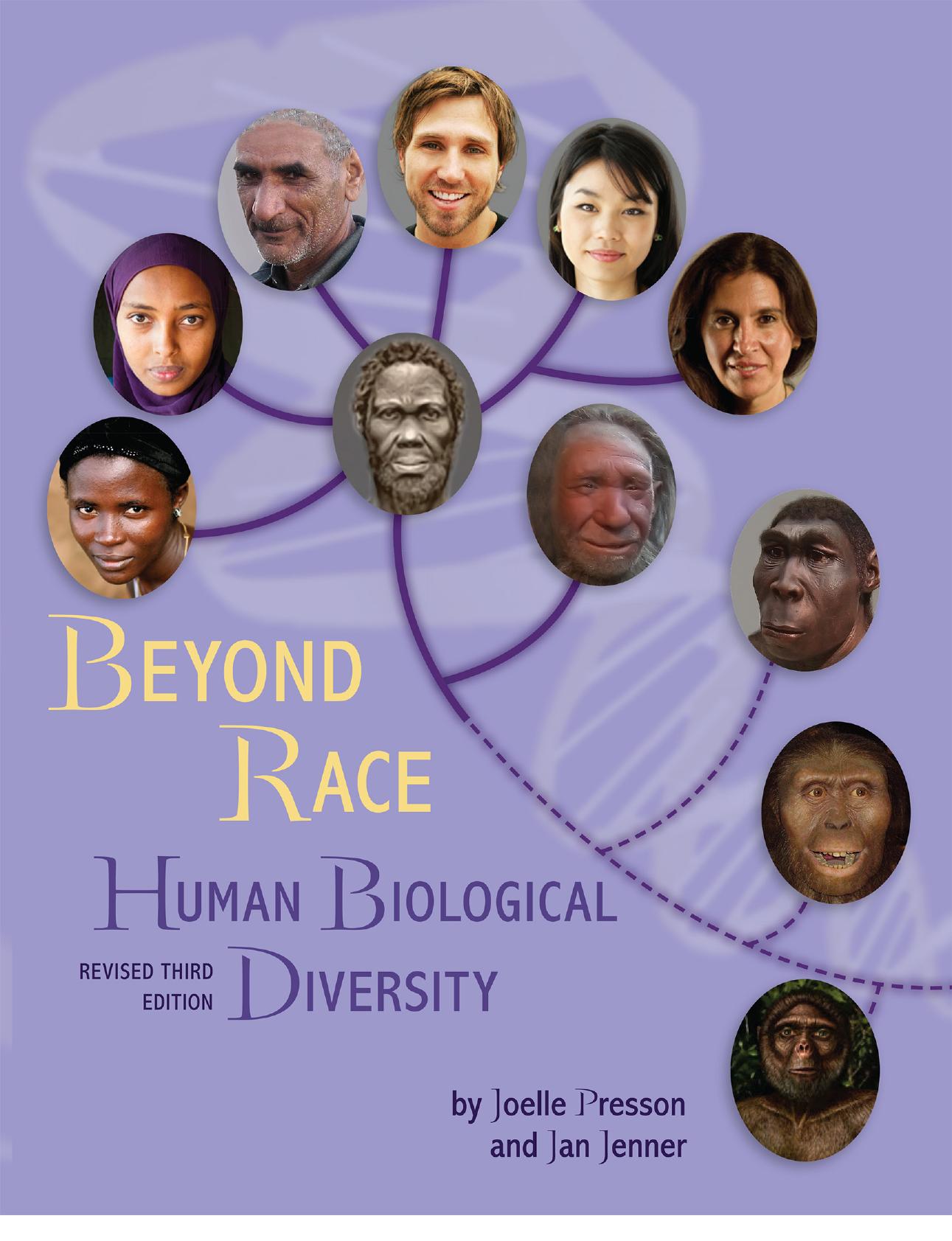
Beyond Race 3rd edition By Joelle Presson, Jan Jenner – Ebook PDF Instant Download/Delivery: 1626613648, 978-1626613645
Full download Beyond Race 3rd edition after payment
Product details:
ISBN 10: 1626613648
ISBN 13: 978-1626613645
Author: Joelle Presson, Jan Jenner
“Race. It’s an idea that dominates our culture and continues to generate societal tensions. But what really are human races? Are races meaningful in a biological sense? What is the significance of the variety of human skin and hair colors? Are black, white, Asian, and Native American valid categories that reflect basic human differences?
Beyond Race: Human Biological Diversity answers these questions and provides the most recent scientific studies on human genetic groups and on the origins of the human family tree. Beyond Race allows students to view humanity through the lens of modern biology and re-evaluate society’s traditional ideas about human races. Exciting new findings about human evolution are presented along with DNA analyses that have revised our understanding of human history. In this context the reader will reflect on race and how racial distinctions have influenced society’s attitude to and treatment of different groups of people.
Beyond Race begins with discussions of the concepts that are the foundation of biology. These foundations provide the basic biological context that is essential to a genuine understanding of the current revolution in the study of human relationships. Coverage of Darwin’s principles, evolution, biological classification, the emergence of life from chemistry, cell reproduction, and genetics lead to a sophisticated appreciation of DNA lineages. The reader will find all of this invaluable in navigating the modern world of genetic and ancestry testing. The study of genomics also is central to understanding human biological diversity and is woven into the content.
As a result of this comprehensive and integrated coverage, students will learn that the separation of humans into “races” is not biologically valid and that the idea of race can now be replaced with the concept of a more accurately detailed human family tree. The primary goal of Beyond Race is not to give students simple answers to complex questions concerning race, but rather to enable them to draw their own conclusions about the value of continuing to use “races” as labels for human beings.
Sections entitled Threads… begin each chapter and demonstrate the clear, vital, critically important connections between the science studied in the classroom and life on a broader stage. Of special note are the Now You Can Understand, What Do You Think?, and Chapter Review sections that conclude each chapter. These offer opportunities for reflection and synthesis, reinforce important ideas and concepts, and enhance student retention of the material.
Beyond Race is designed for use in courses on Human Biology and Genetics.
Joelle Presson earned her B.S. in Psychology from the University of South Florida and her Ph.D. in Neuroscience from the University of Oregon. Currently she teaches at the University of Maryland, where she focuses on teaching biology to non-majors. In addition to teaching, Dr. Presson serves as the Assistant Dean of Undergraduate Academic Programs in the College of Chemical and Life Sciences, working to develop the curriculum within Biology, as well as across other disciplines.
Jan Jenner earned her Ph.D. in Biology from New York University, studying herpetology under the mentorship of Herndon Dowling. Dr. Jenner’s previous professional experience includes serving on the faculty at New York University, where she taught Introductory Biology, Field Biology, and Ecology. During her time at NYU, Dr. Jenner was the recipient of two teaching awards. She has also taught at the American Museum of Natural History in New York City, St. David’s School in New York, and Talladega College, Alabama. Dr. Jenner has written several biology textbooks for middle school students, served as an author and developmental editor for numerous educational publications, and authored two college-level biology texts.”
Beyond Race 3rd Table of contents:
Introduction
Chapter 1: The Framework of Biology
1.1 Biology Touches Every Aspect of Your Life
1.2 Life is Defined by a Set of Features That All Living Things Share
1.3 Levels of Organization Are Characteristic of Life
1.4 Evolution and Natural Selection Have Produced Life’s Diverse Forms
1.5 Biology Applies the Methods of Science to the Study of Life
1.6 Weaving Life’s tapestry
Now You Can Understand
What Do You Think?
Chapter Review
Chapter 2: Life Emerges from Chemistry
2.1 New Properties Emerge When Substances Interact
2.2 Matter Is Made of Atoms
2.3 Bonds Hold Atoms Together in More Complex Structures
2.4 The Chemicals of Life Interact in Water
2.5 Weaving Life’s Tapestry
Now You Can Understand
What Do You Think?
Chapter Review
Chapter 3: Biological Molecules
3.1 Life Depends on Complex Biological Molecules
3.2 Biological Molecules Are Built Around Carbon Atoms
3.3 Lipids Are Biological Molecules That Do Not Mix Well with Water
3.4 Carbohydrates Are Made of Carbon, Oxygen, and Hydrogen
3.5 Nucleic Acids Are Strings of Nucleotides
3.6 Proteins Are Folded Chains of Amino Acids
3.7 Hemoglobin Is an Example of the Emergent Properties of Proteins
Now You Can Understand
What Do You Think?
Chapter Review
Chapter 4: Life Is Cellular
4.1 Living Things Are Made of Cells
4.2 The Cell Membrane Protects Internal Processes and Allows the Cell to Interact with the Environm
4.3 Cells Interact with the Environment via Membrane Proteins
4.4 The Inside of a Cell Is Highly Organized
4.5 Weaving Life’s Tapestry
Now You Can Understand
What Do You Think?
Chapter Review
Chapter 5: Life Uses Chemical Energy
5.1 Life Requires Energy
5.2 Cells Use Chemical Energy
5.3 Photosynthesis Produces ATP and Glucose
5.4 Enzymes Control the Pace of Life’s Chemical Processes
5.5 Weaving Life’s Tapestry
Now You Can Understand
What Do You Think?
Chapter Review
Chapter 6: The Master Molecule of Life
6.1 DNA Is the Master Molecule of Life
6.2 Scientific Sleuthing: The Discovery of the Structure of DNA
6.3 The Structure of DNA is a Double Helix
6.4 The Structure of DNA Contains Genetic Information
6.5 DNA Directs the Synthesis of Proteins
6.6 DNA Helps to Explain the Unity and Diversity of Life
6.7 Weaving Life’s Tapestry
Now You Can Understand
What Do You Think?
Chapter Review
Chapter 7: Life Renews Itself
7.1 Life Continues Because Organisms Reproduce
7.2 Eukaryotic Chromosomes Have Characteristics That Allow Sexual Reproduction
7.3 Cell Division Is the Cellular Basis for Reproduction
7.4 The Cell Cycle Is the Orderly Progression of Cellular Activities of Eukaryotic Cells
7.5 Sexual Reproduction Involves the Fusion of Haploid Gametes
7.6 Meiotic Cell Division Produces Gametes
7.7 Weaving Life’s Tapestry
Now You Can Understand
What Do You Think?
Chapter Review
Chapter 8: Rules of Inheritance
8.1 The Science of Genetics Brings Together DNA, Cell Division, and Gene Expression
8.2 Gregor Mendel Was the First Systematic Researcher in the Field of Genetics
8.3 Mendel Discovered Three Rules of Inheritance
8.4 More Complex Patterns of Inheritance Are an Extension of Mendel’s Basic Rules
8.5 Knowledge About DNA Illuminates Genetics
8.6 Weaving Life’s Tapestry
Now You Can Understand
What Do You Think
Chapter Review
Chapter 9: Life Evolves
9.1 Evolution Is the Central Idea of Biology
9.2 The Intellectual Climate of the 1800s Set the Stage for Charles Darwin’s Ideas About Evolut
9.3 Darwin Discovered the Fundamental Principles of Evolution
9.4 Scientific Studies Document Natural Selection
9.5 Scientific Evidence Supports and Expands Darwin’s Conclusions
9.6 Arguments Against Evolution Are Not Supported by Scientific Evidence
9.7 Weaving Life’s Tapestry
Now You Can Understand
What Do You Think?
Chapter Review
Chapter 10: Biological Classification
10.1 Classification is Sorting
10.2 Biological Classification Has a Long History
10.3 Cells Are Classified Into Three Phylogenetic Groups
10.4 A Phylogenetic Classification of Eukaryotes
10.5 Weaving Life’s Tapestry
Now You Can Understand
What Do You Think?
Chapter Review
Chapter 11: The Evolution of Homo sapiens
11.1 An Asteroid Crash Allowed Mammals to Diversify
11.2 Geologic and Climate Changes Influenced Primate Diversification
11.3 Human Traits Reflect Our Evolution from Earlier Primates
11.4 Human-like Species Emerged Gradually Over the Past Five Million Years
11.5 Evolutionary History Reveals Many Kinds of Humans
11.6 Weaving Life’s Tapestry
Now You Can Understand
What Do You Think?
Chapter Review
Chapter 12: Human Maternal DNA Lineages
12.1 Human Maternal Lineages: A Starting Point for Understanding Modern Human Ancestry
12.2 DNA Mutations Reveal Lineages
12.3 DNA Mutations Track Lineages of Living Populations
12.4 Mitochondrial DNA Reveals Maternal Lineages
12.5 mtDNA Haplogroups Reveal Human Maternal Lineages
12.6 Weaving Life’s Tapestry
Now You Can Understand
What do you think?
Chapter Review
Chapter 13: Human Paternal DNA Lineages
13.1 Paternal Lineages Can Be Constructed Using the Y Chromosome
13.2 Distribution of Y Chromosome Haplogroups Reveals the Migrations of Human Paternal Ancestors
13.3 Do Maternal and Paternal Ancestors Share the Same History?
13.4 DNA Can Answer Questions About Mating Patterns in the Americas
Now You Can Understand
What Do You Think?
Chapter Review
Chapter 14: Sickle Cell Anemia and Thalassemia
14.1 Sickle Cell Anemia Is an Inherited Blood Disorder
14.2 Sickle Cell Anemia Is Caused by Abnormal Hemoglobin
14.3 Sickle Cell Anemia Is a Recessive Inherited Disorder
14.4 Sickle Cell Anemia Can Be Treated, But Not Cured
14.5 Sickle Cell Alleles Are Found in Populations with High rates of Malaria Infection
14.6 Is Sickle Cell a Racial Disease?
14.7 Weaving the Tapestry of Life
Now You Can Understand
What Do You Think?
Chapter Review
Chapter 15: The Biology and Evolution of Human Skin Color
15.1 Ancestral Equatorial Populations Have the Darkest Skins
15.2 A Complex Set of Biological Processes Produce Skin Color
15.3 Mutations Produce Differences in Melanin Production and in Human Skin Color
15.4 Differences in Skin Color Result from Evolution by Natural Selection
15.5 Tanning Is an Adaptation of Skin Pigmentation
15.6 Skin Color Is Not the Same as Race
15.7 Weaving Life’s Tapestry
Now You Can Understand
What Do You Think?
Chapter 16: Who Were Your Ancestors
16.1 Your DNA Can Resolve Some Questions About Your Ancestry
16.2 Hunter–Gatherers: Who Were They and How Did They Live?
16.3 The Farming Lifestyle Came to Dominate and Replace Hunting and Gathering
16.4 Modern Descendants of Hunter–Gatherers and of Farmers in Europe
16.5 Ancient DNA Gives Us Some Insight into the History of Farmers and Hunter–Gatherers
16.6 Who Were the Ancestors of Other Modern Populations?
16.7 Weaving Life’s Tapestry
Chapter Review
Index
People also search for Beyond Race 3rd:
beyond race magazine
beyond the race
beyond ravens rumble
beyond pre-k
race noeldner