


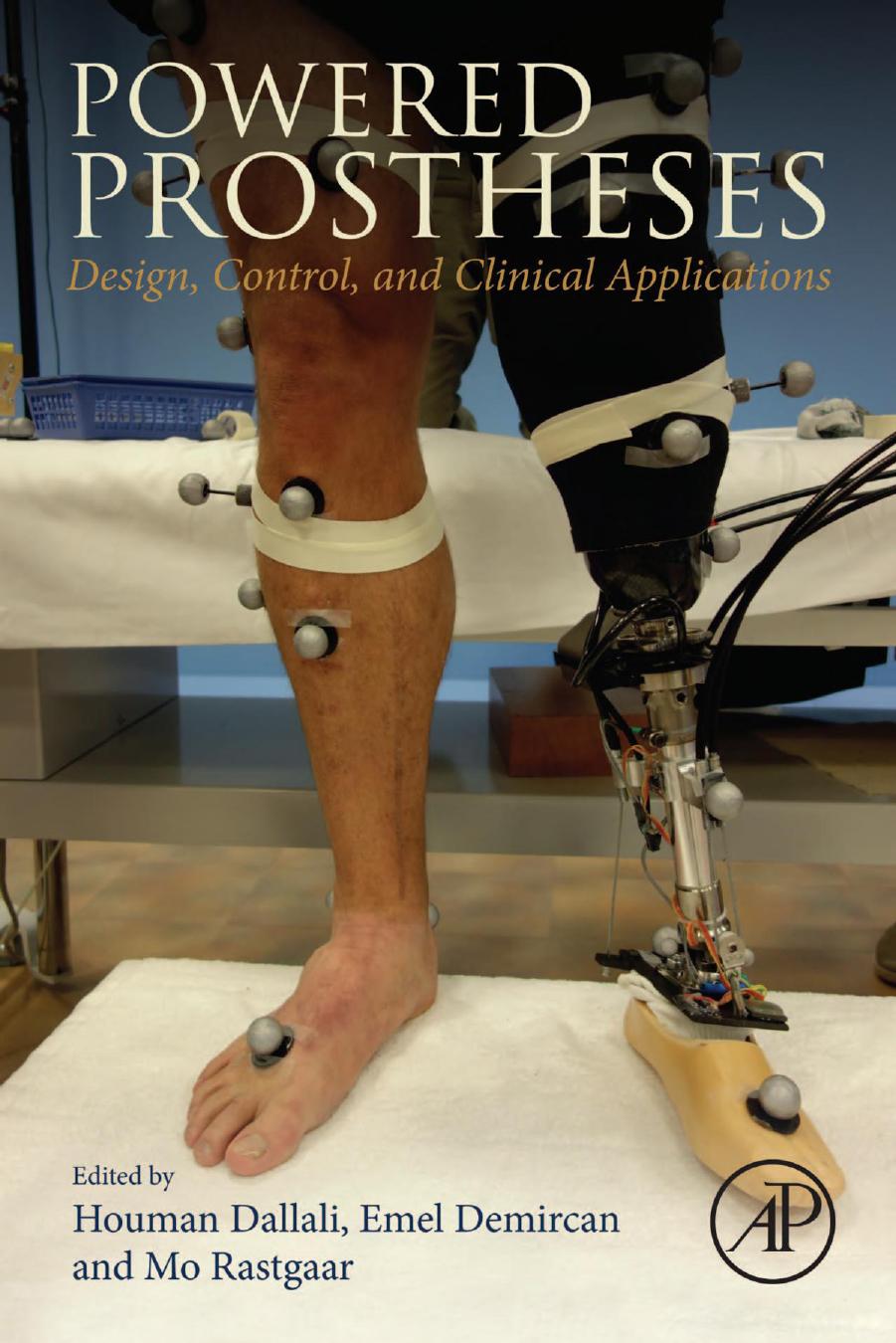
Powered Prostheses Design Control and Clinical Applications 1st edition by Houman Dallali, Emel Demircan, Mo Rastgaar – Ebook PDF Instant Download/Delivery: 0128174517, 9780128174517
Full download Powered Prostheses Design Control and Clinical Applications 1st edition after payment
Product details:
ISBN 10: 0128174517
ISBN 13: 9780128174517
Author: Houman Dallali, Emel Demircan, Mo Rastgaar
Powered Prostheses: Design, Control, and Clinical Applications presents the state-of-the-art in design, control and application of assistive technologies used in rehabilitation, including powered prostheses used in lower and upper extremity amputees and orthosis used in the rehabilitation of various joint disorders. The progress made in this field over the last decade is so vast that any new researcher in this field will have to spend years digesting the main achievements and challenges that remain. This book provides a comprehensive vision of advances, along with the challenges that remain on the path to the development of true bionic technology.
Powered Prostheses Design Control and Clinical Applications 1st Table of contents:
Chapter 1: Control of transhumeral prostheses based on electromyography pattern recognition: from amputees to deep learning
Abstract
1. Introduction
2. Unmet needs for transhumeral amputees
3. Available upper limb prostheses
4. Myoelectric prosthesis, how does it work?
5. EMG pattern recognition
6. Deep learning
7. Usability instead of accuracy
8. Latest trend for transhumeral prosthesis
9. Discussion
10. Conclusion
Chapter 2: The 2-DOF mechanical impedance of the human ankle during poses of the stance phase
Abstract
1. Introduction
2. Methods
3. Results and discussion
4. Conclusions
Chapter 3: Task-dependent modulation of multi-dimensional human ankle stiffness
Abstract
1. Introduction
2. Task-dependent modulation of multi-dimensional human ankle stiffness
3. Summary
Chapter 4: Kriging for prosthesis control
Abstract
1. Related work
2. Locomotion envelopes
3. Simulation setup
4. Prosthesis impedance controller
5. Empirical evaluation
6. Discussion and conclusion
Chapter 5: Disturbance observer applications in rehabilitation robotics: an overview
Abstract
1. Introduction
2. Background on disturbance observers
3. Disturbance observers in upper extremity robotic rehabilitation
4. Disturbance observers in lower extremity robotic rehabilitation
5. Disturbance observers in robotic telerehabilitation
6. Conclusion and further remarks
Chapter 6: Reduction in the metabolic cost of human walking gaits using quasi-passive upper body exoskeleton
Abstract
1. Introduction
2. Methodology
3. Discussion and conclusion
Chapter 7: Neural control in prostheses and exoskeletons
Abstract
1. Overview
2. Sensory signals for control
3. Neural control as part of the control architecture
4. Template-based neural control
5. Summary
Chapter 8: Stair negotiation made easier using low-energy interactive stairs
Abstract
1. Introduction
2. Materials and methods
3. Results
4. Discussion
5. Summary
Acknowledgments
Chapter 9: Semi-active prostheses for low-power gait adaptation
Abstract
1. Adaptability in lower-limb control
2. The semi-active approach to biomechatronic design
3. The semi-active design process
4. Design principles for semi-active mechanisms
5. Example concepts and design implementations
6. Challenges of semi-active prostheses
7. Conclusion
Index
People also search for Powered Prostheses Design Control and Clinical Applications 1st :
prosthetic design and research
powered prosthetics
prosthetic design software
powered prostheses design control and clinical applications
powered prostheses design
Tags: Houman Dallali, Emel Demircan, Mo Rastgaar, Powered Prostheses, Clinical Applications