


An introduction to mathematical cryptography 1st Edition by Jeffrey Hoffstein, Jill Pipher, Joseph Silverman – Ebook PDF Instant Download/Delivery: 0387779930, 9780387779935
Full download An introduction to mathematical cryptography 1st Edition after payment
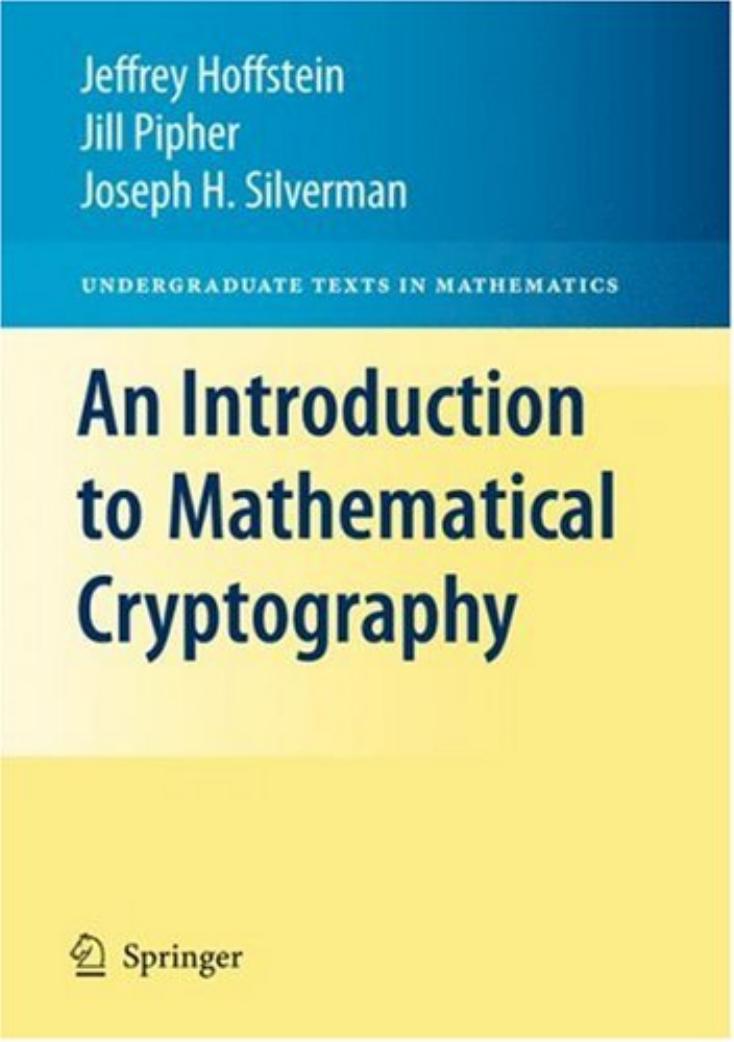
Product details:
ISBN 10: 0387779930
ISBN 13: 9780387779935
Author: Jeffrey Hoffstein; Jill Pipher; Joseph H. Silverman
ThecreationofpublickeycryptographybyDi?eandHellmanin1976andthe subsequent invention of the RSA public key cryptosystem by Rivest, Shamir, and Adleman in 1978 are watershed events in the long history of secret c- munications. It is hard to overestimate the importance of public key cr- tosystems and their associated digital signature schemes in the modern world of computers and the Internet. This book provides an introduction to the theory of public key cryptography and to the mathematical ideas underlying that theory. Public key cryptography draws on many areas of mathematics, including number theory, abstract algebra, probability, and information theory. Each of these topics is introduced and developed in su?cient detail so that this book provides a self-contained course for the beginning student. The only prerequisite is a ?rst course in linear algebra. On the other hand, students with stronger mathematical backgrounds can move directly to cryptographic applications and still have time for advanced topics such as elliptic curve pairings and lattice-reduction algorithms. Amongthemanyfacetsofmoderncryptography,thisbookchoosestoc- centrate primarily on public key cryptosystems and digital signature schemes. This allows for an in-depth development of the necessary mathematics – quired for both the construction of these schemes and an analysis of their security. The reader who masters the material in this book will not only be well prepared for further study in cryptography, but will have acquired a real understanding of the underlying mathematical principles on which modern cryptography is based.
Table of contents:
- An Introduction to Cryptography
- Simple substitution ciphers
- Divisibility and greatest common divisors
- Modular arithmetic
- Prime numbers, unique factorization, and finite fields
- Powers and primitive roots in finite fields
- Cryptography before the computer age
- Symmetric and asymmetric ciphers
- Exercises
- Discrete Logarithms and Diffie–Hellman
- The birth of public key cryptography
- The discrete logarithm problem
- Diffie–Hellman key exchange
- The ElGamal public key cryptosystem
- An overview of the theory of groups
- How hard is the discrete logarithm problem?
- A collision algorithm for the DLP
- The Chinese remainder theorem
- The Pohlig–Hellman algorithm
- Rings, quotients, polynomials, and finite fields
- Exercises
- Integer Factorization and RSA
- Euler’s formula and roots modulo pq
- The RSA public key cryptosystem
- Implementation and security issues
- Primality testing
- Pollard’s bold0mu mumu ppunitspppp-1 factorization algorithm
- Factorization via difference of squares
- Smooth numbers and sieves
- The index calculus and discrete logarithms
- Quadratic residues and quadratic reciprocity
- Probabilistic encryption
- Exercises
- Combinatorics, Probability, and Information Theory
- Basic principles of counting
- The Vigenère cipher
- Probability theory
- Collision algorithms and meet-in-the-middle attacks
- Pollard’s bold0mu mumu units method
- Information theory
- Complexity Theory and P versus NP
- Exercises
- Elliptic Curves and Cryptography
- Elliptic curves
- Elliptic curves over finite fields
- The elliptic curve discrete logarithm problem
- Elliptic curve cryptography
- The evolution of public key cryptography
- Lenstra’s elliptic curve factorization algorithm
- Elliptic curves over F2k and over F2k
- Bilinear pairings on elliptic curves
- The Weil pairing over fields of prime power order
- Applications of the Weil pairing
- Exercises
- Lattices and Cryptography
- A congruential public key cryptosystem
- Subset-sum problems and knapsack cryptosystems
- A brief review of vector spaces
- Lattices: Basic definitions and properties
- Short vectors in lattices
- Babai’s algorithm
- Cryptosystems based on hard lattice problems
- The GGH public key cryptosystem
- Convolution polynomial rings
- The NTRU public key cryptosystem
- NTRU as a lattice cryptosystem
- Lattice reduction algorithms
- Applications of LLL to cryptanalysis
- Exercises
- Digital Signatures
- What is a digital signature?
- RSA digital signatures
- ElGamal digital signatures and DSA
- GGH lattice-based digital signatures
- NTRU digital signatures
- Exercises
- Additional Topics in Cryptography
- Hash functions
- Random numbers and pseudorandom number generators
- Zero-knowledge proofs
- Secret sharing schemes
- Identification schemes
- Padding schemes and the random oracle model
- Building protocols from cryptographic primitives
- Hyperelliptic curve cryptography
- Quantum computing
- Modern symmetric cryptosystems: DES and AES
People also search:
an introduction to mathematical cryptography pdf
an introduction to mathematical cryptography answers
an introduction to mathematical cryptography solutions
an introduction to mathematical cryptography
Tags: Jeffrey Hoffstein, Jill Pipher, Joseph Silverman, mathematical