

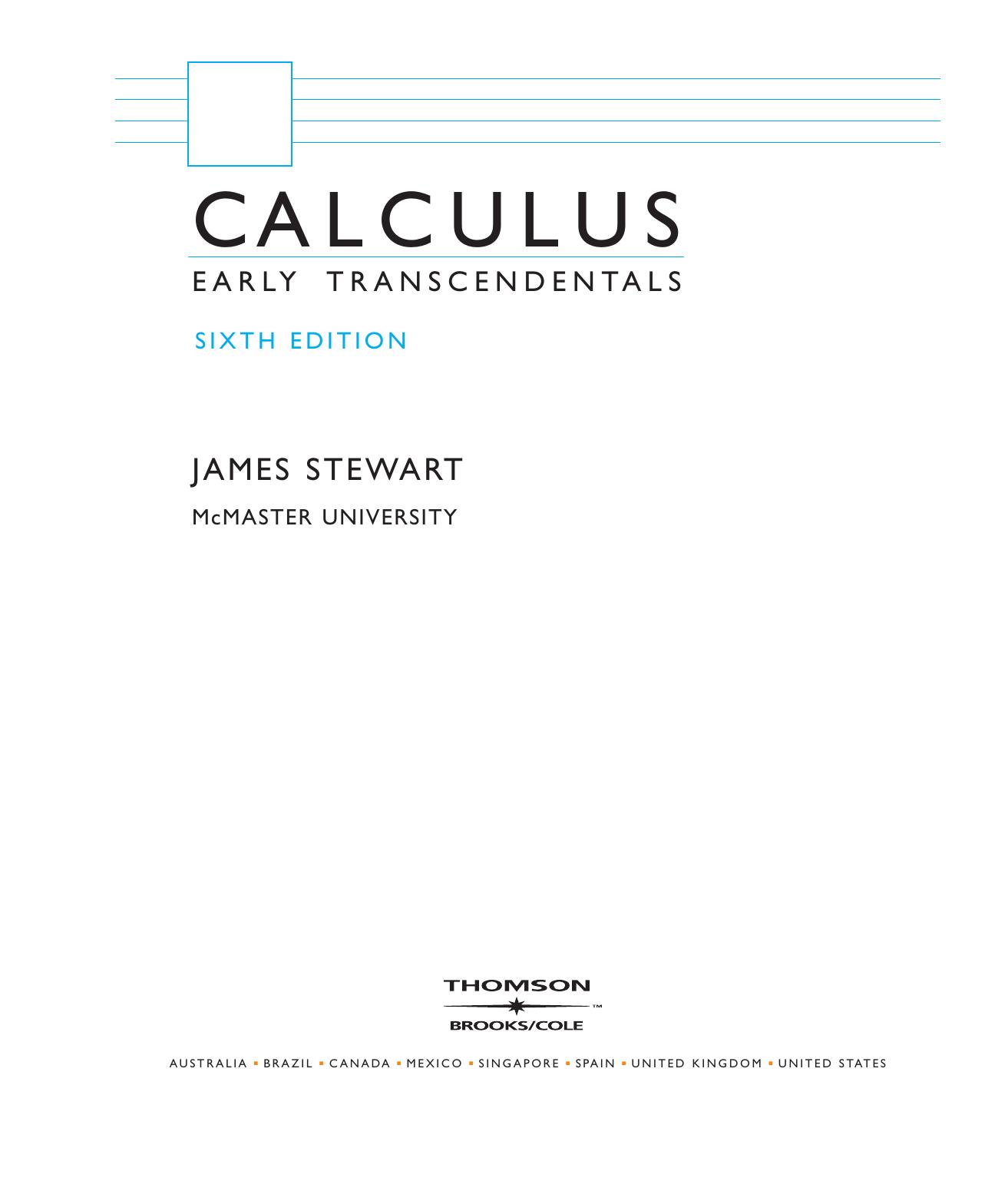
Stewart Calculus Early Transcedentals 6th Edition by James Stewart – Ebook PDF Instant Download/Delivery: 0495011665, 9780495011668
Full download Stewart Calculus Early Transcedentals 6th Edition after payment
Product details:
ISBN 10: 0495011665
ISBN 13: 9780495011668
Author: James Stewart
“Stewart Calculus: Early Transcendentals, 6th Edition” is a widely recognized and highly respected textbook in collegiate-level calculus. Authored by the late James Stewart, it is celebrated for its clear exposition, precise mathematical rigor, and extensive collection of problems.
The “Early Transcendentals” approach means that exponential and logarithmic functions are introduced earlier in the text, allowing for their integration into applications and problem-solving throughout the study of derivatives and integrals. This edition, like its predecessors, aims to make calculus accessible to a broad range of students by balancing theoretical understanding with practical application. It includes a wealth of examples, detailed explanations, and a variety of exercises designed to build both conceptual understanding and problem-solving skills, making it a cornerstone for students pursuing studies in mathematics, science, engineering, and economics.
Stewart Calculus Early Transcedentals 6th Table of contents:
-
1. Functions and Models
-
1.1 Four Ways to Represent a Function
-
1.2 Mathematical Models: A Catalog of Essential Functions
-
1.3 New Functions from Old Functions
-
1.4 Graphing Calculators and Computers
-
1.5 Exponential Functions
-
1.6 Inverse Functions and Logarithms
-
-
2. Limits and Derivatives
-
2.1 The Tangent and Velocity Problems
-
2.2 The Limit of a Function
-
2.3 Calculating Limits Using the Limit Laws
-
2.4 The Precise Definition of a Limit
-
2.5 Continuity
-
2.6 Limits at Infinity; Horizontal Asymptotes
-
2.7 Derivatives and Rates of Change
-
2.8 The Derivative as a Function
-
-
3. Differentiation Rules
-
3.1 Derivatives of Polynomials and Exponential Functions
-
3.2 The Product and Quotient Rules
-
3.3 Derivtives of Trigonometric Functions
-
3.4 The Chain Rule
-
3.5 Implicit Differentiation
-
3.6 Derivatives of Logarithmic Functions
-
3.7 Rates of Change in the Natural and Social Sciences
-
3.8 Exponential Growth and Decay
-
3.9 Related Rates
-
3.10 Linear Approximations and Differentials
-
3.11 Hyperbolic Functions
-
-
4. Applications of Differentiation
-
4.1 Maximum and Minimum Values
-
4.2 The Mean Value Theorem
-
4.3 How Derivatives Affect the Shape of a Graph
-
4.4 Indeterminate Forms and L’Hospital’s Rule
-
4.5 Summary of Curve Sketching
-
4.6 Graphing with Calculus and Calculators
-
4.7 Optimization Problems
-
4.8 Newton’s Method
-
4.9 Antiderivatives
-
-
5. Integrals
-
5.1 Areas and Distances
-
5.2 The Definite Integral
-
5.3 The Fundamental Theorem of Calculus
-
5.4 Indefinite Integrals and the Net Change Theorem
-
5.5 The Substitution Rule
-
-
6. Applications of Integration
-
6.1 Areas Between Curves
-
6.2 Volumes
-
6.3 Volumes by Cylindrical Shells
-
6.4 Work
-
6.5 Average Value of a Function
-
-
7. Inverse Functions: Exponential, Logarithmic, and Inverse Trigonometric Functions (Note: Some editions might integrate these more directly into earlier chapters, but 6e often has a dedicated chapter.)
-
7.1 Inverse Functions
-
7.2 Exponential Functions and Their Derivatives
-
7.3 Logarithmic Functions
-
7.4 Derivatives of Logarithmic Functions
-
7.5 Exponential Growth and Decay
-
7.6 Inverse Trigonometric Functions
-
7.7 Hyperbolic Functions
-
-
8. Techniques of Integration
-
8.1 Integration by Parts
-
8.2 Trigonometric Integrals
-
8.3 Trigonometric Substitution
-
8.4 Integration of Rational Functions by Partial Fractions
-
8.5 Strategy for Integration
-
8.6 Integration Using Tables and Computer Algebra Systems
-
8.7 Approximate Integration
-
8.8 Improper Integrals
-
-
9. Further Applications of Integration
-
9.1 Arc Length
-
9.2 Area of a Surface of Revolution
-
9.3 Applications to Physics and Engineering
-
9.4 Applications to Economics and Biology
-
9.5 Probability
-
-
10. Differential Equations
-
10.1 Modeling with Differential Equations
-
10.2 Direction Fields and Euler’s Method
-
10.3 Separable Equations
-
10.4 First-Order Linear Equations
-
10.5 Modeling with First-Order Differential Equations
-
10.6 Predator-Prey Systems
-
-
11. Parametric Equations and Polar Coordinates
-
11.1 Curves Defined by Parametric Equations
-
11.2 Calculus with Parametric Curves
-
11.3 Polar Coordinates
-
11.4 Areas and Lengths in Polar Coordinates
-
11.5 Conic Sections
-
11.6 Conic Sections in Polar Coordinates
-
-
12. Infinite Sequences and Series
-
12.1 Sequences
-
12.2 Series
-
12.3 The Integral Test and Estimates of Sums
-
12.4 The Comparison Tests
-
12.5 Alternating Series
-
12.6 Absolute Convergence and the Ratio and Root Tests
-
12.7 Strategy for Testing Series
-
12.8 Power Series
-
12.9 Representation of Functions as Power Series
-
12.10 Taylor and Maclaurin Series
-
12.11 Applications of Taylor Polynomials
-
-
13. Vectors and the Geometry of Space
-
13.1 Three-Dimensional Coordinate Systems
-
13.2 Vectors
-
13.3 The Dot Product
-
13.4 The Cross Product
-
13.5 Equations of Lines and Planes
-
13.6 Cylinders and Quadric Surfaces
-
-
14. Vector Functions
-
14.1 Vector Functions and Space Curves
-
14.2 Derivatives and Integrals of Vector Functions
-
14.3 Arc Length and Curvature
-
14.4 Motion in Space: Velocity and Acceleration
-
-
15. Partial Derivatives
-
15.1 Functions of Several Variables
-
15.2 Limits and Continuity
-
15.3 Partial Derivatives
-
15.4 Tangent Planes and Linear Approximations
-
15.5 The Chain Rule
-
15.6 Directional Derivatives and the Gradient Vector
-
15.7 Maximum and Minimum Values
-
15.8 Lagrange Multipliers
-
-
16. Multiple Integrals
-
16.1 Double Integrals over Rectangles
-
16.2 Iterated Integrals
-
16.3 Double Integrals over General Regions
-
16.4 Double Integrals in Polar Coordinates
-
16.5 Applications of Double Integrals
-
16.6 Triple Integrals
-
16.7 Triple Integrals in Cylindrical Coordinates
-
16.8 Triple Integrals in Spherical Coordinates
-
16.9 Change of Variables in Multiple Integrals
-
-
17. Vector Calculus
-
17.1 Vector Fields
17.2 Line Integrals
-
17.3 The Fundamental Theorem for Line Integrals
-
17.4 Green’s Theorem
-
17.5 Curl and Divergence
-
17.6 Surface Integrals
-
17.7 Stokes’ Theorem
-
17.8 The Divergence Theorem
-
People also search for Stewart Calculus Early Transcedentals 6th:
stewart calculus early transcedentals
stewart calculus early transcendentals 7th edition
quizlet calculus early transcendentals 3rd edition
james stewart calculus early transcendentals 6th edition thomson
solutions to stewart calculus early transcendentals 7th edition
solutions to stewart calculus early transcendentals
Tags: James Stewart, Stewart, Calculus