


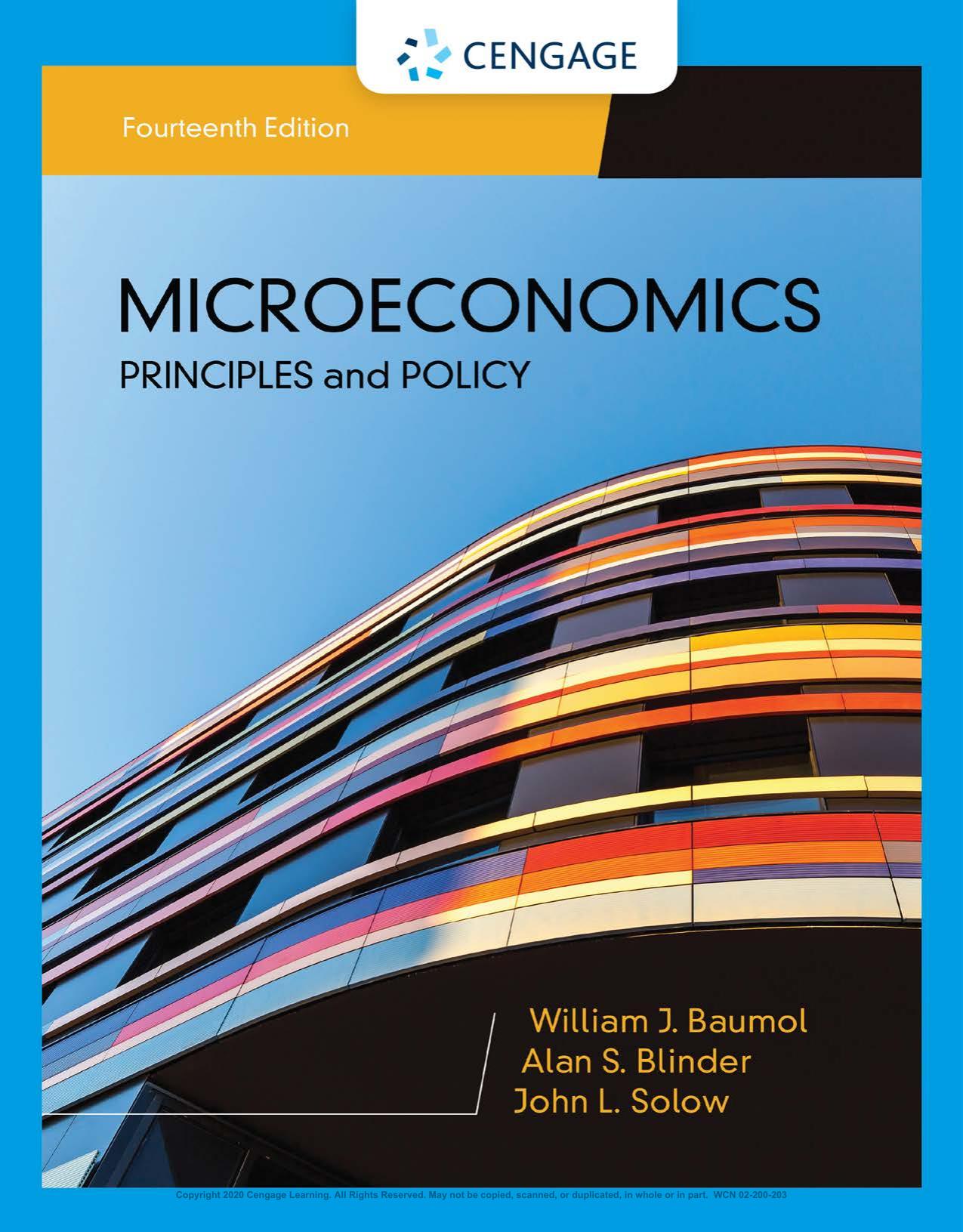
Microeconomics Principles & Policy 14th Edition by William Baumol, Alan Blinder, John Solow – Ebook PDF Instant Download/Delivery: 1337794996 , 978-1337794992
Full download Microeconomics Principles & Policy 14th edition after payment
Product details:
ISBN 10: 1337794996
ISBN 13: 978-1337794992
Author: William Baumol, Alan Blinder, John Solow
Master today’s principles of microeconomics and gain an understanding of current economic issues with the solid introduction and policy-based examples and applications found in Baumol/Blinder/Solow’s MICROECONOMICS: PRINCIPLES AND POLICY, 14E. Written by several of today’s most respected economists, this book is one of the most up-to-date microeconomics texts on the market — incorporating data and issues as recent as 2018. The authors combine the right level of rigor and detail to clarify even the most complicated microeconomic concepts. An entirely new chapter closes the book by delving into some of the most important issues confronting the U.S. economy today. Throughout this edition, well-developed examples, intriguing puzzles and meaningful microeconomic issues provide an excellent balance of theory to application while keeping you engaged and intrigued.
Microeconomics Principles & Policy 14th Table of contents:
Part 1. Getting Acquainted with Economics
1. What Is Economics?
1-1. Ideas for Beyond the Final Exam
1-1a. Idea 1: How Much Does It Really Cost?
1-1b. Idea 2: Attempts to Repeal the Laws of Supply and Demand—The Market Strikes Back
1-1c. Idea 3: The Surprising Principle of Comparative Advantage
1-1d. Idea 4: Trade Is a Win–Win Situation
1-1e. Idea 5: Government Policies Can Limit Economic Fluctuations—But Don’t Always Succeed
1-1f. Idea 6: The Short-Run Trade-Off between Inflation and Unemployment
1-1g. Idea 7: Productivity Growth Is (Almost) Everything in the Long Run
1-1h. Epilogue
1-2. Inside the Economist’s Tool Kit
1-2a. Economics as a Discipline
1-2b. The Need for Abstraction
1-2c. The Role of Economic Theory
1-2d. What Is an Economic Model?
1-2e. Reasons for Disagreements: Imperfect Information and Value Judgments
Summary
Key Terms
Discussion Questions
Appendix Using Graphs: A Review
Summary
Key Terms
Test Yourself
2. The Economy: Myth and Reality
2-1. The American Economy: A Thumbnail Sketch
2-1a. A Private-Enterprise Economy
2-1b. A Relatively “Closed” Economy
2-1c. A Growing Economy …
2-1d. But with Bumps along the Growth Path
2-2. The Inputs: Labor and Capital
2-2a. The American Workforce: Who Is in It?
2-2b. The American Workforce: What Does It Do?
2-2c. The American Workforce: What Does It Earn?
2-2d. Capital and Its Earnings
2-3. The Outputs: What Does America Produce?
2-4. The Central Role of Business Firms
2-5. What’s Missing from the Picture? Government
2-5a. The Government as Referee
2-5b. The Government as Business Regulator
2-5c. Government Expenditures
2-5d. Taxes in America
2-5e. The Government as Redistributor
2-6. Conclusion: It’s a Mixed Economy
Summary
Key Terms
Discussion Questions
3. The Fundamental Economic Problem: Scarcity and Choice
3-1. Scarcity, Choice, and Opportunity Cost
3-1a. Opportunity Cost and Money Cost
3-1b. Optimal Choice: Not Just Any Choice
3-2. Scarcity and Choice for a Single Firm
3-2a. The Production Possibilities Frontier
3-2b. The Principle of Increasing Costs
3-3. Scarcity and Choice for the Entire Society
3-3a. Scarcity and Choice Elsewhere in the Economy
3-4. The Three Coordination Tasks of Any Economy
3-5. The Concept of Efficiency
3-6. Task 1. How the Market Fosters Efficient Resource Allocation
3-6a. The Wonders of the Division of Labor
3-6b. The Amazing Principle of Comparative Advantage
3-6c. The Arithmetic of Comparative Advantage and Trade
3-6d. The Graphics of Comparative Advantage and Trade
3-7. Task 2. Market Exchange and Deciding How Much of Each Good to Produce
3-8. Task 3. How to Distribute the Economy’s Outputs among Consumers
3-9. Looking Ahead
Summary
Key Terms
Test Yourself
Discussion Questions
4. Supply and Demand: An Initial Look
4-1. The Invisible Hand
4-2. Demand and Quantity Demanded
4-2a. The Demand Schedule
4-2b. The Demand Curve
4-2c. Shifts of the Demand Curve
4-3. Supply and Quantity Supplied
4-3a. The Supply Schedule and the Supply Curve
4-3b. Shifts of the Supply Curve
4-4. Supply and Demand Equilibrium
4-4a. The Law of Supply and Demand
4-5. Effects of Demand Shifts on Supply-Demand Equilibrium
4-6. Supply Shifts and Supply-Demand Equilibrium
4-6a. Application: Who Really Pays That Tax?
4-6b. Speculation
4-7. Battling the Invisible Hand: The Market Fights Back
4-7a. Restraining the Market Mechanism: Price Ceilings
4-7b. Case Study: Rent Controls in New York City
4-7c. Restraining the Market Mechanism: Price Floors
4-7d. Case Study: Farm Price Supports and the Case of Sugar Prices
4-7e. A Can of Worms
4-8. A Simple But Powerful Lesson
Summary
Key Terms
Test Yourself
Discussion Questions
Part 2. The Macroeconomy: Aggregate Supply and Demand
5. An Introduction to Macroeconomics
5-1. Drawing a Line between Macroeconomics and Microeconomics
5-1a. Aggregation and Macroeconomics
5-1b. The Foundations of Aggregation
5-1c. The Line of Demarcation Revisited
5-2. Supply and Demand in Macroeconomics
5-2a. A Quick Review
5-2b. Moving to Macroeconomic Aggregates
5-2c. Inflation
5-2d. Recession and Unemployment
5-2e. Economic Growth
5-3. Gross Domestic Product
5-3a. Money as the Measuring Rod: Real versus Nominal GDP
5-3b. What Gets Counted in GDP?
5-3c. Limitations of the GDP: What GDP Is Not
5-4. The Economy on a Roller Coaster
5-4a. Growth, but with Fluctuations
5-4b. Inflation and Deflation
5-4c. The Great Depression
5-4d. From World War II to 1973
5-4e. The Great Stagflation, 1973–1981
5-4f. Reaganomics and Its Aftermath
5-4g. Clintonomics: Deficit Reduction and the “New Economy”
5-4h. Tax Cuts and the Bush Economy
5-4i. Obamanomics and the Great Recession
5-4j. What Is Trumponomics?
5-5. The Problem of Macroeconomic Stabilization: A Sneak Preview
5-5a. Combating Unemployment
5-5b. Combating Inflation
5-5c. Does It Really Work?
Summary
Key Terms
Test Yourself
Discussion Questions
6. The Goals of Macroeconomic Policy
6-1. The Goal of Economic Growth
6-2. The Capacity to Produce: Potential GDP and the Production Function
6-3. The Growth Rate of Potential GDP
6-4. The Goal of Low Unemployment
6-5. The Human Costs of High Unemployment
6-6. Counting the Unemployed: The Official Statistics
The Employed
6-7. Types of Unemployment
6-8. How Much Employment Is “Full Employment”?
6-9. Unemployment Insurance: The Invaluable Cushion
6-10. The Goal of Low Inflation
6-10a. Inflation and Real Wages
6-10b. The Importance of Relative Prices
6-11. Inflation as a Redistributor of Income and Wealth
6-12. Real versus Nominal Interest Rates
6-13. Inflation Distorts Measurements
6-13a. Confusing Real and Nominal Interest Rates
6-13b. The Malfunctioning Tax System
6-14. Other Costs of Inflation
6-15. The Costs of Low versus High Inflation
6-16. Low Inflation does not Necessarily Lead to High Inflation
Summary
Key Terms
Test Yourself
Discussion Questions
Appendix. How Statisticians Measure Inflation
Summary
Key Terms
Test Yourself
7. Economic Growth: Theory and Policy
7-1. The Three Pillars of Productivity Growth
7-1a. Capital
7-1b. Technology
7-1c. Labor Quality: Education and Training
7-2. Levels, Growth Rates, and the Convergence Hypothesis
7-3. Growth Policy: Encouraging Capital Formation
Real Interest Rates
7-4. Growth Policy: Improving Education and Training
7-5. Growth Policy: Spurring Technological Change
Expanding Higher Education
7-6. Recent Productivity Performance in the United States
7-6a. The Productivity Slowdown, 1973–1995
7-6b. The Productivity Speed-up, 1995–2010
7-6c. The Productivity Slowdown Since 2010
7-7. Growth in the Developing Countries
7-7a. The Three Pillars Revisited
7-7b. Some Special Problems of Developing Countries
7-8. From the Long Run to the Short Run
Summary
Key Terms
Test Yourself
Discussion Questions
8. Aggregate Demand and the Powerful Consumer
8-1. Aggregate Demand, Domestic Product, and National Income
8-2. The Circular Flow of Spending, Production, and Income
8-3. Consumer Spending and Income: The Important Relationship
8-4. The Consumption Function and the Marginal Propensity to Consume
8-5. Factors That Shift the Consumption Function
Wealth
8-6. The Extreme Variability of Investment
8-7. The Determinants of Net Exports
8-7a. National Incomes
8-7b. Relative Prices and Exchange Rates
8-8. How Predictable Is Aggregate Demand?
Summary
Key Terms
Test Yourself
Discussion Questions
Appendix. National Income Accounting
Summary
Key Terms
Test Yourself
Discussion Questions
9. Demand-Side Equilibrium: Unemployment or Inflation?
9-1. The Meaning of Equilibrium GDP
9-2. The Mechanics of Income Determination
9-3. The Aggregate Demand Curve
9-4. Demand-Side Equilibrium and Full Employment
9-5. The Coordination of Saving and Investment
9-6. Changes on the Demand Side: Multiplier Analysis
9-6a. The Magic of the Multiplier
9-6b. Demystifying the Multiplier: How It Works
9-6c. Algebraic Statement of the Multiplier
9-7. The Multiplier Is a General Concept
9-8. The Multiplier and the Aggregate Demand Curve
Summary
Key Terms
Test Yourself
Discussion Questions
Appendix A. The Simple Algebra of Income Determination and the Multiplier
Test Yourself
Discussion Questions
Appendix B. The Multiplier with Variable Imports
Summary
Test Yourself
10. Bringing in the Supply Side: Unemployment and Inflation?
10-1. The Aggregate Supply Curve
10-1a. Why the Aggregate Supply Curve Slopes Upward
10-1b. Shifts of the Aggregate Supply Curve
10-2. Equilibrium of Aggregate Demand and Supply
10-3. Inflation and the Multiplier
10-4. Recessionary and Inflationary Gaps Revisited
10-5. Adjusting to a Recessionary Gap: Deflation or Unemployment?
10-5a. Why Nominal Wages and Prices Won’t Fall (Easily)
10-5b. Does the Economy Have a Self-Correcting Mechanism?
10-5c. An Example from Recent History: Deflation Worries in the United States
10-6. Adjusting to an Inflationary Gap: Inflation
10-6a. Demand Inflation and Stagflation
10-6b. A U.S. Example
10-7. Stagflation from a Supply Shock
10-8. Applying the Model to a Growing Economy
10-8a. Demand-Side Fluctuations
10-8b. Supply-Side Fluctuations
10-9. A Role for Stabilization Policy
Summary
Key Terms
Test Yourself
Discussion Questions
Part 3. Fiscal and Monetary Policy
11. Managing Aggregate Demand: Fiscal Policy
11-1. Income Taxes and the Consumption Schedule
11-2. The Multiplier Revisited
11-2a. The Tax Multiplier
11-2b. Income Taxes and the Multiplier
11-2c. Automatic Stabilizers
11-2d. Government Transfer Payments
11-3. Planning Expansionary Fiscal Policy
11-4. Planning Contractionary Fiscal Policy
11-5. The Choice between Spending Policy and Tax Policy
11-6. Some Harsh Realities
11-7. The Idea behind Supply-Side Tax Cuts
Lower Personal Income-Tax Rates
11-7a. Some Flies in the Ointment
11-7b. Toward an Assessment of Supply-Side Economics
Summary
Key Terms
Test Yourself
Discussion Questions
Appendix A. Graphical Treatment of Taxes and Fiscal Policy
Summary
Key Terms
Test Yourself
Discussion Questions
Appendix B. Algebraic Treatment of Taxes and Fiscal Policy
Test Yourself
12. Money and the Banking System
12-1. The Nature of Money
12-1a. Barter versus Monetary Exchange
12-1b. The Conceptual Definition of Money
12-1c. What Serves as Money?
12-2. How the Quantity of Money is Measured
12-2a. M1
12-2b. M2
12-2c. Other Definitions of the Money Supply
12-3. The Banking System
12-3a. How Banking Began
12-3b. Principles of Bank Management: Profits versus Safety
12-3c. Bank Regulation
12-3d. Deposit Insurance
12-3e. Bank Supervision
12-3f. Reserve Requirements
12-4. Systemic Risk and the “Too Big to Fail” Doctrine
12-5. The Origins of the Money Supply
12-5a. How Bankers Keep Books
12-6. Banks and Deposit Creation
12-6a. The Limits to Deposit Creation by a Single Bank
12-6b. Multiple Deposit Creation by a Series of Banks
12-6c. The Process in Reverse: Multiple Contraction of Bank Deposits
12-7. Why the Deposit-Creation Formula is Oversimplified
12-8. The Need for Monetary Policy
Summary
Key Terms
Test Yourself
Discussion Questions
13. Monetary Policy: Conventional and Unconventional
13-1. Money and Income: The Important Difference
13-2. America’s Central Bank: The Federal Reserve System
13-2a. Origins and Structure
13-2b. Central Bank Independence
13-3. Implementing Monetary Policy in Normal Times: Open-Market Operations
13-3a. The Market for Bank Reserves
13-3b. The Mechanics of an Open-Market Operation
13-3c. Open-Market Operations, Bond Prices, and Interest Rates
13-3d. Which Interest Rate?
13-4. Other Instruments of Monetary Policy
13-4a. Lending to Banks
13-4b. Changing Reserve Requirements
13-4c. Quantitative Easing
13-5. How Monetary Policy Works in Normal Times
13-5a. Investment and Interest Rates
13-5b. Monetary Policy and Total Expenditure
13-6. Money and the Price Level
13-7. Application: Why the Aggregate Demand Curve Slopes Downward
13-8. Unconventional Monetary Policies
13-9. From Financial Distress to Recession
13-10. From Models to Policy Debates
Summary
Key Terms
Test Yourself
Discussion Questions
14. The Financial Crisis and the Great Recession
14-1. Roots of the Crisis
14-2. Leverage, Profits, and Risk
14-3. The Housing Price Bubble and the Subprime Mortgage Crisis
14-4. From the Housing Bubble to the Financial Crisis
14-5. From the Financial Crisis to the Great Recession
14-6. Hitting Bottom and Recovering
14-7. Lessons from the Financial Crisis
Summary
Key Terms
Test Yourself
Discussion Questions
15. The Debate Over Monetary and Fiscal Policy
15-1. Velocity and the Quantity Theory of Money
15-1a. Some Determinants of Velocity
15-1b. Monetarism: The Quantity Theory Modernized
15-2. Debate: Should the Fed Use Unconventional Monetary Policies?
15-3. Debate: Should Policymakers Fight Asset Price Bubbles?
15-4. Debate: Should We Rely on Fiscal or Monetary Policy?
15-5. Debate: The Shape of the Aggregate Supply Curve
15-6. Debate: Should the Government Intervene at All?
15-6a. Lags and the Rules-versus-Discretion Debate
15-7. Dimensions of the Rules-versus-Discretion Debate
15-7a. How Fast Does the Economy’s Self-Correcting Mechanism Work?
15-7b. How Long Are the Lags in Stabilization Policy?
15-7c. How Accurate Are Economic Forecasts?
15-7d. The Size of Government
15-7e. Uncertainties Caused by Government Policy
15-7f. A Political Business Cycle?
Summary
Key Terms
Test Yourself
Discussion Questions
16. Budget Deficits in the Short and Long Run
16-1. Should the Budget Always Be Balanced? The Short Run
16-2. The Importance of the Policy Mix
16-2a. The Multiplier Formula Revisited
16-2b. The Government Budget and Investment
16-3. Deficits and Debt: Terminology and Facts
16-3a. Some Facts about the National Debt
16-4. Interpreting the Budget Deficit or Surplus
16-4a. The Structural Deficit or Surplus
16-4b. Conclusion: What’s Happened to the Deficit?
16-5. Why Is the National Debt Considered a Burden?
16-6. Budget Deficits and Inflation
16-6a. The Monetization Issue
16-7. Debt, Interest Rates, and Crowding Out
16-7a. The Bottom Line
16-8. The Main Burden of the National Debt: Slower Growth
16-9. The Economics And Politics of the U.S. Budget Deficit
Summary
Key Terms
Test Yourself
Discussion Questions
17. The Trade-Off Between Inflation and Unemployment
17-1. Demand-Side Inflation Versus Supply-Side Inflation: A Review
17-2. Origins of the Phillips Curve
17-3. Supply-Side Inflation and the Collapse of the Phillips Curve
17-3a. Explaining the Fabulous Late 1990s
17-4. What the Phillips Curve Is Not
17-5. Fighting Unemployment with Fiscal and Monetary Policy
17-6. What Should Be Done?
17-6a. The Costs of Inflation and Unemployment
17-6b. The Slope of the Short-Run Phillips Curve
17-6c. The Efficiency of the Economy’s Self-Correcting Mechanism
17-7. Inflationary Expectations and the Phillips Curve
17-8. The Theory of Rational Expectations
17-8a. What Are Rational Expectations?
17-8b. Rational Expectations and the Trade-Off
17-8c. An Evaluation
17-9. Why Economists (and Politicians) Disagree
17-10. The Dilemma of Demand Management
17-11. Attempts to Improve the Trade-Off
17-11a. Reducing the Natural Rate of Unemployment
17-11b. Indexing Contracts for Inflation
Summary
Key Terms
Test Yourself
Discussion Questions
Part 4. The United States in the World Economy
18. International Trade and Comparative Advantage
18-1. Why Trade?
18-1a. Mutual Gains from Trade
18-2. International Versus Intranational Trade
18-2a. Political Factors in International Trade
18-2b. The Many Currencies Involved in International Trade
18-2c. Impediments to Mobility of Labor and Capital
18-3. The Principle of Comparative Advantage
18-4. The Arithmetic of Comparative Advantage
18-4a. The Graphics of Comparative Advantage
18-4b. Must Specialization Be Complete?
18-5. Tariffs, Quotas, and Other Interferences with Trade
18-5a. Tariffs versus Quotas
18-6. Why Inhibit Trade?
18-6a. Gaining a Price Advantage for Domestic Firms
18-6b. Protecting Particular Industries
18-6c. National Defense and Other Noneconomic Considerations
18-6d. The Infant-Industry Argument
18-6e. Strategic Trade Policy
18-7. Can Cheap Imports Hurt a Country?
Summary
Key Terms
Test Yourself
Discussion Questions
Appendix. Supply, Demand, and Pricing in World Trade
Summary
Test Yourself
19. The International Monetary System: Order or Disorder?
19-1. What Are Exchange Rates?
19-2. Exchange Rate Determination in a Free Market
Exercise
19-2a. Interest Rates and Exchange Rates: The Short Run
19-2b. Economic Activity and Exchange Rates: The Medium Run
19-2c. The Purchasing-Power Parity Theory: The Long Run
19-2d. Market Determination of Exchange Rates: Summary
19-3. When Governments Fix Exchange Rates: The Balance of Payments
19-4. A Bit of History: The Gold Standard and the Bretton Woods System
19-4a. The Classical Gold Standard
19-4b. The Bretton Woods System
19-5. Adjustment Mechanisms Under Fixed Exchange Rates
19-6. Why Try to Fix Exchange Rates?
19-7. The Current “Nonsystem”
19-7a. The Role of the International Monetary Fund
19-7b. The Volatile Dollar
19-7c. The Birth and Adolescence of the Euro
Summary
Key Terms
Test Yourself
Discussion Questions
20. Exchange Rates and the Macroeconomy
20-1. International Trade, Exchange Rates, and Aggregate Demand
20-1a. Relative Prices, Exports, and Imports
20-1b. The Effects of Changes in Exchange Rates
20-2. Aggregate Supply in an Open Economy
20-3. The Macroeconomic Effects of Exchange Rates
20-3a. Interest Rates and International Capital Flows
20-4. Fiscal and Monetary Policies in an Open Economy
20-4a. Fiscal Policy Revisited
20-4b. Monetary Policy Revisited
20-5. International Aspects of Deficit Reduction
20-5a. The Loose Link between the Budget Deficit and the Trade Deficit
20-6. Should We Worry About the Trade Deficit?
20-7. On Curing the Trade Deficit
20-7a. Change the Mix of Fiscal and Monetary Policy
20-7b. More Rapid Economic Growth Abroad
20-7c. Raise Domestic Saving or Reduce Domestic Investment
20-7d. Protectionism
20-8. Conclusion: No Nation Is an Island
Summary
Key Terms
Test Yourself
Discussion Questions
Part 5. The Economy Today
21. Contemporary Issues in the U.S. Economy
21-1. Can We Grow Much Faster Than 2 Percent a Year?
21-2. Who Loses from Globalization?
21-3. Are Trade Wars “Good and Easy to Win”?
21-4. Where Is the National Debt Headed?
21-5. Has the Phillips Curve Disappeared?
Summary
Key Terms
Discussion Questions
People also search for Microeconomics Principles & Policy 14th :
relevance and significance of microeconomics principles
describing the relevance and significance of microeconomics principles
basic microeconomics principles
microeconomics principles and business decisions
microeconomics principles for a changing world 6th edition
Tags: William Baumol, Alan Blinder, John Solow, Principles and Policy