


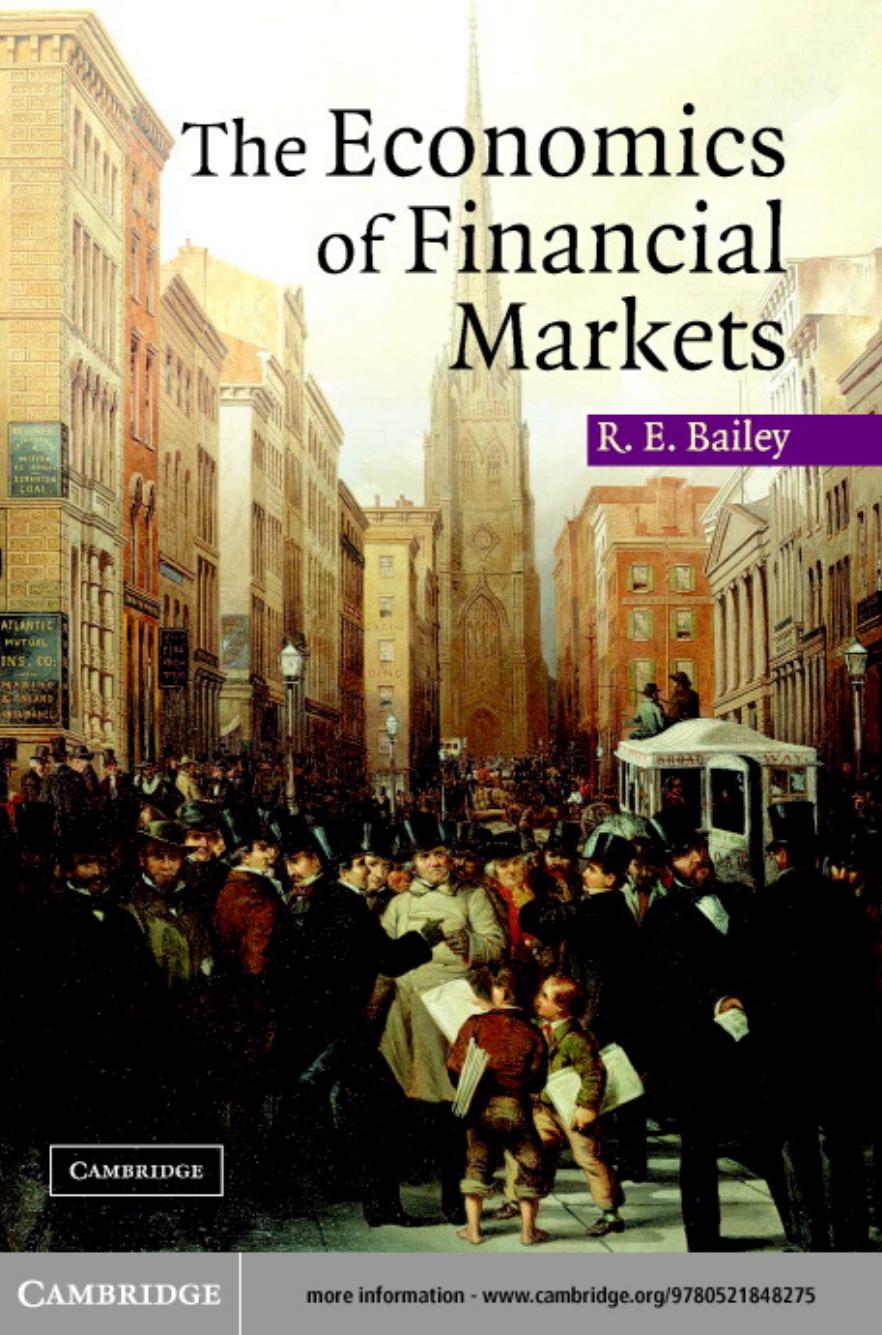
The Economics of Financial Markets 1st edition by Roy Bailey – Ebook PDF Instant Download/Delivery: 0521612802, 978-0521612807
Full download The Economics of Financial Markets 1st edition after payment
Product details:
ISBN 10: 0521612802
ISBN 13: 978-0521612807
Author: Roy Bailey
The Economics of Financial Markets presents a concise overview of capital markets, suitable for advanced undergraduates and for beginning graduate students in financial economics. Following a brief overview of financial markets–their microstructure and the randomness of stock market prices–this textbook explores how the economics of uncertainty can be applied to financial decision-making. Emphasis is placed on the economic principles underlying all financial markets, focusing on markets for equities, bonds, futures and options contracts.
The Economics of Financial Markets 1st Table of contents:
1. Asset markets and asset prices
1.1 Capital markets
1.2 Asset price determination: an introduction
1.3 The role of expectations
1.4 Performance risk, margins and short-selling
1.5 Arbitrage
1.6 The role of time
1.7 Asset market efficiency
1.8 Summary
Appendix 1.1: Averages and indexes of stock prices
Appendix 1.2: Real rates of return
Appendix 1.3: Continuous compounding and the force of interest
References
2. Asset market microstructure
2.1 Financial markets: functions and participants
2.2 Trading mechanisms
2.3 Industrial organization of financial markets
2.4 Trading and asset prices in a call market
2.5 Bid–ask spreads: inventory-based models
2.6 Bid–ask spreads: information-based models
2.7 Summary
References
3. Predictability of prices and market efficiency
3.1 Using the past to predict the future
3.2 Informational efficiency
3.3 Patterns of information
3.4 Asset market anomalies
3.5 Event studies
3.6 Summary
Appendix 3.1: The law of iterated expectations and martingales
References
4. Decision making under uncertainty
4.1 The state-preference approach
4.2 The expected utility hypothesis
4.3 Behavioural alternatives to the EUH
4.4 The mean-variance model
4.5 Summary
Appendix 4.1: Useful notation
Appendix 4.2: Derivation of the FVR
Appendix 4.3: Implications of complete asset markets
Appendix 4.4: Quadratic von Neumann–Morgenstern utility
Appendix 4.5: The FVR in the mean-variance model
References
5. Portfolio selection: the mean-variance model
5.1 Mean-variance analysis: concepts and notation
5.2 Portfolio frontier: two risky assets
5.3 Portfolio frontier: many risky assets and no risk-free asset
5.4 Portfolio frontier: many risky assets with a risk-free asset
5.5 Optimal portfolio selection in the mean-variance model
5.6 Summary
Appendix 5.1: Numerical example: two risky assets
Appendix 5.2: Variance minimization: risky assets only
Appendix 5.3: Variance minimization with a risk-free asset
Appendix 5.4: Derivation of Δσ[sub(P)] = β[sub(jP)]σ[sub(P)]Δa[sub(j)]
Appendix 5.5: The optimal portfolio with a single risky asset
References
6. The capital asset pricing model
6.1 Assumptions of the CAPM
6.2 Asset market equilibrium
6.3 The characteristic line and the market model
6.4 The security market line
6.5 Risk premia and diversification
6.6 Extensions
6.7 Summary
Appendix 6.1: The CAPM in terms of asset prices
Appendix 6.2: Linear dependence of ε[sub(j)] in the CAPM
Appendix 6.3: The CAPM when all assets are risky
References
7. Arbitrage
7.1 Arbitrage in theory and practice
7.2 Arbitrage in an uncertain world
7.3 State prices and the risk-neutral valuation relationship
7.4 Summary
Appendix 7.1: Implications of the arbitrage principle
References
8. Factor models and the arbitrage pricing theory
8.1 Factor models
8.2 APT
8.3 Predictions of the APT
8.4 Summary
Appendix 8.1: The APT in a multifactor model
Appendix 8.2: The APT in an exact single-factor model
References
9. Empirical appraisal of the CAPM and APT
9.1 The CAPM
9.2 Tests of the CAPM: time series
9.3 Tests of the CAPM: cross-sections
9.4 Sharpe ratios and Roll’s criticism
9.5 Multiple-factor models and the APT
9.6 Summary
Appendix 9.1: The Black CAPM in terms of excess returns
References
10. Present value relationships and price variability
10.1 Net present value
10.2 Asset price volatility
10.3 Behavioural finance, noise trading and models of dividend growth
10.4 Extreme asset price fluctuations
10.5 Summary
Appendix 10.1: Present values in continuous time
Appendix 10.2: Infinitely lived assets: constant growth
Appendix 10.3: The RNVR with multiple time periods
References
11. Intertemporal choice and the equity premium puzzle
11.1 Consumption and investment in a two-period world with certainty
11.2 Uncertainty, multiple assets and long time horizons
11.3 Lifetime portfolio selection
11.4 The equity premium puzzle and the risk-free rate puzzle
11.5 Intertemporal capital asset pricing models
11.6 Summary
Appendix 11.1: Intertemporal consumption and portfolio selection
Appendix 11.2: Simplifying the FVR
Appendix 11.3: The consumption CAPM
References
12. Bond markets and fixed-interest securities
12.1 What defines a bond?
12.2 Zero-coupon bonds
12.3 Coupon-paying bonds
12.4 Bond valuation
12.5 Risks in bond portfolios
12.6 Immunization of bond portfolios
12.7 Summary
Appendix 12.1: Some algebra of bond yields
References
13. Term structure of interest rates
13.1 Yield curves
13.2 Index-linked bonds
13.3 Implicit forward rates
13.4 The expectations hypothesis of the term structure
13.5 Allowing for risk preferences in the term structure
13.6 Arbitrage and the term structure
13.7 Summary
Appendix 13.1: The expectations hypothesis with explicit uncertainty
Appendix 13.2: Risk aversion and bond portfolios
References
14. Futures markets I: fundamentals
14.1 Forward contracts and futures contracts
14.2 The operation of futures markets
14.3 Arbitrage between spot and forward prices
14.4 Arbitrage in foreign exchange markets
14.5 Repo markets
14.6 Summary and conclusion
Appendix 14.1: Forward and futures prices
Appendix 14.2: Revaluation of a forward contract
References
15. Futures markets II: speculation and hedging
15.1 Speculation
15.2 Hedging strategies
15.3 Optimal hedging
15.4 Theories of futures prices
15.5 Manipulation of futures markets
15.6 Summary
Appendix 15.1: Futures investment as portfolio selection
Appendix 15.2: Derivation of [h(tilde above)]
References
16. Futures markets III: applications
16.1 Weather futures
16.2 Financial futures contracts
16.3 Short-term interest rate futures
16.4 Long-term interest rate, or bond, futures
16.5 Stock index futures
16.6 The fall of Barings Bank
16.7 Summary
References
17. Swap contracts and swap markets
17.1 Swap agreements: the fundamentals
17.2 Why do swaps occur?
17.3 Risks associated with swaps
17.4 Valuation of swaps
17.5 Metallgesellschaft: a case study
17.6 Summary
References
18. Options markets I: fundamentals
18.1 Call options and put options
18.2 Varieties of options
18.3 Option-like assets
18.4 Upper and lower bounds for option prices
18.5 Put-call parity for European options
18.6 The Modigliani–Miller theorem
18.7 Summary
Appendix 18.1: Lower bound for a European call option premium
Appendix 18.2: Lower bound for a European put option premium
Appendix 18.3: Put-call parity for European options
Appendix 18.4: The Modigliani–Miller theorem: a proof
References
19. Options markets II: price determination
19.1 The fundamentals of option price models
19.2 A two-state option-pricing model
19.3 The Black–Scholes model
19.4 Contingent claims analysis
19.5 Summary
References
20. Options markets III: applications
20.1 Stock index options
20.2 Options on futures contracts
20.3 Interest rate options
20.4 Options and portfolio risks
20.5 Portfolio insurance
20.6 Combinations and spreads
20.7 Summary
Appendix 20.1: Put-call parity for European options on futures
References
Subject index
Author index
People also search for The Economics of Financial Markets 1st:
the economics of financial markets pdf
the economics of financial markets bailey
introduction to the economics of financial markets
ecos3022 the economics of financial markets
the economics of financial markets and institutions from first principles
Tags: Roy Bailey, The Economics, Financial Markets