


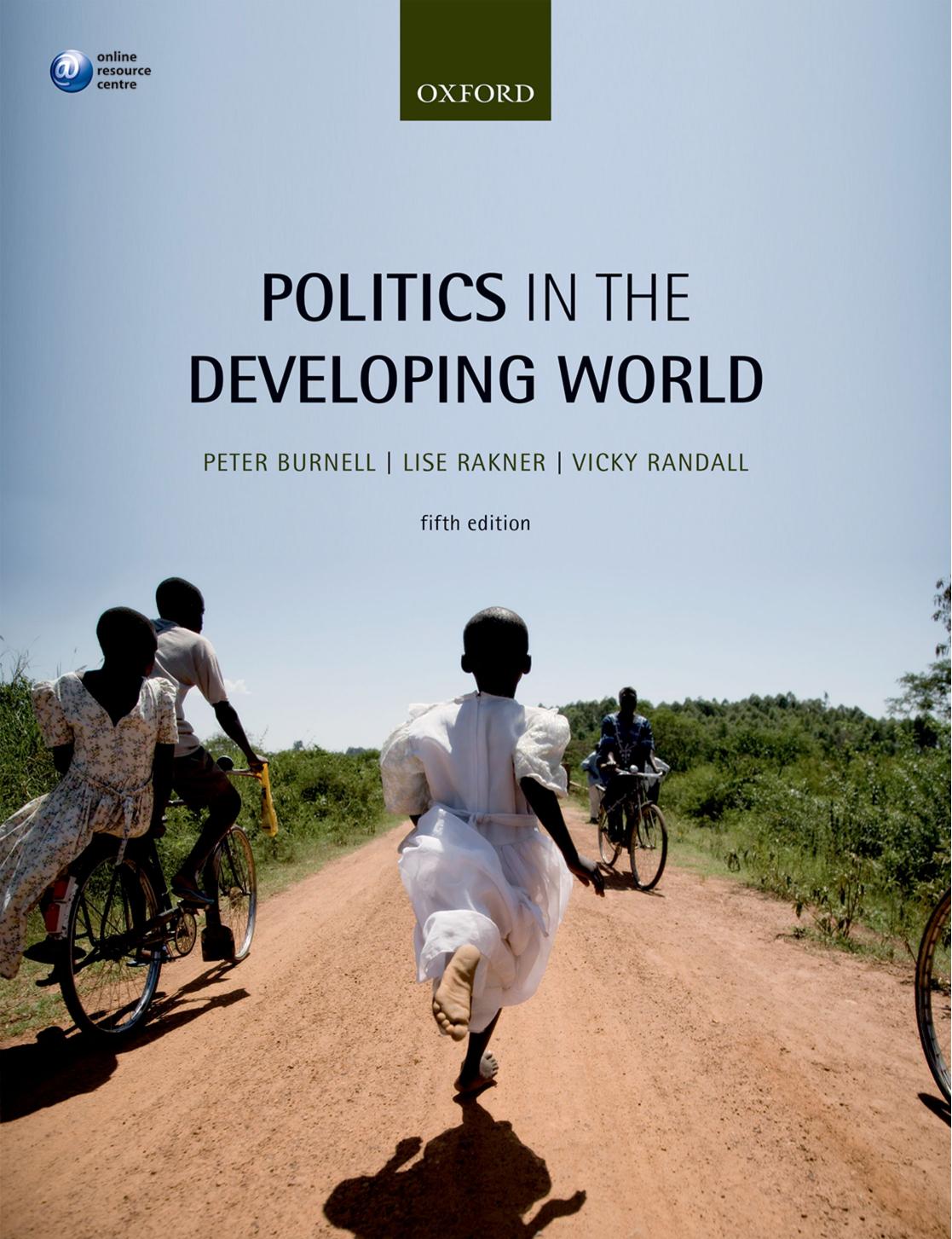
Politics in the Developing World 5th Edition by Peter Burnell, Vicky Randall, Lise Rakner – Ebook PDF Instant Download/Delivery: 0198737432, 978-0198737438
Full download Politics in the Developing World 5th edition after payment
Product details:
ISBN 10: 0198737432
ISBN 13: 978-0198737438
Author: Peter Burnell, Vicky Randall, Lise Rakner
An impressive line-up of international contributors provides a comprehensive and accessible introduction to politics in the developing world. The first four parts explore the theoretical approaches, the changing nature and role of the state, and the major policy issues that confront all developing countries. The final parts set out a diverse range of country case studies, representing all the main geographical regions. These country case studies illustrate the themes introduced in the thematic chapters and highlight the developing world as a place of diversity and rapid transformations. Readers are provided with the tools to appreciate the perspectives of developing countries.
The fifth edition has been thoroughly updated to address topical issues and themes, including refugee movements; the rise of the so-called Islamic State; organised crime; gender; the role of new forms of communication in political mobilization; and the replacement of Millennium Development Goals by Sustainable Development Goals. Two new country case studies have been added: Syria and the Sudan.
Politics in the Developing World 5th Table of contents:
Introduction
Lise Rakner and Vicky Randall
From Third World to Developing World
Politics as Independent or Dependent Variable?
Global Trends
Organization of the Book
Part 1 Approaches and Global Context
1 Changing Analytical Approaches to the Study of Politics in the Developing World
Vicky Randall
Introduction
‘Politics’ and the ‘Developing World’
Modernization and Dependency Approaches
Globalization: Theories and Responses
Current Approaches
Strategies and Methods of Analysis
Conclusion
2 Colonialism and Post-Colonial Development
James Chiriyankandath
Introduction: The Post-Colonial World
Pre-Colonial States and Societies
Colonial Patterns
Post-Colonial Development
Conclusion: The Colonial Legacy
3 Institutional Perspectives
Lise Rakner and Vicky Randall
Introduction
New Institutionalism and the Study of the Developing World
The Theoretical Underpinnings of Institutionalism: Three Kinds of Institutionalism
Political Institutions in Developing Countries
Formal and Informal Institutions
Conclusion: Institutionalism and the Developing World
4 The Developing World in the Global Economy
Robert Ahearne
Introduction: Trends in the Global Economy
Trade
Foreign Direct Investment and Financial Flows
The Developing World Today
Conclusion
5 The Developing World in International Politics
Stephen Hobden
Introduction: International Relations and the Developing World
North–South Relations during the Cold War
North–South Relations after the Cold War
All Change? The Developing World in the ‘Chinese Century’
Conclusion
Part 2 Society and State
6 Inequality
Jenny Pearce
Introduction
Key Conceptual Debates
The Politics and Economics of Inequality in Developing Countries: The Cold War and Its Aftermath
Inequalities in the Age of Globalization
Conclusion: Inequality Matters—Toward ‘Shared Prosperity’?
7 Ethnopolitics and Nationalism
James R. Scarritt and Jóhanna K Birnir
Introduction
The Construction and Politicization of Ethnic Identities
Varieties of Nationalism in the Developing World
Ethnopolitics in Multi-Ethnic and Deeply Divided Societies
The State and Nation-Building in the Developing World
Conclusion
8 Religion
Jeff Haynes
Introduction
Religion and Politics
Religion and the State
Religion and Democratization in the Developing World
Religion in International Politics after 9/11
Conclusion
9 Women and Gender
Vicky Randall
Introduction
Women in Society
The State, Politics, and Women
Women’s Movements and Feminism
Political Representation and Participation
Women and Policy
Conclusion
10 Civil Society
Marina Ottaway
Introduction: Defining ‘Civil Society’
Traditional and Modern Civil Society
The Modern State and Civil Society as a Specialized Entity
Civil Society and the State in the Developing World
Civil Society and Democratization
Conclusion
11 Social Movements and Alternative Politics
Siri Gloppen
Introduction
Social Movements and Alternative Politics
The Origins of Social Movements
Social Movements and Alternative Politics in the Developing World
Social Movements and Democratization
Social Movements and Identity Politics
Social Movements and Social Justice
What Makes Social Movements Successful?
Conclusion
Part 3 State and Society
12 The Modern State: Characteristics, Capabilities, and Consequences
Anna Persson
Introduction: The State and Development
Conceptualizing the Modern State
Statehood in the Contemporary World
The Evolution of the Modern State: Variations on a Theme
Opportunities and Strategies for Change
Conclusion
13 Violent Conflict and Intervention
Astri Suhrke, Torunn Wimpelmann, and Ingrid Samset
Introduction: Decolonization and Its Aftermath
Social Order Conflicts and the Cold War
The Nature of Conflicts in the post-Cold-War World
New Forces
Conclusion
14 Democratization and Regime Change
Lise Rakner
Introduction
Regime Change, Democracy, and Democratization
Democratization as Process
Explaining Democratization and Regime Change
International Dimensions of Democratization
Conclusion
15 Governance
Lise Rakner
Introduction
Conceptualizing Governance and Good Governance
Governance and Development
Corruption: A Key Governance Challenge
The Relationship between Democracy and Governance
Conclusion
Part 4 Policy Issues
16 Development
Tony Addison
Introduction
Defining Development Policy Objectives
Markets and States
Achieving Structural Transformation
The Global Development Landscape
Conclusion
17 Environment
Peter Newell
Introduction
Global Context
Environment and Development: An Uneasy Relationship
Policy Processes
New Policy Instruments for Environmental Protection
Futures
Conclusion
18 Human Rights
Michael Freeman
Introduction
The Concept of Human Rights
Human Rights Regimes
Development and Human Rights
Universalism and Cultural Diversity
The New Political Economy of Human Rights
Conclusion
Part 5 Regime Change
19 Pakistan: Regime Change and Military Power
David Taylor
Introduction: From Independence to State Breakup in 1971
Unstable Government from 1971 to 1999
General Musharraf’s Rule from 1999 to 2008
Conclusion: Military Rule or Military Influence
20 Indonesia: Dynamics of Regime Change
Gyda Marås Sindre
Introduction
Authoritarian Legacies
Democratization and Decentralization
Political Mobilization and Participation
Civil Society: The Narrowing of Space for Political Mobilization
Conclusion
21 The Onset of the Syrian Uprising and the Origins of Violence
Reinoud Leenders
Introduction
Syria: A Short History of Growing Popular Discontent
The Onset of the Syrian Uprising
The Roots of the Uprising’s Militarization
Conclusion: A Vicious and Protracted Civil War
Part 6 Fragile versus Strong States
22 Iraq: A Failing State?
Nadje Al-Ali and Nicola Pratt
Introduction
Reconstructing Iraq’s Political Institutions
Post-Invasion Violence and Security
Human and Economic Development
Conclusion
23 Mexico: Transition to Civil War Democracy
Andreas Schedler
Introduction: From Independence to Revolution
The Foundations of Electoral Authoritarianism
The Structural Bases of Regime Change
Democratization by Elections
Transition to Civil War
Conclusion
24 South Korea: Strong State, Successful Development
Peter Ferdinand
Introduction: Historical Sources of National Strength
The Korean Developmental State: Dictatorship, Development, and National Restoration
Development Policies
The Emergence of Democracy: Stronger Society, Weaker State, and Challenges of Corruption
Conclusion: Travails after Achieving Development
Part 7 Development and Human Rights
25 Nigeria: Consolidating Democracy and Human Rights
Stephen Wright
Introduction
The Political Economy of Oil
Human Security and Civil Society
Conclusion: Development Challenges
26 Guatemala: Enduring Underdevelopment and Insecurity
Rachel Sieder
Introduction: Guatemala’s Poverty and Multiple Inequalities
Patterns of State Formation
The Peace Accords: A Turning Point?
Human Security and Development
Conclusion
27 Sudan: Human Rights, Development, and Democracy
Liv Tønnessen
Introduction: Political Instability
Civil War and Sudan’s Perpetual Conflicts
Human Development and Political Economy
Democracy and Human Rights
Conclusion: Human Rights and Development
Part 8 South–South Relations
28 Brazil as a Global Player?
Leslie Elliott Armijo
Introduction: A Brief History
Brazil in the World: Pursuit of Continental Integration and Global Voice
Key International Issues for Brazil
Toward Global Multipolarity?
Conclusion
29 China and the Developing World
Deborah Bräutigam and Yunnan Chen
Introduction
A Brief History
Instruments of Engagement
China’s Economy Goes Global
Controversies
Conclusion
30 India’s Development Partnerships in the Twenty-First Century
Emma Mawdsley
Introduction
The ‘Rising Powers’ as Development Actors
India and South–South Relations
India as a Development Assistance Partner
Conclusion
Appendix A Case Study Countries: Basic Indicators
Appendix B Case Study Countries: Gender-Related Indicators
Glossary
References
Index
People also search for Politics in the Developing World 5th:
transboundary water politics in the developing world
currency politics in the developing world
cities and politics in the developing world
the other world issues and politics in the developing world
politics in the developing world pdf
Tags: Peter Burnell, Vicky Randall, Lise Rakner, Developing World