


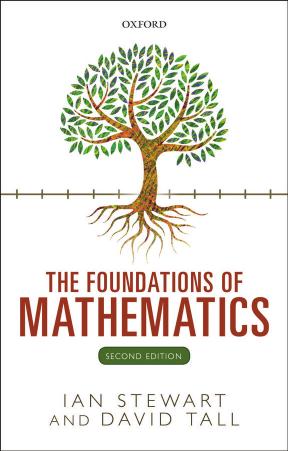
The Foundations of Mathematics 2nd Edition by Ian Stewart, David Tall – Ebook PDF Instant Download/Delivery: 0198706448 , 978-0198706441
Full download The Foundations of Mathematics 2nd edition after payment
Product details:
ISBN 10: 0198706448
ISBN 13: 978-0198706441
Author: Ian Stewart, David Tall
The transition from school mathematics to university mathematics is seldom straightforward. Students are faced with a disconnect between the algorithmic and informal attitude to mathematics at school, versus a new emphasis on proof, based on logic, and a more abstract development of general concepts, based on set theory.
The authors have many years’ experience of the potential difficulties involved, through teaching first-year undergraduates and researching the ways in which students and mathematicians think. The book explains the motivation behind abstract foundational material based on students’ experiences of school mathematics, and explicitly suggests ways students can make sense of formal ideas.
This second edition takes a significant step forward by not only making the transition from intuitive to formal methods, but also by reversing the process- using structure theorems to prove that formal systems have visual and symbolic interpretations that enhance mathematical thinking. This is exemplified by a new chapter on the theory of groups.
While the first edition extended counting to infinite cardinal numbers, the second also extends the real numbers rigorously to larger ordered fields. This links intuitive ideas in calculus to the formal epsilon-delta methods of analysis. The approach here is not the conventional one of ‘nonstandard analysis’, but a simpler, graphically based treatment which makes the notion of an infinitesimal natural and straightforward.
This allows a further vision of the wider world of mathematical thinking in which formal definitions and proof lead to amazing new ways of defining, proving, visualising and symbolising mathematics beyond previous expectations.
The Foundations of Mathematics 2nd Table of contents:
Part I The Intuitive Background
1 Mathematical Thinking
Concept Formation
Schemas
An Example
Natural and Formal Mathematics
Building Formal Ideas on Human Experience
Formal Systems and Structure Theorems
Using Formal Mathematics More Flexi
Exercises
2 Number Systems
Natural Numbers
Fractions
Integers
Rational Numbers
Real Numbers
Inaccurate Arithmetic in Practical Drawing
A Theoretical Model of the Real Line
Different Decimal Expansions for Different Numbers
Rationals and Irrationals
The Need for Real Numbers
Arithmetic of Decimals
Sequences
Order Properties and the Modulus
Convergence
Completeness
Decreasing Sequences
Different Decimal Expansions for the Same Real Number
Bounded Sets
Exercises
Part II The Beginnings of Formalisation
3 Sets
Members
Subsets
Is There a Universe?
Union and Intersection
Complements
Sets of Sets
Exercises
4 Relations
Ordered Pairs
Mathematical Precision and Human Insight
AlternativeWays to Conceptualise Ordered Pairs
Relations
Equivalence Relations
Example: Arithmetic Modulo n
Subtle Aspects of Equivalence Relations
Order Relations
Exercises
5 Functions
Some Traditional Functions
The General Function Concept
General Properties of Functions
The Graph of a Function
Composition of Functions
Inverse Functions
Restriction
Sequences and n-tuples
Functions of Several Variables
Binary Operations
Indexed Families of Sets
Exercises
6 Mathematical Logic
Statements
Predicates
All and Some
More Than One Quantifier
Negation
Logical Grammar: Connectives
The Link with Set Theory
Formulas for Compound Statements
Logical Deductions
Proof
Exercises
7 Mathematical Proof
Axiomatic Systems
Proof Comprehension and Self-Explanation
Examination Questions
Exercises
Part III The Development of Axiomatic Systems
8 Natural Numbers and Proof by Induction
Natural Numbers
Definition by Induction
Laws of Arithmetic
Ordering the Natural Numbers
Uniqueness of N0
Counting
Von Neumann’s Brainwave
Other Forms of Induction
Division
Factorisation
The Euclidean Algorithm
Reflections
Exercises
9 Real Numbers
Preliminary Arithmetical Deductions
Preliminary Deductions about Order
Construction of the Integers
Construction of Rational Numbers
Construction of Real Numbers
Sequences of Rationals
The Ordering on R
Completeness of R
Exercises
10 Real Numbers as a Complete Ordered Field
Examples of Rings and Fields
Examples of Ordered Rings and Fields
Isomorphisms Again
Some Characterisations
The Connection with Intuition
Exercises
11 Complex Numbers and Beyond
Historical Background
Construction of the Complex Numbers
Complex Conjugation
The Modulus
Euler’s Approach to the Exponential Function
Addition Formulas for Cosine and Sine
The Complex Exponential Function
Quaternions
The Change in Approach to Formal Mathematics
Exercises
Part IV Using Axiomatic Systems
12 Axiomatic Systems, Structure Theorems, and Flexible Thinking
Structure Theorems
Psychological Aspects of Different Approaches to Mathematical Thinking
Building Formal Theories
Semigroups and Groups
Rings and Fields
Vector Spaces
The Way Ahead
Exercises
13 Permutations and Groups
Permutations
Permutations as Cycles
Group Properties for Permutations
Axioms for a Group
Subgroups
Isomorphisms and Homomorphisms
Partitioning a Group to Obtain a Quotient Group
The Number of Elements in a Group and a Subgroup
Partitions that Define a Group Structure
The Structure of Group Homomorphisms
The Structure of Groups
Major Contributions of Group Theory throughout Mathematics
The Way Ahead
14 Cardinal Numbers
Cantor’s Cardinal Numbers
The Schröder–Bernstein Theorem
Cardinal Arithmetic
Order Relations on Cardinals
Exercises
15 Infinitesimals
Ordered Fields Larger than the Real Numbers
Super Ordered Fields
The Structure Theorem for Super Ordered Fields
Visualising Infinitesimals on a Geometric Number Line
Magnification in Higher Dimensions
Calculus with Infinitesimals
Non-standard Analysis
Amazing Possibilities in Non-standard Analysis
Exercises
Part V Strengthening the Foundations
16 Axioms for Set Theory
Some Difficulties
Sets and Classes
The Axioms Themselves
The Axiom of Choice
Consistency
Exercises
Appendix—How to Read Proofs: The ‘Self-Explanation’ Strategy
How to Self-Explain
Example Self-Explanations
Self-Explanation Compared with Other Comments
Paraphrasing
Monitoring
Practice Proof 1
Practice Proof 2
Remember . . .
References and Further Reading
References
Further Reading
Online Reading
Index
People also search for The Foundations of Mathematics 2nd :
the foundations of mathematics 2nd edition
the foundations of mathematics 2nd edition pdf
what is the foundation of mathematics
is set theory the foundation of mathematics
the foundations of mathematics pdf
Tags: Ian Stewart, David Tall, The Foundations