


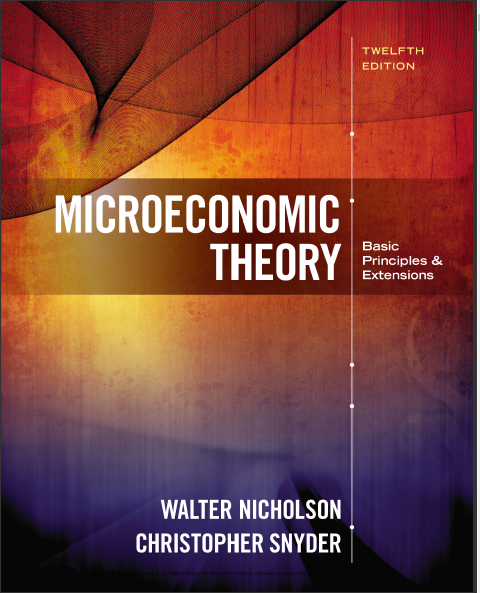
Test Bank for Microeconomic Theory Basic Principles and Extensions 12th Edition by Walter Nicholson, Christopher Snyder ISBN 1305505794 978-1305505797
Original price was: $70.00.$35.00Current price is: $35.00.
Instant download (Test Bank) Microeconomic Theory Basic Principles and Extensions 12th Edition by Nicholson after payment
Test Bank for Microeconomic Theory Basic Principles and Extensions 12th Edition by Walter Nicholson, Christopher Snyder – Ebook PDF Instant Download/Delivery: 1305505794 , 978-1305505797
Full download Microeconomic Theory Basic Principles and Extensions 12th edition after payment
Product details:
ISBN 10: 1305505794
ISBN 13: 978-1305505797
Author: Walter Nicholson, Christopher Snyder
Now you can truly understand and apply the latest economic models as you work directly with theoretical tools, real-world applications, and the popular new behavioral economics in this reader-friendly, market-leading book. MICROECONOMIC THEORY: BASIC PRINCIPLES AND EXTENSIONS, 12E takes a calculus-based approach to provide the ideal level of mathematical rigor, whether you are an upper-level undergraduate or beginning graduate student. Insightful graphic presentations help you visually grasp the connections between the calculus and the algebraic and geometric approach to the same material. End-of-chapter problems present simple numerical/mathematical exercises, which strengthen your microeconomic intuition and are followed by more analytical, theoretical, behavioral, and complex problems. Unlike other more theoretical texts, MICROECONOMIC THEORY, 12E closely connects all theory to real applications in the world today.
Microeconomic Theory Basic Principles and Extensions 12th Table of contents:
Part 1. Introduction
Chapter 1. Economic Models
1.1. Theoretical Models
1.2. Verification of Economic Models
1.2.1. The Profit-Maximization Model
1.2.2. Testing Assumptions
1.2.3. Testing Predictions
1.2.4. Importance of Empirical Analysis
1.3. General Features of Economic Models
1.3.1. The Ceteris Paribus Assumption
1.4. Structure of Economic Models
1.4.1. Optimization Assumptions
1.4.2. Positive-Normative Distinction
1.5. Development of the Economic Theory of Value
1.5.1. Early Economic Thoughts on Value
1.5.2. The Founding of Modern Economics
1.5.3. Labor Theory of Exchange Value
1.5.4. The Marginalist Revolution
1.5.5. Marshallian Supply–Demand Synthesis
1.5.6. Paradox Resolved
1.5.7. General Equilibrium Models
1.5.8. Production Possibility Frontier
1.5.9. Welfare Economics
1.6. Modern Developments
1.6.1. The Mathematical Foundations of Economic Models
1.6.2. New Tools for Studying Markets
1.6.3. The Economics of Uncertainty and Information
1.6.4. Behavioral Economics
1.6.5. Computers and Empirical Analysis
Summary
Suggestions for Further Reading
Chapter 2. Mathematics for Microeconomics
2.1. Maximization of a Function of One Variable
2.1.1. Derivatives
2.1.2. Value of the Derivative at a Point
2.1.3. First-Order Condition for a Maximum
2.1.4. Second-Order Conditions
2.1.5. Second Derivatives
2.1.6. Rules for Finding Derivatives
2.2. Functions of Several Variables
2.2.1. Partial Derivatives
2.2.2. Calculating Partial Derivatives
2.2.3. Partial Derivatives and the Ceteris Paribus Assumption
2.2.4. Partial Derivatives and Units of Measurement
2.2.5. Elasticity—A General Definition
2.2.6. Second-Order Partial Derivatives
2.2.7. Young’s Theorem
2.2.8. Uses of Second-Order Partials
2.2.9. The Chain Rule with Many Variables
2.2.10. Implicit Functions
2.2.11. A Special Case—Comparative Statics Analysis
2.3. Maximization of Functions of Several Variables
2.3.1. First-Order Conditions for a Maximum
2.3.2. Second-Order Conditions
2.4. The Envelope Theorem
2.4.1. A Specific Example
2.4.2. A Direct, Time-Consuming Approach
2.4.3. The Envelope Shortcut
2.4.4. Many-Variable Case
2.5. Constrained Maximization
2.5.1. Lagrange Multiplier Method
2.5.2. The Formal Problem
2.5.3. First-Order Conditions
2.5.4. Interpretation of the Lagrange Multiplier
2.5.5. Lagrange Multiplier as a Benefit–Cost Ratio
2.5.6. Duality
2.6. Envelope Theorem in Constrained Maximization Problems
2.7. Inequality Constraints
2.7.1. A Two-Variable Example
2.7.2. Slack Variables
2.7.3. Solution Using Lagrange Multipliers
2.7.4. Complementary Slackness
2.8. Second-Order Conditions and Curvature
2.8.1. Functions of One Variable
2.8.2. Functions of Two Variables
2.8.3. An Intuitive Argument
2.8.4. A Formal Analysis
2.8.5. Concave Functions
2.8.6. Constrained Maximization
2.8.7. Quasi-Concave Functions
2.9. Homogeneous Functions
2.9.1. Homogeneity and Derivatives
2.9.2. Euler’s Theorem
2.9.3. Homothetic Functions
2.10. Integration
2.10.1. Antiderivatives
2.10.2. Calculating Antiderivatives
2.10.3. Definite Integrals
2.10.4. Fundamental Theorem of Calculus
2.10.5. Differentiating a Definite Integral
2.11. Dynamic Optimization
2.11.1. The Optimal Control Problem
2.11.2. The Maximum Principle
2.12. Mathematical Statistics
2.12.1. Random Variables and Probability Density Functions
2.12.2. Discrete and Continuous Random Variables
2.12.3. Probability Density Functions
2.12.4. A Few Important PDFs
2.12.5. Expected Value
2.12.6. Variance and Standard Deviation
2.12.7. Covariance
Summary
Problems
Suggestions for Further Reading
Extensions. Second-Order Conditions and Matrix Algebra
Part 2. Choice and Demand
Chapter 3. Preferences and Utility
3.1. Axioms of Rational Choice
3.2. Utility
3.2.1. Nonuniqueness of Utility Measures
3.2.2. The Ceteris Paribus Assumption
3.2.3. Utility from Consumption of Goods
3.2.4. Arguments of Utility Functions
3.2.5. Economic Goods
3.3. Trades and Substitution
3.3.1. Indifference Curves and the Marginal Rate of Substitution
3.3.2. Indifference Curve Map
3.3.3. Indifference Curves and Transitivity
3.3.4. Convexity of Indifference Curves
3.3.5. Convexity and Balance in Consumption
3.4. The Mathematics of Indifference Curves
3.4.1. The Marginal Rate of Substitution
3.4.2. Convexity of Indifference Curves
3.5. Utility Functions for Specific Preferences
3.5.1. Cobb–Douglas Utility
3.5.2. Perfect Substitutes
3.5.3. Perfect Complements
3.5.4. CES Utility
3.6. The Many-Good Case
3.6.1. The MRS with Many Goods
Summary
Problems
Suggestions for Further Reading
Extensions. Special Preferences
Chapter 4. Utility Maximization and Choice
4.1. An Initial Survey
4.1.1. A Numerical Illustration
4.2. The Two-Good Case: A Graphical Analysis
4.2.1. Budget Constraint
4.2.2. First-Order Conditions for a Maximum
4.2.3. Second-Order Conditions for a Maximum
4.2.4. Corner Solutions
4.3. The n-Good Case
4.3.1. First-Order Conditions
4.3.2. Implications of First-Order Conditions
4.3.3. Interpreting the Lagrange Multiplier
4.3.4. Corner Solutions
4.4. Indirect Utility Function
4.5. The Lump Sum Principle
4.6. Expenditure Minimization
4.6.1. A Mathematical Statement
4.7. Properties of Expenditure Functions
Summary
Problems
Suggestions for Further Reading
Extensions. Budget Shares
Chapter 5. Income and Substitution Effects
5.1. Demand Functions
5.1.1. Homogeneity
5.2. Changes in Income
5.2.1. Normal and Inferior Goods
5.3. Changes in a Good’s Price
5.3.1. Graphical Analysis of a Decrease in Price
5.3.2. Graphical Analysis of an Increase in Price
5.3.3. Effects of Price Changes for Inferior Goods
5.3.4. Giffen’s Paradox
5.3.5. A Summary
5.4. The Individual’s Demand Curve
5.4.1. Shifts in the Demand Curve
5.5. Compensated (Hicksian) Demand Curves and Functions
5.5.1. Shephard’s Lemma
5.5.2. Relationship between Compensated and Uncompensated Demand Curves
5.6. A Mathematical Development of Response to Price Changes
5.6.1. Direct Approach
5.6.2. Indirect Approach
5.6.3. The Substitution Effect
5.6.4. The Income Effect
5.6.5. The Slutsky Equation
5.6.6. Final Form of the Slutsky Equation
5.7. Demand Elasticities
5.7.1. Marshallian Demand Elasticities
5.7.2. Price Elasticity of Demand
5.7.3. Price Elasticity and Total Spending
5.7.4. Compensated Price Elasticities
5.7.5. Relationships Among Demand Elasticities
5.8. Consumer Surplus
5.8.1. Consumer Welfare and the Expenditure Function
5.8.2. Using the Compensated Demand Curve to Show CV
5.8.3. The Consumer Surplus Concept
5.8.4. Welfare Changes and the Marshallian Demand Curve
5.9. Revealed Preference and the Substitution Effect
5.9.1. Graphical Approach
5.9.2. Revealed Preference and the Negativity of the Substitution Effect
Summary
Problems
Suggestions for Further Reading
Extensions. Demand Concepts and the Evaluation of Price Indices
Chapter 6. Demand Relationships among Goods
6.1. The Two-Good Case
6.1.1. A Mathematical Treatment
6.2. Substitutes and Complements
6.2.1. Gross (Marshallian) Substitutes and Complements
6.2.2. Asymmetry of the Gross Definitions
6.3. Net (Hicksian) Substitutes and Complements
6.4. Substitutability with Many Goods
6.5. Composite Commodities
6.5.1. Composite Commodity Theorem
6.5.2. Generalizations and Limitations
6.6. Home Production, Attributes of Goods, and Implicit Prices
6.6.1. Household Production Model
6.6.2. The Linear Attributes Model
6.6.3. Illustrating the Budget Constraints
6.6.4. Corner Solutions
Summary
Problems
Suggestions for Further Reading
Extensions. Simplifying Demand and Two-Stage Budgeting
Part 3. Uncertainty and Strategy
Chapter 7. Uncertainty
7.1. Mathematical Statistics
7.2. Fair Gambles and the Expected Utility Hypothesis
7.2.1. St. Petersburg Paradox
7.3. Expected Utility
7.4. The Von Neumann–Morgenstern Theorem
7.4.1. The von Neumann–Morgenstern Utility Index
7.4.2. Expected Utility Maximization
7.5. Risk Aversion
7.5.1. Risk Aversion and Fair Gambles
7.5.2. Risk Aversion and Insurance
7.6. Measuring Risk Aversion
7.6.1. Risk Aversion and Insurance Premiums
7.6.2. Risk Aversion and Wealth
7.6.3. Relative Risk Aversion
7.7. Methods for Reducing Uncertainty and Risk
7.8. Insurance
7.9. Diversification
7.10. Flexibility
7.10.1. Types of Options
7.10.2. Model of Real Options
7.10.3. More Options Are Better (Typically)
7.10.4. Computing Option Value
7.10.5. Option Value of Delay
7.10.6. Implications for Cost–Benefit Analysis
7.11. Information
7.11.1. Information as a Good
7.11.2. Quantifying the Value of Information
7.12. The State-Preference Approach to Choice under Uncertainty
7.12.1. States of the World and Contingent Commodities
7.12.2. Utility Analysis
7.12.3. Prices of Contingent Commodities
7.12.4. Fair Markets for Contingent Goods
7.12.5. Risk Aversion
7.12.6. A Graphic Analysis
7.12.7. Risk Aversion and Risk Premiums
7.13. Asymmetry of Information
Summary
Problems
Suggestions for Further Reading
Extensions. The Portfolio Problem
Chapter 8. Game Theory
8.1. Basic Concepts
8.1.1. Players
8.1.2. Strategies
8.1.3. Payoffs
8.2. Prisoners’ Dilemma
8.2.1. Normal Form
8.2.2. Thinking Strategically about the Prisoners’ Dilemma
8.3. Nash Equilibrium
8.3.1. A Formal Definition
8.3.2. Nash Equilibrium in the Prisoners’ Dilemma
8.3.3. Underlining Best-Response Payoffs
8.3.4. Dominant Strategies
8.3.5. Battle of the Sexes
8.4. Mixed Strategies
8.4.1. Formal Definitions
8.4.2. Computing Mixed-Strategy Equilibria
8.5. Existence of Equilibrium
8.6. Continuum of Actions
8.6.1. Tragedy of the Commons
8.7. Sequential Games
8.7.1. Sequential Battle of the Sexes
8.7.2. Extensive Form
8.7.3. Nash Equilibria
8.7.4. Subgame-Perfect Equilibrium
8.7.5. Backward Induction
8.8. Repeated Games
8.8.1. Finitely Repeated Games
8.8.2. Infinitely Repeated Games
8.9. Incomplete Information
8.10. Simultaneous Bayesian Games
8.10.1. Player Types and Beliefs
8.10.2. Bayesian–Nash Equilibrium
8.11. Signaling Games
8.11.1. Job-Market Signaling
8.11.2. Bayes’ Rule
8.11.3. Perfect Bayesian Equilibrium
8.12. Experimental Games
8.12.1. Experiments with the Prisoners’ Dilemma
8.12.2. Experiments with the Ultimatum Game
8.12.3. Experiments with the Dictator Game
8.13. Evolutionary Games and Learning
Summary
Problems
Suggestions for Further Reading
Extensions. Existence of Nash Equilibrium
Part 4. Production and Supply
Chapter 9. Production Functions
9.1. Marginal Productivity
9.1.1. Marginal Physical Product
9.1.2. Diminishing Marginal Productivity
9.1.3. Average Physical Productivity
9.2. Isoquant Maps and the Rate of Technical Substitution
9.2.1. The Marginal Rate of Technical Substitution (RTS)
9.2.2. RTS and Marginal Productivities
9.2.3. Reasons for a Diminishing RTS
9.2.4. Importance of Cross-Productivity Effects
9.3. Returns to Scale
9.3.1. Constant Returns to Scale
9.3.2. Homothetic Production Functions
9.3.3. The n-Input Case
9.4. The Elasticity of Substitution
9.4.1. The n-Input Case
9.5. Four Simple Production Functions
9.5.1. Case 1: Linear ( σ = ∞ )
9.5.2. Case 2: Fixed Proportions ( σ = 0 )
9.5.3. Case 3: Cobb–Douglas ( σ = 1 )
9.5.4. Case 4: CES Production Function
9.6. Technical Progress
9.6.1. Measuring Technical Progress
9.6.2. Growth Accounting
Summary
Problems
Suggestions for Further Reading
Extensions. Many-Input Production Functions
Chapter 10. Cost Functions
10.1. Definitions of Costs
10.1.1. Labor Costs
10.1.2. Capital Costs
10.1.3. Costs of Entrepreneurial Services
10.1.4. Economic Costs
10.1.5. Simplifying Assumptions
10.2. Relationship between Profit Maximization and Cost Minimization
10.3. Cost-Minimizing Input Choices
10.3.1. Mathematical Analysis
10.3.2. Further Interpretations
10.3.3. Graphical Analysis
10.3.4. Contingent Demand for Inputs
10.3.5. Firm’s Expansion Path
10.4. Cost Functions
10.4.1. Average and Marginal Cost Functions
10.4.2. Graphical Analysis of Total Costs
10.4.3. Graphical Analysis of Average and Marginal Costs
10.5. Shifts in Cost Curves
10.5.1. Properties of Cost Functions
10.5.2. Input Substitution
10.5.3. Substitution with Many Inputs
10.5.4. Quantitative Size of Shifts in Cost Curves
10.5.5. Technical Change
10.5.6. Contingent Demand for Inputs and Shephard’s Lemma
10.5.7. Shephard’s Lemma and the Elasticity of Substitution
10.6. Short-Run, Long-Run Distinction
10.6.1. Short-Run Total Costs
10.6.2. Fixed and Variable Costs
10.6.3. Nonoptimality of Short-Run Costs
10.6.4. Short-Run Marginal and Average Costs
10.6.5. Relationship between Short-Run and Long-Run Cost Curves
10.6.6. Graphs of Per-Unit Cost Curves
10.6.7. Practical Examples of Fixed Costs
Summary
Problems
Suggestions for Further Reading
Extensions. The Translog Cost Function
Chapter 11. Profit Maximization
11.1. The Nature and Behavior of Firms
11.1.1. Simple Model of a Firm
11.1.2. Complicating Factors
11.1.3. Relationship to Consumer Theory
11.2. Profit Maximization
11.2.1. Profit Maximization and Marginalism
11.2.2. Output Choice
11.2.3. Second-Order Conditions
11.2.4. Graphical Analysis
11.3. Marginal Revenue
11.3.1. Marginal Revenue and Elasticity
11.3.2. Price–Marginal Cost Markup
11.3.3. Marginal Revenue Curve
11.4. Short-Run Supply by a Price-Taking Firm
11.4.1. Profit-Maximizing Decision
11.4.2. The Firm’s Short-Run Supply Curve
11.5. Profit Functions
11.5.1. Properties of the Profit Function
11.5.2. Envelope Results
11.5.3. Producer Surplus in the Short Run
11.6. Profit Maximization and Input Demand
11.6.1. Second-Order Conditions
11.6.2. Input Demand Functions
11.6.3. Single-Input Case
11.6.4. Two-Input Case
11.6.5. Substitution Effect
11.6.6. Output Effect
11.6.7. Cross-Price Effects
11.6.8. A Summary of Substitution and Output Effects
11.6.9. A Mathematical Development
Summary
Problems
Suggestions for Further Reading
Extensions. Boundaries of the Firm
Part 5. Competitive Markets
Chapter 12. The Partial Equilibrium Competitive Model
12.1. Market Demand
12.1.1. The Market Demand Curve
12.1.2. Shifts in the Market Demand Curve
12.1.3. Generalizations
12.1.4. A Simplified Notation
12.1.5. Elasticity of Market Demand
12.2. Timing of the Supply Response
12.3. Pricing in the Very Short Run
12.4. Short-Run Price Determination
12.4.1. Short-Run Market Supply Curve
12.4.2. Short-Run Market Supply
12.4.3. Short-Run Supply Elasticity
12.4.4. Equilibrium Price Determination
12.4.5. Market Reaction to a Shift in Demand
12.5. Shifts in Supply and Demand Curves: A Graphical Analysis
12.5.1. Shifts in Supply Curves: Importance of the Shape of the Demand Curve
12.5.2. Shifts in Demand Curves: Importance of the Shape of the Supply Curve
12.6. A Comparative Statics Model of Market Equilibrium
12.6.1. An Elasticity Interpretation
12.7. Long-Run Analysis
12.7.1. Equilibrium Conditions
12.8. Long-Run Equilibrium: Constant Cost Case
12.8.1. Initial Equilibrium
12.8.2. Responses to an Increase in Demand
12.8.3. Infinitely Elastic Supply
12.9. Shape of the Long-Run Supply Curve
12.9.1. Increasing Cost Industry
12.9.2. Decreasing Cost Industry
12.9.3. Classification of Long-Run Supply Curves
12.10. Long-Run Elasticity of Supply
12.10.1. Empirical Estimates
12.11. Comparative Statics Analysis of Long-Run Equilibrium
12.11.1. Industry Structure
12.11.2. Shifts in Demand
12.11.3. Changes in Input Costs
12.12. Producer Surplus in the Long Run
12.12.1. Ricardian Rent
12.12.2. Capitalization of Rents
12.12.3. Input Supply and Long-Run Producer Surplus
12.13. Economic Efficiency and Applied Welfare Analysis
12.13.1. A Graphic Proof
12.13.2. A Mathematical Proof
12.13.3. Applied Welfare Analysis
12.14. Price Controls and Shortages
12.14.1. Welfare Evaluation
12.14.2. Disequilibrium Behavior
12.15. Tax Incidence Analysis
12.15.1. A Comparative Statics Model of Tax Incidence
12.15.2. A Welfare Analysis
12.15.3. Deadweight Loss and Elasticity
12.15.4. Transaction Costs
12.15.5. Effects on the Attributes of Transactions
Summary
Problems
Suggestions for Further Reading
Extensions. Demand Aggregation and Estimation
Chapter 13. General Equilibrium and Welfare
13.1. Perfectly Competitive Price System
13.1.1. The Law of One Price
13.1.2. Behavioral Assumptions
13.2. A Graphical Model of General Equilibrium with Two Goods
13.2.1. General Equilibrium Demand
13.2.2. General Equilibrium Supply
13.2.3. Edgeworth Box Diagram for Production
13.2.4. Efficient Allocations
13.2.5. Production Possibility Frontier
13.2.6. Rate of Product Transformation
13.2.7. A Mathematical Derivation
13.2.8. Opportunity Cost and Supply
13.2.9. Determination of Equilibrium Prices
13.3. Comparative Statics Analysis
13.4. General Equilibrium Modeling and Factor Prices
13.4.1. The Corn Laws Debate
13.4.2. Trade and Factor Prices
13.4.3. Political Support for Trade Policies
13.5. A Mathematical Model of Exchange
13.5.1. Vector Notation
13.5.2. Utility, Initial Endowments, and Budget Constraints
13.5.3. Demand Functions and Homogeneity
13.5.4. Equilibrium and Walras’ Law
13.5.5. Existence of Equilibrium in the Exchange Model
13.5.6. First Theorem of Welfare Economics
13.5.7. A Graphic Illustration of the First Theorem
13.5.8. Second Theorem of Welfare Economics
13.5.9. Social Welfare Functions
13.6. A Mathematical Model of Production and Exchange
13.6.1. Budget Constraints and Walras’ Law
13.6.2. Walrasian Equilibrium
13.6.3. Welfare Economics in the Walrasian Model with Production
13.7. Computable General Equilibrium Models
13.7.1. Structure of General Equilibrium Models
13.7.2. Solving General Equilibrium Models
13.7.3. Economic Insights from General Equilibrium Models
Summary
Problems
Suggestions for Further Reading
Extensions. Computable General Equilibrium Models
Part 6. Market Power
Chapter 14. Monopoly
14.1. Barriers to Entry
14.1.1. Technical Barriers
14.1.2. Legal Barriers
14.1.3. Barriers Erected by the Monopolist
14.2. Profit Maximization and Output Choice
14.2.1. The Inverse Elasticity Rule, Again
14.2.2. Monopoly Profits
14.2.3. There Is No Monopoly Supply Curve
14.3. Misallocated Resources under Monopoly
14.3.1. Basis of Comparison
14.3.2. A Graphical Analysis
14.4. Comparative Statics Analysis of Monopoly
14.5. Monopoly Product Quality
14.5.1. A Formal Treatment of Quality
14.5.2. Product Durability
14.6. Price Discrimination
14.6.1. Perfect Price Discrimination
14.6.2. Price Discrimination across Segmented Markets
14.7. Price Discrimination through Non-Uniform Schedules
14.7.1. Two-Part Tariffs
14.7.2. Dynamic Price Discrimination and the Coase Conjecture
14.8. Regulation of Monopoly
14.8.1. Marginal Cost Pricing and the Natural Monopoly Dilemma
14.8.2. Two-Tier Pricing Systems
14.8.3. Rate of Return Regulation
14.8.4. A Formal Model
14.9. Dynamic Views of Monopoly
Summary
Problems
Suggestions for Further Reading
Extensions. Optimal Linear Two-Part Tariffs
Chapter 15. Imperfect Competition
15.1. Short-Run Decisions: Pricing and Output
15.2. Bertrand Model
15.2.1. Nash Equilibrium of the Bertrand Game
15.2.2. Bertrand Paradox
15.3. Cournot Model
15.3.1. Nash Equilibrium of the Cournot Game
15.3.2. Varying the Number of Cournot Firms
15.3.3. Prices or Quantities?
15.4. Capacity Constraints
15.5. Product Differentiation
15.5.1. Meaning of “the Market”
15.5.2. Bertrand Competition with Differentiated Products
15.5.3. Consumer Search and Price Dispersion
15.6. Tacit Collusion
15.6.1. Finitely Repeated Game
15.6.2. Infinitely Repeated Game
15.7. Longer-Run Decisions: Investment, Entry, and Exit
15.7.1. Flexibility versus Commitment
15.7.2. Sunk Costs
15.7.3. First-Mover Advantage in the Stackelberg Model
15.7.4. Contrast with Price Leadership
15.8. Strategic Entry Deterrence
15.9. Signaling
15.9.1. Entry-Deterrence Model
15.9.2. Separating Equilibrium
15.9.3. Pooling Equilibrium
15.9.4. Predatory Pricing
15.10. How Many Firms Enter?
15.10.1. Barriers to Entry
15.10.2. Long-Run Equilibrium
15.10.3. Feedback Effect
15.11. Innovation
15.11.1. Monopoly on Innovation
15.11.2. Competition for Innovation
Summary
Problems
Suggestions for Further Reading
Extensions. Strategic Substitutes and Complements
Part 7. Pricing in Input Markets
Chapter 16. Labor Markets
16.1. Allocation of Time
16.1.1. Simple Two-Good Model
16.1.2. Utility Maximization
16.1.3. Income and Substitution Effects of a Change In w
16.1.4. A Graphical Analysis
16.2. A Mathematical Analysis of Labor Supply
16.2.1. Dual to the Labor Supply Problem
16.2.2. Slutsky Equation for Labor Supply
16.3. Market Supply Curve for Labor
16.4. Labor Market Equilibrium
16.5. Wage Variation
16.5.1. Human Capital
16.5.2. Compensating Wage Differentials
16.5.3. Job Search
16.6. Monopsony in the Labor Market
16.6.1. Graphical Analysis
16.7. Labor Unions
16.7.1. Unions’ Goals
Summary
Problems
Suggestions for Further Reading
Chapter 17. Capital and Time
17.1. Capital and the Rate of Return
17.1.1. Rate of Return
17.2. Determining the Rate of Return
17.2.1. Rate of Return and Price of Future Goods
17.2.2. Demand for Future Goods
17.2.3. Utility Maximization
17.2.4. Effects of Changes in r
17.2.5. Supply of Future Goods
17.2.6. Equilibrium Price of Future Goods
17.2.7. The Equilibrium Rate of Return
17.2.8. Rate of Return, Real Interest Rates, and Nominal Interest Rates
17.3. Pricing of Risky Assets
17.3.1. Risk-Free Rate of Return
17.3.2. Systematic and Idiosyncratic Risk
17.4. The Firm’s Demand for Capital
17.4.1. Determinants of Market Rental Rates
17.4.2. Nondepreciating Machines
17.4.3. Ownership of Machines
17.4.4. Theory of Investment
17.5. Present Discounted Value Criterion
17.5.1. A Simple Case
17.6. Natural Resource Pricing
17.6.1. Profit-Maximizing Pricing and Output
17.6.2. Generalizing the Model
Summary
Problems
Suggestions for Further Reading
Appendix to Chapter Seventeen. The Mathematics of Compound Interest
Part 8. Market Failure
Chapter 18. Asymmetric Information
18.1. Complex Contracts as a Response to Asymmetric Information
18.1.1. Asymmetric Information
18.1.2. The Value of Contracts
18.2. Principal-Agent Model
18.2.1. Two Leading Models
18.2.2. First, Second, and Third Best
18.3. Hidden Actions
18.4. Owner-Manager Relationship
18.4.1. First Best (Full-Information Case)
18.4.2. Second Best (Hidden-Action Case)
18.4.3. Comparison to Standard Model of the Firm
18.5. Moral Hazard in Insurance
18.5.1. Mathematical Model
18.5.2. First-Best Insurance Contract
18.5.3. Second-Best Insurance Contract
18.5.4. Competitive Insurance Market
18.6. Hidden Types
18.7. Nonlinear Pricing
18.7.1. Mathematical Model
18.7.2. First-Best Nonlinear Pricing
18.7.3. Second-Best Nonlinear Pricing
18.7.4. Continuum of Types
18.8. Adverse Selection in Insurance
18.8.1. First Best
18.8.2. Second Best
18.8.3. Competitive Insurance Market
18.9. Market Signaling
18.9.1. Signaling in Competitive Insurance Markets
18.9.2. Market for Lemons
18.10. Auctions
Summary
Problems
Suggestions for Further Reading
Extensions. Using Experiments to Measure Asymmetric-Information Problems
Chapter 19. Externalities and Public Goods
19.1. Defining Externalities
19.1.1. Externalities in Production
19.1.2. Beneficial Externalities
19.1.3. Externalities in Consumption
19.1.4. Externalities from Public Goods
19.2. Externalities and Allocative Inefficiency
19.2.1. Finding the Efficient Allocation
19.2.2. Inefficiency of the Competitive Allocation
19.3. Partial-Equilibrium Model of Externalities
19.4. Solutions to Negative Externality Problems
19.4.1. Pigovian Tax
19.4.2. Taxation in the General-Equilibrium Model
19.4.3. Pollution Rights
19.4.4. The Coase Theorem
19.5. Attributes of Public Goods
19.5.1. Nonexclusivity
19.5.2. Nonrivalry
19.5.3. Typology of Public Goods
19.6. Public Goods and Resource Allocation
19.6.1. Failure of a Competitive Market
19.6.2. Inefficiency of a Nash Equilibrium
19.7. Lindahl Pricing of Public Goods
19.7.1. Shortcomings of the Lindahl Solution
19.7.2. Local Public Goods
19.8. Voting and Resource Allocation
19.8.1. Majority Rule
19.8.2. The Paradox of Voting
19.8.3. Single-Peaked Preferences and the Median Voter Theorem
19.9. A Simple Political Model
19.9.1. The Median Voter Equilibrium
19.9.2. Optimality of the Median Voter Result
19.10. Voting Mechanisms
19.10.1. The Groves Mechanism
19.10.2. The Clarke Mechanism
19.10.3. Generalizations
Summary
People also search for Microeconomic Theory Basic Principles and Extensions 12th :
nicholson and snyder microeconomic theory basic principles and extensions
borrow microeconomic theory basic principles and extensions
nicholson and snyder microeconomic theory basic principles and extensions pdf
microeconomic theory basic principles and extensions 12th edition pdf
microeconomic theory basic principles and extensions 12th edition
Tags: Walter Nicholson, Christopher Snyder., Basic Principles