


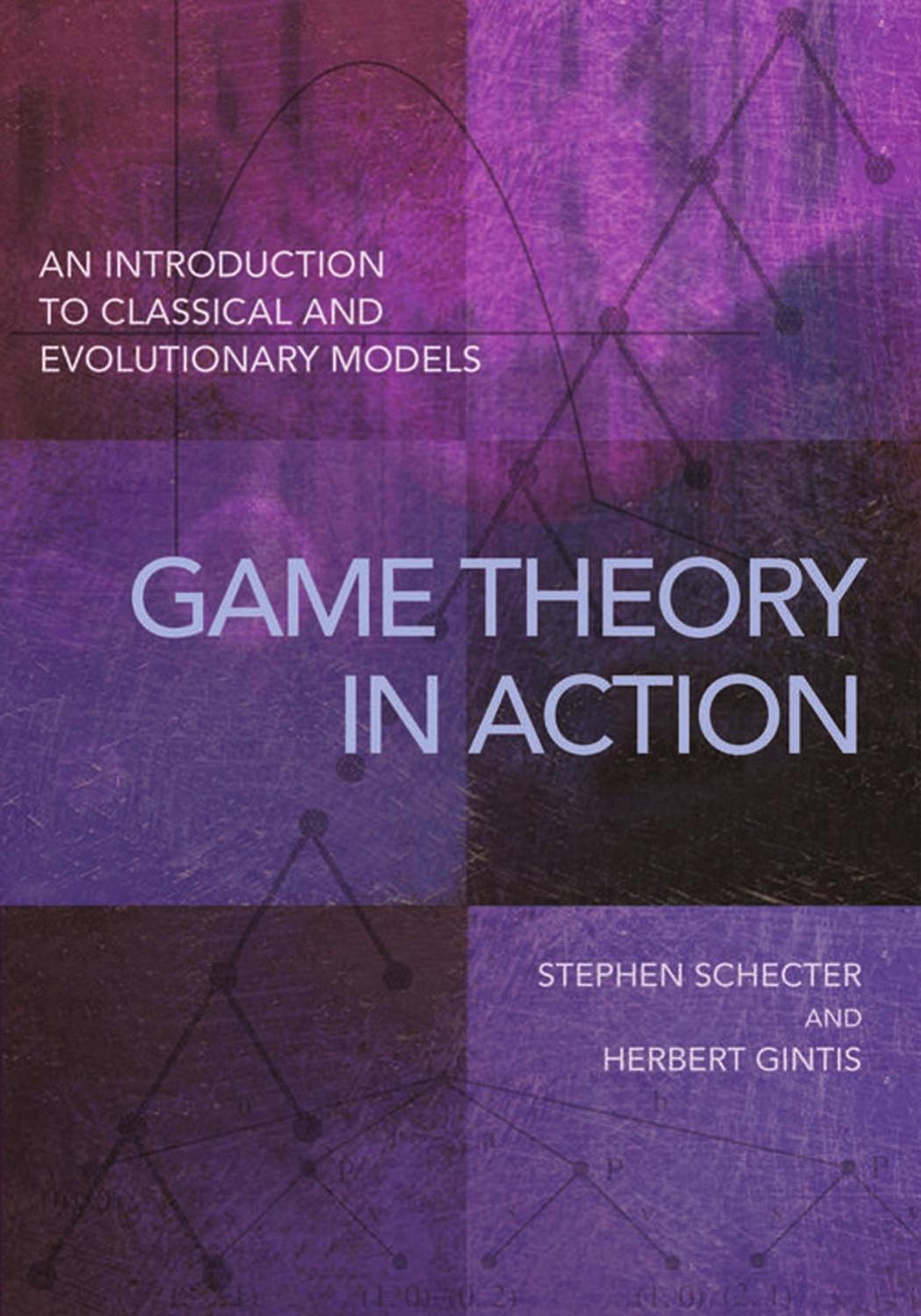
Game Theory in Action An Introduction to Classical and Evolutionary Models 1st ediiton by Stephen Schecter, Herbert Gintis ISBN 0691167656 978-0691167657
Original price was: $70.00.$35.00Current price is: $35.00.
Instant download Game Theory in Action An Introduction to Classical and Evolutionary Models Stephen Schecter Herbert Gintis after payment
Game Theory in Action An Introduction to Classical and Evolutionary Models 1st ediiton by Stephen Schecter, Herbert Gintis – Ebook PDF Instant Download/Delivery: 0691167656, 978-0691167657
Full download Game Theory in Action An Introduction to Classical and Evolutionary Models 1st edition after payment
Product details:
ISBN 10: 0691167656
ISBN 13: 978-0691167657
Author: Stephen Schecter, Herbert Gintis
Game Theory in Action is a textbook about using game theory across a range of real-life scenarios. From traffic accidents to the sex lives of lizards, Stephen Schecter and Herbert Gintis show students how game theory can be applied in diverse areas including animal behavior, political science, and economics.
The book’s examples and problems look at such fascinating topics as crime-control strategies, climate-change negotiations, and the power of the Oracle at Delphi. The text includes a substantial treatment of evolutionary game theory, where strategies are not chosen through rational analysis, but emerge by virtue of being successful. This is the side of game theory that is most relevant to biology; it also helps to explain how human societies evolve.
Game Theory in Action An Introduction to Classical and Evolutionary Models 1st Table of contents:
Chapter 1. Backward induction
1.1 Tony’s Accident
1.2 Games in extensive form with complete information
1.3 Strategies
1.4 Backward induction
1.5 Big Monkey and Little Monkey 1
1.6 Threats, promises, commitments
1.7 Ultimatum Game
1.8 Rosenthal’s Centipede Game
1.9 Continuous games
1.10 Stackelberg’s model of duopoly 1
1.11 Stackelberg’s model of duopoly 2
1.12 Backward induction for finite horizon games
1.13 Critique of backward induction
1.14 Problems
Chapter 2. Eliminating dominated strategies
2.1 Prisoner’s Dilemma
2.2 Games in normal form
2.3 Dominated strategies
2.4 Israelis and Palestinians
2.5 Global Warming
2.6 Hagar’s Battles
2.7 Second-price auctions
2.8 Iterated elimination of dominated strategies
2.9 The Battle of the Bismarck Sea
2.10 Normal form of a game in extensive form with complete information
2.11 Big Monkey and Little Monkey 2
2.12 Backward induction
2.13 Critique of elimination of dominated strategies
2.14 Problems
Chapter 3. Nash equilibria
3.1 Big Monkey and Little Monkey 3 and the definition of Nash equilibria
3.2 Finding Nash equilibria by inspection: Important examples
3.3 Water Pollution 1
3.4 Arguing over Marbles
3.5 Tobacco Market
3.6 Iterated elimination of dominated strategies
3.7 Big Monkey and Little Monkey 4
3.8 Finding Nash equilibria using best response
3.9 Big Monkey and Little Monkey 5
3.10 Water Pollution 2
3.11 Cournot’s model of duopoly
3.12 Problems
Chapter 4. Games in extensive form with incomplete information
4.1 Utility functions and lotteries
4.2 Buying Fire Insurance
4.3 Games in extensive form with incomplete information
4.4 Buying a Used Car
4.5 The Travails of Boss Gorilla 1
4.6 Cuban Missile Crisis
4.7 Problems
Chapter 5. Mixed strategy Nash equilibria
5.1 Mixed strategy Nash equilibria
5.2 Tennis
5.3 Other ways to find mixed strategy Nash equilibria
5.4 One-card Two-round Poker
5.5 Two-player zero-sum games
5.6 The Ultimatum Minigame
5.7 Colonel Blotto vs. the People’s Militia
5.8 Water Pollution 3
5.9 Equivalent games
5.10 Software for computing Nash equilibria
5.11 Critique of Nash equilibrium
5.12 Problems
Chapter 6. More about games in extensive form with complete information
6.1 Subgame perfect Nash equilibria
6.2 Big Monkey and Little Monkey 6
6.3 Subgame perfect equilibria and backward induction
6.4 Duels and Truels
6.5 The Rubinstein bargaining model
6.6 Discount factor and repeated games
6.7 The Wine Merchant and the Connoisseur
6.8 The Folk Theorem
6.9 Maximum value of a function
6.10 The Samaritan’s Dilemma
6.11 The Rotten Kid Theorem
6.12 Problems
Chapter 7. Symmetries of games
7.1 Interchangeable players
7.2 Reporting a Crime
7.3 Sex Ratio 1
7.4 Other symmetries of games
7.5 Problems
Chapter 8. Alternatives to the Nash equilibrium
8.1 Correlated equilibrium
8.2 Epistemic game theory
8.3 Evolutionary stability
8.4 Evolutionary stability with two pure strategies
8.5 Sex Ratio 2
8.6 Problems
Chapter 9. Differential equations
9.1 Differential equations and scientific laws
9.2 The phase line
9.3 Vector fields
9.4 Functions and differential equations
9.5 Linear differential equations
9.6 Linearization
Chapter 10. Evolutionary dynamics
10.1 Replicator system
10.2 Microsoft vs. Apple
10.3 Evolutionary dynamics with two pure strategies
10.4 Hawks and Doves revisited
10.5 Side-blotched Lizards
10.6 Equilibria of the replicator system
10.7 Cooperators, Defectors, and Tit-for-Tatters
10.8 Dominated strategies and the replicator system
10.9 Asymmetric evolutionary games
10.10 Big Monkey and Little Monkey 7
10.11 Hawks and Doves with Unequal Value
10.12 The Ultimatum Minigame revisited
10.13 Problems
People also search for Game Theory in Action An Introduction to Classical and Evolutionary Models 1st :
game theory summary
game theory in action
game theory introduction
game theory an introduction pdf
game theory an introduction
Tags: Stephen Schecter, Herbert Gintis, Game Theory, Evolutionary Models