


Maths A Student’s Survival Guide 2nd edition by Jenny Olive – Ebook PDF Instant Download/Delivery: 0521017076 , 978-0521017077
Full download Maths A Student’s Survival Guide 2nd edition after payment
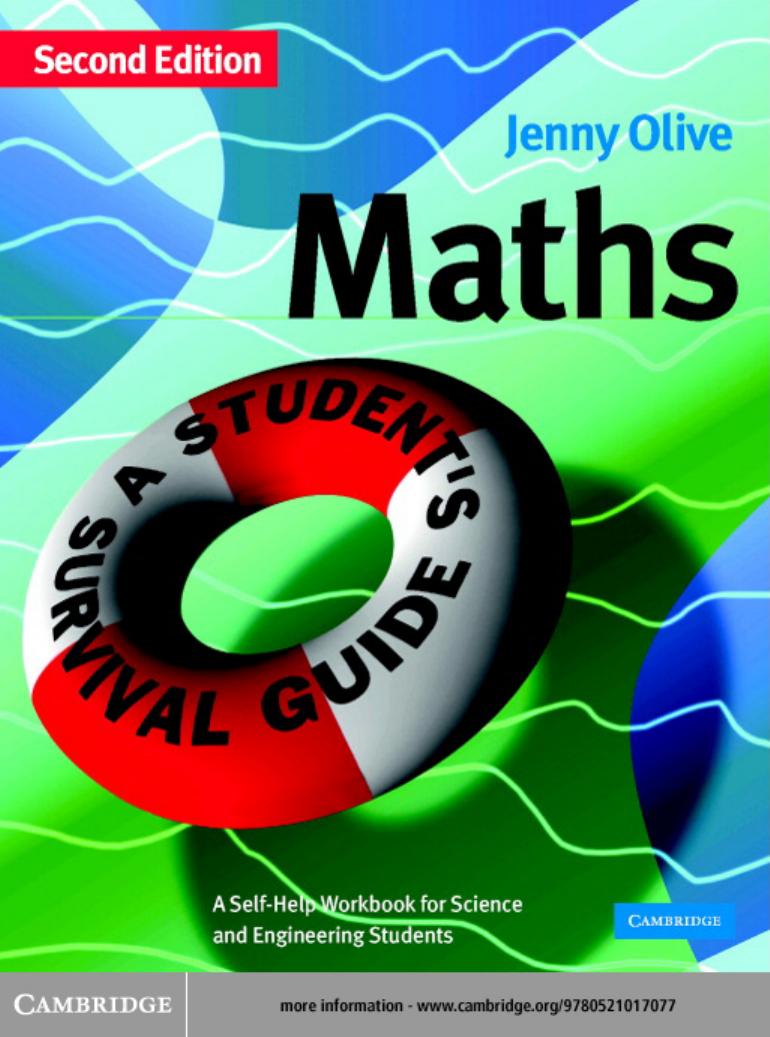
Product details:
ISBN 10: 0521017076
ISBN 13: 978-0521017077
Author: Jenny Olive
The second edition of this highly successful textbook has been completely revised and now includes a new chapter on vectors. Mathematics is the basis of all science and engineering degrees, and a source of difficulty for some students. Jenny Olive helps resolve this problem by presenting the core mathematics needed by students starting science or engineering courses in user-friendly comprehensible terms. First Edition Hb (1998): 0-521-57306-8 First Edition Pb (1998): 0-521-57586-9
Maths A Student’s Survival Guide 2nd Table of contents:
1 Basic algebra: some reminders of how it works
1.A Handling unknown quantities
1.A.(a) Where do you start? Self-test 1
1.A.(b) A mind-reading explained
1.A.(c) Some basic rules
1.A.(d) Working out in the right order
1.A.(e) Using negative numbers
1.A.(f ) Putting into brackets, or factorising
1.B Multiplications and factorising: the next stage
1.B.(a) Self-test 2
1.B.(b) Multiplying out two brackets
1.B.(c) More factorisation: putting things back into brackets
1.C Using fractions
1.C.(a) Equivalent fractions and cancelling down
1.C.(b) Tidying up more complicated fractions
1.C.(c) Adding fractions in arithmetic and algebra
1.C.(d) Repeated factors in adding fractions
1.C.(e) Subtracting fractions
1.C.(f) Multiplying fractions
1.C.(g) Dividing fractions
1.D The three rules for working with powers
1.D.(a) Handling powers which are whole numbers
1.D.(b) Some special cases
1.E The different kinds of numbers
1.E.(a) The counting numbers and zero
1.E.(b) Including negative numbers: the set of integers
1.E.(c) Including fractions: the set of rational numbers
1.E.(d) Including everything on the number line: the set of real numbers
1.E.(e) Complex numbers: a very brief forwards look
1.F Working with different kinds of number: some examples
1.F.(a) Other number bases: the binary system
1.F.(b) Prime numbers and factors
1.F.(c) A useful application – simplifying square roots
1.F.(d) Simplifying fractions with…signs underneath
2 Graphs and equations
2.A Solving simple equations
2.A.(a) Do you need help with this? Self-test 3
2.A.(b) Rules for solving simple equations
2.A.(c) Solving equations involving fractions
2.A.(d) A practical application – rearranging formulas to fit different situations
2.B Introducing graphs
2.B.(a) Self-test 4
2.B.(b) A reminder on plotting graphs
2.B.(c) The midpoint of the straight line joining two points
2.B.(d) Steepness or gradient
2.B.(e) Sketching straight lines
2.B.(f) Finding equations of straight lines
2.B.(g) The distance between two points
2.B.(h) The relation between the gradients of two perpendicular lines
2.B.(i) Dividing a straight line in a given ratio
2.C Relating equations to graphs: simultaneous equations
2.C.(a) What do simultaneous equations mean?
2.C.(b) Methods of solving simultaneous equations
2.D Quadratic equations and the graphs which show them
2.D.(a) What do the graphs which show quadratic equations look like?
2.D.(b) The method of completing the square
2.D.(c) Sketching the curves which give quadratic equations
2.D.(d) The ‘formula’ for quadratic equations
2.D.(e) Special properties of the roots of quadratic equations
2.D.(f) Getting useful information from ‘b2 – 4ac’
2.D.(g) A practical example of using quadratic equations
2.D.(h) All equations are equal – but are some more equal than others?
2.E Further equations – the Remainder and Factor Theorems
2.E.(a) Cubic expressions and equations
2.E.(b) Doing long division in algebra
2.E.(c) Avoiding long division – the Remainder and Factor Theorems
2.E.(d) Three examples of using these theorems, and a red herring
3 Relations and functions
3.A Two special kinds of relationship
3.A.(a) Direct proportion
3.A.(b) Some physical examples of direct proportion
3.A.(c) More exotic examples
3.A.(d) Partial direct proportion – lines not through the origin
3.A.(e) Inverse proportion
3.A.(f) Some examples of mixed variation
3.B An introduction to functions
3.B.(a) What are functions? Some relationships examined
3.B.(b) y = f(x) – a useful new shorthand
3.B.(c) When is a relationship a function?
3.B.(d) Stretching and shifting – new functions from old
3.B.(e) Two practical examples of shifting and stretching
3.B.(f) Finding functions of functions
3.B.(g) Can we go back the other way? Inverse functions
3.B.(h) Finding inverses of more complicated functions
3.B.(i) Sketching the particular case of f(x ) = (x + 3)/(x – 2), and its inverse
3.B.(j) Odd and even functions
3.C Exponential and log functions
3.C.(a) Exponential functions – describing population growth
3.C.(b) The inverse of a growth function: log functions
3.C.(c) Finding the logs of some particular numbers
3.C.(d) The three laws or rules for logs
3.C.(e) What are ‘e’ and ‘exp’? A brief introduction
3.C.(f) Negative exponential functions – describing population decay
3.D Unveiling secrets – logs and linear forms
3.D.(a) Relationships of the form y = axn
3.D.(b) Relationships of the form y = anx
3.D.(c) What can we do if logs are no help?
4 Some trigonometry and geometry of triangles and circles
4.A Trigonometry in right-angled triangles
4.A.(a) Why use trig ratios?
4.A.(b) Pythagoras’ Theorem
4.A.(c) General properties of triangles
4.A.(d) Triangles with particular shapes
4.A.(e) Congruent triangles – what are they, and when?
4.A.(f) Matching ratios given by parallel lines
4.A.(g) Special cases – the sin, cos and tan of 30°, 45° and 60°
4.A.(h) Special relations of sin, cos and tan
4.B Widening the field in trigonometry
4.B.(a) The Sine Rule for any triangle
4.B.(b) Another area formula for triangles
4.B.(c) The Cosine Rule for any triangle
4.C Circles
4.C.(a) The parts of a circle
4.C.(b) Special properties of chords and tangents of circles
4.C.(c) Special properties of angles in circles
4.C.(d) Finding and working with the equations which give circles
4.C.(e) Circles and straight lines – the different possibilities
4.C.(f) Finding the equations of tangents to circles
4.D Using radians
4.D.(a) Measuring angles in radians
4.D.(b) Finding the perimeter and the area of a sector of a circle
4.D.(c) Finding the area of a segment of a circle
4.D.(d) What do we do if the angle is given in degrees?
4.D.(e) Very small angles in radians – why we like them
4.E Tidying up – some thinking points returned to
4.E.(a) The sum of interior and exterior angles of polygons
4.E.(b) Can we draw circles round all triangles and quadrilaterals?
5 Extending trigonometry to angles of any size
5.A Giving meaning to trig functions of any size of angle
5.A.(a) Extending sin and cos
5.A.(b) The graph of y = tan x from 0° to 90°
5.A.(c) Defining the sin, cos and tan of angles of any size
5.A.(d) How does X move as P moves round its circle?
5.A.(e) The graph of tan Theta for any value of Theta
5.A.(f) Can we find the angle from its sine?
5.A.(g) sin-1 x and cos-1 x: what are they?
5.A.(h) What do the graphs of sin-1 x and cos-1 x look like?
5.A.(i) Defining the function tan x
5.B The trig reciprocal functions
5.B.(a) What are trig reciprocal functions?
5.B.(b) The trig reciprocal identities: tan2 Theta + 1 = sec2 Theta and cot2 Theta + 1 = cosec2 Thet
5.B.(c) Some examples of proving other trig identities
5.B.(d) What do the graphs of the trig reciprocal functions look like?
5.B.(e) Drawing other reciprocal graphs
5.C Building more trig functions from the simplest ones
5.C.(a) Stretching, shifting and shrinking trig functions
5.C.(b) Relating trig functions to how P moves round its circle and SHM
5.C.(c) New shapes from putting together trig functions
5.C.(d) Putting together trig functions with different periods
5.D Finding rules for combining trig functions
5.D.(a) How else can we write sin(A + B)?
5.D.(b) A summary of results for similar combinations
5.D.(c) Finding tan (A + B) and tan (A – B)
5.D.(d) The rules for sin 2A, cos 2A and tan 2A
5.D.(e) How could we find a formula for sin 3A?
5.D.(f) Using sin(A + B) to find another way of writing 4 sin t + 3 cos t
5.D.(g) More examples of the R sin (t ± Alpha) and R cos (t ± Alpha) forms
5.D.(h) Going back the other way – the Factor Formulas
5.E Solving trig equations
5.E.(a) Laying some useful foundations
5.E.(b) Finding solutions for equations in cos x
5.E.(c) Finding solutions for equations in tan x
5.E.(d) Finding solutions for equations in sin x
5.E.(e) Solving equations using R sin (x + Alpha) etc
6 Sequences and series
6.A Patterns and formulas
6.A.(a) Finding patterns in sequences of numbers
6.A.(b) How to describe number patterns mathematically
6.B Arithmetic progressions (APs)
6.B.(a) What are arithmetic progressions?
6.B.(b) Finding a rule for summing APs
6.B.(c) The arithmetic mean or ‘average’
6.B.(d) Solving a typical problem
6.B.(e) A summary of the results for APs
6.C Geometric progressions (GPs)
6.C.(a) What are geometric progressions?
6.C.(b) Summing geometric progressions
6.C.(c) The sum to infinity of a GP
6.C.(d) What do ‘convergent’ and ‘divergent’ mean?
6.C.(e) More examples using GPs; chain letters
6.C.(f) A summary of the results for GPs
6.C.(g) Recurring decimals, and writing them as fractions
6.C.(h) Compound interest: a faster way of getting rich
6.C.(i) The geometric mean
6.C.(j) Comparing arithmetic and geometric means
6.C.(k) What is the fate of the frog down the well?
6.D A compact way of writing sums: the Sigma notation
6.D.(a) What does Sigma stand for?
6.D.(b) Unpacking the Sigmas
6.D.(c) Summing by breaking down to simpler series
6.E Partial fractions
6.E.(a) Introducing partial fractions for summing series
6.E.(b) General rules for using partial fractions
6.E.(c) The cover-up rule
6.E.(d) Coping with possible complications
6.F The fate of the frog down the well
7 Binomial series and proof by induction
7.A Binomial series for positive whole numbers
7.A.(a) Looking for the patterns
7.A.(b) Permutations or arrangements
7.A.(c) Combinations or selections
7.A.(d) How selections give binomial expansions
7.A.(e) Writing down rules for binomial expansions
7.A.(f) Linking Pascal’s Triangle to selections
7.A.(g) Some more binomial examples
7.B Some applications of binomial series and selections
7.B.(a) Tossing coins and throwing dice
7.B.(b) What do the probabilities we have found mean?
7.B.(c) When is a game fair? (Or are you fair game?)
7.B.(d) Lotteries: winning the jackpot…or not
7.C Binomial expansions when n is not a positive whole number
7.C.(a) Can we expand (1 + x)n if n is negative or a fraction? If so, when?
7.C.(b) Working out some expansions
7.C.(c) Dealing with slightly different situations
7.D Mathematical induction
7.D.(a) Truth from patterns – or false mirages?
7.D.(b) Proving the Binomial Theorem by induction
7.D.(c) Two non-series applications of induction
8 Differentiation
8.A Some problems answered and difficulties solved
8.A.(a) How can we find a speed from knowing the distance travelled?
8.A.(b) How does y = xn change as x changes?
8.A.(c) Different ways of writing differentiation…
8.A.(d) Some special cases of y = axn
8.A.(e) Differentiating x = cos t answers another thinking point
8.A.(f) Can we always differentiate? If not, why not?
8.B Natural growth and decay – the number et
8.B.(a) Even more money – compound interest and exponential growth
8.B.(b) What is the equation of this smooth growth curve?
8.B.(c) Getting numerical results from the natural growth law of x = et
8.B.(d) Relating ln x to the log of x using other bases
8.B.(e) What do we get if we differentiate ln t?
8.C Differentiating more complicated functions
8.C.(a) The Chain Rule
8.C.(b) Writing the Chain Rule as…
8.C.(c) Differentiating functions with angles in degrees or logs to base 10
8.C.(d) The Product Rule, or ‘uv’ Rule
8.C.(e) The Quotient Rule or ‘u/v’ Rule
8.D The hyperbolic functions of sinh x and cosh x
8.D.(a) Getting symmetries from ex and e-x
8.D.(b) Differentiating sinh x and cosh x
8.D.(c) Using sinh x and cosh x to get other hyperbolic functions
8.D.(d) Comparing other hyperbolic and trig formulas – Osborn’s Rule
8.D.(e) Finding the inverse function for sinh x
8.D.(f) Can we find an inverse function for cosh x?
8.D.(g) tanh x and its inverse function tanh-1 x
8.D.(h) What’s in a name? Why ‘hyperbolic’ functions?
8.D.(i) Differentiating inverse trig and hyperbolic functions
8.E Some uses for differentiation
8.E.(a) Finding the equations of tangents to particular curves
8.E.(b) Finding turning points and points of inflection
8.E.(c) General rules for sketching curves
8.E.(d) Some practical uses of turning points
8.E.(e) A clever use for tangents – the Newton–Raphson Rule
8.F Implicit differentiation
8.F.(a) How implicit differentiation works, using circles as examples
8.F.(b) Using implicit differentiation with more complicated relationships
8.F.(c) Differentiating inverse functions implicitly
8.F.(d) Differentiating exponential functions like x = 2t
8.F.(e) A practical application of implicit differentiation
8.G Writing functions in an alternative form using series
9 Integration
9.A Doing the opposite of differentiating
9.A.(a) What could this tell us?
9.A.(b) A physical interpretation of this process
9.A.(c) Finding the area under a curve
9.A.(d) What happens if the area we are finding is below the horizontal axis?
9.A.(e) What happens if we change the order of the limits?
9.A. (f) What is…
9.B Techniques of integration
9.B.(a) Making use of what we already know
9.B.(b) Integration by substitution
9.B.(c) A selection of trig integrals with some hyperbolic cousins
9.B.(d) Integrals which use inverse trig and hyperbolic functions
9.B.(e) Using partial fractions in integration
9.B.(f) Integration by parts
9.B.(g) Finding rules for doing integrals like…
9.B.(h) Using the t = tan (x/2) substitution
9.C Solving some more differential equations
9.C.(a) Solving equations where we can split up the variables
9.C.(b) Putting flesh on the bones – some practical uses for differential equations
9.C.(c) A forwards look at some other kinds of differential equation, including ones which describe
10 Complex numbers
10.A A new sort of number
10.A.(a) Finding the missing roots
10.A.(b) Finding roots for all quadratic equations
10.A.(c) Modulus and argument (or mod and arg for short)
10.B Doing arithmetic with complex numbers
10.B.(a) Addition and subtraction
10.B.(b) Multiplication of complex numbers
10.B.(c) Dividing complex numbers in mod/arg form
10.B.(d) What are complex conjugates?
10.B.(e) Using complex conjugates to simplify fractions
10.C How e connects with complex numbers
10.C.(a) Two for the price of one – equating real and imaginary parts
10.C.(b) How does e get involved?
10.C.(c) What is the geometrical meaning of z = e?
10.C.(d) What is e and what does it do geometrically?
10.C.(e) A summary of the sin/cos and sinh/cosh links
10.C.(f) De Moivre’s Theorem
10.C.(g) Another example: writing cos 5Theta in terms of cos Theta
10.C.(h) More examples of writing trig functions in different forms
10.C.(i) Solving a differential equation which describes SHM
10.C.(j) A first look at how we can use complex numbers to describe electric circuits
10.D Using complex numbers to solve more equations
10.D.(a) Finding the n roots of zn = a + bj
10.D.(b) Solving quadratic equations with complex coefficients
10.D.(c) Solving cubic and quartic equations with complex roots
10.E Finding where z can be if it must fit particular rules
10.E.(a) Some simple examples of paths or regions where z must lie
10.E.(b) What do we do if z has been shifted?
10.E.(c) Using algebra to find where z can be
10.E.(d) Another example involving a relationship between w and z
11 Working with vectors
11.A Basic rules for handling vectors
11.A.(a) What are vectors?
11.A.(b) Adding vectors and what this can mean physically
11.A.(c) Using components to describe vectors
11.A.(d) Vector components in three-dimensional space
11.A.(e) Finding the magnitude of a three-dimensional vector
11.A.(f) Finding unit vectors
11.B Multiplying vectors
11.B.(a) Defining the scalar or dot product of two vectors
11.B.(b) Working out the dot product of two vectors
11.B.(c) Defining the vector or cross product of two vectors
11.B.(d) Working out the cross product of two vectors
11.B.(e) Can we multiply three vectors together by using dot or cross products?
11.B.(f) The vector triple product
11.B.(g) The scalar triple product and what it means geometrically
11.C Finding equations for lines and planes
11.C.(a) Finding a vector equation for a line
11.C.(b) Dealing with lines in two dimensions
11.C.(c) Dealing with lines in three dimensions
11.C.(d) Finding the Cartesian equation of a line in three dimensions
11.C.(e) Another form for the vector equation of a line
11.C.(f) Finding vector equations for planes
11.C.(g) Finding equations of planes using normal vectors
11.C.(h) Finding the perpendicular distance from the origin to a plane
11.C.(i) The Cartesian form of the equation of a plane
11.C.(j) Finding where a line intersects a plane
11.C.(k) Finding the line of intersection of two planes
11.D Finding angles and distances involving lines and planes
11.D.(a) Finding the angle between two lines
11.D.(b) Finding the angle between two planes
11.D.(c) Finding the acute angle between a line and a plane
11.D.(d) Finding the shortest distance from a point to a line
11.D.(e) Finding the shortest distance from a point to a plane
11.D.(f) Finding the shortest distance between two skew lines
People also search for Maths A Student’s Survival Guide 2nd :
maths a student’s survival guide by jenny olive
survival guide for math
math survival game
a mathematician’s survival guide
survival math games
Tags: Jenny Olive, Student’s Survival