

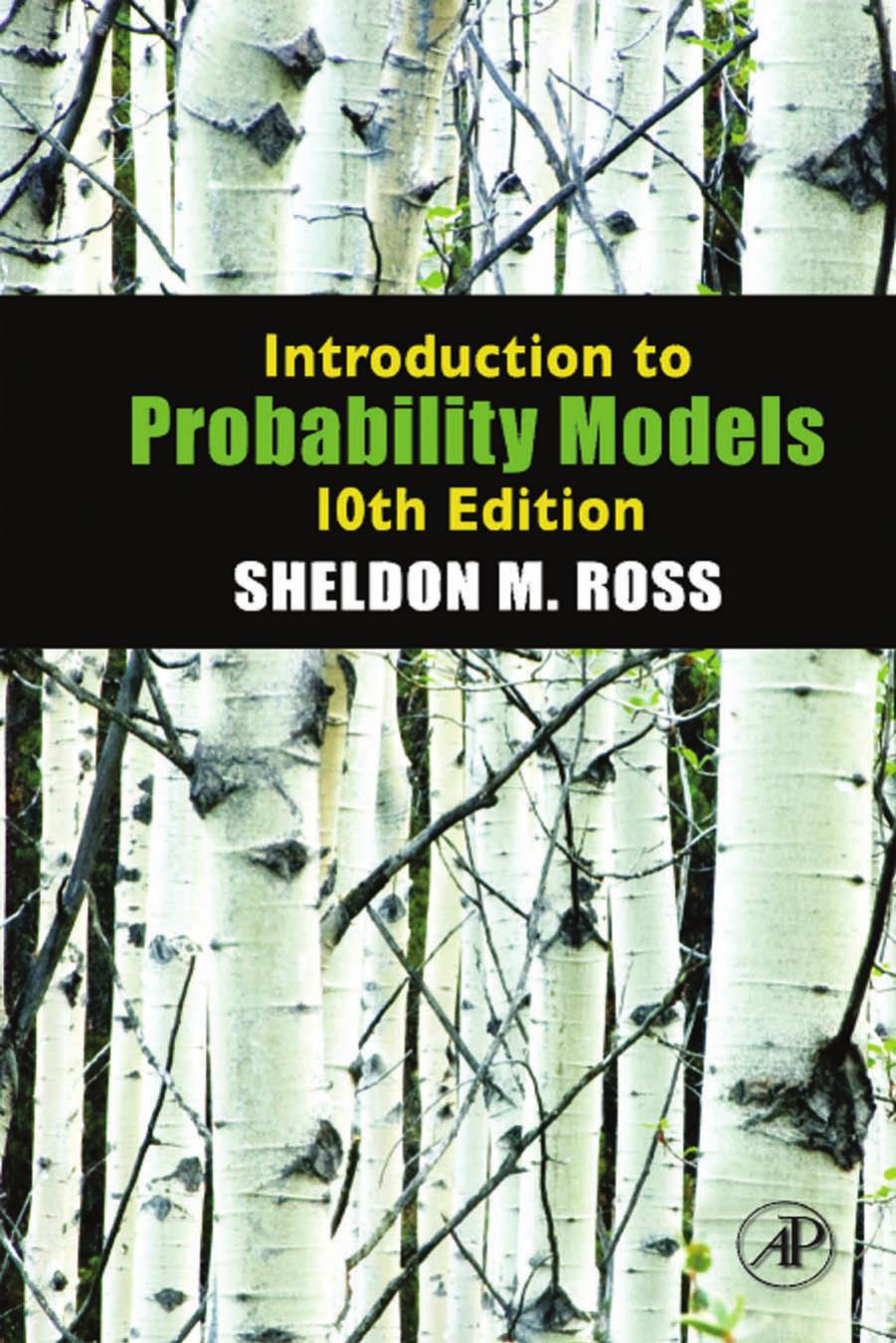
Introduction to Probability Models 10th Edition by Sheldon Ross – Ebook PDF Instant Download/Delivery: 0123756863 , 978-0123756862
Full download Introduction to Probability Models 10th edition after payment
Product details:
ISBN 10: 0123756863
ISBN 13: 978-0123756862
Author: Sheldon Ross
Introduction to Probability Models, Tenth Edition, provides an introduction to elementary probability theory and stochastic processes. There are two approaches to the study of probability theory.
One is heuristic and nonrigorous, and attempts to develop in students an intuitive feel for the subject that enables him or her to think probabilistically. The other approach attempts a rigorous development of probability by using the tools of measure theory. The first approach is employed in this text.
The book begins by introducing basic concepts of probability theory, such as the random variable, conditional probability, and conditional expectation. This is followed by discussions of stochastic processes, including Markov chains and Poison processes. The remaining chapters cover queuing, reliability theory, Brownian motion, and simulation. Many examples are worked out throughout the text, along with exercises to be solved by students.
This book will be particularly useful to those interested in learning how probability theory can be applied to the study of phenomena in fields such as engineering, computer science, management science, the physical and social sciences, and operations research. Ideally, this text would be used in a one-year course in probability models, or a one-semester course in introductory probability theory or a course in elementary stochastic processes.
Introduction to Probability Models 10th Table of contents:
CHAPTER 1. Introduction to Probability Theory
1.1 Introduction
1.2 Sample Space and Events
1.3 Probabilities Defined on Events
1.4 Conditional Probabilities
1.5 Independent Events
1.6 Bayes′ Formula
Exercises
References
CHAPTER 2. Random Variables
2.1 Random Variables
2.2 Discrete Random Variables
2.2.2 The Binomial Random Variable
2.4 Expectation of a Random Variable
2.9 Stochastic process
Exercises
References
CHAPTER 3. Conditional Probability and Conditional Expectation
3.1 Introduction
3.2 The Discrete Case
3.3 The Continuous Case
3.4 Computing Expectations by Conditioning
3.5 Computing Probabilities by Conditioning
3.6 Some Applications
3.7 An Identity for Compound Random Variables
Exercises
CHAPTER 4. Markov Chains
4.1 Introduction
4.2 Chapman-Kolmogorov Equations
4.3 Classification of States
4.4 Limiting Probabilities
4.5 Some Applications
4.6 Mean Time Spent in Transient States
4.7 Branching Processes
4.8 Time Reversible Markov Chains
4.9 Markov Chain Monte Carlo Methods
4.10 Markov Decision Processes
4.11 Hidden Markov Chains
Exercises
References
CHAPTER 5. The Exponential Distribution and the Poisson Process
5.1 Introduction
5.2 The Exponential Distribution
5.3 The Poisson Process
Example 5.18 (An Infinite Server Queue)
Example 5.19 (Minimizing the Number of Encounters)
5.3. Proof of Proposition
5.4 Generalizations of the Poisson Process
Exercises
References
CHAPTER 6. Continuous-Time Markov Chains
6.1 Introduction
6.2 Continuous-Time Markov Chains
6.3 Birth and Death Processes
6.6 Time Reversibility
6.7 Uniformization
6.8 Computing the Transition Probabilities
Exercises
References
CHAPTER 7. Renewal Theory and Its Applications
7.1 Introduction
7.2 Distribution of N(t)
7.3 Limit Theorems and Their Applications
7.4 Renewal Reward Processes
7.5 Regenerative Processes
7.6 Semi−Markov Processes
7.7 The Inspection Paradox
7.8 Computing the Renewal Function
7.9 Applications to Patterns
7.10 The Insurance Ruin Problem
Exercises
References
CHAPTER 8. Queueing Theory
8.1 Introduction
8.2 Preliminaries
8.3 Exponential Models
8.4 Network of Queues
8.5 The System M/G/1
8.6 Variations on the M/G/1
8.7 The Model G/M/1
8.8 A Finite Source Model
8.9 Multiserver Queues
References
CHAPTER 9. Reliability Theory
9.1 Introduction
9.2 Structure Functions
9.3 Reliability of Systems of Independent Components
9.4 Bounds on the Reliability Function
9.5 System Life as a Function of Component Lives
9.6 Expected System Lifetime
9.7 Systems with Repair
Exercises
References
CHAPTER 10. Brownian Motion and Stationary Processes
10.1 Brownian Motion
10.2 Hitting Times, Maximum Variable, and the Gambler’s Ruin Problem
10.3 Variations on Brownian Motion
10.4 Pricing Stock Options
10.5 White Noise
10.6 Gaussian Processes
10.7 Stationary and Weakly Stationary Processes
10.8 Harmonic Analysis of Weakly Stationary Processes
Exercises
References
CHAPTER 11. Simulation
11.1 Introduction
11.2 General Techniques for Simulating Continuous Random Variables
11.3 Special Techniques for Simulating Continuous Random Variables
11.4 Simulating from Discrete Distributions
11.5 Stochastic Processes
11.6 Variance Reduction Techniques
11.7 Determining the Number of Runs
11.8 Generating from the Stationary Distribution of a Markov Chain
People also search for Introduction to Probability Models 10th :
ross introduction to probability models
sm ross introduction to probability models
introduction to probability models 11th edition
introduction to probability models pdf
introduction to probability models 12th edition pdf
Tags: Sheldon Ross, Probability Models