

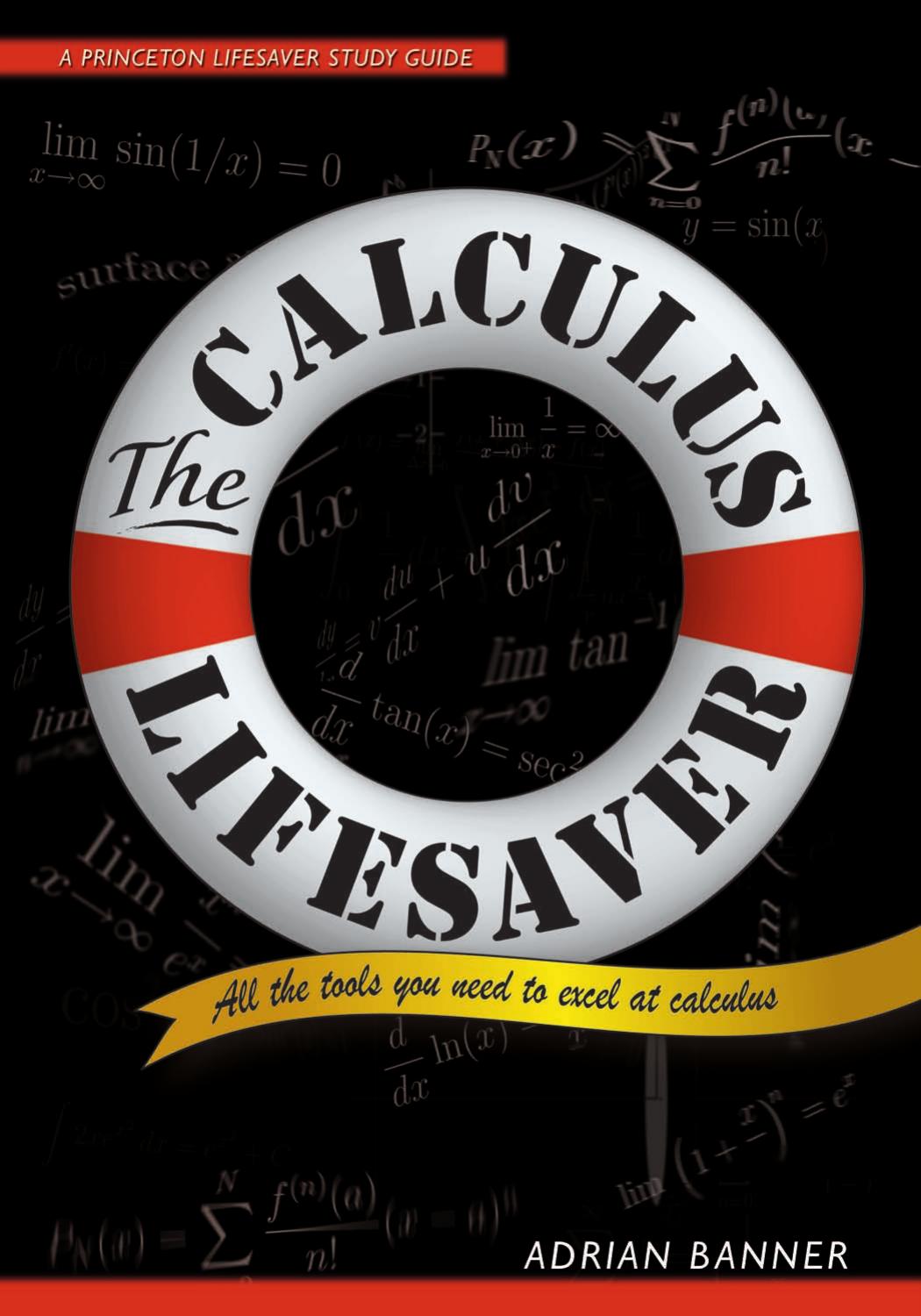
The Calculus Lifesaver All the Tools You Need to Excel at Calculus 1st edition by Adrrian Banner ISBN 140083578X 9781400835782
Original price was: $70.00.$35.00Current price is: $35.00.
Instant download Calculus Lifesaver All the Tools You Need to Excel at Calculus (Princeton Lifesaver Study Guides) 1st The after payment
The Calculus Lifesaver All the Tools You Need to Excel at Calculus 1st edition by Adrrian Banner – Ebook PDF Instant Download/Delivery: 140083578X, 9781400835782
Full download The Calculus Lifesaver All the Tools You Need to Excel at Calculus 1st edition after payment
Product details:
ISBN 10: 140083578X
ISBN 13: 9781400835782
Author: Adrrian Banner
For many students, calculus can be the most mystifying and frustrating course they will ever take. The Calculus Lifesaver provides students with the essential tools they need not only to learn calculus, but to excel at it. All of the material in this user-friendly study guide has been proven to get results. The book arose from Adrian Banner’s popular calculus review course at Princeton University, which he developed especially for students who are motivated to earn A’s but get only average grades on exams. The complete course will be available for free on the Web in a series of videotaped lectures. This study guide works as a supplement to any single-variable calculus course or textbook. Coupled with a selection of exercises, the book can also be used as a textbook in its own right. The style is informal, non-intimidating, and even entertaining, without sacrificing comprehensiveness. The author elaborates standard course material with scores of detailed examples that treat the reader to an “inner monologue”–the train of thought students should be following in order to solve the problem–providing the necessary reasoning as well as the solution. The book’s emphasis is on building problem-solving skills. Examples range from easy to difficult and illustrate the in-depth presentation of theory. The Calculus Lifesaver combines ease of use and readability with the depth of content and mathematical rigor of the best calculus textbooks. It is an indispensable volume for any student seeking to master calculus. Serves as a companion to any single-variable calculus textbook Informal, entertaining, and not intimidating Informative videos that follow the book–a full forty-eight hours of Banner’s Princeton calculus-review course–is available at Adrian Banner lectures More than 475 examples (ranging from easy to hard) provide step-by-step reasoning Theorems and methods justified and connections made to actual practice Difficult topics such as improper integrals and infinite series covered in detail Tried and tested by students taking freshman calculus
The Calculus Lifesaver All the Tools You Need to Excel at Calculus 1st Table of contents:
1 Functions, Graphs, and Lines
1.1 Functions
1.1.1 Interval notation
1.1.2 Finding the domain
1.1.3 Finding the range using the graph
1.1.4 The vertical line test
1.2 Inverse Functions
1.2.1 The horizontal line test
1.2.2 Finding the inverse
1.2.3 Restricting the domain
1.2.4 Inverses of inverse functions
1.3 Composition of Functions
1.4 Odd and Even Functions
1.5 Graphs of Linear Functions
1.6 Common Functions and Graphs
2 Review of Trigonometry
2.1 The Basics
2.2 Extending the Domain of Trig Functions
2.2.1 The ASTC method
2.2.2 Trig functions outside [0; 2]
2.3 The Graphs of Trig Functions
2.4 Trig Identities
3 Introduction to Limits
3.1 Limits: The Basic Idea
3.2 Left-Hand and Right-Hand Limits
3.3 When the Limit Does Not Exist
3.4 Limits at 1 and 1
3.4.1 Large numbers and small numbers
3.5 Two Common Misconceptions about Asymptotes
3.6 The Sandwich Principle
3.7 Summary of Basic Types of Limits
4 How to Solve Limit Problems Involving Polynomials
4.1 Limits Involving Rational Functions as x ! a
4.2 Limits Involving Square Roots as x ! a
4.3 Limits Involving Rational Functions as x ! 1
4.3.1 Method and examples
4.4 Limits Involving Poly-type Functions as x ! 1
4.5 Limits Involving Rational Functions as x ! 1
4.6 Limits Involving Absolute Values
5 Continuity and Dierentiability
5.1 Continuity
5.1.1 Continuity at a point
5.1.2 Continuity on an interval
5.1.3 Examples of continuous functions
5.1.4 The Intermediate Value Theorem
5.1.5 A harder IVT example
5.1.6 Maxima and minima of continuous functions
5.2 Dierentiability
5.2.1 Average speed
5.2.2 Displacement and velocity
5.2.3 Instantaneous velocity
5.2.4 The graphical interpretation of velocity
5.2.5 Tangent lines
5.2.6 The derivative function
5.2.7 The derivative as a limiting ratio
5.2.8 The derivative of linear functions
5.2.9 Second and higher-order derivatives
5.2.10 When the derivative does not exist
5.2.11 Dierentiability and continuity
6 How to Solve Dierentiation Problems
6.1 Finding Derivatives Using the Denition
6.2 Finding Derivatives (the Nice Way)
6.2.1 Constant multiples of functions
6.2.2 Sums and dierences of functions
6.2.3 Products of functions via the product rule
6.2.4 Quotients of functions via the quotient rule
6.2.5 Composition of functions via the chain rule
6.2.6 A nasty example
6.2.7 Justication of the product rule and the chain rule
6.3 Finding the Equation of a Tangent Line
6.4 Velocity and Acceleration
6.4.1 Constant negative acceleration
6.5 Limits Which Are Derivatives in Disguise
6.6 Derivatives of Piecewise-Dened Functions
6.7 Sketching Derivative Graphs Directly
7 Trig Limits and Derivatives
7.1 Limits Involving Trig Functions
7.1.1 The small case
7.1.2 Solving problems|the small case
7.1.3 The large case
7.1.4 The other” case
7.1.5 Proof of an important limit
7.2 Derivatives Involving Trig Functions
7.2.1 Examples of dierentiating trig functions
7.2.2 Simple harmonic motion
7.2.3 A curious function
8 Implicit Dierentiation and Related Rates
8.1 Implicit Dierentiation
8.1.1 Techniques and examples
8.1.2 Finding the second derivative implicitly
8.2 Related Rates
8.2.1 A simple example
8.2.2 A slightly harder example
8.2.3 A much harder example
8.2.4 A really hard example
9 Exponentials and Logarithms
9.1 The Basics
9.1.1 Review of exponentials
9.1.2 Review of logarithms
9.1.3 Logarithms, exponentials, and inverses
9.1.4 Log rules
9.2 Denition of e
9.2.1 A question about compound interest
9.2.2 The answer to our question
9.2.3 More about e and logs
9.3 Dierentiation of Logs and Exponentials
9.3.1 Examples of dierentiating exponentials and logs
9.4 How to Solve Limit Problems Involving Exponentials or Logs
9.4.1 Limits involving the denition of e
9.4.2 Behavior of exponentials near 0
9.4.3 Behavior of logarithms near 1
9.4.4 Behavior of exponentials near 1 or 1
9.4.5 Behavior of logs near 1
9.4.6 Behavior of logs near 0
9.5 Logarithmic Dierentiation
9.5.1 The derivative of xa
9.6 Exponential Growth and Decay
9.6.1 Exponential growth
9.6.2 Exponential decay
9.7 Hyperbolic Functions
10 Inverse Functions and Inverse Trig Functions
10.1 The Derivative and Inverse Functions
10.1.1 Using the derivative to show that an inverse exists
10.1.2 Derivatives and inverse functions: what can go wrong
10.1.3 Finding the derivative of an inverse function
10.1.4 A big example
10.2 Inverse Trig Functions
10.2.1 Inverse sine
10.2.2 Inverse cosine
10.2.3 Inverse tangent
10.2.4 Inverse secant
10.2.5 Inverse cosecant and inverse cotangent
10.2.6 Computing inverse trig functions
10.3 Inverse Hyperbolic Functions
10.3.1 The rest of the inverse hyperbolic functions
11 The Derivative and Graphs
11.1 Extrema of Functions
11.1.1 Global and local extrema
11.1.2 The Extreme Value Theorem
11.1.3 How to nd global maxima and minima
11.2 Rolle’s Theorem
11.3 The Mean Value Theorem
11.3.1 Consequences of the Mean Value Theorem
11.4 The Second Derivative and Graphs
11.4.1 More about points of in ection
11.5 Classifying Points Where the Derivative Vanishes
11.5.1 Using the rst derivative
11.5.2 Using the second derivative
12 Sketching Graphs
12.1 How to Construct a Table of Signs
12.1.1 Making a table of signs for the derivative
12.1.2 Making a table of signs for the second derivative
12.2 The Big Method
12.3 Examples
12.3.1 An example without using derivatives
12.3.2 The full method: example 1
12.3.3 The full method: example 2
12.3.4 The full method: example 3
12.3.5 The full method: example 4
13 Optimization and Linearization
13.1 Optimization
13.1.1 An easy optimization example
13.1.2 Optimization problems: the general method
13.1.3 An optimization example
13.1.4 Another optimization example
13.1.5 Using implicit dierentiation in optimization
13.1.6 A dicult optimization example
13.2 Linearization
13.2.1 Linearization in general
13.2.2 The dierential
13.2.3 Linearization summary and examples
13.2.4 The error in our approximation
13.3 Newton’s Method
14 L’H^opital’s Rule and Overview of Limits
14.1 L’H^opital’s Rule
14.1.1 Type A: 0/0 case
14.1.2 Type A: 1=1 case
14.1.3 Type B1 (11)
14.1.4 Type B2 (0 1)
14.1.5 Type C (11, 00, or 10)
14.1.6 Summary of l’H^opital’s Rule types
14.2 Overview of Limits
15 Introduction to Integration
15.1 Sigma Notation
15.1.1 A nice sum
15.1.2 Telescoping series
15.2 Displacement and Area
15.2.1 Three simple cases
15.2.2 A more general journey
15.2.3 Signed area
15.2.4 Continuous velocity
15.2.5 Two special approximations
16 Denite Integrals
16.1 The Basic Idea
16.1.1 Some easy examples
16.2 Denition of the Denite Integral
16.2.1 An example of using the denition
16.3 Properties of Denite Integrals
16.4 Finding Areas
16.4.1 Finding the unsigned area
16.4.2 Finding the area between two curves
16.4.3 Finding the area between a curve and the y-axis
16.5 Estimating Integrals
16.5.1 A simple type of estimation
16.6 Averages and the Mean Value Theorem for Integrals
16.6.1 The Mean Value Theorem for integrals
16.7 A Nonintegrable Function
17 The Fundamental Theorems of Calculus
17.1 Functions Based on Integrals of Other Functions
17.2 The First Fundamental Theorem
17.2.1 Introduction to antiderivatives
17.3 The Second Fundamental Theorem
17.4 Indenite Integrals
17.5 How to Solve Problems: The First Fundamental Theorem
17.5.1 Variation 1: variable left-hand limit of integration
17.5.2 Variation 2: one tricky limit of integration
17.5.3 Variation 3: two tricky limits of integration
17.5.4 Variation 4: limit is a derivative in disguise
17.6 How to Solve Problems: The Second Fundamental Theorem
17.6.1 Finding indenite integrals
17.6.2 Finding denite integrals
17.6.3 Unsigned areas and absolute values
17.7 A Technical Point
17.8 Proof of the First Fundamental Theorem
18 Techniques of Integration, Part One
18.1 Substitution
18.1.1 Substitution and denite integrals
18.1.2 How to decide what to substitute
18.1.3 Theoretical justication of the substitution method
18.2 Integration by Parts
18.2.1 Some variations
18.3 Partial Fractions
18.3.1 The algebra of partial fractions
18.3.2 Integrating the pieces
18.3.3 The method and a big example
19 Techniques of Integration, Part Two
19.1 Integrals Involving Trig Identities
19.2 Integrals Involving Powers of Trig Functions
19.2.1 Powers of sin and/or cos
19.2.2 Powers of tan
19.2.3 Powers of sec
19.2.4 Powers of cot
19.2.5 Powers of csc
19.2.6 Reduction formulas
19.3 Integrals Involving Trig Substitutions
19.3.1 Type 1: p a2 x2
19.3.2 Type 2: p x2 + a2
19.3.3 Type 3: p x2 a2
19.3.4 Completing the square and trig substitutions
19.3.5 Summary of trig substitutions
19.3.6 Technicalities of square roots and trig substitutions
19.4 Overview of Techniques of Integration
20 Improper Integrals: Basic Concepts
20.1 Convergence and Divergence
20.1.1 Some examples of improper integrals
20.1.2 Other blow-up points
20.2 Integrals over Unbounded Regions
20.3 The Comparison Test (Theory)
20.4 The Limit Comparison Test (Theory)
20.4.1 Functions asymptotic to each other
20.4.2 The statement of the test
20.5 The p-test (Theory)
20.6 The Absolute Convergence Test
21 Improper Integrals: How to Solve Problems
21.1 How to Get Started
21.1.1 Splitting up the integral
21.1.2 How to deal with negative function values
21.2 Summary of Integral Tests
21.3 Behavior of Common Functions near 1 and 1
21.3.1 Polynomials and poly-type functions near 1 and 1
21.3.2 Trig functions near 1 and 1
21.3.3 Exponentials near 1 and 1
21.3.4 Logarithms near 1
21.4 Behavior of Common Functions near 0
21.4.1 Polynomials and poly-type functions near 0
21.4.2 Trig functions near 0
21.4.3 Exponentials near 0
21.4.4 Logarithms near 0
21.4.5 The behavior of more general functions near 0
21.5 How to Deal with Problem Spots Not at 0 or 1
22 Sequences and Series: Basic Concepts
22.1 Convergence and Divergence of Sequences
22.1.1 The connection between sequences and functions
22.1.2 Two important sequences
22.2 Convergence and Divergence of Series
22.2.1 Geometric series (theory)
22.3 The nth Term Test (Theory)
22.4 Properties of Both Innite Series and Improper Integrals
22.4.1 The comparison test (theory)
22.4.2 The limit comparison test (theory)
22.4.3 The p-test (theory)
22.4.4 The absolute convergence test
22.5 New Tests for Series
22.5.1 The ratio test (theory)
22.5.2 The root test (theory)
22.5.3 The integral test (theory)
22.5.4 The alternating series test (theory)
23 How to Solve Series Problems
23.1 How to Evaluate Geometric Series
23.2 How to Use the nth Term Test
23.3 How to Use the Ratio Test
23.4 How to Use the Root Test
23.5 How to Use the Integral Test
23.6 Comparison Test, Limit Comparison Test, and p-test
23.7 How to Deal with Series with Negative Terms
24 Taylor Polynomials, Taylor Series, and Power Series
24.1 Approximations and Taylor Polynomials
24.1.1 Linearization revisited
24.1.2 Quadratic approximations
24.1.3 Higher-degree approximations
24.1.4 Taylor’s Theorem
24.2 Power Series and Taylor Series
24.2.1 Power series in general
24.2.2 Taylor series and Maclaurin series
24.2.3 Convergence of Taylor series
24.3 A Useful Limit
25 How to Solve Estimation Problems
25.1 Summary of Taylor Polynomials and Series
25.2 Finding Taylor Polynomials and Series
25.3 Estimation Problems Using the Error Term
25.3.1 First example
25.3.2 Second example
25.3.3 Third example
25.3.4 Fourth example
25.3.5 Fifth example
25.3.6 General techniques for estimating the error term
25.4 Another Technique for Estimating the Error
26 Taylor and Power Series: How to Solve Problems
26.1 Convergence of Power Series
26.1.1 Radius of convergence
26.1.2 How to nd the radius and region of convergence
26.2 Getting New Taylor Series from Old Ones
26.2.1 Substitution and Taylor series
26.2.2 Dierentiating Taylor series
26.2.3 Integrating Taylor series
26.2.4 Adding and subtracting Taylor series
26.2.5 Multiplying Taylor series
26.2.6 Dividing Taylor series
26.3 Using Power and Taylor Series to Find Derivatives
26.4 Using Maclaurin Series to Find Limits
27 Parametric Equations and Polar Coordinates
27.1 Parametric Equations
27.1.1 Derivatives of parametric equations
27.2 Polar Coordinates
27.2.1 Converting to and from polar coordinates
27.2.2 Sketching curves in polar coordinates
27.2.3 Finding tangents to polar curves
27.2.4 Finding areas enclosed by polar curves
28 Complex Numbers
28.1 The Basics
28.1.1 Complex exponentials
28.2 The Complex Plane
28.2.1 Converting to and from polar form
28.3 Taking Large Powers of Complex Numbers
28.4 Solving zn = w
28.4.1 Some variations
28.5 Solving ez = w
28.6 Some Trigonometric Series
28.7 Euler’s Identity and Power Series
29 Volumes, Arc Lengths, and Surface Areas
29.1 Volumes of Solids of Revolution
29.1.1 The disc method
29.1.2 The shell method
29.1.3 Summary
29.1.4 Variation 1: regions between a curve and the y-axis
29.1.5 Variation 2: regions between two curves
29.1.6 Variation 3: axes parallel to the coordinate axes
29.2 Volumes of General Solids
29.3 Arc Lengths
29.3.1 Parametrization and speed
29.4 Surface Areas of Solids of Revolution
30 Dierential Equations
30.1 Introduction to Dierential Equations
30.2 Separable First-order Dierential Equations
30.3 First-order Linear Equations
30.3.1 Why the integrating factor works
30.4 Constant-coecient Dierential Equations
30.4.1 Solving rst-order homogeneous equations
30.4.2 Solving second-order homogeneous equations
30.4.3 Why the characteristic quadratic method works
30.4.4 Nonhomogeneous equations and particular solutions
30.4.5 Finding a particular solution
30.4.6 Examples of nding particular solutions
30.4.7 Resolving con icts between yP and yH
30.4.8 Initial value problems (constant-coecient linear)
30.5 Modeling Using Dierential Equations
Appendix A Limits and Proofs
A.1 Formal Denition of a Limit
A.1.1 A little game
A.1.2 The actual denition
A.1.3 Examples of using the denition
A.2 Making New Limits from Old Ones
A.2.1 Sums and dierences of limits|proofs
A.2.2 Products of limits|proof
A.2.3 Quotients of limits|proof
A.2.4 The sandwich principle|proof
A.3 Other Varieties of Limits
A.3.1 Innite limits
A.3.2 Left-hand and right-hand limits
A.3.3 Limits at 1 and 1
A.3.4 Two examples involving trig
A.4 Continuity and Limits
A.4.1 Composition of continuous functions
A.4.2 Proof of the Intermediate Value Theorem
A.4.3 Proof of the Max-Min Theorem
A.5 Exponentials and Logarithms Revisited
A.6 Dierentiation and Limits
A.6.1 Constant multiples of functions
A.6.2 Sums and dierences of functions
A.6.3 Proof of the product rule
A.6.4 Proof of the quotient rule
A.6.5 Proof of the chain rule
A.6.6 Proof of the Extreme Value Theorem
A.6.7 Proof of Rolle’s Theorem
A.6.8 Proof of the Mean Value Theorem
A.6.9 The error in linearization
A.6.10 Derivatives of piecewise-dened functions
A.6.11 Proof of l’H^opital’s Rule
A.7 Proof of the Taylor Approximation Theorem
Appendix B Estimating Integrals
B.1 Estimating Integrals Using Strips
B.1.1 Evenly spaced partitions
B.2 The Trapezoidal Rule
B.3 Simpson’s Rule
B.3.1 Proof of Simpson’s rule
B.4 The Error in Our Approximations
B.4.1 Examples of estimating the error
B.4.2 Proof of an error term inequality
List of Symbols
Index
People also search The Calculus Lifesaver All the Tools You Need to Excel at Calculus 1st :
the calculus lifesaver
the calculus lifesaver reddit
the calculus lifesaver by adrian banner
calculus lifesaver videos
calculus for the life sciences answers
calculus lifesaver
Tags: Adrrian Banner, The Calculus, You Need