


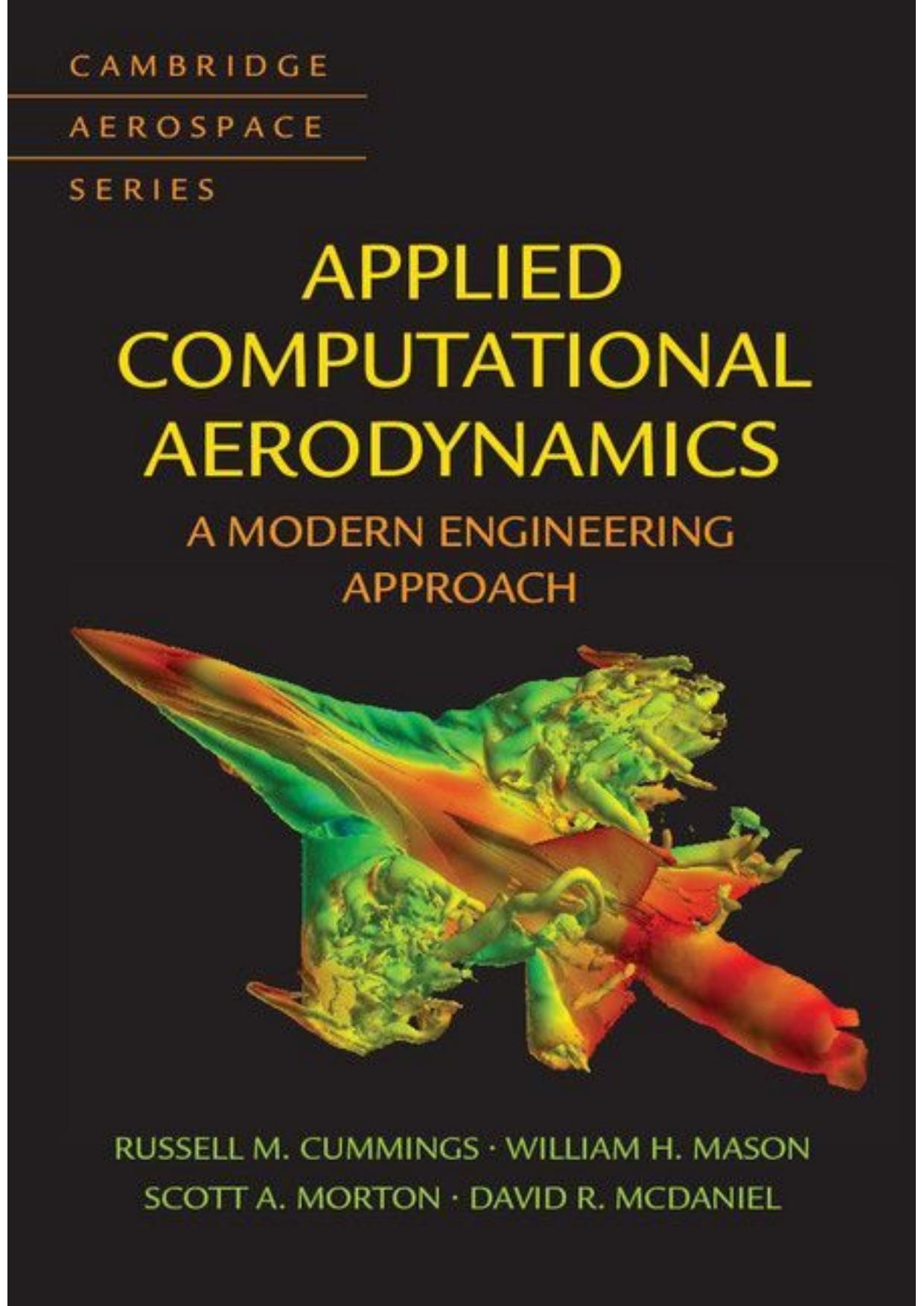
Applied Computational Aerodynamics A Modern Engineering Approach 1st edition by Russell Cummings, William Mason, Scott Morton, David McDaniel ISBN 1316234622 9781316234624
Original price was: $70.00.$35.00Current price is: $35.00.
Instant download Applied Computational Aerodynamics A Modern Engineering Approammings & William H. Mason & Scott A. Morton & David R. McDaniel after payment
Applied Computational Aerodynamics A Modern Engineering Approach 1st edition by Russell Cummings, William Mason, Scott Morton, David McDaniel – Ebook PDF Instant Download/Delivery: 1316234622, 9781316234624
Full download Applied Computational Aerodynamics A Modern Engineering Approach 1st edition after payment
Product details:
ISBN 10: 1316234622
ISBN 13: 9781316234624
Author: Russell Cummings, William Mason, Scott Morton, David McDaniel
This computational aerodynamics textbook is written at the undergraduate level, based on years of teaching focused on developing the engineering skills required to become an intelligent user of aerodynamic codes. This is done by taking advantage of CA codes that are now available and doing projects to learn the basic numerical and aerodynamic concepts required. This book includes a number of unique features to make studying computational aerodynamics more enjoyable. These include: • The computer programs used in the book’s projects are all open source and accessible to students and practicing engineers alike on the book’s website, www.cambridge.org/aerodynamics. The site includes access to images, movies, programs, and more • The computational aerodynamics concepts are given relevance by CA Concept Boxes integrated into the chapters to provide realistic asides to the concepts • Readers can see fluids in motion with the Flow Visualization Boxes carefully integrated into the text.
Applied Computational Aerodynamics A Modern Engineering Approach 1st Table of contents:
1. Introduction to Computational Aerodynamics
1.1 Introduction
1.2 The Goals of Computational Aerodynamics
1.3 The Intelligent User
1.4 A Bit of Computational Aerodynamics History
1.5 What Can Computational Aerodynamics Do Today and Tomorrow?
1.5.1 Commercial Aircraft Applications
1.5.2 Military Aircraft Applications
1.6 Integration of CA and Experiments
1.7 Design, Analysis, and Multidisciplinary Optimization
1.8 The Computational Aerodynamics Process
1.8.1 Geometry Modeling
1.8.2 Grid Generation
1.8.3 Flow Solution
1.8.4 Post Processing
1.8.5 Code Validation
1.9 Computational Aerodynamics Users and Errors
1.10 Scope, Purpose, and Outline of the Book
1.11 Project
1.12 References
2. Computers, Codes, and Engineering
2.1 Introduction
2.2 From Engineering Methods to High-Performance Computing
2.2.1 Semi-Empirical Methods
2.2.2 Linear Potential Flow Methods
2.2.3 CFD Methods
2.2.4 When Should You Use a Given Method?
2.3 Computing Systems
2.3.1 Why CA Requires Large Computers
2.3.2 CA Historical Development
2.3.3 Computer Measures of Merit
2.3.4 Parallel Computer Scalability
2.4 Computer Codes: Verification, Validation, and Certification
2.5 Some Comments on Programming
2.6 Elements of a Solution
2.7 Projects
2.8 References
3. Getting Ready for Computational Aerodynamics: Fluid Mechanics Foundations
3.1 Introduction
3.2 Governing Equations of Fluid Mechanics
3.3 Derivation of Governing Equations
3.3.1 Conservation of Mass: The Continuity Equation
3.3.2 Conservation of Momentum and the Substantial Derivative
3.3.2.1 Substantial Derivative
3.3.2.2 Forces
3.3.3 The Energy Equation
3.4 Solution of the Set of Governing Equations
3.5 Standard Forms and Terminology of Governing Equations
3.5.1 Nondimensionalization
3.5.2 Use of Divergence Form
3.5.3 The “Standard” or “Vector” Form of the Equations
3.6 Boundary Conditions, Initial Conditions, and the Mathematics Classification of Partial Differential Equations (PDEs)
3.6.1 Hyperbolic Type
3.6.2 Parabolic Type
3.6.3 Elliptic Type
3.6.4 Equations of Mixed Type
3.6.5 Elaboration on Characteristics
3.7 Hyperbolic PDEs
3.8 Parabolic PDEs
3.9 Elliptic PDEs
3.10 Boundary Conditions
3.11 Using and Simplifying These Equations: High- to Low-Fidelity Flowfield Models
3.12 Inviscid Flow Models
3.12.1 Potential Flow
3.12.2 Small Disturbance Expansion of the Full Potential and Energy Equation
3.12.3 Transonic Small Disturbance Equation
3.12.4 Prandtl-Glauert Equation
3.12.5 Incompressible Irrotational Flow: Laplace’s Equation
3.13 Viscous Flow Models
3.13.1 Thin-Layer Navier-Stokes Equations
3.13.2 Parabolized Navier-Stokes Equations
3.13.3 Boundary-Layer Equations
3.14 Examples of Zones of Application
3.15 Requirements for a Complete Problem Formulation
3.16 Exercises
3.17 References
4. Getting Ready for Computational Aerodynamics: Aerodynamic Concepts
4.1 Introduction
4.2 Review of Potential Flow Theory
4.2.1 Vorticity
4.2.2 Simplified Equations of Motion
4.3 Potential Flow Applications
4.3.1 Flow Over a Circular Cylinder
4.3.2 Flow Over a Circular Cylinder with Circulation
4.4 Applications to Airfoils
4.4.1 Conformal Mapping
4.4.2 Singularity Distribution Approaches
4.4.3 Kutta Condition
4.5 Boundary Layers and Viscous Effects
4.5.1 Boundary Layer Concepts
4.5.1.1 Laminar Boundary Layers
4.5.1.2 Turbulent Boundary Layers
4.5.1.3 Relative Features of Boundary Layers
4.5.2 Skin Friction Estimation
4.6 Airfoil Aerodynamics
4.6.1 Airfoil Terminology
4.6.2 Forces and Moments on an Airfoil
4.6.3 Airfoil Aerodynamic Coefficients
4.6.4 Airfoil Lift and Drag Variations
4.6.5 NACA Airfoil Families
4.6.6 How to Use NACA Airfoil Data
4.6.7 Factors That Affect Airfoil Aerodynamics
4.6.7.1 Reynolds Number
4.6.7.2 Camber
4.6.7.3 Thickness
4.6.8 How Airfoils Work
4.6.9 Thin Airfoil Theory
4.7 Wing Aerodynamics
4.7.1 Wing Terminology
4.7.2 Wing Aerodynamic Coefficients
4.7.3 The Vortex Filament
4.7.4 Prandtl’s Lifting Line Theory
4.7.5 Subsonic Compressibility Effects
4.8 Transonic Aerodynamics
4.8.1 Transonic Theories
4.8.2 Supercritical Airfoils
4.8.3 Korn Airfoil Equation
4.8.4 Wing Sweep
4.8.5 Korn Wing Equation
4.9 Supersonic Aerodynamics
4.9.1 Supersonic Linear Theory and Airfoil Aerodynamics
4.9.2 Volumetric Wave Drag
4.9.3 Wing Aerodynamics
4.10 Hypersonic Aerodynamics
4.10.1 Importance of Temperature in Hypersonic Flow
4.10.2 Newtonian and Modified Newtonian Flow Theory
4.10.3 Aerodynamic Heating
4.10.4 Engine/Airframe Integration
4.11 Exercises
4.12 Projects
4.13 References
People also search for Applied Computational Aerodynamics A Modern Engineering Approach 1st :
applied computational mathematics jobs
applied force formula
applied computational aerodynamics a modern engineering approach
applied computational fluid dynamics and turbulence modeling
applied computing jobs
Tags: Russell Cummings, William Mason, Scott Morton, David McDaniel, Applied Computational, Engineering Approach