


Advanced Computational Fluid and Aerodynamics 1st edition by Paul Tucker – Ebook PDF Instant Download/Delivery: 1316666107 , 9781316666104
Full download Advanced Computational Fluid and Aerodynamics 1st edition after payment
Product details:
ISBN 10: 1316666107
ISBN 13: 9781316666104
Author: Paul Tucker
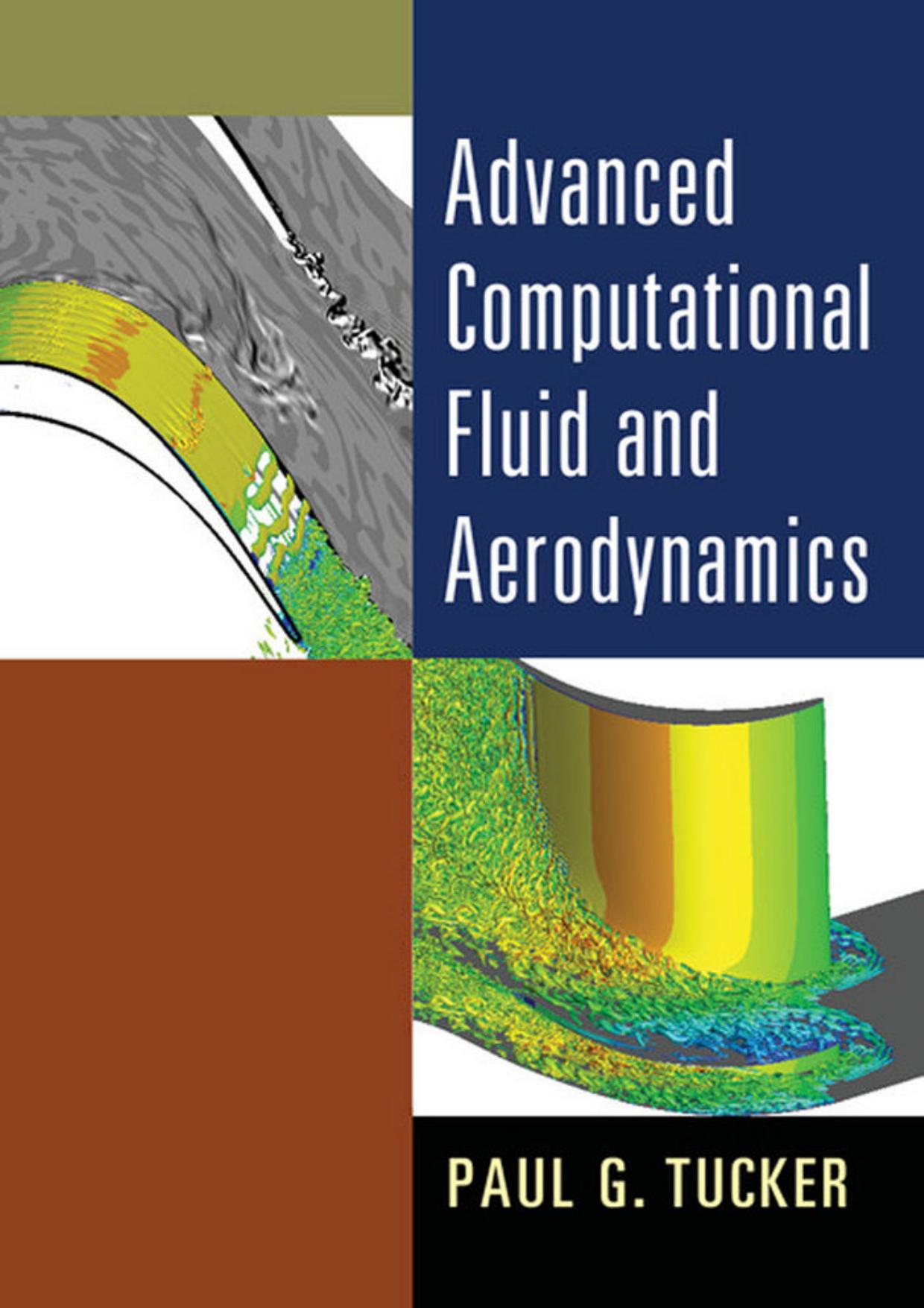
The advent of supercomputers has brought computational fluid dynamics (CFD) to the forefront as a tool to analyze increasingly complex simulation scenarios in many fields. Computational aerodynamics problems are also increasingly moving towards being coupled, multi-physics and multi-scale with complex, moving geometries. The latter presents severe geometry handling and meshing challenges. Simulations also frequently use formal design optimization processes. This book explains the evolution of CFD and provides a comprehensive overview of the plethora of tools and methods available for solving complex scenarios while exploring the future directions and possible outcomes. Using numerous examples, illustrations and computational methods the author discusses turbulence modeling, pre and post processing, coupled solutions, the importance of design optimization, multiphysics problems, reduced order models, and large scale computations and the future of CFD. Advanced Computational Fluid and Aerodynamics is suitable for audiences engaged in computational fluid dynamics including advanced undergraduates, researchers and industrial practitioners.
Advanced Computational Fluid and Aerodynamics 1st Table of contents:
Chapter 1: The Need and Methods for Studying Aerodynamics
1.1 Introduction
1.2 Computational Fluid Dynamics
1.3 Experimental Methods
1.4 Analytical Solutions
1.5 CFD in Aerospace
References
Chapter 2: Governing Equations
2.1 Introduction
2.2 Derivation of Navier-Stokes and Continuity Equations
2.2.1 Continuity Equation
2.2.2 Navier-Stokes Equations
2.2.2.1 Pressure Forces
2.2.2.2 Shear Forces
2.2.2.3 Normal Stresses
2.2.2.4 Modelling of Viscous Stresses
2.3 Forms of the Navier-Stokes Equations
2.3.1 Full Three-Dimensional Form of Equations
2.3.2 Concise Forms of Equations
2.3.2.1 Tensor Forms of Equations
2.3.2.2 Vector Form of Equations
2.3.3 Equations in Cylindrical Polar Coordinates
2.3.4 Curvilinear Form of Equations
2.3.5 Equations in a Rotating Frame of Reference
2.3.5.1 Reduced Pressures
2.4 Energy and Temperature Equations
2.5 Turbulent Flow Equations
2.6 Substantial Derivative and Convective Term Forms
2.6.1 The Substantial Derivative
2.6.2 Different Convective Term Forms
2.6.3 Strong Conservation Form of Equations
2.6.3.1 Stokes Equations
2.7 Real Gas Form of Equations
2.8 Reduced Forms of Navier-Stokes Equations
2.8.1 Axisymmetric Form of Equations
2.8.2 Orthogonal Form of Equations
2.8.3 Thin Shear Layer Form of Equations
2.8.4 The Boundary Layer Equations
2.8.5 Parabolised Equations
2.9 Further Reduced Equation Forms
2.9.1 Stream Function Vorticity Equation
2.9.2 Throughflow Equations
2.9.3 Dimensionless Form of Equations
2.9.4 Viscous Force Dominated Flows
2.9.5 Reynolds Equation
2.9.6 Other Forms of the Flow-Governing Equations
2.10 Equations in Solids
2.11 Auxiliary Equations
2.11.1 Boussinesq Approximation and Buoyancy
2.11.2 Thermodynamic Equations
2.11.3 Fluid Properties
2.11.3.1 Real Gases
2.11.3.2 Liquids
2.12 Source Terms
Problems
References
Chapter 3: Mesh Generation
3.1 Introduction
3.2 Mesh Types, Applicability and Solver Compatibility
3.2.1 Basic Mesh Types
3.2.2 Body Fitted Grid Types
3.2.3 Applicability of Different Mesh Types
3.2.4 Mesh-Solver Compatibility
3.3 Structured Mesh Generation Techniques
3.3.1 Basic Body Fitted Mesh Generation
3.3.1.1 Algebraic
3.3.1.2 Transfinite Interpolation
3.3.1.3 Differential Equation Mesh Generation
3.3.2 Multiblock Meshes
3.3.2.1 Medial Axis
3.3.2.2 TopMaker
3.3.2.3 Cartesian Fitting
3.3.3 Further Examples Showing Application of Automatic Blocking Approaches
3.3.4 Hybrid Blocking Approaches
3.4 Unstructured Mesh Generation Techniques
3.4.1 Grid Based Methods
3.4.2 Advancing Front Method
3.4.3 Delaunay Triangulation
3.4.4 Unstructured Quadrilateral/Hexahedral Meshes
3.4.4.1 ‘Hexing the Tet’
3.4.4.2 Octree Meshes
3.4.5 Hybridization
3.5 Mesh Control
3.5.1 Control of Near Wall Grid Distributions
3.5.2 Use of Sources
3.5.3 Use of Level Sets
3.5.3.1 Gradient Limiting Level Set Equation
3.5.4 Mesh Smoothing and Loss of Grid Control
3.5.4.1 Smoothing
3.5.4.2 Loss of Grid Control
3.6 Mesh Quality and Features
3.6.1 Impact of Cell Shape
3.6.2 Basic Mesh Features
3.6.3 Grid Generator Diagnostics and Quality
3.6.4 Some Basic Grid Error Estimates
3.6.4.1 Non-flow Aligned Grids
3.6.4.2 Grid Stretching
3.7 Grid Distributions in more Practical Flows
3.7.1 Leading and Trailing Edge Grid Distributions
3.7.2 Free Shear Layer Grid Distributions
3.8 High-Order Meshing
3.9 Meshing for Turbulence
3.9.1 RANS Meshes
3.9.2 Eddy Resolving Simulation Grids
3.9.2.1 LES Grids
3.9.2.2 Hybrid LES-RANS Grids
3.9.3 Use of Correlations and Preliminary RANS to Inform Grid Design
3.9.3.1 Taylor Microscale based LES Grid Design
3.10 Moving Meshes and Adaptation
3.10.1 Adaptation
3.10.1.1 Structured Grid, Flow Feature Based Adaptation
3.10.1.2 Structured Grid, Grid Feature Based Adaptation
3.10.1.3 Unstructured Grid Refinement and De-refinement
3.10.1.4 Mesh De-refinement and Multigrid Convergence Acceleration
3.10.2 Adjoint Analysis
3.10.3 Space-Time Meshes and Adaptation
3.10.4 Boundary Movement
3.10.4.1 Mesh Movement Algorithms
3.10.4.1.1 Algebraic Interpolations
3.10.4.1.2 Delaunay Mapping
3.10.4.1.3 Spring Analogy
3.10.4.1.4 Non-deforming Meshes that Account for Movement
3.10.4.2 Hybrid Mesh Movement Approach
3.11 Conclusions
Problems
References
Chapter 4: Numerical Methods
4.1 Introduction
Part A – Spatial Procedures
4.2 Finite Difference, Related Methods and Numerical Traits
4.2.1 Geometric Approach
4.2.2 Taylor Series Approach
4.2.2.1 Non-uniform Grid Second Order Centred Representation of ∂ϕ / ∂x
4.2.2.2 Second Order Backwards Difference (Non-uniform Grid)
4.2.3 Compact Schemes
4.2.4 Simple Finite Difference–Finite Volume Discretization
4.2.5 Body Fitted Grids
4.2.6 Numerical Considerations
4.2.6.1 Algorithm Consistency
4.2.6.2 The Modified Equation
4.2.6.3 Dissipation and Dispersion
4.2.6.4 Stability and Aliasing
4.2.6.5 Resolution of Schemes
4.3 Finite Volume Method
4.3.1 Advantages and Disadvantages of Differing Control Volumes
4.3.2 Control Volume Face Integration
4.3.3 Areas/Volumes
4.3.4 Viscous Flux Evaluation
4.4 Convective Flux Evaluation
4.4.1 Numerical Smoothing
4.4.1.1 Pseudo Laplacian
4.4.2 Modelling Shocks
4.4.3 Interpolation, its Limiting, Biasing and Control
4.4.3.1 Compressible Flow Procedures
4.4.3.2 Piecewise Reconstructions
4.4.3.3 Flux Limiters
4.4.3.4 Kinetic Energy Conservation
4.4.3.5 Smoothing Controls for Eddy Resolving Simulations
4.4.3.6 Going to High Order with Unstructured Grids
4.5 Alternative Discretization Methods
4.5.1 Lattice Boltzmann
4.5.2 Smooth Particle Hydrodynamics (SPH)
4.5.3 Vortex Methods
4.5.4 Boundary Element Method
4.5.4.1 Fundamental Solution
4.5.4.2 BEM Equations
Part B – Specialized Solution Procedures
4.6 Simultaneous Equation Solvers and Preconditioning
4.6.1 Diagonal Dominance
4.6.2 The Multigrid Algorithm
4.6.3 Coupling Enhancements and Coupled Solvers
4.6.4 Preconditioning
4.7 Evaluation of the Pressure Field
4.7.1 Velocity-Vorticity Approach
4.7.2 Artificial Compressibility Methods
4.7.3 SIMPLE Related Methods
4.7.3.1 Fractional Step Methods
4.7.4 Pressure/Velocity Coupling
4.7.4.1 Momentum Interpolation on Collocated Grids
4.8 Temporal Schemes
4.8.1 Two-Level Schemes
4.8.1.1 Implicit/Semi-Implicit
4.8.1.2 Linearization of Crank-Nicolson Equation
4.8.1.3 General Explicit Schemes
4.8.1.4 Stability and Accuracy
4.8.2 Higher-Level Schemes
4.8.2.1 Gear Schemes
4.8.3 Predictor-Corrector Methods
4.8.4 Splitting Methods
4.8.5 Adaptive Time-Steps
4.9 Boundary Conditions
4.10 Conclusions
Problems
References
Chapter 5: Turbulence
5.1 Introduction
5.1.1 The Basic Nature of Turbulence
5.1.1.1 The Energy Cascade
5.1.1.2 Forward Transition
5.1.1.3 Reverse Transition
5.1.1.4 Scale of Turbulent Vortices and Their Treatment
5.1.1.5 Turbulent Boundary Layers
5.2 Basic RANS Method
5.2.1 The Reynolds Equations
5.2.2 RANS Model Character
5.2.3 Zero Equation Models
5.2.3.1 The Mixing Length Turbulence Model
5.2.4 One-Equation Turbulence Models
5.2.4.1 Eddy Viscosity Transport Models
5.2.4.2 SA Model
5.2.4.3 Secundov v v t-92 model
5.2.4.4 Turbulence Kinetic Energy Transport Models
5.2.5 Two-Equation Turbulence Models
5.2.5.1 k-ε ɛ model
5.2.5.2 k-ω k – ω models
5.2.5.3 Other two-equation models
5.2.6 Non-linear Eddy Viscosity Models
5.2.6.1 Speziale Model
5.2.6.2 Cubic Model
5.2.6.3 Explicit Algebraic Stress Model
5.2.7 Reynolds Stress Model
5.2.7.1 Deficiencies of the Reynolds Stress Model
5.2.8 Scalar Transport
5.2.9 Summary of Reynolds-Averaged Navier-Stokes
Problems
References
People also search for Advanced Computational Fluid and Aerodynamics 1st :
computational fluid dynamics aerospace
computational fluid dynamics aircraft
computational aerodynamics
advanced computational fluid dynamics
computational aerodynamics jameson
Tags: Paul Tucker, Advanced Computational, Fluid and Aerodynamics