


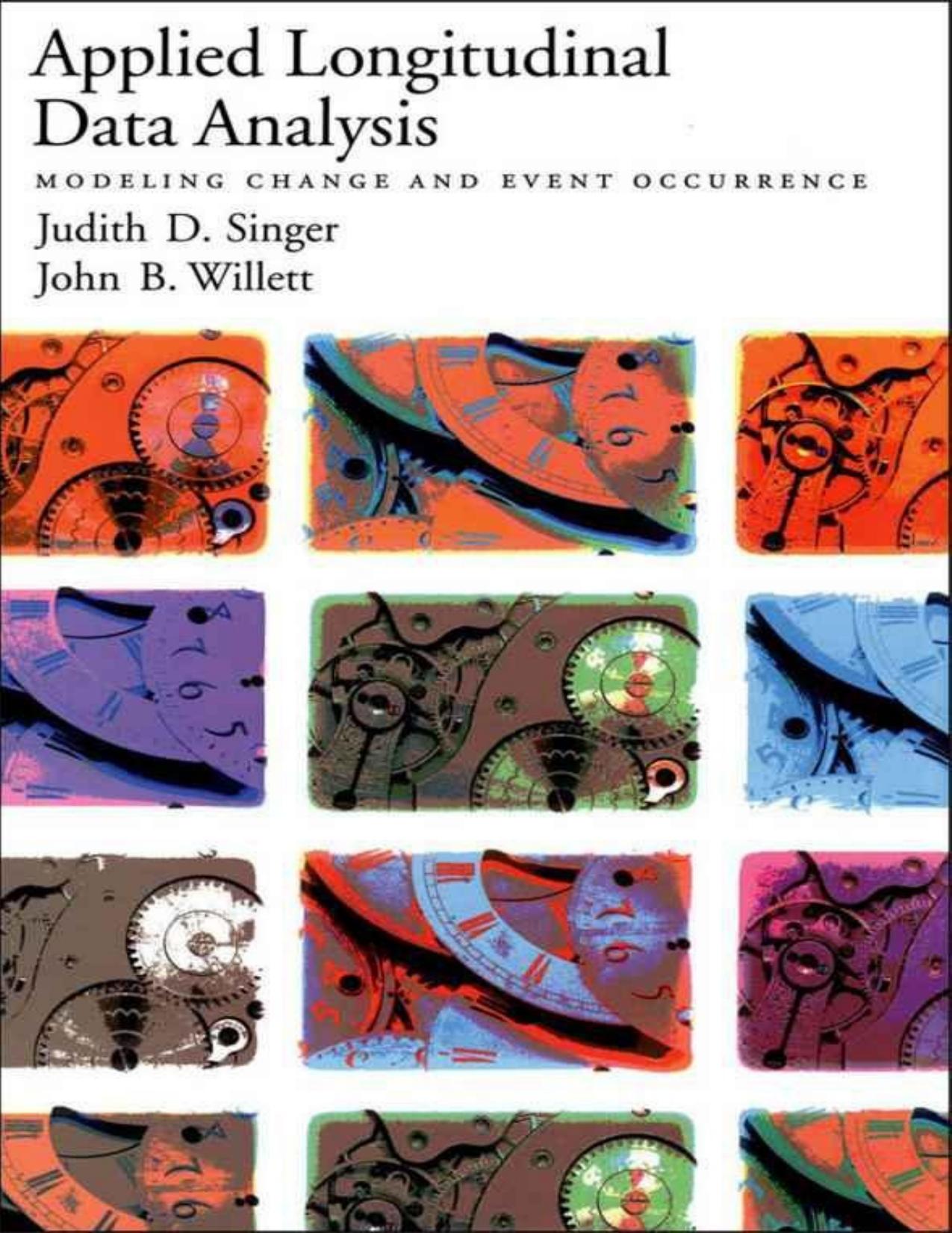
Applied Longitudinal Data Analysis Modeling Change and Event Occurrence 1st edition by Judith Singer, John Willett ISBN 0195152964 978-0195152968
Original price was: $70.00.$35.00Current price is: $35.00.
Instant download Applied Longitudinal Data Analysis Modeling Change and Event Occurrence Singer Judith D. & Willett John B after payment
Applied Longitudinal Data Analysis Modeling Change and Event Occurrence 1st edition by Judith Singer, John Willett – Ebook PDF Instant Download/Delivery: 0195152964, 978-0195152968
Full download Applied Longitudinal Data Analysis Modeling Change and Event Occurrence 1st edition after payment
Product details:
ISBN 10: 0195152964
ISBN 13: 978-0195152968
Author: Judith Singer, John Willett
Change is constant in everyday life. Infants crawl and then walk, children learn to read and write, teenagers mature in myriad ways, the elderly become frail and forgetful. Beyond these natural processes and events, external forces and interventions instigate and disrupt change: test scores may rise after a coaching course, drug abusers may remain abstinent after residential treatment. By charting changes over time and investigating whether and when events occur, researchers reveal the temporal rhythms of our lives. Applied Longitudinal Data Analysis is a much-needed professional book for empirical researchers and graduate students in the behavioral, social, and biomedical sciences. It offers the first accessible in-depth presentation of two of today’s most popular statistical methods: multilevel models for individual change and hazard/survival models for event occurrence (in both discrete- and continuous-time). Using clear, concise prose and real data sets from published studies, the authors take you step by step through complete analyses, from simple exploratory displays that reveal underlying patterns through sophisticated specifications of complex statistical models.
Applied Longitudinal Data Analysis offers readers a private consultation session with internationally recognized experts and represents a unique contribution to the literature on quantitative empirical methods.
Applied Longitudinal Data Analysis Modeling Change and Event Occurrence 1st Table of contents:
Part I
1 A Framework for Investigating Change over Time
1.1 When Might You Study Change over Time?
1.2 Distinguishing Between Two Types of Questions about Change
1.3 Three Important Features of a Study of Change
2 Exploring Longitudinal Data on Change
2.1 Creating a Longitudinal Data Set
2.2 Descriptive Analysis of Individual Change over Time
2.3 Exploring Differences in Change across People
2.4 Improving the Precision and Reliability of OLS-Estimated Rates of Change: Lessons for Research Design
3 Introducing the Multilevel Model for Change
3.1 What Is the Purpose of the Multilevel Model for Change?
3.2 The Level-1 Submodel for Individual Change
3.3 The Level-2 Submodel for Systematic Interindividual Differences in Change
3.4 Fitting the Multilevel Model for Change to Data
3.5 Examining Estimated Fixed Effects
3.6 Examining Estimated Variance Components
4 Doing Data Analysis with the Multilevel Model for Change
4.1 Example: Changes in Adolescent Alcohol Use
4.2 The Composite Specification of the Multilevel Model for Change
4.3 Methods of Estimation, Revisited
4.4 First Steps: Fitting Two Unconditional Multilevel Models for Change
4.5 Practical Data Analytic Strategies for Model Building
4.6 Comparing Models Using Deviance Statistics
4.7 Using Wald Statistics to Test Composite Hypotheses About Fixed Effects
4.8 Evaluating the Tenability of a Model’s Assumptions
4.9 Model-Based (Empirical Bayes) Estimates of the Individual Growth Parameters
5 Treating TIME More Flexibly
5.1 Variably Spaced Measurement Occasions
5.2 Varying Numbers of Measurement Occasions
5.3 Time-Varying Predictors
5.4 Recentering the Effect of TIME
6 Modeling Discontinuous and Nonlinear Change
6.1 Discontinuous Individual Change
6.2 Using Transformations to Model Nonlinear Individual Change
6.3 Representing Individual Change Using a Polynomial Function of TIME
6.4 Truly Nonlinear Trajectories
7 Examining the Multilevel Model’s Error Covariance Structure
7.1 The “Standard” Specification of the Multilevel Model for Change
7.2 Using the Composite Model to Understand Assumptions about the Error Covariance Matrix
7.3 Postulating an Alternative Error Covariance Structure
8 Modeling Change Using Covariance Structure Analysis
8.1 The General Covariance Structure Model
8.2 The Basics of Latent Growth Modeling
8.3 Cross-Domain Analysis of Change
8.4 Extensions of Latent Growth Modeling
Part II
9 A Framework for Investigating Event Occurrence
9.1 Should You Conduct a Survival Analysis? The “Whether” and “When” Test
9.2 Framing a Research Question About Event Occurrence
9.3 Censoring: How Complete Are the Data on Event Occurrence?
10 Describing Discrete-Time Event Occurrence Data
10.1 The Life Table
10.2 A Framework for Characterizing the Distribution of Discrete-Time Event Occurrence Data
10.3 Developing Intuition About Hazard Functions, Survivor Functions, and Median Lifetimes
10.4 Quantifying the Effects of Sampling Variation
10.5 A Simple and Useful Strategy for Constructing the Life Table
11 Fitting Basic Discrete-Time Hazard Models
11.1 Toward a Statistical Model for Discrete-Time Hazard
11.2 A Formal Representation of the Population Discrete-Time Hazard Model
11.3 Fitting a Discrete-Time Hazard Model to Data
11.4 Interpreting Parameter Estimates
11.5 Displaying Fitted Hazard and Survivor Functions
11.6 Comparing Models Using Deviance Statistics and Information Criteria
11.7 Statistical Inference Using Asymptotic Standard Errors
12 Extending the Discrete-Time Hazard Model
12.1 Alternative Specifications for the “Main Effect of TIME”
12.2 Using the Complementary Log-Log Link to Specify a Discrete-Time Hazard Model
12.3 Time-Varying Predictors
12.4 The Linear Additivity Assumption: Uncovering Violations and Simple Solutions
12.5 The Proportionality Assumption: Uncovering Violations and Simple Solutions
12.6 The No Unobserved Heterogeneity Assumption: No Simple Solution
12.7 Residual Analysis
13 Describing Continuous-Time Event Occurrence Data
13.1 A Framework for Characterizing the Distribution of Continuous-Time Event Data
13.2 Grouped Methods for Estimating Continuous-Time Survivor and Hazard Functions
13.3 The Kaplan-Meier Method of Estimating the Continuous-Time Survivor Function
13.4 The Cumulative Hazard Function
13.5 Kernel-Smoothed Estimates of the Hazard Function
13.6 Developing an Intuition about Continuous-Time Survivor, Cumulative Hazard, and Kernel-Smoothed Hazard Functions
14 Fitting Cox Regression Models
14.1 Toward a Statistical Model for Continuous-Time Hazard
14.2 Fitting the Cox Regression Model to Data
14.3 Interpreting the Results of Fitting the Cox Regression Model to Data
14.4 Nonparametric Strategies for Displaying the Results of Model Fitting
15 Extending the Cox Regression Model
15.1 Time-Varying Predictors
15.2 Nonproportional Hazards Models via Stratification
15.3 Nonproportional Hazards Models via Interactions with Time
15.4 Regression Diagnostics
15.5 Competing Risks
15.6 Late Entry into the Risk Set
Notes
References
Index
People also search for Applied Longitudinal Data Analysis Modeling Change and Event Occurrence 1st :
applied longitudinal data analysis modeling change and event occurrence pdf
applied longitudinal data analysis pdf
applied longitudinal data analysis
applied longitudinal analysis
applied smoothing techniques for data analysis
Tags: Judith Singer, John Willett, Applied Longitudinal, Modeling Change