


Applied Survey Sampling 1st edition by Edward Blair, Blair Johnny – Ebook PDF Instant Download/DeliveryISBN: 1483355146, 9781483355146
Full download Applied Survey Sampling 1st edition after payment.
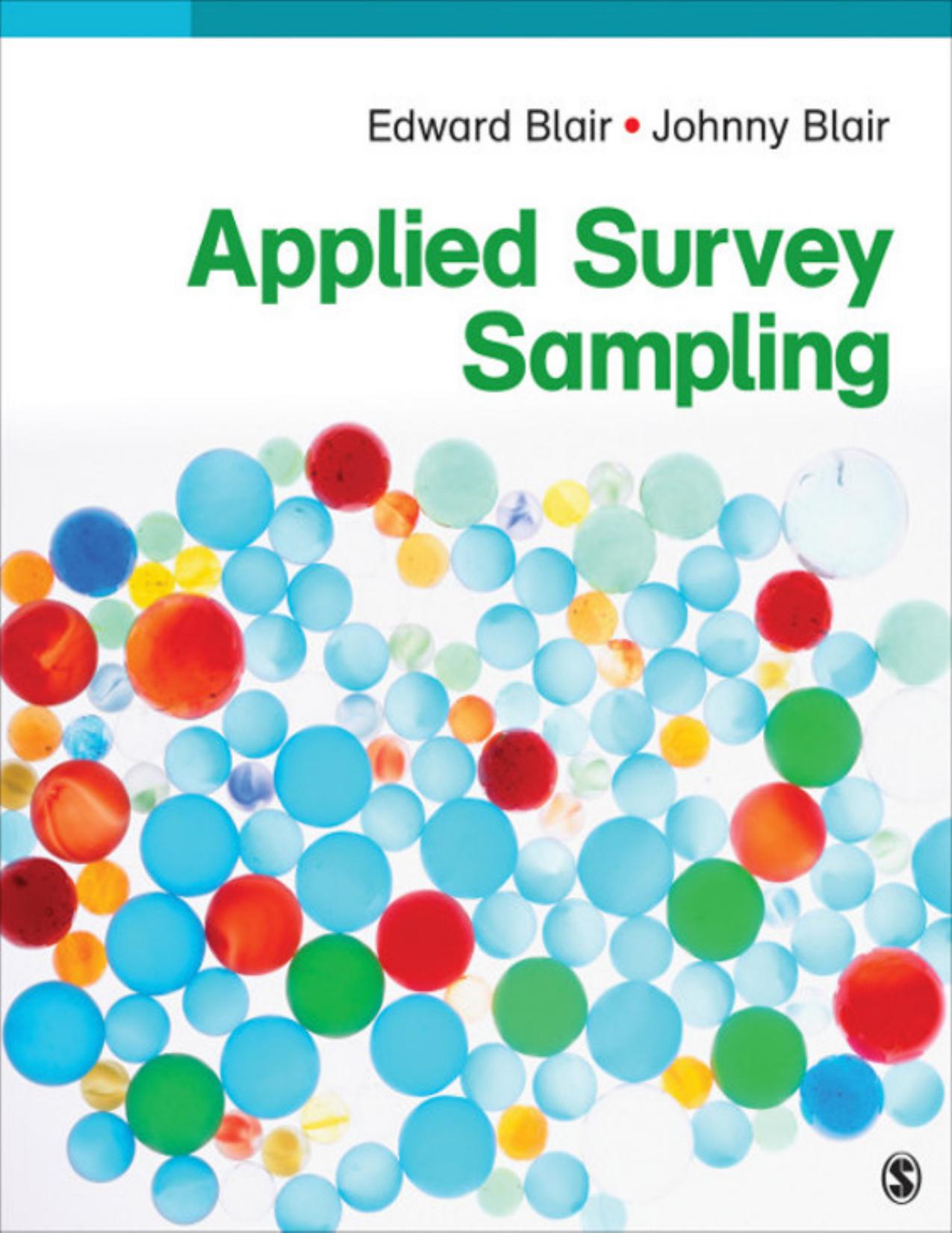
Product details:
ISBN-10 : 1483355146
ISBN-13 : 9781483355146
Author: Edward Blair, Blair Johnny
Written for students and researchers who wish to understand the conceptual and practical aspects of sampling, this book is designed to be accessible without requiring advanced statistical training. It covers a wide range of topics, from the basics of sampling to special topics such as sampling rare populations, sampling organizational populations, and sampling visitors to a place. Using cases and examples to illustrate sampling principles and procedures, the book thoroughly covers the fundamentals of modern survey sampling, and addresses recent changes in the survey environment such as declining response rates, the rise of Internet surveys, the need to accommodate cell phones in telephone surveys, and emerging uses of social media and big data.
Applied Survey Sampling 1st Table of contents:
SECTION I: SAMPLING BASICS
Chapter 1: Introduction to Sampling
1.1 Introduction
1.2 A Brief History of Sampling
1.3 Sampling Concepts
1.3.1 Sources of Research Error
1.3.2 Probability versus Nonprobability Samples
Types of Probability Samples
Calculating Sampling Probabilities
Types of Nonprobability Samples
Comparing Probability and Nonprobability Samples
1.4 Guidelines for Good Sampling
1.5 Chapter Summary and Overview of Book
Exercises and Discussion Questions
Chapter 2: Defining and Framing the Population
2.1 Defining the Population
2.1.1 Defining Population Units
2.1.2 Setting Population Boundaries
The Need for Operational Specificity in Population Boundaries
Other Issues in Setting Population Boundaries
2.2 Framing the Population
2.2.1 Obtaining a List
2.2.2 Problems With Lists
2.2.3 Coping With Omissions
Random Digit Dialing
Incorporating Cellphones
Address-Based Sampling
Registration-Based Sampling
Half-Open Intervals
Dual-Frame Designs
General Comments on Coping With Omissions
2.2.4 Coping With Ineligibles
2.2.5 Coping With Duplications
2.2.6 Coping With Clustering
Sampling Within Households
Weighting Data to the Proper Population Unit
2.2.7 Framing Populations Without a List
2.3 Chapter Summary
Exercises and Discussion Questions
Chapter 3: Drawing the Sample and Executing the Research
3.1 Drawing the Sample
3.1.1 Simple Random Sampling
3.1.2 Systematic Sampling
3.1.3 Physical Sampling
Sampling From Directories
Sampling From File Drawers
3.2 Executing the Research
3.2.1 Controlling Nonresponse Bias
Maximizing Response Rates
Quota Sampling
Probability Sampling With Quotas
Weighting for Differential Response Rates
Comparing Early Versus Late Respondents
Follow-up Studies of Nonrespondents
3.2.2 Calculating Response Rates
3.3 Chapter Summary
Exercises and Discussion Questions
SECTION II: SAMPLE SIZE AND SAMPLE EFFICIENCY
Chapter 4: Setting Sample Size
4.1 Sampling Error Illustrated
4.2 Sample Size Based on Confidence Intervals
4.2.1 Computational Examples
4.2.2 How to Estimate σ or p
4.3 Sample Size Based on Hypothesis Testing Power
4.4 Sample Size Based on the Value of Information
4.4.1 Why Information Has Value
4.4.2 Factors Related to the Value of Information
4.4.3 Sample Size and the Value of Information
4.5 Informal Methods for Setting Sample Size
4.5.1 Using Previous or Typical Sample Sizes
4.5.2 Using the Magic Number
4.5.3 Anticipating Subgroup Analyses
4.5.4 Using Resource Limitations
4.6 Chapter Summary
Exercises and Discussion Questions
Chapter 5: Stratified Sampling
5.1 When Should Stratified Samples Be Used?
5.1.1 The Strata Are of Direct Interest
5.1.2 Variances Differ Across Strata
5.1.3 Costs Differ Across Strata
5.1.4 Prior Information Differs Across Strata
5.2 Other Uses of Stratification
5.3 How to Draw a Stratified Sample
5.4 Chapter Summary
Exercises and Discussion Questions
Chapter 6: Cluster Sampling
6.1 When Are Cluster Samples Appropriate?
6.1.1 Travel Costs
6.1.2 Fixed Costs
6.1.3 Listing Costs
6.1.4 Locating Special Populations
6.2 Increased Sample Variability as a Result of Clustering
6.2.1 Measuring Homogeneity Within Clusters
6.2.2 Design Effects From Clustering
6.3 Optimum Cluster Size
6.3.1 Typical Cluster Sizes
In-Home Surveys
Repetitive Studies
Shopping Mall Studies
Graduate Student Projects
Clustering Within Households
6.4 Defining Clusters
6.5 How to Draw a Cluster Sample
6.5.1 Drawing Clusters With Equal Probabilities
6.5.2 Drawing Clusters With Probabilities Proportionate to Size
6.5.3 Drawing Stratified Cluster Samples
6.6 Chapter Summary
Exercises and Discussion Questions
SECTION III: ADDITIONAL TOPICS IN SAMPLING
Chapter 7: Estimating Population Characteristics From Samples
7.1 Weighting Sample Data
7.1.1 Should Data Be Weighted?
7.2 Using Models to Guide Sampling and Estimation
7.2.1 Examples of Using Models
7.2.2 Using Models to Reduce the Variance of Estimates
Sample Allocation in Stratified Probability Designs
Cutoff Sampling
Small Area Estimation
7.2.3 Using Models to Cope With Violations of Probability Sampling Assumptions
Dealing With the Lack of an Adequate Frame
Dealing With High Nonresponse
Making Estimates for Nonfinite Populations
7.2.4 Conclusions About the Use of Models
7.3 Measuring the Uncertainty of Estimates From Complex or Nonprobability Samples
7.4 Chapter Summary
Exercises and Discussion Questions
Chapter 8: Sampling in Special Contexts
8.1 Sampling for Online Research
8.2 Sampling Visitors to a Place
8.2.1 Selecting Places for Intercept Research
8.2.2 Sampling Visitors Within Places
8.3 Sampling Rare Populations
8.3.1 Telephone Cluster Sampling
8.3.2 Disproportionate Stratified Sampling
8.3.3 Network Sampling
8.3.4 Dual-Frame Sampling
8.3.5 Location Sampling
8.3.6 Online Data Collection for Rare Groups
8.4 Sampling Organizational Populations
8.5 Sampling Groups Such as Influence Groups or Elites
8.6 Panel Sampling
8.6.1 Initial Nonresponse in Panels
8.6.2 Differential Mortality Over Time
8.6.3 Panel Aging
8.6.4 Implications for Panel Sampling
8.6.5 Other Issues in Panel Sampling
8.7 Sampling in International Contexts
8.8 Big Data and Survey Sampling
8.8.1 Big Data as a Survey Complement
8.8.2 Big Data as a Survey Replacement
8.9 Incorporating Smartphones, Social Media, and Technological Changes
8.9.1 Smartphones and Surveys
8.9.2 Social Media and Surveys
8.9.3 A General Framework for Incorporating New Technologies
8.10 Chapter Summary
Exercises and Discussion Questions
Chapter 9: Evaluating Samples
9.1 The Sample Report
9.2 How Good Must the Sample Be?
9.2.1 Concepts of Representation and Error
9.2.2 Requirements for Sample Quality Across Research Contexts
Imperfect Samples May Be Useful for Exploration or Screening
Imperfect Samples May Be Useful for Testing Relationships
Imperfect Samples Are Usable in Academic Research
The Heaviest Burden on Sample Quality
General Advice
9.3 Chapter Summary
Exercises and Discussion Questions
People also search for Applied Survey Sampling 1st:
applied sampling
applied survey data analysis
applied survey data analysis pdf
applied survey research
applied survey research san jose