


Becoming a Master Student 16th edition by Dave Ellis – Ebook PDF Instant Download/Delivery: 1337097101, 978-1337097109
Full download Becoming a Master Student 16th edition after payment
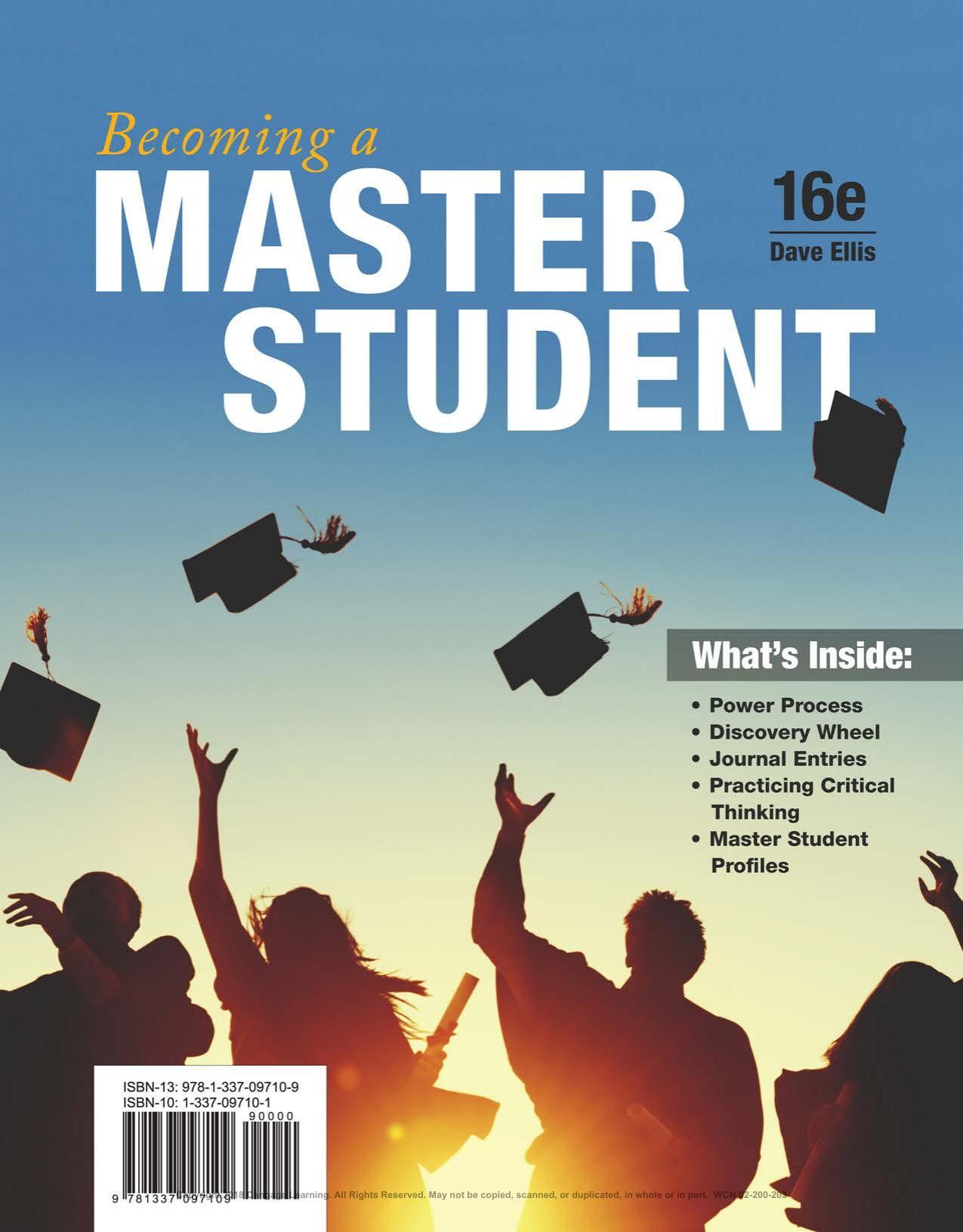
Product details:
ISBN 10: 1337097101
ISBN 13: 978-1337097109
Author: Dave Ellis
BECOMING A MASTER STUDENT, Sixteenth Edition, is all about discovery, intention, and action. BECOMING A MASTER STUDENT is your guide to the culture of higher education. Through interactive journal entries, hands-on activities, and articles about success, this text will help you gain the qualities needed to become a master student. Tools like the Discovery Wheel, Discovery and Intention Journal, Master Student Profiles, Power Process articles, and the Kolb Learning Style Inventory deepen your knowledge of yourself and help you prepare for success in school and in life.
Becoming a Master Student 16th Table of contents:
- Introduction: The Master Student
- I-1. Power Process: Discover what you want
- I-2. Rewrite this book
- I-3. Master student qualities
- I-4. The master student process: Discovery
- I-5. The master student process: Intention
- I-6. The master student process: ACTION
- I-7. Keep the process alive
- I-8. Get the most from this book
- I-8a. Get used to a new look and tone
- I-8b. Skip around
- I-8c. Use what works
- I-8d. Rip ’em out
- I-8e. Practice critical thinking
- I-8f. Learn about learning styles
- I-8g. Experience the power of the power processes
- I-8h. Read the sidebars
- I-9. Motivation: I’m just not in the mood
- I-10. Ways to change a habit
- I-10a. Tell the truth
- I-10b. Start small
- I-10c. Rehearse the new habit
- I-10d. Trigger the habit
- I-10e. Practice the new habit
- I-10f. Give it time
- I-10g. Be willing to revise your plans
- I-10h. Get feedback and support
- I-10i. Monitor your behavior
- I-10j. Celebrate success
- I-10k. Change your environment
- Chapter 1. Discovering Yourself
- Power Process: Ideas are tools
- First Step: Truth is a key to mastery
- First steps are universal
- First steps are judgment-free
- First steps point us toward goals
- First steps include strengths
- First steps are specific
- The Discovery Wheel
- Learning styles: Discovering how you learn
- We learn by perceiving and processing
- Perceiving and processing—an example
- Learning Style Inventory
- Scoring Your Inventory
- Learning Style Graph
- Interpreting Your Learning Style Graph
- Developing All Four Modes of Learning
- Balancing Your Preferences
- Using your learning style profile to succeed
- Develop all four modes of learning
- Look for examples of the modes in action
- Use the modes while choosing courses
- Use the modes to explore your major
- Use the modes of learning to explore your career
- Expect to encounter different styles
- Look for specific clues to another person’s style
- Accommodate differing styles
- Resolve conflict with respect for styles
- Accept change—and occasional discomfort
- Claim your multiple intelligences
- Learning through your senses: The VARK system
- Signs of the four preferences
- Discovering your vark preferences
- To enhance visual learning
- To enhance auditory learning
- To enhance read/write learning
- To enhance kinesthetic learning
- Mixing the preferences
- Master Student Profile: Joshua Williams
- Quiz Chapter 1
- Skills Snapshot Chapter 1
- Chapter 2. Time
- Power Process: Be here now
- You’ve got the time
- Make choices about multitasking
- Unplug from technology
- Capture fast-breaking ideas with minimal interruption
- Handle interruptions with care
- Commit to “single tasking”
- Multitask with skill
- Align your activities with your passions
- Define your values
- Consider one set of values
- Translate your values into visible behaviors
- Setting and achieving goals
- The ABC daily to-do list
- Brainstorm tasks
- Estimate time
- Rate each task by priority
- Cross off tasks
- Evaluate
- Tinker
- Planning sets you free
- Making the transition to higher education
- Deal with common challenges
- Manage time with transition in mind
- Making time for school as an adult learner
- Break it down, get it done—using a long-term planner
- Create a work flow that works
- 1. Collect
- 2. Choose
- 3. Classify
- 4. Complete
- There’s an app for that—using technology for time management
- Calendar applications
- List managers
- More possibilities
- What to consider before you choose
- Stop procrastination now
- 25 ways to get the most out of now
- Choosing your time
- Choosing your place
- Getting focused
- Questions that keep you focused
- Making time for health
- Choose your fuel
- Choose to exercise
- Choose to rest
- Choose freedom from sexually transmitted infection
- Choose emotional health
- Choose a responsible relationship with drugs
- Use the power of small daily choices
- Beyond time management: Stay focused on what matters
- Focus on values
- Focus on outcomes
- Do less
- Buy less
- Slow down
- Handle it now
- Remember people
- Forget about time
- Master Student Profile: Ramit Sethi
- Quiz Chapter 2
- Skills Snapshot Chapter 2
- Chapter 3. Memory
- Power Process: Love your problems
- Your memory and your brain—6 key principles
- Principle 1: See memory as something you do—Not something you have
- Principle 2: Remember that the memory process works in stages
- Principle 3: Sink deeply into sense experience
- Principle 4: Choose strategies for encoding
- Principle 5: Choose strategies for decoding
- Principle 6: Take care of your brain
- The memory jungle
- Visualization 1: A well-worn path
- Visualization 2: A herd of thoughts
- Visualization 3: Turning your back
- Visualization 4: Directing the animal traffic
- 25 memory techniques
- Escape the short-term memory trap
- Encode by thinking
- Encode by feeling
- Encode by moving
- Recall it
- Set a trap for your memory
- Mnemonic devices
- Retool your memory
- Store important information where it’s just one click away
- Name digital documents for easy recall
- Use outlining software to encode information
- Make conscious choices about what to remember
- Remembering names
- Master Student Profile: Maria Popova
- Quiz Chapter 3
- Skills Snapshot Chapter 3
- Chapter 4. Reading
- Power Process: Notice your pictures and let them go
- Muscle Reading
- How Muscle Reading works
- Phase 1: Before you read
- Step 1: Preview
- Step 2: Outline
- Step 3: Question
- Phase 2: While you read
- Step 4: Focus
- Step 5: Flag answers
- Phase 3: After you read
- Step 6: Recite
- Step 7: Review
- Step 8: Review again
- Extending Muscle Reading to web pages and ebooks
- Phase 1: Before you read
- Phase 2: While you read
- Phase 3: After you read
- Muscle Reading at work
- When reading is tough
- Getting past roadblocks to reading
- Making choices about what to read
- Dealing with interruptions
- Remembering what you read
- Beyond speed reading: Becoming a flexible reader
- Practice psuedo-skimming
- Read widely
- Read wisely
- Word power— expanding your vocabulary
- Mastering the English language
- Learn to use standard english when it counts
- Build confidence
- Analyze errors in using english
- Learn by speaking and listening
- Use online resources
- Gain skills in note taking and testing
- Create a community of english learners
- Celebrate your gains
- Developing information literacy
- Get ideas for a topic
- Discover questions about your topic
- Discovering questions—an example
- Find sources
- Refine your topic
- Refine your questions
- Refine your key words
- Dig deeper into the web
- Get to know your library
- Talk to people
- Evaluate information
- Evaluate internet sources with extra care
- Distinguish between primary and secondary sources
- Take notes and reflect on them
- Master Student Profile: Matias Manzano
- Quiz Chapter 4
- Skills Snapshot Chapter 4
- Chapter 5. Notes
- Power Process: I create it all
- The note-taking process flows
- Observe: The note-taking process flows
- Set the stage
- “Be here now” in class
- Watch for clues about important material
- Record: The note-taking process flows
- General techniques for note taking
- The Cornell method
- Mind mapping
- Outlining
- Combining formats
- Review: The note-taking process flows
- Turn PowerPoints into powerful notes
- Before the presentation
- During the presentation
- After the presentation
- When your instructor talks quickly
- Taking notes while reading
- Review notes
- Research notes
- Visualize ideas with concept maps
- Choose one concept as a focus
- List related concepts
- Arrange concepts in a hierarchy
- Add links
- Revise your map
- Examples of concept maps
- Benefits of concept maps
- Taking effective notes for online coursework
- Note taking 2.0
- Start with software you already own
- Store your notes in the “cloud”
- Consider online outliners and mind mappers
- Consider dedicated note-taking software
- Master Student Profile: Teresa Amabile
- Quiz Chapter 5
- Skills Snapshot Chapter 5
- Chapter 6. Tests
- Power Process: Detach
- Think beyond the grade
- What to do before the test
- Find or create practice materials
- Schedule your practice sessions
- Ways to predict test questions
- Cooperative learning: Studying in groups
- Form a study group
- Conduct your group
- What to do during the test
- As you begin
- Multiple-choice questions
- True/false questions
- Computer-graded tests
- Open-book tests
- Short-answer/fill-in-the-blank tests
- Matching tests
- Essay questions
- The high costs of cheating
- Let go of test anxiety
- Accept your feelings
- Describe your thoughts in writing
- Dispute your thoughts
- Praise yourself
- Consider the worst
- Breathe
- Over-prepare for tests
- Care for your body as much as your mind
- Take this article to work
- Getting ready for math tests
- Overcome math anxiety
- Boost study skills for math
- Use tests to show what you know
- Studying across the curriculum
- The test isn’t over until …
- Celebrate mistakes
- Notable failures
- Master Student Profile: Lalita Booth
- Quiz Chapter 6
- Skills Snapshot Chapter 6
- Chapter 7. Thinking
- Power Process: Embrace the new
- Critical thinking: A survival skill
- Six kinds of thinking
- Finding answers
- A process for critical thinking
- Check your attitudes
- Check for logic
- Check for evidence
- Finding “aha!”: Creativity fuels critical thinking
- Ways to create ideas
- Attitudes, affirmations, and visualizations
- Don’t fool yourself: 15 common mistakes in logic
- Think critically about information on the Internet
- Gaining skill at decision making
- Four ways to solve problems
- Asking questions: Learning through inquiry
- Thinking about your major
- 1 Discover options
- 2 Make a trial choice
- 3 Evaluate your trial choice
- 4 Choose again
- Service-learning: Turn thinking into contribution
- Getting the most from service-learning
- Master Student Profile: Irshad Manji
- Quiz Chapter 7
- Skills Snapshot Chapter 7
- Chapter 8. Communicating
- Power Process: Employ your word
- Communication: Keeping the channels open
- Choosing to listen
- Nonverbal listening
- Verbal listening
- Stay open to the adventure of listening
- Choosing to speak
- Developing emotional intelligence
- Recognize three elements of emotion
- Name your emotions
- Accept your emotions
- Express your emotions
- Respond rather than react
- Make decisions with emotional intelligence
- Communicating in teams: Getting things done as a group
- Start with an attitude check
- Master your first meeting
- Deal with challenges
- Put the finishing touches on your project
- Managing conflict
- Focus on content
- Focus on process
- Five ways to say no… respectfully
- Five steps to effective complaints
- Communicating with instructors
- Diversity is real—and valuable
- Communicating across cultures
- Communicating as a first-generation student
- Ask for academic support
- Ask for emotional support
- Resolve conflict with family members
- Build relationships with instructors
- Respond to prejudice
- Share your experiences
- Staying safe on social networks
- Three phases of effective writing
- Phase 1: Getting ready to write
- Phase 2: Writing a first draft
- Phase 3: Revising your draft
- Academic integrity: Avoid plagiarism
- Mastering public speaking
- Phase 1: Preparing your presentation
- Phase 2: Delivering your presentation
- Phase 3: Reflecting on your presentation
- Master Student Profile: Chimamanda Adichie
- Quiz Chapter 8
- Skills Snapshot Chapter 8
- Chapter 9. Money
- Power Process: Risk being a fool
- The end of money worries
- Make more money
- Get financial aid
- Work at a job while you’re in school
- Ask for a raise
- Start a business on the side
- Be a high performer
- Be a lifetime learner
- Spend less money
- Managing money during tough times
- Spend less and save more
- Make sure that your savings are protected
- Pay off your credit cards
- Invest only after saving
- Do stellar work at your current job
- Think about your next job
- Research unemployment benefits
- Get health insurance
- Get help that you can trust
- Put your plan in writing
- Cope with stress in positive ways
- Choose your money conversations
- Take charge of your credit
- Take control of your credit cards
- Manage student loans
- Education pays off—and you can pay for it
- Money for the future
- Save for an emergency fund
- Save for long-term goals
- Save for the last decades of your life
- Invest carefully
- Consider home ownership carefully
- Be a wise car-shopper
- Be careful with contracts
- Save on insurance
- Use tools to tame your money
- Learn spreadsheet software
- Explore other applications
- Organize your money files
- Automate your personal finances
- Protect your money
- Your money and your values
- Master Student Profile: Leo Babauta
- Quiz Chapter 9
- Skills Snapshot Chapter 9
- Chapter 10. Next Steps
- Power Process: Persist
- Jump-start your education with transferable skills
- Succeed in many situations
- Focus on the “4 c’s”
- Think of character as a skill
- Learn to develop new skills
- Taking the road to graduation
- Discover what your academic goals mean for today
- Connect with services
- Connect with people
- Light the path with lots of rewards
- Find the time and the money
- Revisit your strategies
- Transferring to a new school
- Know key terms
- Gather information
- Visit schools
- Choose your new school
- Succeed at your new school
- Start creating your career
- Rethink the role of passion
- Think like an entrepreneur
- Use career services to explore your options
- Describe your ideal lifestyle
- Test your career choice and be willing to change
- Start creating your résumé
- Start building skills for your ideal résumé
- Remember the reason for a résumé
- Cut the fluff
- Get feedback
- Discover the hidden job market
- Think like an employer
- Discover your network
- Contact people in your network
- Extend your network
- Be specific about the job you want—and why you can do it
- Pitch ideas and offer to implement them
- Offer a limited amount of work for free
- Develop interviewing skills
- Before you go to the interview
- During the interview
- After the interview
- Join a diverse workplace
- Expect differences
- Mind the details
- Put messages in context
- Be willing to bridge gaps
- Put your health to work
- Persist on the path of mastery
- Tools for lifelong learning
- Make time to learn
- Go online
- Learn at work
- Launch side projects
- Meet people
- The Discovery Wheel: Coming full circle
- Master Student Profile: Ben Barry
- Quiz Chapter 10
- Skills Snapshot Chapter 10
- Exclusive Digital Content: Health
- Exclusive Digital Content: Health
- Power Process: Surrender
- The Master Guide to Becoming a Master Student
- Exclusive Digital Content: Health
- Exclusive Digital Content: Diversity
- Additional Reading
- College Success Glossary
People also search for Becoming a Master Student 16th:
becoming a master student 16th edition pdf free download
becoming a master student 16th edition pdf free
becoming a master student 16th edition pdf download
becoming a master student by dave ellis 16th edition
becoming a master student by dave ellis 16th edition pdf
Tags: Dave Ellis, Master Student