


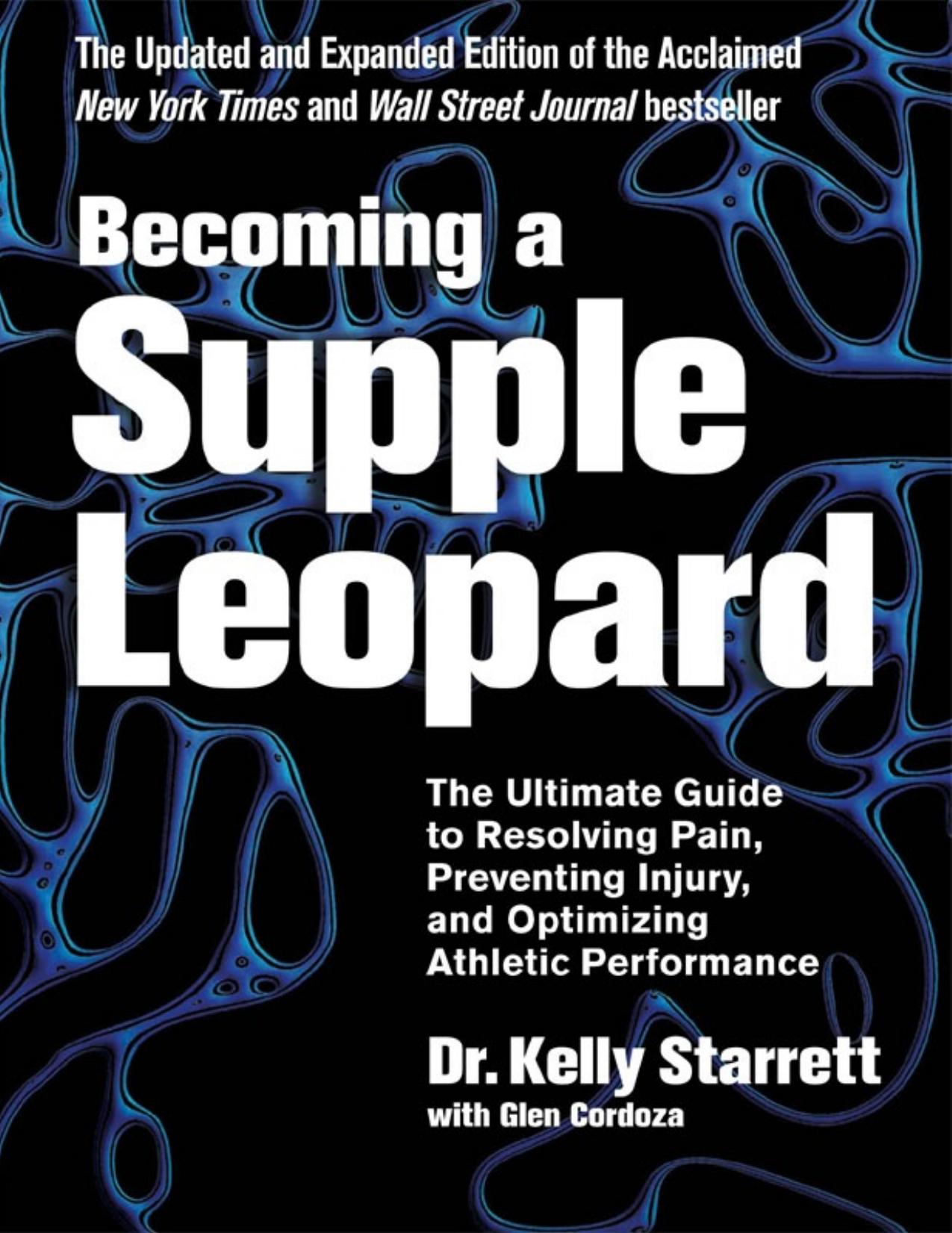
Becoming a Supple Leopard 2nd edition by Kelly Starrett, Glen Cordoza – Ebook PDF Instant Download/Delivery: 1628600837, 978-1628600834
Full download Becoming a Supple Leopard 2nd edition after payment
Product details:
ISBN 10: 1628600837
ISBN 13: 978-1628600834
Author: Kelly Starrett, Glen Cordoza
Improve your athletic performance, extend your athletic career, treat stiffness and achy joints, and prevent and rehabilitate injuries—all without having to seek out a coach, doctor, chiropractor, physical therapist, or massage therapist. In Becoming a Supple Leopard, Dr. Kelly Starrett shares his revolutionary approach to mobility and maintenance of the human body and teaches you how to hack your own movement, allowing you to live a healthier, more fulfilling life.
This new edition of the New York Times and Wall Street Journal bestseller has been thoroughly revised to make it even easier to put to use. Want to truly understand the principles that guide human movement? Becoming a Supple Leopard lays out a blueprint for moving safely and effectively through life and sport. Want to learn how to apply those principles to specific movements, whether you are doing squats in the gym or picking up a bag of groceries? Hundreds of step-by-step photos show you not only how to perform a host of exercise movements, such the squat, deadlift, pushup, kettlebell swing, clean, snatch, and muscle-up, but also how to correct the common faults associated with those movements. Frustrated because you can’t perform a certain movement correctly due to range of motion restrictions? Breaking the body down into 14 distinct areas, Starrett demonstrates hundreds of mobilization techniques that will help you resolve restrictions and reclaim your mobility. Unsure how to put it all together into a program that addresses your individual needs? This updated edition lays out dozens of prescriptions that allow you to hone in on a specific limitation, a nagging injury, or an exercise fault that you just can’t seem to get right. It even offers a 14-day full-body mobility overhaul.
Performance is what drives us as human beings, but dysfunctional movement patterns can bring the human body to an abrupt halt. Often, the factors that impede performance are invisible even to seasoned athletes and coaches. Becoming a Supple Leopard makes the invisible visible. Whether you are a professional athlete, a weekend warrior, or simply someone wanting to live healthy and free from physical restrictions, this one-of-a-kind training manual will teach you how to harness your athletic potential and maintain your body. Learn how to perform basic maintenance on your body, unlock your athletic potential, live pain-free…and become a Supple Leopard. This step-by-step guide to movement and mobility will show you how to:
• Move safely and efficiently in all situations
• Organize your spine and joints in optimal, stable positions
• Restore normal function to your joints and tissues
• Accelerate recovery after training sessions and competition
• Properly perform strength and conditioning movements like the squat, bench press, pushup, deadlift, clean, and snatch
• Build efficient, transferable movement patterns and skill progressions from simple to more advanced exercises
• Identify, diagnose, and correct inefficient movement patterns
• Treat and resolve common symptoms like low back pain, carpal tunnel, shoulder pain, and tennis elbow
• Prevent and rehabilitate common athletic injuries Use mobilization techniques to address short and stiff muscles, soft tissue and joint capsule restriction, motor control problems, and joint range of motion limitations
• Create personalized mobility prescriptions to improve movement efficiency
Becoming a Supple Leopard 2nd Table of contents:
Introduction: A New Human Performance Epoch
PART 1 PRINCIPLES AND THEORY
Chapter 1: Midline Stabilization and Organization (Spinal Mechanics)
Prioritizing spinal mechanics is the first and most important step in rebuilding and ingraining functional motor patterns, optimizing movement efficiency, maximizing force production, and avoiding injury. In order to safely and effectively transmit force through your core and into your extremities, you need to organize your spine in a neutral position and then create stability throughout that organized system by engaging the musculature of your trunk, which is known as bracing. This is the basis of midline stabilization and organization. This chapter explains why it’s important to prioritize spinal mechanics over everything else—and how to organize and brace your spine in an optimal position.
Chapter 2: One-Joint Rule
The premise of the one-joint rule is simple: When you are working from a braced neutral position, flexion and extension should occur only in your hips and shoulders, not in your spine. Your hips and shoulders are designed to support and accommodate large loads and dynamic movements, and movement should always be initiated from those primary engines. In fact, it’s easier to think of your hips and shoulders as a single joint because they are governed by the same principles—hence the name “one-joint rule.”
Chapter 3: Laws of Torque
In order to create safe and stable positions for your joints as well as preserve a braced neutral spinal position, you have to create tension in your hips and shoulders and, by extension, your elbows, knees, wrists, and ankles. You do so by generating torque, which is expressed through external rotation (rotating your limb away from your body) and internal rotation (rotating your limb toward the center of your body).
Chapter 4: Body Archetypes and the Tunnel
The functional positions for the hips and shoulders can be categorized into seven basic configurations: four for the shoulders and three for the hips. These seven body archetypes, which represent the start and finish positions for most exercise movements, encompass all the range of motion and motor control that you need to be a fully functional human being. Consider the body archetypes and the tunnel concept as a blueprint for assessing movement and positional competency and range of motion restrictions.
Chapter 5: Movement Hierarchy
The movement hierarchy categorizes exercise movements based on stabilization demands and complexity. It provides a framework for building efficient, transferable movement patterns and skill progressions—from simple to more advanced exercises—and for modifying strength and conditioning movements based on skill, fitness level, and mobility.
Chapter 6: Mobility: A Systematic Approach
There is no one-size-fits-all approach when it comes to correcting range of motion restrictions, addressing tight muscles, and treating achy joints. To account for all positional and movement-related problems, soft tissue stiffness, and joint restriction, you need to combine techniques and take a systematic approach. What’s more, you need to perform basic, routine maintenance on your body—that is, spend 10 to 15 minutes a day working on your mobility. In this chapter, you’ll find a template for improving range of motion, resolving pain, and treating sore muscles. Equally important, you’ll learn how and when to mobilize.
PART 2 CATEGORIES OF MOVEMENT
CATEGORY 1 MOVEMENTS
Air Squat
Box Squat
Back Squat
Front Squat
Overhead Squat
Deadlift
Pushup
Bench Press
Dip
Strict Press
Handstand Pushup
Pull-up
CATEGORY 2 MOVEMENTS
Wall Ball
Push-Press
Jumping and Landing
Kettlebell Swing
One-Arm Swing
Rowing
Kipping Pull-up
Snatch Balance Progression
CATEGORY 3 MOVEMENTS
Burpee
Turkish Getup
Clean
Jerk
Snatch
Muscle-up
PART 3 MOBILIZATION TECHNIQUES
MOBILIZATION TARGET AREAS:
AREA 1: Jaw, Head, and Neck
AREA 2: Upper Back (Thoracic Spine, Ribs, Trapezius, Scapula)
AREA 3: Posterior Shoulder, Lat, Serratus
AREA 4: Anterior Shoulder and Chest
AREA 5: Arm (Triceps, Elbow, Forearm, Wrist)
AREA 6: Trunk (Psoas, Low Back, Obliques)
AREA 7: Glutes, Hip Capsules
AREA 8: Hip Flexors, Quadriceps
AREA 9: Adductors
AREA 10: Hamstrings
AREA 11: Knee
AREA 12: Shin
AREA 13: Calf
AREA 14: Ankle, Foot, and Toes
PART 4 MOBILITY PRESCRIPTIONS
General Overhead Archetype Mobility Prescription
Troubleshooting Overhead Archetype Mobility Prescriptions
General Press Archetype Mobility Prescription
Troubleshooting Press Archetype Mobility Prescriptions
General Hang Archetype Mobility Prescription
Troubleshooting Hang Archetype Mobility Prescriptions
General Front Rack Archetype Mobility Prescription
Troubleshooting Front Rack Archetype Mobility Prescriptions
General Squat Archetype Mobility Prescription
Troubleshooting Squat 1 (Squat Position) Archetype Mobility Prescriptions
Troubleshooting Squat 2 (Deadlift/Pulling Position) Archetype Mobility Prescriptions
General Pistol Archetype Mobility Prescription
Troubleshooting Pistol Archetype Mobility Prescriptions
General Lunge Archetype Mobility Prescription
Troubleshooting Lunge Archetype Mobility Prescriptions
Joint and Body Area Prescriptions (Pain)
14-Day Whole-Body Mobility Overhaul
14-Day Whole-Body Sample Programs
People also search for Becoming a Supple Leopard 2nd :
kelly starrett becoming a supple leopard
kelly starrett becoming a supple leopard pdf
becoming a supple leopard 2nd edition pdf
becoming a supple leopard 1st edition vs 2nd edition
dr kelly starrett becoming a supple leopard
Tags: Kelly Starrett, Glen Cordoza, Supple Leopard