


Big Ideas of Early Mathematics 1st edition by Pearson Education – Ebook PDF Instant Download/Delivery: 0132946971 , 978-0132946971
Full download edition Big Ideas of Early Mathematics 1stafter payment
Product details:
ISBN 10: 0132946971
ISBN 13: 978-0132946971
Author: Pearson Education
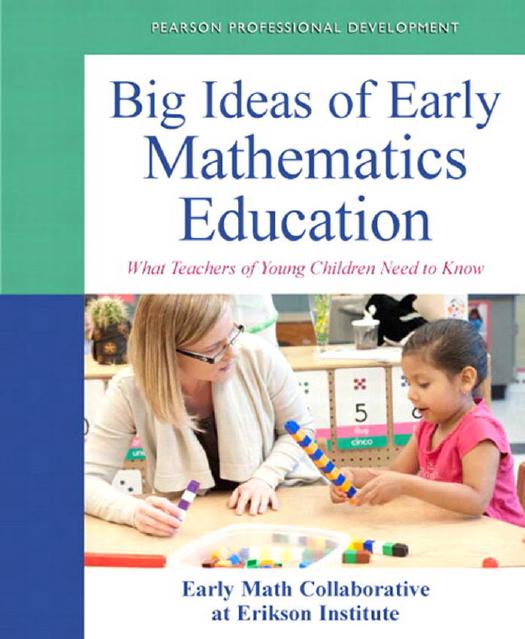
In this unique guide, classroom teachers, coaches, curriculum coordinators, college students, and teacher educators get a practical look at the foundational concepts and skills of early mathematics, and see how to implement them in their early childhood classrooms.
Big Ideas of Early Mathematics presents the skills educators need to organize for mathematics teaching and learning during the early years. For teachers of children ages three through six, the book provides foundations for further mathematics learning and helps facilitate long-term mathematical understanding. The Enhanced Pearson eText features embedded video.
Improve mastery and retention with the Enhanced Pearson eText*
The Enhanced Pearson eText provides a rich, interactive learning environment designed to improve student mastery of content. The Enhanced Pearson eText is:
- Engaging. The new interactive, multimedia learning features were developed by the authors and other subject-matter experts to deepen and enrich the learning experience.
- Convenient. Enjoy instant online access from your computer or download the Pearson eText App to read on or offline on your iPad® and Android® tablet.*
- Affordable. Experience the advantages of the Enhanced Pearson eText for 40-65% less than a print bound book.
*The Enhanced eText features are only available in the Pearson eText format. They are not available in third-party eTexts or downloads.
*The Pearson eText App is available on Google Play and in the App Store. It requires Android OS 3.1-4, a 7” or 10” tablet, or iPad iOS 5.0 or later.
Big Ideas of Early Mathematics 1st Table of contents:
Chapter 1 SETS: Using Attributes to Make Collections
Big Idea: Attributes Can Be Used to Sort Collections into Sets
Big Idea: The Same Collection Can Be Sorted in Different Ways
Big Idea: Sets Can Be Compared and Ordered
Implications for Teaching
Chapter 2 NUMBER SENSE: Developing a Meaningful Sense of Quantity
Big Idea: Numbers Are Used in Many Ways, Some More Mathematical than Others
Big Idea: Quantity Is an Attribute of a Set of Objects, and We Use Numbers to Name Specific Quantiti
Big Idea: The Quantity of a Small Collection Can Be Intuitively Perceived without Counting
Implications for Teaching
Chapter 3 COUNTING: More than Just 1, 2, 3
Big Idea: Counting Can Be Used to Find Out “How Many” in a Collection
Big Idea: Counting Has Rules That Apply to Any Collection
Implications for Teaching
Chapter 4 NUMBER OPERATIONS: Every Operation Tells a Story
Big Idea: Sets Can Be Changed by Adding Items (Joining) or by Taking Some Away (Separating)
Big Idea: Sets Can Be Compared Using the Attribute of Numerosity, and Ordered by More than, Less tha
Big Idea: A Quantity (Whole) Can Be Decomposed into Equal or Unequal Parts; The Parts Can Be Compose
Implications for Teaching
Chapter 5 PATTERN: Recognizing Repetition and Regularity
Big Idea: Patterns Are Sequences Governed by a Rule; They Exist Both in the World and in Mathematics
Big Idea: Identifying the Rule of a Pattern Brings Predictability and Allows Us to Make Generalizati
Big Idea: The Same Pattern Structure Can Be Found in Many Different Forms
Implications for Teaching
Chapter 6 MEASUREMENT: Making Fair Comparisons
Big Idea: Many Different Attributes Can Be Measured, Even When Measuring a Single Object
Big Idea: All Measurement Involves a “Fair” Comparison
Big Idea: Quantifying a Measurement Helps Us Describe and Compare More Precisely
Implications for Teaching
Chapter 7 DATA ANALYSIS: Asking Questions and Finding Answers
Big Idea: The Purpose of Collecting Data Is to Answer Questions When the Answers Are Not Immediately
Big Idea: Data Must Be Represented in Order to Be Interpreted, and How Data Are Gathered and Organiz
Big Idea: It Is Useful to Compare Parts of the Data and to Draw Conclusions about the Data as a Whol
Implications for Teaching
Chapter 8 SPATIAL RELATIONSHIPS: Mapping the World Around Us
Big Idea: Relationships between Objects and Places Can Be Represented with Mathematical Precision
Big Idea: Our Own Experiences of Space and Two-Dimensional Representations of Space Reflect a Specif
Big Idea: Spatial Relationships Can Be Visualized and Manipulated Mentally
Implications for Teaching
Chapter 9 SHAPE: Developing Definitions
Big Idea: Shapes Can Be Defined and Classified by Their Attributes
Big Idea: The Flat Faces of Solid (Three-Dimensional) Shapes Are Two-Dimensional Shapes
Big Idea: Shapes Can Be Combined and Separated (Composed and Decomposed) to Make New Shapes
Implications for Teaching
People also search for Big Ideas of Early Mathematics 1st:
big ideas of early mathematics pdf
big ideas of early mathematics book
big ideas of early mathematics erikson institute
big ideas of early mathematics pdf free download
big ideas of early mathematics citation