

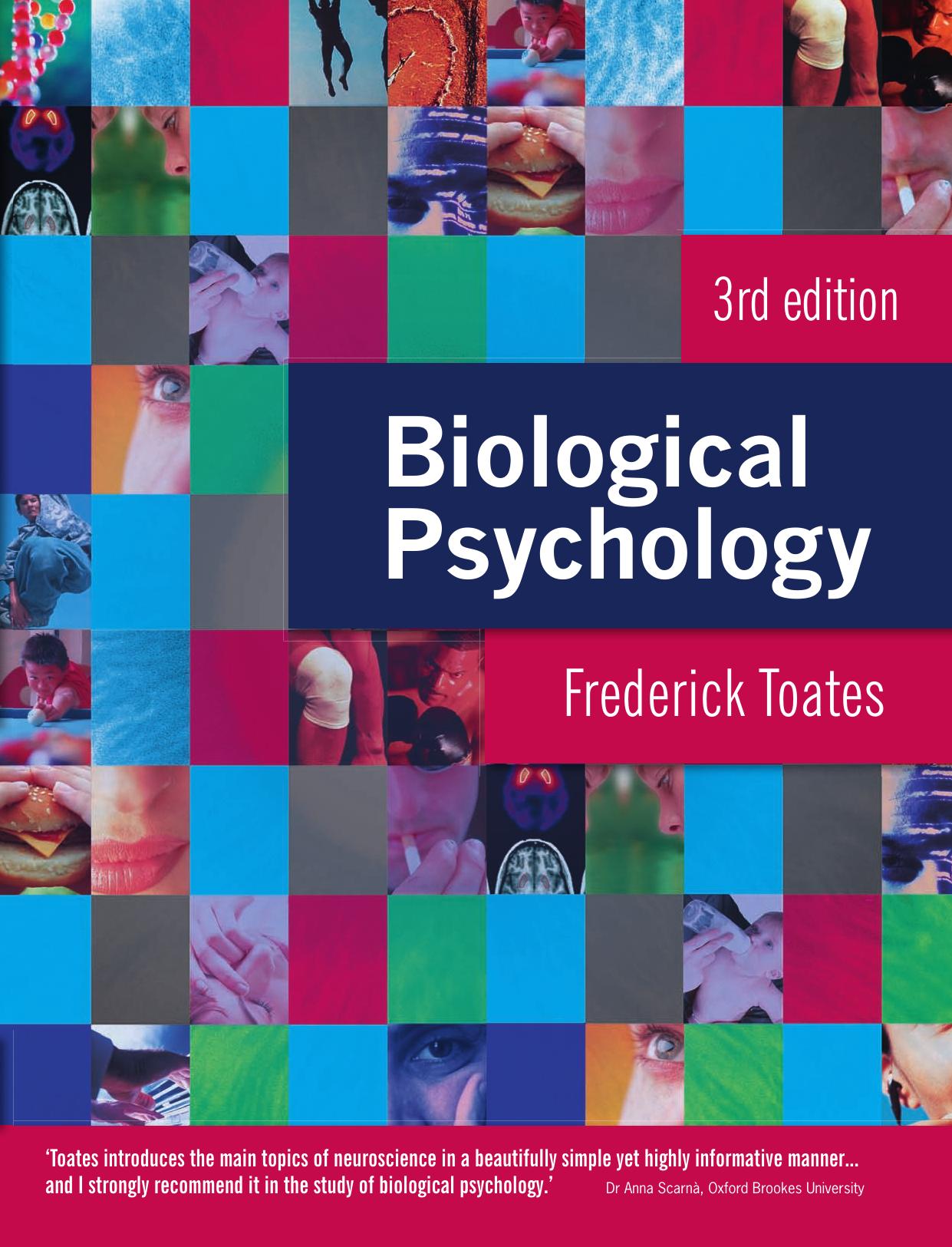
Biological psychology 3rd Edition by Fred Toates – Ebook PDF Instant Download/Delivery: 0273734997, 978-0273734994
Full download Biological psychology 3rd edition after payment
Product details:
ISBN 10: 0273734997
ISBN 13: 978-0273734994
Author: Fred Toates
These include video clips, interactions, animations, self-test questions and research updates to help students consolidate their understanding and prepare for assessment.
“Professor of Biological Psychology Frederick Toates from The Open University has done the field an enormous service in the Third Edition of Biological Psychology. Students worldwide will enjoy this text as it sets a new benchmark for a life science approach to brain and behaviour. The inclusion of evolutionary (both ultimate function and phylogeny), neurobiological and developmental perspectives on brain and behaviour make this textbook a first choice for the next generation of undergraduates studying biology and psychology.” Dr William M Brown, BA (Hons) MSc PhD, Lecturer, School of Psychology, University of East London
“Toates? third edition is both readable and palatable. It arouses interest by focusing on the thought-provoking questions that arise within a study of biological psychology. The author’s conversational style is helpful as he talks the reader through the more straightforward and also the more conceptually demanding sections. Although accessible, the text provides a thorough account of key areas. It answers questions and stimulates interest. This up-to-date third edition retains the excellent pedagogical features of the previous edition. This is an enormously useful textbook. The author understands the problems, questions and fascinations of biological psychology students. Toates is an excellent teacher and a real authority in this area. This textbook captures his knowledge and understanding, and his infectious love of the subject.” Dr Graham Mitchell, The University of Northampton
“If the processes of the mind and brain have baffled you, this book is the key to unlocking its mysteries. Toates introduces the main topics of neuroscience in a beautifully simple yet highly informative manner. Each topic is covered in a massively integrative way. This renders the text suitable for both students and lay readers, for both medics and psychologists, for both undergraduates and postgraduates. Chapters are hugely informative and achieve the perfect combination of presenting scientific findings and research with the author’s personal experience and good humour. This text is engaging at all times, and I strongly recommend it in the study of biological psychology. No stone is left unturned in the quest for understanding the brain.” Dr Anna Scarnà, Senior Lecturer, Department of Psychology, Oxford Brookes University
“Toates? Biological Psychology offers its readers a lucid and well-balanced exploration of this conceptually challenging field. Over the last decade I have found the various editions of this textbook invaluable as a teaching aid for my students. It is no mean feat to have improved on the second edition but Toates seems somehow to have managed it. I especially enjoyed the additional material on evolutionary psychology and, in particular, how this might help to explain both when things work out (e.g. the complexities of the human visual system) and when things go wrong (e.g. why depression might be kept in the population).” Dr Lance Workman, Head of Research, Bath Spa University
Biological psychology 3rd Table of contents:
Summary of Chapter 1
Further reading
Answers
Genes, environment and evolution
Introduction
Principles of evolution
Processes controlling behaviour
Genes, replication and reproduction
The process of inheritance
Genes, brains and behaviour
Genes, learning and the environment
Evolutionary psychology
Depression: a case study
Bringing things together
Summary of Chapter 2
Further reading
Answers
The nervous and endocrine systems
Introduction
What nervous systems do
Neurochemical actions at synapses
Neurons: development and learning
Terminology and organization of the nervous system
Hormones – the endocrine system
The autonomic nervous system
Bringing things together
Summary of Chapter 3
Further reading
Answers
How the cells of the nervous system work
Introduction
The neuron as a typical cell
The neuron: an excitable cell
Glial cells
The synapse and neurotransmitters
Alterations in synaptic strength
Bringing things together
Summary of Chapter 4
Further reading
Answers
The brain: basics of structure and role
Introduction
Describing the brain and finding your way around it
Relating structure to role: sensory and motor systems
Emotion, regulation and motivation
Integration, reasoning, planning and anticipation
Comparative and evolutionary perspectives
Techniques for studying the brain
Bringing things together
Summary of Chapter 5
Further reading
Answers
Development and plasticity
Introduction
Conceptual issues in development
The basic biology of nervous system development
Development of neurons, neural systems and behaviour
Hormones and development
The brain: cognitive and social development
Atypical development and health issues
Ethology and a comparative perspective
Change and plasticity in adults
Bringing things together
Summary of Chapter 6
Further reading
Answers
Sensory systems: general principles
Introduction
Sensory systems and perception
General principles
Bringing things togeth
Summary of Chapter 7
Further reading
Answers
Vision
Introduction
Within the eye
Basics of visual pathways
Functional specialization: perception and action
Functional specialization within perception
Linking brain activity and conscious perception
Bringing things together
Summary of Chapter 8
Further reading
Answers
The other sensory systems
Introduction
Hearing
The vestibular system
The somatosensory system
Chemical senses – taste and smell
Bringing things together
Summary of Chapter 9
Further reading
Answers
The control of movement
Introduction
Basics of control
How stability is maintained
Muscles and motor neurons
The control of skeletal muscle
The control of movement by the brain
From brain to motor neurons
Motor imagery
Development of motor systems
Bringing things together
Summary of Chapter 10
Further reading
Answers
Learning and memory
Introduction
The learning tradition
The memory tradition
Linking brains to evolution and function
Cellular mechanisms
Bringing things together
Summary of Chapter 11
Further reading
Answers
Emotion
Introduction
The nature and function of emotion
Some emotions and their triggers
Feedback from the periphery
Role of brain regions
Neurochemicals
Some other effects of emotions
Bringing things together
Summary of Chapter 12
Further reading
Answers
Stress and coping
Introduction
Characterizing stress
Two neurohormonal systems
Stressors, contexts and reactions
Stress and the immune system
Brain mechanisms
Depression
Stress and the cardiovascular system
Post-traumatic stress disorder
Influence of stress on the gut
Positive action for health
Bringing things together
Summary of Chapter 13
Further reading
Answers
Pain
Introduction
Adaptive value of pain
Tissue damage and the sensory input side
The gate theory
Brain processes
Analgesia
Some unusual types of pain
Cognitive and social factors: theory and therapy
Bringing things together
Summary of Chapter 14
Further reading
Answers
Motivation
Introduction
Properties of motivation
The neuroscience of motivation
Temperature regulation
Social behaviour
Aggression
Exploration
Bringing things together
Summary of Chapter 15
Further reading
Answers
Feeding and drinking
Introduction
Some physiology
The internal cue for feeding
The role of sensory factors, learning and cognition
Satiety
Neuronal and hormonal mechanisms of eating
Abnormalities of feeding
Drinking and sodium ingestion
Bringing things together
Summary of Chapter 16
Further reading
Answers
Sexual behaviour
Introduction
An organizing framework
Control of the secretion of sex hormones
A comparative perspective
Human sexual desire, motivation and arousal
The human genital response
Chemical interventions and sexual behaviour
Sexual orientation
Sexual disgust
Bringing things together
Summary of Chapter 17
Further reading
Answers
Drugs and addiction
Introduction
Characteristics of drug-taking
Drugs and drug-taking
Non-drug-related activities
Trying to explain addiction
Bringing things together
Summary of Chapter 18
Further reading
Answers
Sleep and waking
Introduction
Rhythms of sleep–waking
The function of sleep and its link to causation
The motivation to sleep
Characterizing sleep
Brain mechanisms
Development
Dreaming
Issues of health
Bringing things together
Summary of Chapter 19
Further reading
Answers
Cognition and action
Introduction
Modularity
Attention
Hemispheric asymmetry
Goal-directed behaviour
Language
Bringing things together
Summary of Chapter 20
Further reading
Answers
Brains, minds and consciousness
Introduction
Conscious and unconscious information processing
Neuroscience perspectives
Functional and comparative issues
Some philosophical considerations
Bringing things together
Summary of Chapter 21
Further reading
Answers
When things go wrong
Introduction
Dementia
Schizophrenia
Obsessive-compulsive disorder
Attention deficit hyperactivity disorder
Bringing things together
People also search for Biological psychology 3rd:
biological psychology examples
biological psychology 13th edition ebook
biological psychology explained
biological psychology 7th edition 2013
biological psychology 13th edition citation
Tags: Fred Toates, Biological psychology