


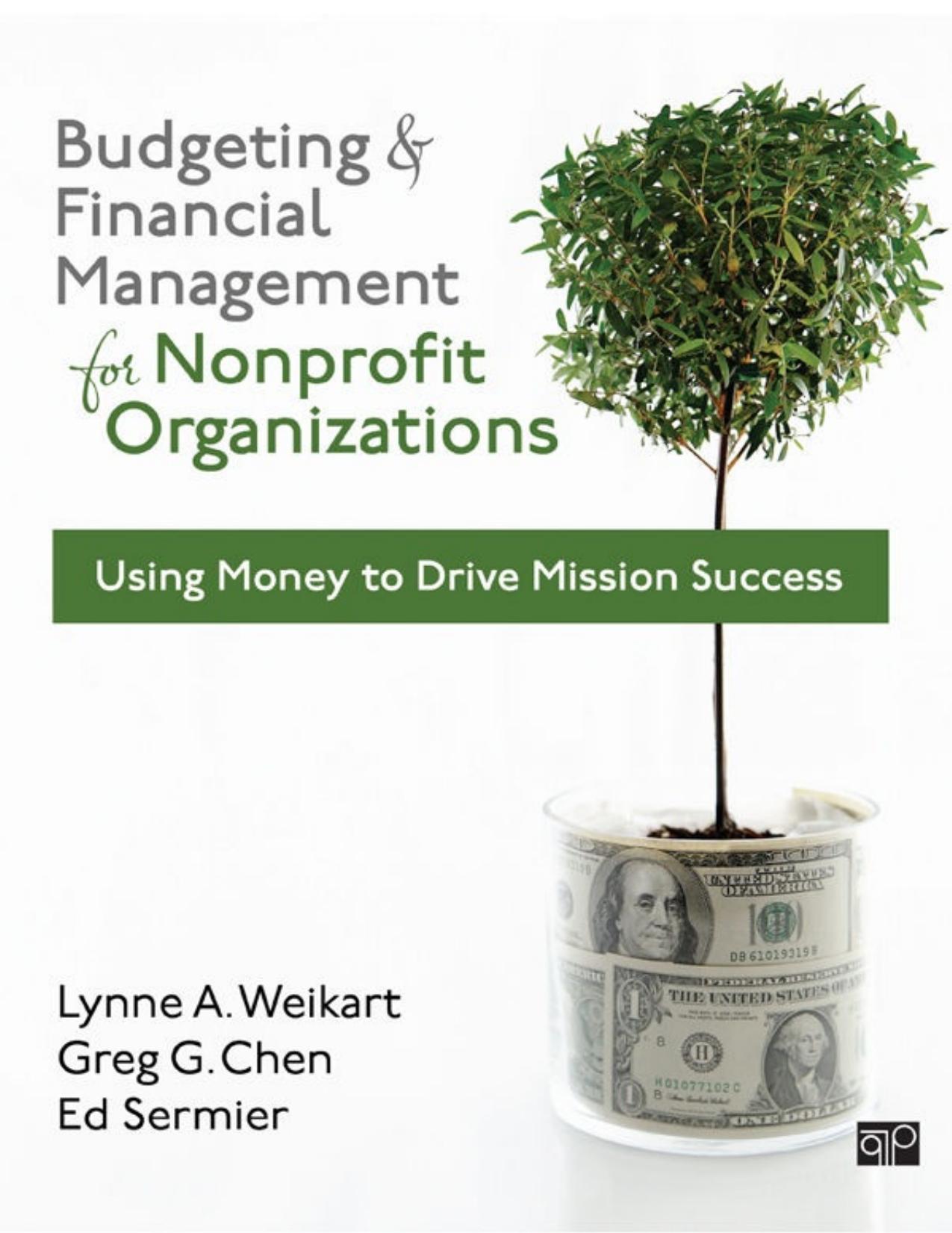
Budgeting and Financial Management for Nonprofit Organizations Using Money to Drive Mission Success 1st edition by Lynne Weikart, Greg Chen, Edward Sermier ISBN 1608716937 978-1608716937
Original price was: $70.00.$35.00Current price is: $35.00.
Instant download Budgeting and Financial Management for Nonprofit Organizations Using Money to Drive Mission Success after payment
Budgeting and Financial Management for Nonprofit Organizations Using Money to Drive Mission Success 1st edition by Lynne Weikart, Greg Chen, Edward Sermier – Ebook PDF Instant Download/Delivery: 1608716937, 978-1608716937
Full download Budgeting and Financial Management for Nonprofit Organizations Using Money to Drive Mission Success 1st edition after payment
Product details:
ISBN 10: 1608716937
ISBN 13: 978-1608716937
Author: Lynne Weikart, Greg Chen, Edward Sermier
In the nonprofit sector, money drives mission. Well-managed budgets and investments can spur long-term growth and achievement, while financial mismanagement can damage or destroy an organization. Lynne A. Weikart, Greg G. Chen, and Ed Sermier―in their exciting new text geared wholly to nonprofits―provide the financial tools nonprofit managers need to thrive in pursuit of mission success.
Given the wide array of nonprofit managers′ backgrounds and a common fear of “the financials,” the authors explain financial concepts without leaning unnecessarily on intimidating jargon. The result is a practical, accessible resource the prepares the next generation of nonprofit managers in financial planning and analysis as well as conventional and entrepreneurial financial management.
Grounded in real-world cases and offering plenty of opportunity for application and practice, Budgeting and Financial Management for Nonprofit Organizations helps readers develop a stable fiscal foundation and sound financial strategies for their organizations to prosper in times of economic expansion and contraction.
Budgeting and Financial Management for Nonprofit Organizations Using Money to Drive Mission Success 1st Table of contents:
PART I: INTRODUCTION
1. An Introduction to Nonprofits: Mission and Money
Definition of a Nonprofit
Nonprofit Origins and Growth
The Modern Nonprofit Structure
The Identification of Nonprofits as the Third Sector
Size and Scope of the Nonprofit World
Nonprofit Structure
Differences between the Business and Nonprofit Worlds
Setting Financial Policies
The Link between Mission and Money
The Push for Accountability: Watchdog Organizations and Their Standards
Conclusion
Discussion Questions
Assignments
Assignment 1.1. Linking Mission to Money
Assignment 1.2. Proposing Improvements to a Nonprofit’s Accountability Standards
Key Terms
Suggested Readings
PART II: PLANNING AND BUDGETING
2. Budgeting as Part of the Planning Process
Budget Vocabulary
The Links between Mission and Budgeting
Roles of the Board, Executive Director, and Staff
The Tools of Budgeting
Budgeting as a Planning Tool
Budgeting as a Management Tool
Budgeting as a Communications Tool
Different Types of Budgets: Operating and Capital
Two Sides of a Coin: Revenue and Expenses
The Link between Operating and Capital Budgets
Formatting Budgets: Line-Item Budgets, Program Budgets, and Performance Budgets
Line-Item Budgets
Program Budgets
Performance Budgeting or Results-Based Budgeting
Cutbacks and Performance-Based Budgets
The Budget Process as a Cycle
The Preparation Stage
The Approval Stage
The Execution Stage
Ending the Fiscal Year: The Auditing and Reporting Stage
Periodic Budget Reviews and Revisions
Applying Indirect Costs for a New Program
Cutback Budgeting
Conclusion
Case Study: Examining the Hypothetical Budget of the Sojourner Truth Settlement House
Discussion Questions
Class Exercise
Class Exercise 2.1. Creating a Projected Budget for a New Program
Assignments
Assignment 2.1. Creating a Nonprofit Budget
Assignment 2.2. Serving Seniors
Key Terms
Suggested Readings
3. Liquidity and Managing Cash Flow
Liquidity
Timing of Cash Flows and Undercapitalization
Restricted Monies
Liquidity Targets
Cash and Cash-Flow Management
Cash Budget
Examples of Cash-Flow Management and Cash-Flow Budget
Working through a Cash-Flow Analysis
Cash-Flow Budgeting in Practice
Cash-Flow and Liquidity Management Issues: Updating the Cash Budget with Actuals
Cash-Flow Strategies
What Do We Do When We Run Out of Cash?
What Do We Do When We Have Too Much Short-Term Cash?
Conclusion
Case Study: Hope for All (HFA) Borrows Money
Discussion Questions
Assignments
Assignment 3.1. Identifying Working Capital and Liquidity
Assignment 3.2. Developing a Cash Budget
Assignment 3.3. Managing Cash Flow
Key Terms
Suggested Readings
4. Costs and Cost Analysis
Opportunity Costs and Accounting Costs
Opportunity Costs
Accounting Costs
A Short Study in Determining Program Costs
Direct Costs and Indirect Costs
Estimating Direct and Indirect Costs
Costing Services and Allocating Costs
Step-Down Method to Allocate Costs
Working through the Step-Down Method
Fixed, Variable, and Step Costs
Average Costs and Marginal Costs
Examples of Average and Marginal Costs
Relevant Costs in Financial Decision Making
Extension of Existing Services: Marginal Analysis
Potential New Programs or Services: Break-Even Analysis
Conclusion
Case Study: New Program at City University to Help the Unemployed
Discussion Questions
Class Exercises
Class Exercise 4.1. Assessing Fixed and Variable Costs
Class Exercise 4.2. Considering Program Expansion with Marginal Analysis
Class Exercise 4.3. Conducting Break-Even Analysis
Assignments
Assignment 4.1. Applying Opportunity Costs to a Grant Application
Assignment 4.2. Determining the Break Even Point for a New Program
Assignment 4.3. Identifying Types of Costs
Key Terms
Suggested Readings
PART III: FINANCIAL ANALYSIS IN NONPROFIT ORGANIZATIONS
5. Basic Principles of Accounting and Reporting Requirements
Accounting Standards Structure
Users of Accounting
Principles of Accounting
The Four Key Assumptions
The Four Basic Principles
The Four Basic Constraints
Basis of Accounting
Cash Accounting
Accrual Accounting
Advantages of the Accrual Accounting Method
Fund Accounting
Unrestricted Net Assets
Temporarily Restricted Net Assets
Permanently Restricted Net Assets
Introduction to Financial Statements
Balance Sheet or Statement of Financial Position
Income Statement or Statement of Activities
Statement of Cash Flow
Statement of Functional Expenses
The Accounting Cycle
Reporting Requirements
National-Level Requirements
State-Level Requirements
The Task of Financial Responsibility
Conclusion
Case Study: Fraud and the Importance of Accounting Principles
Discussion Questions
Class Exercise
Class Exercise 5.1. Identifying Financial Terms
Assignments
Assignment 5.1. The Assumptions, Principles, and Constraints of Accounting
Assignment 5.2. Identifying Cash and Accrual Accounting
Assignment 5.3. Creating Balance Sheets
Assignment 5.4. Reconciling Surplus and Deficit in Wisconsin’s Budget
Key Terms
Suggested Readings
6. Understanding Financial Statements
The Statement of Financial Position (Balance Sheet)
Assets
Current Assets
Long-Term Assets
Liabilities
Current Liabilities
Long-Term Liabilities
Net Assets (Fund Balance)
Unrestricted Net Assets
Temporarily Restricted Funds
Permanently Restricted Net Assets
Nonprofit Financial Statements: The Statement of Activities (Income Statement)
Revenues
Expenses
Relationship between the Statement of Financial Position and the Statement of Activities
Cash-Flow Statement
Statement of Functional Expenses
Conclusion
Discussion Questions
Class Exercise
Class Exercise 6.1. Recording and Categorizing Transactions
Assignments
Assignment 6.1. Recording Transactions
Assignment 6.2. Determining Marketable Securities
Key Terms
Suggested Readings
7. Financial Analysis
Financial Resources
Liquidity
Long-Term Solvency
Efficiency
Profitability
Matching
Revenue Diversification
Conducting Ratio Analysis
Ratios and Liquidity
Ratios and Long-Term Solvency
Ratios and Efficiency
Ratios and Profitability
Matching
Diversification
Red Flags
Financial Health of the ABC Nonprofit Corporation
Ratios and Rating Agencies
Conclusion
Case Study: Financial Analysis of the Montana Mentoring Nonprofit
Discussion Questions
Assignments
Assignment 7.1. Using Ratios to Assess Current and Long-Term Liabilities
Assignment 7.2. A Second Year’s Worth of Data
Assignment 7.3. The MLK Settlement House and Its Profits
Key Terms
Suggested Readings
8. Financial Tools for Informed Decision Making
Reporting Problems in Financial Statements
Separating the Net Asset Classes
Fiscal Year Comparisons within the Statement of Activities
Transferring Funds
Confusion with the Budget
Campaign Funds
Financial Tools to Drive Management Decisions
Breaking Down the Data for Effective Comparison
Determining Financial Issues
Understanding Budgets as an Aid to Mission Success
The Importance of Cash Management
The Benefits of a Quarterly Financial Reporting System
Financial Plans Offer Strategy for the Future
Conclusion
Case Study: Creating a Balanced Budget for Management Decision Making
Assignments
Assignment 8.1. Creating a Statement of Financial Position
Assignment 8.2. Creating a Statement of Activities
Assignment 8.3. Describing the Financial Situation
Key Terms
Suggested Readings
PART IV: FINANCIAL MANAGEMENT
9. Understanding Revenues
Theoretical Development on Nonprofits’ Finance: The Benefit Theory
Types of Benefits
Matching Benefits and Revenues
Existing Sources of Revenue
Donations
Government Grants and Fees for Services and Goods from Government
Earned Revenues
Nonprofit Revenue Strategies
Funding Models of Large Nonprofits: The Benefit Theory in Practice
Diversification: Revenue Strategies and Risk Management
Advantages and Disadvantages of Different Funding Sources
Conclusion
Case Study: An Environmental Nonprofit Considers Extending Its Cleanup Program
Discussion Questions
Assignments
Assignment 9.1. Identifying Main Sources of Revenue
Assignment 9.2. Using the Benefit Theory in Revenue Strategy
Assignment 9.3. Considering a Deal for Corporate Support
Assignment 9.4. Assessing a Nonrelated Business
Key Terms
Suggested Readings
10. Performance Measurement in Financial Management
Performance Measurement’s Role in Mission Success
Linking to Budgets
Educating Stakeholders
Managing Resources
The Ingredients to Measuring Program Performance
Inputs, Process, Outputs, and Outcomes
The Challenges of Measuring Effectiveness
Efficiency or Unit Cost Ratio as Compared to Effectiveness
The Development of Performance Management Systems
The Urban Institute’s Steps to Develop a Performance Management System
The Balanced Scorecard System
The Challenges of Selecting Performance Indicators
Outcomes as Compared to Outputs
Relationship between Program Evaluation and Performance Measurement
Performance Measures and Management Information Systems
The Role of the Federal Government
The Role of Foundations and Policy Centers
Conclusion
Case Study: Mentoring Program to Reintegrate Ex-Prisoners into the Community
Discussion Questions
Class Exercise
Class Exercise 10.1. Indicators of Program Performance
Assignments
Assignment 10.1. Identifying Program Performance Indicators
Assignment 10.2. Working within the Balanced Scorecard Framework
Assignment 10.3. Developing a Performance Management System
Key Terms
Suggested Readings
11. Time Value of Money and Cost-Benefit Analysis
The Time Value of Money
Calculating Future Value
Calculating Present Value
Net Present Value: A Decision Criterion
Introduction to Cost-Benefit Analysis
Conceptual Framework of CBA
Steps in Conducting CBA
Conclusion
Case Study: Cost-Benefit Analysis for a Nonprofit Hospital Considering Adopting New Technology
Discussion Questions
Assignments
Assignment 11.1. Calculating Future Value
Assignment 11.2. Budgeting for Debt Service Payment
Assignment 11.3. Evaluating Property Purchase
Key Terms
Suggested Readings
12. Capital Budgeting and Financing
Capital Budgeting and Capital Assets
The Relationship between Capital Budgets and Operating Budgets
Accepting or Not Accepting a Donated Capital Asset: An Example
Capital Budgeting Process
Life-Cycle Costing
Capital Financing: Pay-as-You-Go and Debt Financing
Debt Financing: Bank Loans and Bond Issuance
Securing a Bank Loan
Issuing Bonds
Payment Schedules
Level Debt Service Payments
Level Principal Payments
Capital Budgeting Policy and Debt Policy
Conclusion
Case Study: The Drug-Free Center Considers Which Repayment Schedule to Select in Bond Financing Its Facility Expansion
Discussion Questions
Assignments
Assignment 12.1. Conducting Life-Cycle Costing
Assignment 12.2. Preparing a Level Debt Service Bond Payment Schedule
Assignment 12.3. Understanding Capital Budgeting
Key Terms
Suggested Readings
13. Investment Strategies
Investment Policies and Guidelines
Roles and Responsibilities of the Board
Investment Policy Statement
Short-Term Investment Strategy
Issues in Short-Term Investment
Investment Objectives: Safety, Liquidity, and Yield
Default and Market Risks
Key Short-Term Investment Vehicles
Long-Term Investment Strategy
Key Issues in Endowment Investment: Spending Policy
Key Issues in Endowment Investment: Investment Policy
Other Key Investment Practices and Considerations
Key Long-Term Investment Vehicles and Instruments
Conclusion
Case Study: The Financial Manager Takes Steps to Manage a New Endowment
Discussion Questions
Assignments
Assignment 13.1. Formulating an Investment Policy
Assignment 13.2. Where to Invest Short-Term
Assignment 13.3. Managing Endowment Funds
Key Terms
Suggested Readings
14. Internal Controls
Defining Internal Controls
The Internal Control System
Safeguarding Assets
Controlling Personnel and Nonpersonnel Services
Setting Audit Standards
The Independent Sector and Accountability
The Sarbanes-Oxley Act
Examples of Fraud
Controlling Cash and Its Equivalents and Reconciliation of Bank Accounts
Accessing Cash: Forging Signatures and Controlling Payroll
Nonprofits as Victims
Conclusion
Discussion Questions
Assignments
Assignment 14.1. Crafting Internal Control Policies to Prevent Conflict of Interest
Assignment 14.2. Applying Internal Control Policies to Guard against Theft
Assignment 14.3. Using Internal Control Policies to Discourage Fraud
Key Terms
Suggested Readings
PART V: NEW DIRECTIONS
15. Adapting to Turbulent Times: Conventional and Entrepreneurial Financial Strategies
The Effects of the Economic Crisis
Assessing Financial Risks
Mitigating Risk: Increasing Revenues
Mitigating Risk: Cutting Costs
Mitigating Risk: Collaborations
Changing the Structure
The Growth of Nonprofit Capital Intermediaries
Venture Philanthropy
Nonprofit Loan Funds
The Role of Government in Promoting Innovation
The Federal Level
State Government Models
Local Government Models
University Models
The Role of Foundations in Promoting Social Enterprise
The Fourth Sector of Social Enterprise
The Yunus Centre
Program-Related Investments and the New L3Cs
The Rise of the B Corporation
Conclusion
Discussion Questions
Assignment
Assignment 15.1. Exploring Social Entrepreneurship
Key Terms
Suggested Readings
Appendixes
Appendix A: Form 990
Appendix B: Debits and Credits
Appendix C: Sample Investment Policy Statement for Nonprofit Education Foundations
Glossary
Index
People also search for Budgeting and Financial Management for Nonprofit Organizations Using Money to Drive Mission Success 1st:
healthcare budgeting and financial management
certificate in budgeting and financial management
the basics of public budgeting and financial management
public budgeting and financial
association for budgeting and financial management
Tags: Lynne Weikart, Greg Chen, Edward Sermier, Financial Management, Nonprofit Organizations