

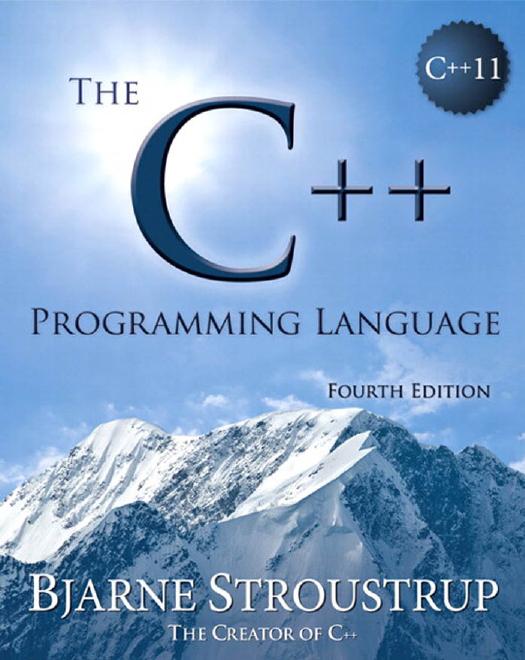
C Programming Language The 4th edition by Bjarne Stroustrup – Ebook PDF Instant Download/Delivery: 0321958322, 978-0321958327
Full download C Programming Language The 4th edition after payment
Product details:
ISBN 10: 0321958322
ISBN 13: 978-0321958327
Author: Bjarne Stroustrup
The new C++11 standard allows programmers to express ideas more clearly, simply, and directly, and to write faster, more efficient code. Bjarne Stroustrup, the designer and original implementer of C++, has reorganized, extended, and completely rewritten his definitive reference and tutorial for programmers who want to use C++ most effectively.
The C++ Programming Language, Fourth Edition, delivers meticulous, richly explained, and integrated coverage of the entire language―its facilities, abstraction mechanisms, standard libraries, and key design techniques. Throughout, Stroustrup presents concise, “pure C++11” examples, which have been carefully crafted to clarify both usage and program design. To promote deeper understanding, the author provides extensive cross-references, both within the book and to the ISO standard.
New C++11 coverage includes
- Support for concurrency
- Regular expressions, resource management pointers, random numbers, and improved containers
- General and uniform initialization, simplified for-statements, move semantics, and Unicode support
- Lambdas, general constant expressions, control over class defaults, variadic templates, template aliases, and user-defined literals
- Compatibility issues
Topics addressed in this comprehensive book include
- Basic facilities: type, object, scope, storage, computation fundamentals, and more
- Modularity, as supported by namespaces, source files, and exception handling
- C++ abstraction, including classes, class hierarchies, and templates in support of a synthesis of traditional programming, object-oriented programming, and generic programming
- Standard Library: containers, algorithms, iterators, utilities, strings, stream I/O, locales, numerics, and more
- The C++ basic memory model, in depth
This fourth edition makes C++11 thoroughly accessible to programmers moving from C++98 or other languages, while introducing insights and techniques that even cutting-edge C++11 programmers will find indispensable.
This is a hardcover version of the Fourth Edition. Content in this hardcover and the paperback version is identical.
This book features an enhanced, layflat binding, which allows the book to stay open more easily when placed on a flat surface. This special binding method―noticeable by a small space inside the spine―also increases durability.
C Programming Language The 4th Table of contents:
Part I: Introduction
1. Notes to the Reader
1.1. The Structure of This Book
1.2. The Design of C++
1.3. Learning C++
1.4. History
1.5. Advice
1.6. References
2. A Tour of C++: The Basics
2.1. Introduction
2.2. The Basics
2.3. User-Defined Types
2.4. Modularity
2.5. Postscript
2.6. Advice
3. A Tour of C++: Abstraction Mechanisms
3.1. Introduction
3.2. Classes
3.3. Copy and Move
3.4. Templates
3.5. Advice
4. A Tour of C++: Containers and Algorithms
4.1. Libraries
4.2. Strings
4.3. Stream I/O
4.4. Containers
4.5. Algorithms
4.6. Advice
5. A Tour of C++: Concurrency and Utilities
5.1. Introduction
5.2. Resource Management
5.3. Concurrency
5.4. Small Utility Components
5.5. Regular Expressions
5.6. Math
5.7. Advice
Part II: Basic Facilities
6. Types and Declarations
6.1. The ISO C++ Standard
6.2. Types
6.3. Declarations
6.4. Objects and Values
6.5. Type Aliases
6.6. Advice
7. Pointers, Arrays, and References
7.1. Introduction
7.2. Pointers
7.3. Arrays
7.4. Pointers into Arrays
7.5. Pointers and const
7.6. Pointers and Ownership
7.7. References
7.8. Advice
8. Structures, Unions, and Enumerations
8.1. Introduction
8.2. Structures
8.3. Unions
8.4. Enumerations
8.5. Advice
9. Statements
9.1. Introduction
9.2. Statement Summary
9.3. Declarations as Statements
9.4. Selection Statements
9.5. Iteration Statements
9.6. goto Statements
9.7. Comments and Indentation
9.8. Advice
10. Expressions
10.1. Introduction
10.2. A Desk Calculator
10.3. Operator Summary
10.4. Constant Expressions
10.5. Implicit Type Conversion
10.6. Advice
11. Select Operations
11.1. Etc. Operators
11.2. Free Store
11.3. Lists
11.4. Lambda Expressions
11.5. Explicit Type Conversion
11.6. Advice
12. Functions
12.1. Function Declarations
12.2. Argument Passing
12.3. Overloaded Functions
12.4. Pre- and Postconditions
12.5. Pointer to Function
12.6. Macros
12.7. Advice
13. Exception Handling
13.1. Error Handling
13.2. Exception Guarantees
13.3. Resource Management
13.4. Enforcing Invariants
13.5. Throwing and Catching Exceptions
13.6. A vector Implementation
13.7. Advice
14. Namespaces
14.1. Composition Problems
14.2. Namespaces
14.3. Modularization and Interfaces
14.4. Composition Using Namespaces
14.5. Advice
15. Source Files and Programs
15.1. Separate Compilation
15.2. Linkage
15.3. Using Header Files
15.4. Programs
15.5. Advice
Part III: Abstraction Mechanisms
16. Classes
16.1. Introduction
16.2. Class Basics
16.3. Concrete Classes
16.4. Advice
17. Construction, Cleanup, Copy, and Move
17.1. Introduction
17.2. Constructors and Destructors
17.3. Class Object Initialization
17.4. Member and Base Initialization
17.5. Copy and Move
17.6. Generating Default Operations
17.7. Advice
18. Operator Overloading
18.1. Introduction
18.2. Operator Functions
18.3. A Complex Number Type
18.4. Type Conversion
18.5. Advice
19. Special Operators
19.1. Introduction
19.2. Special Operators
19.3. A String Class
19.4. Friends
19.5. Advice
20. Derived Classes
20.1. Introduction
20.2. Derived Classes
20.3. Class Hierarchies
20.4. Abstract Classes
20.5. Access Control
20.6. Pointers to Members
20.7. Advice
21. Class Hierarchies
21.1. Introduction
21.2. Design of Class Hierarchies
21.3. Multiple Inheritance
21.4. Advice
22. Run-Time Type Information
22.1. Introduction
22.2. Class Hierarchy Navigation
22.3. Double Dispatch and Visitors
22.4. Construction and Destruction
22.5. Type Identification
22.6. Uses and Misuses of RTTI
22.7. Advice
23. Templates
23.1. Introduction and Overview
23.2. A Simple String Template
23.3. Type Checking
23.4. Class Template Members
23.5. Function Templates
23.6. Template Aliases
23.7. Source Code Organization
23.8. Advice
24. Generic Programming
24.1. Introduction
24.2. Algorithms and Lifting
24.3. Concepts
24.4. Making Concepts Concrete
24.5. Advice
25. Specialization
25.1. Introduction
25.2. Template Parameters and Arguments
25.3. Specialization
25.4. Advice
26. Instantiation
26.1. Introduction
26.2. Template Instantiation
26.3. Name Binding
26.4. Advice
27. Templates and Hierarchies
27.1. Introduction
27.2. Parameterization and Hierarchy
27.3. Hierarchies of Class Templates
27.4. Template Parameters as Base Classes
27.5. Advice
28. Metaprogramming
28.1. Introduction
28.2. Type Functions
28.3. Control Structures
28.4. Conditional Definition: Enable_if
28.5. A Compile-Time List: Tuple
28.6. Variadic Templates
28.7. SI Units Example
28.8. Advice
29. A Matrix Design
29.1. Introduction
29.2. A Matrix Template
29.3. Matrix Arithmetic Operations
29.4. Matrix Implementation
29.5. Solving Linear Equations
29.6. Advice
Part IV: The Standard Library
30. Standard-Library Overview
30.1. Introduction
30.2. Headers
30.3. Language Support
30.4. Error Handling
30.5. Advice
31. STL Containers
31.1. Introduction
31.2. Container Overview
31.3. Operations Overview
31.4. Containers
31.5. Container Adaptors
31.6. Advice
32. STL Algorithms
32.1. Introduction
32.2. Algorithms
32.3. Policy Arguments
32.4. Nonmodifying Sequence Algorithms
32.5. Modifying Sequence Algorithms
32.6. Sorting and Searching
32.7. Min and Max
32.8. Advice
33. STL Iterators
33.1. Introduction
33.2. Iterator Adaptors
33.3. Range Access Functions
33.4. Function Objects
33.5. Function Adaptors
33.6. Advice
34. Memory and Resources
34.1. Introduction
34.2. “Almost Containers”
34.3. Resource Management Pointers
34.4. Allocators
34.5. The Garbage Collection Interface
34.6. Uninitialized Memory
34.7. Advice
35. Utilities
35.1. Introduction
35.2. Time
35.3. Compile-Time Rational Arithmetic
35.4. Type Functions
35.5. Minor Utilities
35.6. Advice
36. Strings
36.1. Introduction
36.2. Character Classification
36.3. Strings
36.4. Advice
37. Regular Expressions
37.1. Regular Expressions
37.2. regex
37.3. Regular Expression Functions
37.4. Regular Expression Iterators
37.5. regex_traits
37.6. Advice
38. I/O Streams
38.1. Introduction
38.2. The I/O Stream Hierarchy
38.3. Error Handling
38.4. I/O Operations
38.5. Stream Iterators
38.6. Buffering
38.7. Advice
39. Locales
39.1. Handling Cultural Differences
39.2. Class locale
39.3. Class facet
39.4. Standard facets
39.5. Convenience Interfaces
39.6. Advice
40. Numerics
40.1. Introduction
40.2. Numerical Limits
40.3. Standard Mathematical Functions
40.4. complex Numbers
40.5. A Numerical Array: valarray
40.6. Generalized Numerical Algorithms
40.7. Random Numbers
40.8. Advice
41. Concurrency
41.1. Introduction
41.2. Memory Model
41.3. Atomics
41.4. volatile
41.5. Advice
42. Threads and Tasks
42.1. Introduction
42.2. Threads
42.3. Avoiding Data Races
42.4. Task-Based Concurrency
42.5. Advice
43. The C Standard Library
43.1. Introduction
43.2. Files
43.3. The printf() Family
43.4. C-Style Strings
43.5. Memory
43.6. Date and Time
43.7. Etc.
43.8. Advice
44. Compatibility
44.1. Introduction
44.2. C++11 Extensions
44.3. C/C++ Compatibility
44.4. Advice
Index
Preparation for Programming in the Real World
Code Snippets
People also search for C Programming Language The 4th:
who developed the c programming language
history of the c programming language
introduction to the c programming language
who is the father of the c programming language
the c programming language (k&r)
Tags: Bjarne Stroustrup, C Programming