

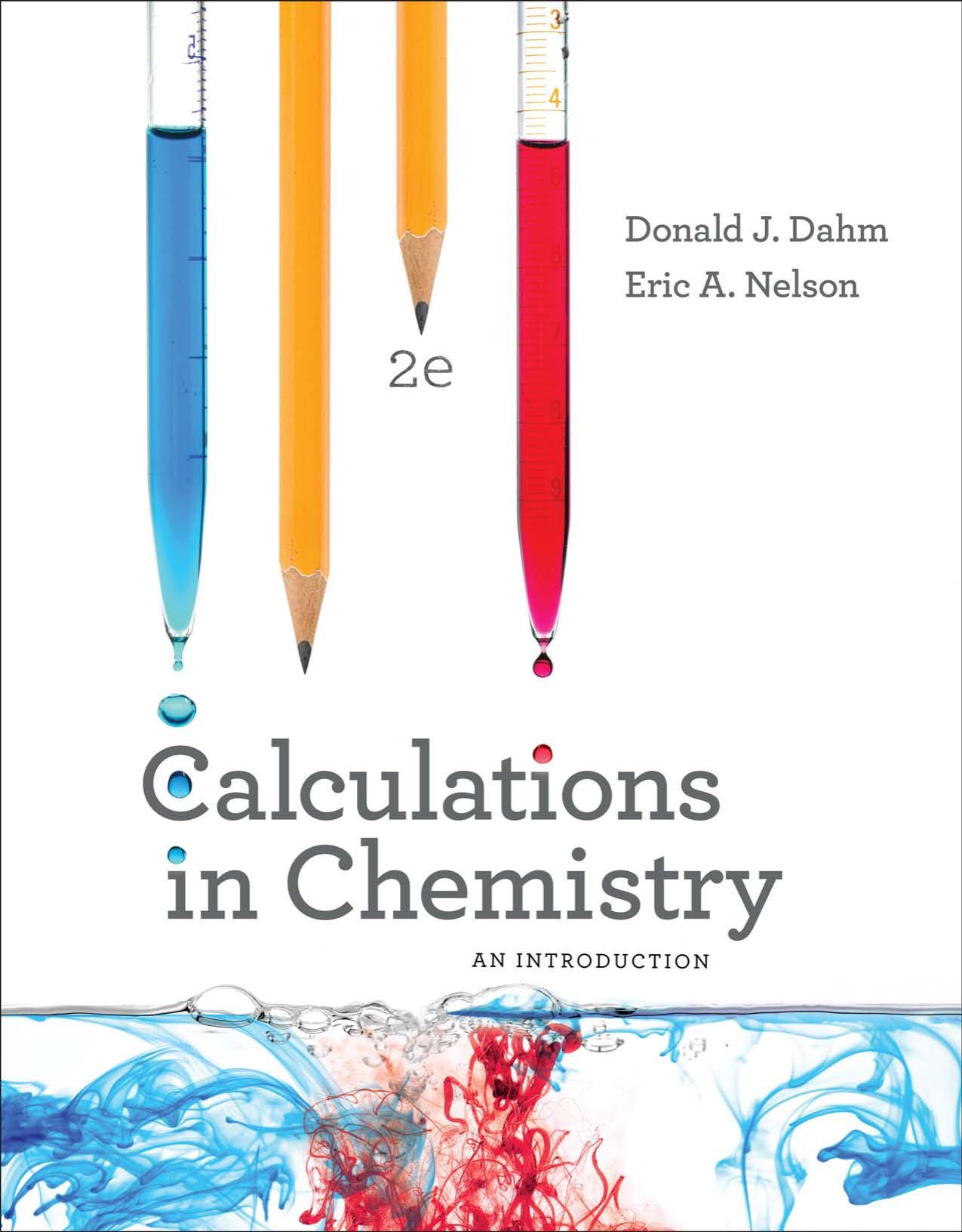
Calculations in Chemistry An Introduction 2nd Edition by Donald Dahm, Eric Nelson – Ebook PDF Instant Download/Delivery: 0393614367, 978-0393614367
Full download Calculations in Chemistry An Introduction 2nd edition after payment
Product details:
ISBN 10: 0393614367
ISBN 13: 978-0393614367
Author: Donald Dahm, Eric Nelson
Calculations in Chemistry uses the latest cognitive research to systematically teach beginning chemistry students the calculations they need for success in first-year chemistry. Instructors can track student progress with Smartwork5 online homework.
Calculations in Chemistry An Introduction 2nd Table of contents:
1 – Numbers in Scientific Calculations
Lesson 1.1 – Learning Chemistry
Lesson1.2 – Numeracy
Lesson 1.3 – Moving the Decimal
Lesson 1.4 – Calculations Using Exponential Notation
Lesson 1.5 – Estimation and Exponential Calculations
2 – The Metric System
Lesson 2.1 – Metric Fundamentals
Lesson 2.2 – Metric Prefixes
Lesson 2.3 – Flashcards
Lesson 2.4 – Calculations with Units
3 – Atoms—and Significant Figures
Lesson 3.1 – The Atoms (Part 1)
Lesson 3.2 – Uncertainty and Significant Figures
Lesson 3.3 – Calculating with Significant Figures
Lesson 3.4 – Zeros and Exact Numbers
4 – Conversion Factors
Lesson 4.1 – Conversion Factor Basics
Lesson 4.2 – Single-Step Conversions
Lesson 4.3 – Multistep Conversions
Lesson 4.4 – Conversions between the English and Metric Systems
Lesson 4.5 – Ratio-Unit Conversions
5 – Word Problems
Lesson 5.1 – Answer Units
Lesson 5.2 – Mining the data
Lesson 5.3 – Solving for Single Units
Lesson 5.4 – Finding the Given for Single Units
6 – Atoms, Ions, and Periodicity
Lesson 6.1 – The Atoms (Part 2)
Lesson 6.2 – Atoms: Terms and Definitions
Lesson 6.3 – The Nucleus
Lesson 6.4 – Elements and Compounds
Lesson 6.5 – The Periodic Table
7 – Writing Names and Formulas
Lesson 7.1 – Elements and Compounds
Lesson 7.2 – Naming Binary Molecular Compounds
Lesson 7.3 – Naming Ions
Lesson 7.4 – Names and Formulas for Ionic Compounds
8 – Moles and Balancing Equations
Lesson 8.1 – Counting Atoms in Formulas
Lesson 8.2 – Moles and Molar Masses
Lesson 8.3 – Grams, Moles, and Particles
Lesson 8.4 – Reactions and Equations
Lesson 8.5 – Balancing Equations
9 – Stoichiometry
Lesson 9.1 – Ratios of Reaction
Lesson 9.2 – Conversion Stoichiometry
Lesson 9.3 – Limiting Reactants
Lesson 9.4 – Limiting Reactant Calculations
10 – Molarity
Lesson 10.1 – Ratio Units
Lesson 10.2 – Answer Units That Are Ratios
Lesson 10.3 – Molarity Calculations
11 – Dimensions
Lesson 11.1 – Units and Dimensions
Lesson 11.2 – Using Dimensions to Arrange Conversions
Lesson 11.3 – Ratios versus Two Related Amounts
Lesson 11.4 – Solving Problems with Parts
12 – Concentration Calculations
Lesson 12.1 – Dilution
Lesson 12.2 – Ion Concentrations
Lesson 12.3 – Fractions and Percentages
Lesson 12.4 – Concentration in Mass Percent
13 – Ionic Equations and Precipitates
Lesson 13.1 – Ionic Compound Solubility
Lesson 13.2 – Total and Net Ionic Equations
Lesson 13.3 – Balancing Precipitation Equations
Lesson 13.4 – Predicting Precipitation
14 – Acid–Base Neutralization
Lesson 14.1 – Ions in Acids and Bases
Lesson 14.2 – Balancing Hydroxide Neutralization
Lesson 14.3 – Neutralization Calculations
Lesson 14.4 – Titration
15 – Redox Reactions
Lesson 15.1 – Oxidation Numbers
Lesson 15.2 – Half Reactions and Balancing Charge
Lesson 15.3 – Oxidizing and Reducing Agents
Lesson 15.4 – Balancing Based on Oxidation Numbers
16 – Gas Laws I: Solving Equations
Lesson 16.1 – Gas Fundamentals
Lesson 16.2 – Gases at STP
Lesson 16.3 – Cancellation of Complex Units
Lesson 16.4 – The Ideal Gas Law and Equations
17 – Gas Laws II: Choosing Equations
Lesson 17.1 – Choosing Consistent Units
Lesson 17.2 – The Combined Equation
Lesson 17.3 – Simplifying Conditions
Lesson 17.4 – Choosing the Right Equation
18 – Phases and Energy
Lesson 18.1 – Phases
Lesson 18.2 – Potential and Kinetic Energy
Lesson 18.3 – Phase Changes and Energy
Lesson 18.4 – Specific Heat Capacity
Lesson 18.5 – Heat Calculations
Lesson 18.6 – Consistent Units in Heat Calculations
19 – Bonding
Lesson 19.1 – Lewis Structures
Lesson 19.2 – Molecular Shapes and Bond Angles
Lesson 19.3 – Electronegativity
Lesson 19.4 – Predicting the Polarity of Substances
20 – Introduction to Equilibrium
Lesson 20.1 – Reversible Reactions
Lesson 20.2 – Le Châtelier’s Principle
Lesson 20.3 – Equilibrium Constants
Lesson 20.4 – Equilibrium Constant Values
21 – Equilibrium Calculations
Lesson 21.1 – Powers and Roots of Exponential Notation
Lesson 21.2 – Equilibrium Constant Calculations
Lesson 21.3 – RICE Tables
Lesson 21.4 – RICE Tables and K Calculations
22 – Acid–Base Fundamentals
Lesson 22.1 – Acid–Base Math Review
Lesson 22.2 – Kw Calculations
Lesson 22.3 – Strong Acid Solutions
Lesson 22.4 – [OH-] in Acid Solutions
Lesson 22.5 – Strong Base Solutions
23 – pH and Weak Acids
Lesson 23.1 – Base 10 Logarithms
Lesson 23.2 – The pH System
Lesson 23.3 – Weak Acids and Ka Expressions
Lesson 23.4 – Ka Equations
Lesson 23.5 – Math for Ka Calculations
Lesson 23.6 – Ka Calculations
24 – Nuclear Chemistry
Lesson 24.1 – Isotopes and Radioactive Decay
Lesson 24.2 – Radioactive Half-Life
Lesson 24.3 – Natural Logarithms
Lesson 24.4 – Radioactive Half-Life Calculations
Table of Atomic Masses
The Periodic Table of the Elements
Index
People also search for Calculations in Chemistry An Introduction 2nd:
calculations in chemistry an introduction pdf
calculations in chemistry an introduction 2nd edition
what is the introduction of chemistry
calculations in chemistry an introduction second edition
how to calculate in chemistry
Tags: Donald Dahm, Eric Nelson, An Introduction, Calculations in Chemistry