


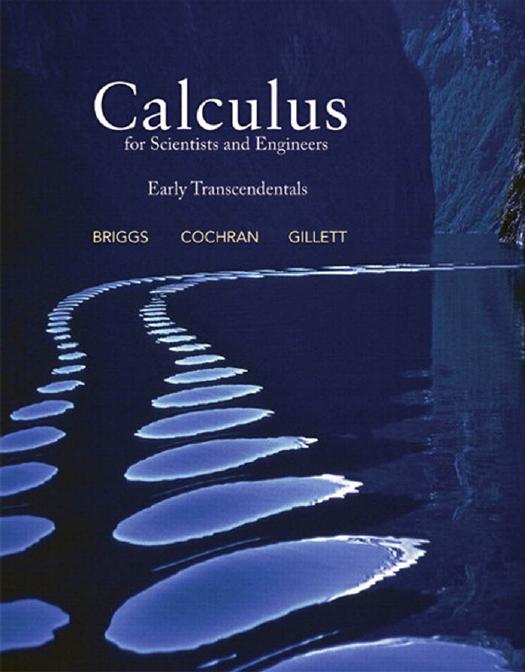
Calculus for Scientists and Engineers 1st by Bill Briggs, Lyle Cochran, Bernard Gillett, Eric Schulz, William Briggs – Ebook PDF Instant Download/Delivery: 0321826698 , 9780321826695
Full download Calculus for Scientists and Engineers 1st edition after payment
Product details:
ISBN 10: 0321826698
ISBN 13: 9780321826695
Author: Bill Briggs, Lyle Cochran, Bernard Gillett, Eric Schulz, William Briggs
Normal 0 false false false Normal 0 false false false Briggs/Cochran is the most successful new calculus series published in the last two decades. The authors’ years of teaching experience resulted in a text that reflects how students generally use a textbook: they start in the exercises and refer back to the narrative for help as needed. The text therefore builds from a foundation of meticulously crafted exercise sets, then draws students into the narrative through writing that reflects the voice of the instructor, examples that are stepped out and thoughtfully annotated, and figures that are designed to teach rather than simply supplement the narrative. The authors appeal to students’ geometric intuition to introduce fundamental concepts, laying a foundation for the rigorous development that follows.
KEY TOPICS: Functions, Limits, Derivatives, Applications of the Derivative, Integration, Applications of Integration, Integration Techniques, Differential Equations, Sequences and Infinite Series, Power Series, Parametric and Polar Curves, Vectors and Vector-Valued Functions, Functions of Several Variables, Multiple Integration, Vector Calculus MARKET: For all readers interested in calculus.
Calculus for Scientists and Engineers 1st Table of contents:
Normal 0 false false false MicrosoftInternetExplorer
1. Functions
1.1 Review of functions
1.2 Representing functions
1.3 Trigonometric functions and their inverses
Review
2. Limits
2.1 The idea of limits
2.2 Definitions of limits
2.3 Techniques for computing limits
2.4 Infinite limits
2.5 Limits at infinity
2.6 Continuity
2.7 Precise definitions of limits
Review
3. Derivatives
3.1 Introducing the derivative
3.2 Rules of differentiation
3.3 The product and quotient rules
3.4 Derivatives of trigonometric functions
3.5 Derivatives as rates of change
3.6 The Chain Rule
3.7 Implicit differentiation
3.8 Derivatives of inverse trigonometric functions
3.9 Related rates
Review
4. Applications of the Derivative
4.1 Maxima and minima
4.2 What derivatives tell us
4.3 Graphing functions
4.4 Optimization problems
4.5 Linear approximation and differentials
4.6 Mean Value Theorem
4.7 L’Hôpital’s Rule
4.8 Newton’s method
4.9 Antiderivatives
Review
5. Integration
5.1 Approximating areas under curves
5.2 Definite integrals
5.3 Fundamental Theorem of Calculus
5.4 Working with integrals
5.5 Substitution rule
Review
6. Applications of Integration
6.1 Velocity and net change
6.2 Regions between curves
6.3 Volume by slicing
6.4 Volume by shells
6.5 Length of curves
6.6 Surface area
6.7 Physical applications
6.8 Hyperbolic functions
Review
7. Logarithmic and Exponential Functions
7.1 Inverse functions
7.2 The natural logarithm and exponential functions
7.3 Logarithmic and exponential functions with general bases
7.4 Exponential models
7.5 Inverse trigonometric functions
7.6 L’Hôpital’s rule and growth rates of functions
Review
8. Integration Techniques
8.1 Basic approaches
8.2 Integration by parts
8.3 Trigonometric integrals
8.4 Trigonometric substitutions
8.5 Partial fractions
8.6 Other integration strategies
8.7 Numerical integration
8.8 Improper integrals
Review
9. Differential Equations
9.1 Basic ideas
9.2 Direction fields and Euler’s method
9.3 Separable differential equations
9.4 Special first-order differential equations
9.5 Modeling with differential equations
Review
10. Sequences and Infinite Series
10.1 An overview
10.2 Sequences
10.3 Infinite series
10.4 The Divergence and Integral Tests
10.5 The Ratio, Root, and Comparison Tests
10.6 Alternating series
Review
11. Power Series
11.1 Approximating functions with polynomials
11.2 Properties of power series
11.3 Taylor series
11.4 Working with Taylor series
Review
12. Parametric and Polar Curves
12.1 Parametric equations
12.2 Polar coordinates
12.3 Calculus in polar coordinates
12.4 Conic sections
Review
13. Vectors and Vector-Valued Functions
13.1 Vectors in the plane
13.2 Vectors in three dimensions
13.3 Dot products
13.4 Cross products
13.5 Lines and curves in space
13.6 Calculus of vector-valued functions
13.7 Motion in space
13.8 Length of curves
13.9 Curvature and normal vectors
Review
14. Functions of Several Variables
14.1 Planes and surfaces
14.2 Graphs and level curves
14.3 Limits and continuity
14.4 Partial derivatives
14.5 The Chain Rule
14.6 Directional derivatives and the gradient
14.7 Tangent planes and linear approximation
14.8 Maximum/minimum problems
14.9 Lagrange multipliers
Review
15. Multiple Integration
15.1 Double integrals over rectangular regions
15.2 Double integrals over general regions
15.3 Double integrals in polar coordinates
15.4 Triple integrals
15.5 Triple integrals in cylindrical and spherical coordinates
15.6 Integrals for mass calculations
15.7 Change of variables in multiple integrals
Review
16. Vector Calculus
16.1 Vector fields
16.2 Line integrals
16.3 Conservative vector fields
16.4 Green’s theorem
16.5. Divergence and curl
16.6 Surface integrals
16.6 Stokes’ theorem
16.8 Divergence theorem
Review
People also search for Calculus for Scientists and Engineers 1st:
applied calculus for scientists and engineers
fractional calculus for scientists and engineers
fractional calculus for scientists and engineers pdf
calculus for scientists and engineers pdf
calculus for scientists and engineers k.d. joshi pdf
Tags: Bill Briggs, Lyle Cochran, Bernard Gillett, Eric Schulz, William Briggs, Scientists and Engineers