


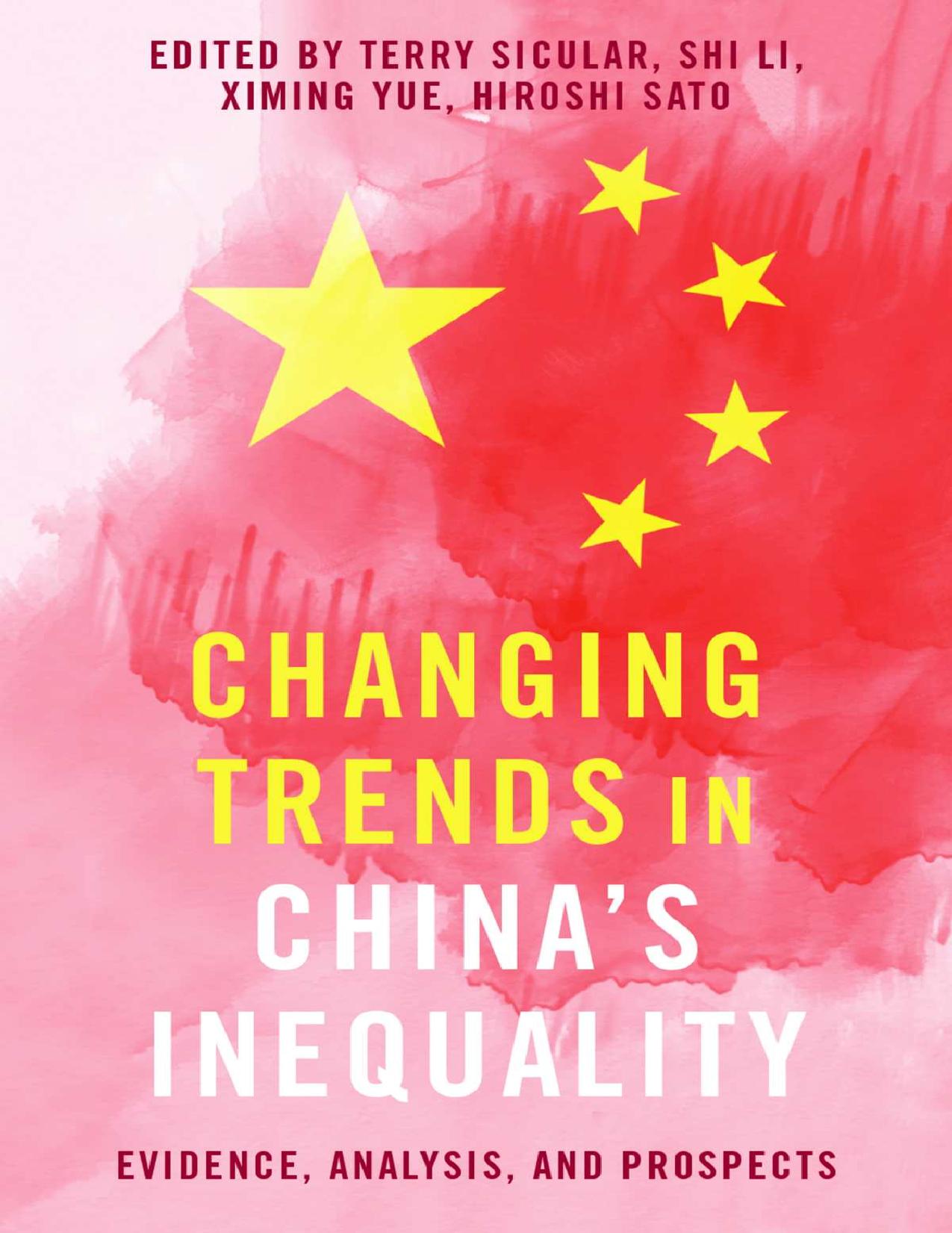
Changing Trends in China’s Inequality 1st edition by Terry Sicular, Shi Li, Ximing Yue, Hiroshi Sato ISBN 0190077938 9780190077938
Original price was: $70.00.$35.00Current price is: $35.00.
Instant download Changing Trends in China’s Inequality Terry Sicular Shi Li Ximing Yue Hiroshi Sato after payment
Changing Trends in China’s Inequality 1st edition by Terry Sicular, Shi Li, Ximing Yue, Hiroshi Sato – Ebook PDF Instant Download/Delivery: 0190077938, 9780190077938
Full download Changing Trends in China’s Inequality 1st edition after payment
Product details:
ISBN 10: 0190077938
ISBN 13: 9780190077938
Author: Terry Sicular, Shi Li, Ximing Yue, Hiroshi Sato
Over the past quarter-century China has seen a dramatic increase in income inequality, prompting a shift in China’s development strategy and the adoption of an array of new policies to redistribute income, promote shared growth, and establish a social safety net. Drawing on of household-level data from the China Household Income Project, Changing Trends in China’s Inequality provides an independent, comprehensive, and empirically grounded study of the evolution of incomes and inequality in China over time. Edited by leading experts on the Chinese economy, the volume analyzes this evolution in China as a whole as well as in the urban and rural sectors, with close attention to measurement issues and to shifts in the economy, institutions, and public policy. Specific essays provides analyses of China’s wealth inequality, the emergence of a new middle class, the income gap between the Han majority and the ethnic minorities, the gender wage gap, and the impacts of government policies such as social welfare programs and the minimum wage.
Changing Trends in China’s Inequality 1st Table of contents:
1. Changing Trends in China’s Inequality: Key Issues and Main Findings
1.1 Introduction
1.2 Recent Economic and Policy Developments
1.3 The CHIP Data
1.4 Measurement of Income
1.5 Estimates of China’s Income Inequality: CHIP, NBS, and Others
1.6 Main Findings
1.7 Conclusions
2. Overview: Incomes and Inequality in China, 2007‒2013
2.1 Introduction
2.2 Data, Weights, and Income Definition
2.3 National Incomes and Inequality
2.4 Incomes and Inequality within the Rural and Formal Urban Sectors
2.5 Rural-to-Urban Migrants and Inequality
2.6 Urban/Rural and Regional Income Gaps
2.7 Incorporating Top Incomes
2.8 Conclusion
A2 Appendix: Methodology Used to Incorporate Top Incomes in the Estimation of the Gini Coefficient
3. China’s Emerging Global Middle Class
3.1 Introduction
3.2 The Meaning of “Middle Class” in Chinese Policy Making and Academic Studies
3.3 The Meaning of the Global Middle Class
3.4 Data and Operational Assumptions
3.5 Growth of the Chinese Middle Class
3.6 Analyzing the Growth of the Chinese Middle Class
3.7 Characteristics of China’s Middle Class
3.8 Conclusions
4. The Increasing Inequality of Wealth in China
4.1 Introduction
4.2 Literature
4.3 China’s Rising Inequality of Wealth and Its Possible Causes
4.4 The Data
4.5 The Level of Wealth and Its Growth, 2002 and 2013
4.6 The Distribution of Wealth, 2002 and 2013
4.7 Decomposition of Wealth Inequality, 2002 and 2013
4.8 Wealth Inequality within and between the Urban and Rural Sectors
4.9 Explaining the Results
4.10 Correction for Underrepresentation and Underreporting in 2013
4.11 Conclusion
A4 Appendix: Measurement of Wealth Per capita in CHIP 2002 and CHIP 2013
5. Social Policy Reforms and Economic Distances in China
5.1 Introduction
5.2 Social Policy Reforms and their Redistributive Effects: 2002–2013
5.3 Data and Methods
5.4 Measuring Social Benefits and Their Effects on Economic Distance
5.5 The Size and Structure of the Social Benefits
5.6 The Effects of Social Benefits on Economic Distance
5.7 Conclusion and Discussion
6. Public Policy and Long-Term Trends in Inequality in Rural China
6.1 Introduction
6.2 Trends in Income Inequality from the Late 1980s through 2013
6.3 Inequality Decomposition by Income Components
6.4 Rural Policy and Inequality
6.5 Impacts of Public Transfers on Income Inequality and the Poverty Index
6.6 Conclusion
7. New Patterns in China’s Rural Poverty
7.1 Introduction
7.2 Background and Evaluation Approaches
7.3 Rural Data
7.4 Poverty Distribution
7.5 The Impact of Regional Prices
7.6 Further Analysis of Rural Poverty
7.7 Factors Related to Poverty
7.8 Discussion and Conclusions
A7 Appendix Tables
8. Unequal Growth: Long-Term Trends in Household Incomes and Poverty in Urban China
8.1 Introduction
8.2 Background
8.3 Data and Definitions
8.4 Overall Development
8.5 The Changed Role of the Income Components
8.6 Conclusions
9. Consumption Inequality in Urban China
9.1 Introduction
9.2 The Data
9.3 Results
9.4 Summary
10. Income and Poverty Gaps between Han and Ethnic Minorities in Rural China
10.1 Introduction
10.2 Preferential Policies for Ethnic Minorities
10.3 Data and Descriptions of the Sample
10.4 Income Inequality and Its Changes
10.5 Empirical Analysis of the Distribution of Poverty Households and Contributing Factors
10.6 Conclusions and Discussion
11. China’s Urban Gender Wage Gap: A New Direction?
11.1 Introduction
11.2 Background: Developments in China’s Urban Labor Market and Relevant Policies
11.3 Data and Descriptive Statistics
11.4 Empirical Methodology
11.5 Pooled Wage Equations: Results
11.6 Separate Wage Equations for Women and Men and Oaxaca-Blinder Decompositions
11.7 Conclusions
12. The Effects of the Minimum-Wage Policy on the Wage Distribution in Urban China: Evidence from the CHIP Data
12.1 Introduction
12.2 Background: MW Policy in China
12.3 Literature Review
12.4 Methodology and Data
12.5 Descriptive Statistics
12.6 Results of the Econometric Analysis
12.7 Conclusions
Index
People also search for Changing Trends in China’s Inequality 1st :
changing trends in china’s inequality evidence analysis and prospects
is there inequality in china
gender inequality in china 2021
gender inequality in china 2020
inequality in china 2022
Tags: Terry Sicular, Shi Li, Ximing Yue, Hiroshi Sato, Changing Trends, China’s Inequality