


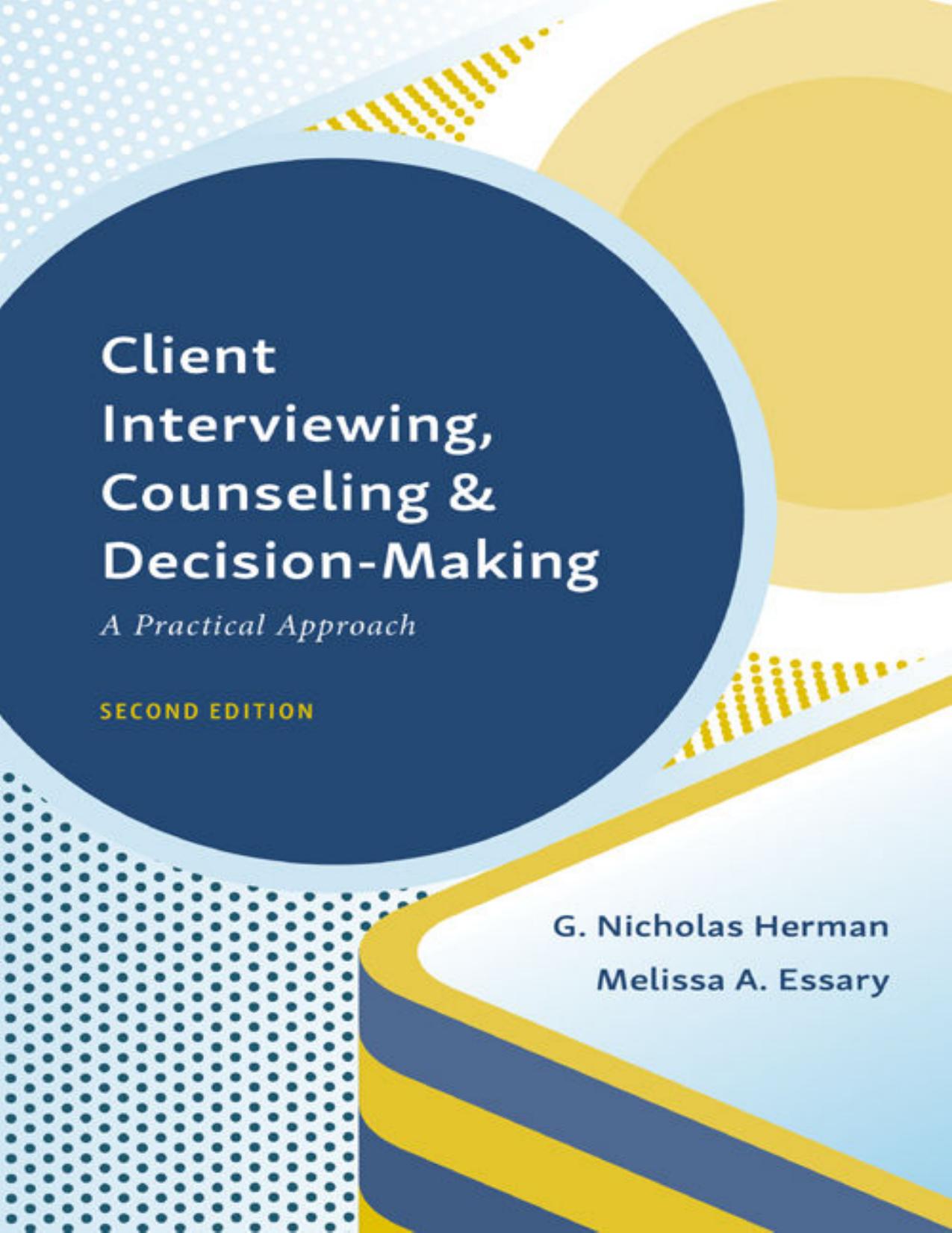
Client Interviewing Counseling and Decision Making 2nd Edition by Nicholas Herman, Melissa Essary ISBN 1531017916 978-1531017910
Original price was: $70.00.$35.00Current price is: $35.00.
Instant download Client Interviewing Counseling and Decision Making A Practicproach Second Edition G. Nicholas Herman & Melissa A. Essary after payment
Client Interviewing Counseling and Decision Making 2nd Edition by Nicholas Herman, Melissa Essary – Ebook PDF Instant Download/Delivery: 1531017916, 978-1531017910
Full download Client Interviewing Counseling and Decision Making 2nd edition after payment
Product details:
ISBN 10: 1531017916
ISBN 13: 978-1531017910
Author: Nicholas Herman, Melissa Essary
This book provides a practical approach to client interviewing, counseling, and decision-making. These are practical skills, not theoretical ones. Thus, the overall pedagogical approach taken by the text is to explain to students what to do and how to do it when engaging in interviewing, counseling, and decision-making with a client. This accords with the growing trend in law schools to de-emphasize heuristic theory in teaching practical skills and instead teach those skills in simulated real-life contexts.
Based on the guidance and techniques provided in the text, students will best learn the skills of interviewing and counseling by applying them in various role plays contained in the Teacher’s Manual or through other role plays developed by their professor. Other features of this book that are worthy of mention:
- The book is deliberately designed to be short―to get to the point, without unnecessary palaver.
- The book provides an extensive discussion of the most pertinent provisions of the ABA Model Rules of Professional Conduct relating to client interviewing, counseling, and decision-making.
- The book discusses interviewing witnesses and counseling in certain special contexts, including counseling about settlement, counseling through the writing of opinion letters, counseling the client as a deponent, and counseling the criminal defendant.
- The new edition of the book adds sections addressing counseling about mediation, counseling about transactional matters, and the role of emotional intelligence.
Client Interviewing Counseling and Decision Making 2nd Table of contents:
Acknowledgments
Chapter One
Learning Client Interviewing, Counseling, and Decision-Making
Synopsis
§1.01 The Importance of Client Interviewing, Counseling, and Decision-Making
§1.02 “Learning by Doing” and the Role of This Book
Chapter Two
Overview of the Counseling Process and Decision-Making Models
Synopsis
§2.01 What Is “Counseling”?
§2.02 An Overview of the Counseling Process
§2.03 Decision-Making Models
[1] The Lawyer-Centered Model [2] The Client-Centered Model [3] The Collaborative Model [4] Using Different Decision-Making Models§2.04 Counseling to Prevent Harm to the Client and Others
§2.05 A Caring Perspective on Counseling
§2.06 Patience in Counseling
§2.07 The Role of Emotional Intelligence
§2.08 The Role of Values
Chapter Three
The Initial Client Meeting
Synopsis
§3.01 Objectives of the Initial Client Meeting
§3.02 Handling the Initial Phone Call from the Client
§3.03 Beginning the Meeting and Developing Rapport
§3.04 Interviewing the Client to Get a Basic Factual Picture of the Client’s Situation
§3.05 Explaining the Duty of Confidentiality, If Appropriate
§3.06 Obtaining a Sense of the Client’s Objectives
§3.07 Determining the Existence of a Conflict of Interest
§3.08 Deciding Whether to Represent the Client and Establishing the Nature and Scope of the Representation
§3.09 Giving Preliminary Advice
§3.10 Establishing an Initial Course of Action
§3.11 Establishing Attorney’s Fees
§3.12 Making Arrangements for Follow-Up Conferences
§3.13 Documenting the Initial Client Meeting
Chapter Four
Interviewing the Client
Synopsis
§4.01 Introduction
§4.02 Facilitators of Communication
[1] Conveying Empathetic Understanding [2] Engaging in Active Listening [3] Encouraging Communication through Conveying Expectations and Recognition [4] Keeping an Open Mind about What Is Relevant§4.03 Inhibitors of Communication
[1] Fears of Embarrassment or Hurting the Case [2] Anxiety, Tension, or Trauma [3] Etiquette Barriers and Prejudices [4] Differing Conceptions about Relevant Information§4.04 Purposes of Interviewing
§4.05 Types of Questions
[1] Open Questions [2] Follow-Up Questions [3] Closed Questions [4] Leading Questions [5] Summary Questions§4.06 Information-Gathering Techniques
[1] The Funnel Technique [2] The Time Line [3] The Strategic Use of Silence [4] Failed Memory Probes [5] Using Writings or Demonstrations to Recreate Events§4.07 Exploring the Client’s Objectives
§4.08 Exploring Legal Theories
§4.09 Taking Notes During the Interview
§4.10 Illustration of Initial Client Meeting and Interview
Chapter Five
Decision-Making and Implementing the Decision
Synopsis
§5.01 Introduction
§5.02 The Process of Legal Decision-Making
§5.03 Summarizing Your Client’s Factual and Legal Situation
§5.04 Refining and Clarifying Your Client’s Objectives
§5.05 Identifying Potential Options for Achieving Your Client’s Objectives
§5.06 Discussing the Pros and Cons and Likely Outcomes of Each Option
[1] Discussing Non-Legal Pros and Cons [2] Discussing Legal Pros and Cons§5.07 Helping Your Client Decide Which Option to Choose
§5.08 Implementing Your Client’s Decision
§5.09 Crisis Counseling
§5.10 Illustration of Decision-Making Conference
Chapter Six
Ethical Considerations in Counseling
Synopsis
§6.01 Introduction
§6.02 Establishing the Attorney-Client Relationship
§6.03 Establishing the Scope of the Representation
§6.04 The Duties of Competence, Diligence, and Communication
[1] Competence [2] Diligence [3] Communication§6.05 Advising the Client
§6.06 Representing a Client Who Is under a Disability
§6.07 Preserving Confidentiality of Information
§6.08 Serving as an Intermediary between Clients
§6.09 Conflicts of Interest
§6.10 Setting Attorney’s Fees
§6.11 Declining or Withdrawing from Representation
§6.12 Dealing with Persons Other Than Your Own Client
§6.13 Attorney’s Authority to Settle and Advising the Client
§6.14 Contingent Fees
§6.15 Example of Contingent Fee Contract
Chapter Seven
Interviewing Witnesses
Synopsis
§7.01 Introduction
§7.02 Who Should Interview the Witness
§7.03 Preparing for the Interview
§7.04 Arranging the Interview and Developing Rapport
§7.05 Interviewing the Neutral or Adverse Witness
§7.06 Preserving the Witness’s Testimony
Chapter Eight
Counseling and Decision-Making in Special Contexts
Synopsis
§8.01 Introduction
§8.02 Counseling about Wise Objectives and Non-Litigation Options
[1] General Tests for Identifying Wise Objectives [2] General Tests for Choosing Best Options§8.03 Counseling about Settlement
[1] Discuss the Most Appropriate Strategy for the Negotiation: “Adversarial” or “Problem-Solving” [2] Discuss Your Client’s “Interests” and “Objectives” [3] Discuss All Potential Solutions [4] Discuss What Information to Obtain from the Other Side, What Information to Reveal to It, and What Information to Protect From Disclosure [5] Discuss Your Client’s Factual and Legal Leverage Points (Strong and Weak) [6] Discuss Your Client’s Potential “Target” and “Resistance Points” [7] Discuss the Extent of Your Client’s Aversion to Risk [8] Discuss Potential Offers or Proposals [9] Discuss the Process for Negotiations and Special Tactics [10] Discuss Your Client’s Role in the Negotiation§8.04 Counseling about Mediation
[1] The Mediation Process, in General [2] What Cases to Mediate and When to Mediate [3] Choosing a Mediator [4] Preparing for Mediation§8.05 Counseling through Opinion Letters
[1] The Function, Format and Contents of an Opinion Letter [2] Illustration of an Opinion Letter§8.06 Counseling about Transactional Matters
[1] Formalize a Transaction That Is Consistent with the Client’s Objectives and Aversion to Risk [2] Explore All Circumstances of Your Client’s Transactional Situation [3] Tailor Your Transactional Document to Your Client, Not Merely to a Form Book§8.07 Counseling the Client as a Deponent
[1] Discuss the Overall Process of the Deposition [2] Review the Substance of Your Client’s Testimony [3] Discuss and Practice How to Answer Questions§8.08 Counseling the Criminal Defendant
[1] Establishing a Close Relationship of Trust and Confidence, and the Decision-Making Role of You and Your Client [2] Advising about Plea Bargaining, Guilty Pleas, and Sentencing [3] Advising about Appeals and Further Post-Conviction RemediesIndex
People also search for Client Interviewing Counseling and Decision Making 2nd :
client interviewing counseling and decision making a practical approach
what is client interviewing
clinical counseling interview questions
counseling for decision making
counseling interviewing techniques
Tags: Nicholas Herman, Melissa Essary, Client Interviewing, Decision Making