


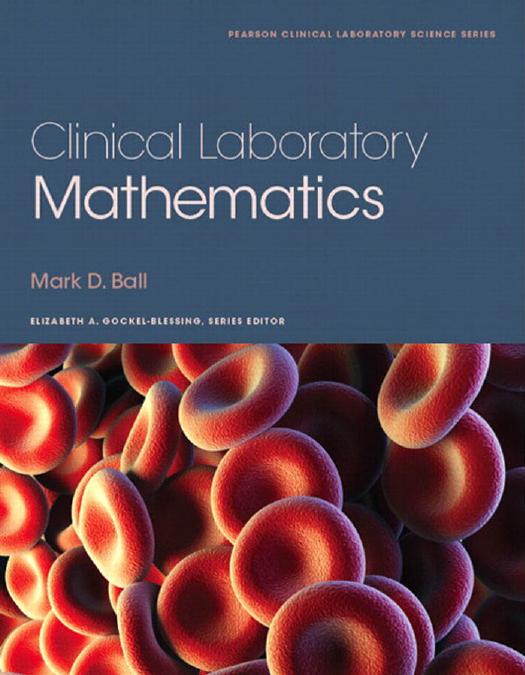
Clinical Laboratory Mathematics 1st edition by Mark Ball – Ebook PDF Instant Download/Delivery: 0133561425 , 9780133561425
Full download Clinical Laboratory Mathematics 1st edition after payment
Product details:
ISBN 10: 0133561425
ISBN 13: 9780133561425
Author: Mark Ball
This is the eBook of the printed book and may not include any media, website access codes, or print supplements that may come packaged with the bound book. This accessible text brings together mathematical techniques that will be indispensable to every student, teacher, practitioner, and user of chemistry- or biology-related laboratory work. Responding to the concerns of both instructors and students, CLINICAL LABORATORY MATHEMATICS begins with a review of arithmetic and algebra. Next, it presents example-rich chapters on exponential notation and logarithms, rounding and figure significance, measurement systems, solutions and concentrations, dilutions, proportionality, graphs, rates of change, statistics, chemistry, quality control, and method evaluation. It answers frequently asked questions, identifies common misunderstandings, and offers an optional advanced section online. Throughout, the author explains why a solid understanding of math is critical in today’s high-technology clinical laboratories. Practice problems are strategically designed to present real-world scenarios with both context and consequence. Supporting both self-guided study and traditional lecture-discussion, the text is logically organized and liberally cross-referenced, revealing hidden connections and common motifs.
Clinical Laboratory Mathematics 1st Table of contents:
1 Arithmetic and Algebra
Chapter Outline
Learning Objectives
Key Terms
Addition
Checkpoint 1-1
Subtraction
Checkpoint 1-2
Multiplication
Checkpoint 1-3
Division
Checkpoint 1-4
Fractions
Multiplying Fractions
Dividing Fractions
Checkpoint 1-5
Reducing Fractions
Canceling
Checkpoint 1-6
Adding and Subtracting Fractions
Checkpoint 1-7
Expressing Fractions as Decimal Numbers
Improper Fractions
Complex Fractions
Checkpoint 1-8
Percentages
Solving Percentage Problems
Two Caveats
Checkpoint 1-9
Algebra
Operational Properties
Approach 1
Approach 2
Approach 1
Approach 2
Approach 3
Checkpoint 1-10
Ratios
Cross-Multiplication
Checkpoint 1-11
Summary
Practice Problems
Contextual Problems
Appendix Mind Over Calculator: A Few Tips for Calculating Without Electronics
Addition and Subtraction Problems
Rough estimate
More-refined estimate
Even-more-refined estimate
Exact sum
Multiplication Problems
Approach 1
Approach 2
Rough estimate
More-refined estimate
Division Problems
Percentage Problems
Alternative 1
Alternative 2
Alternative 3
2 Exponential Notation and Logarithms
Chapter Outline
Learning Objectives
Key Terms
EXPONENTS AND LOGARITHMS
Checkpoint 2-1
NEGATIVE EXPONENTS
EXPONENTIAL NOTATION (SCIENTIFIC NOTATION)
Checkpoint 2-2
Checkpoint 2-3
ALGEBRAIC RULES FOR EXPONENTS
ALGEBRAIC RULES FOR LOGARITHMS
Checkpoint 2-4
THE LOGARITHMIC SCALE
LOGARITHMIC TRANSFORMATION OF RATIOS
THE NATURAL LOGARITHM
Checkpoint 2-5
THE USEFULNESS OF LOGARITHMS
Summary
Practice Problems
Contextual Problems
3 Rounding and the Significance of Figures
Chapter Outline
Learning Objectives
Key Terms
SIMPLE ROUNDING
Rounding Fives
Checkpoint 3-1
FIGURE SIGNIFICANCE
What Significant Figures Are
Figure Significance and Precision
The Significance of Zeros
Trailing Zero
Leading Zero
Embedded Zero
Checkpoint 3-2
SIGNIFICANT FIGURES IN THE RESULTS OF CALCULATIONS
Multiplication and Division
Addition and Subtraction
Combined Operations
The Exception of Repeated Measurements
Checkpoint 3-3
SIGNIFICANT FIGURES IN EXPONENTIAL EXPRESSIONS AND LOGARITHMS
Checkpoint 3-4
ABSOLUTE AND RELATIVE UNCERTAINTY
Checkpoint 3-5
ROUNDING ERROR
KEEPING FIGURE SIGNIFICANCE IN PERSPECTIVE
The Upshot
Summary
Practice Problems
Contextual Problems
4 Systems of Measurement
Chapter Outline
Learning Objectives
Key Terms
UNITED STATES CUSTOMARY SYSTEM OF UNITS
THE METRIC SYSTEM
Prefixes and How to Interpret Them
Converting Between Units
INTERNATIONAL SYSTEM OF UNITS
Checkpoint 4-1
EQUIVALENCIES BETWEEN SYSTEMS
THE MOLE
Checkpoint 4-2
DIMENSIONAL ANALYSIS
Checkpoint 4-3
THE RATIO METHOD
Checkpoint 4-4
TEMPERATURE SCALES
Summary
Practice Problems
Contextual Problems
Chapter 5 Solutions and Concentrations
Chapter Outline
Learning Objectives
Key Terms
Expressing Concentration
Percentage
Parts-Per Notation
Checkpoint 5-1
Molarity
Checkpoint 5-2
Molality
Normality
Checkpoint 5-3
Preparing for Possible Changes
Specific Gravity
The pH Scale
Checkpoint 5-4
Converting Between Units
Checkpoint 5-5
Summary
Practice Problems
Contextual Problems
Chapter 6 Dilutions
Chapter Outline
Learning Objectives
Key Terms
Simple Dilutions
Checkpoint 6-1
6.2 Serial Dilutions
Checkpoint 6-2
Summary
Practice and Contextual Problems
7 Proportionality, Graphs, and Rates of Change
Chapter Outline
Learning Objectives
Key Terms
Proportionality
Straight Lines
Slope as the Rate of Change
Checkpoint 7-1
Standard Curves
Nonlinear Graphs
Checkpoint 7-2
Summary
Practice Problems
Contextual Problems
Chapter 8 Statistics
Chapter Outline
Learning Objectives
Key Terms
The Central Tendency
The Median
The Mean
The Mode
How Outliers Affect the Central Tendency
Checkpoint 8-1
Dispersion
Standard Deviation
Variance
Coefficient of Variation
Checkpoint 8-2
The Normal Distribution
Checkpoint 8-3
Regression
Linear Regression
Caveats
Nonlinear Regression
Data Weighting
Checkpoint 8-4
Judging Goodness-of-Fit
Visual Inspection
Root-Mean-Squared Error
Standard Error of the Slope
Confidence Intervals
Checkpoint 8-5
Correlation
Caveats
Checkpoint 8-6
Coefficient of Determination
Checkpoint 8-7
Significance Testing
The F Test
Student’s t Test
The Paired t Test
The Chi-Square Test
Caveats
Summary
Practice Problems
Contextual Problems
9 Chemistry
Chapter Outline
Learning Objectives
Key Terms
Analytical Spectroscopy
Checkpoint 9-1
Enzyme Kinetics
Reaction Rates
Assay Modes
Reaction Phases
The Michaelis-Menten Equation
Physiological Significance of KM
Significance of KM in the Clinical Laboratory
Linear Transformations
Lineweaver-Burk Plots
pH buffering
The Acid Dissociation Constant
How a Buffering System Works
The Henderson-Hasselbalch Equation
Physiological Acid-Base Calculations
Physiological Buffering
CO2 as a Dissolved Gas
Acid-Base Disorders
Respiratory Acidosis
Respiratory Alkalosis
Metabolic Acidosis
Metabolic Alkalosis
Anion Gap
Osmolarity and Osmolality
Osmolality Gap/Osmolarity Gap
Checkpoint 9-2
Lipid Calculations
Checkpoint 9-3
Creatinine Clearance
Shortcomings of the Test
Summary
Practice and Contextual Problems
10 Hematology
Chapter Outline
Learning Objectives
Key Terms
Manual Cell Enumeration
Enumerating Leukocytes
Enumerating Erythrocytes
Enumerating Platelets
Shortcuts to the Calculated Final Cell Count
Hematocrit
Erythrocyte Indices
Mean Cell Volume (MCV)
Mean Cell Hemoglobin (MCH)
Mean Cell Hemoglobin Concentration (MCHC)
Rule of Three
Red-Cell Distribution Width
Reticulocyte Production Index
Enumerating Reticulocytes
Osmotic Fragility
International Normalized Ratio
Correction Of WBC Count for Nucleated RBCs
Summary
Practice and Contextual Problems
11 Quality Control
Chapter Outline
Learning Objectives
Key Terms
Levey-Jennings Charts
Westgard Multirules
Multirules for Three Controls
Resolution of Out-of-Range Controls
Rationale Behind the Rules
Random and Systematic Error
Summary
Practice and Contextual Problems
12 Method Evaluation
Chapter Outline
Learning Objectives
Key Terms
DIAGNOSTIC VALUE
Sensitivity
Specificity
Efficiency
Prevalence
Predictive Value
Binary Interpretation of Numerical Data
QUALITY ASSURANCE FOR METHODS AND INSTRUMENTS
Verifying or Establishing Accuracy
Detecting Constant Systematic Error
Detecting Proportional Systematic Error
Ascertaining Precision
DETERMINING REPORTABLE RANGE
DETERMINING REFERENCE RANGES
Summary
Practice and Contextual Problems
Frequently Asked Questions and Common Misunderstandings
Are the units “milliliter” and “cubic centimeter” interchangeable?
Are the constants KM and KS the same?
In calculating the standard deviation (SD), which denominator is better: n or n–1?
Is the coefficient of variation (CV) useable with positive and negative data values?
Is the standard deviation (SD) better than the mean absolute deviation (MAD)?
Reasons to Prefer the SD over the MAD
Reasons to Prefer the MAD over the SD
When is the p value misleading?
How is the p value misinterpreted?
The Correct and Incorrect Conclusions
How is the null hypothesis (H0) misleading?
What do the terms “micron,” “lambda,” and “gamma” mean?
Can pH be negative?
When applied to acids and bases, are “strength” and “concentration” synonymous?
Why does the pH scale run from 1 to 14?
Why is “mcg,” instead of “μg,” sometimes used to abbreviate “microgram”?
Is there an easy way to rationalize the equations for Celsius–Fahrenheit conversions?
Why do only some equilibrium constants appear with units?
What are the criteria for choosing a measure of central tendency?
For Continuous Variables
For Ordinal Variables
For Nominal Variables
Answer Key
Chapter 1
Practice Problems
Contextual Problems
Chapter 2 Practice Problems
Contextual Problems
Chapter 3 Practice Problems
Contextual Problems
Chapter 4 Practice Problems
Contextual Problems
Chapter 5 Practice Problems
Contextual Problems
Chapter 6 Practice and Contextual Problems
CHAPTER 7 Practice Problems
Contextual Problems
Chapter 8 Practice Problems
Contextual Problems
CHAPTER 9 Practice and Contextual Problems
Chapter 10 Practice and Contextual Problems
CHAPTER 11 Practice and Contextual Problems
CHAPTER 12 Practice and Contextual Problems
Glossary
Index
People also search for Clinical Laboratory Mathematics 1st :
clinical laboratory mathematics pdf
clinical laboratory mathematics mark d ball
laboratory mathematics in clinical chemistry
mathematics for the clinical laboratory free download
mathematics for the clinical laboratory 4th edition
Tags: Mark Ball, Clinical Laboratory