


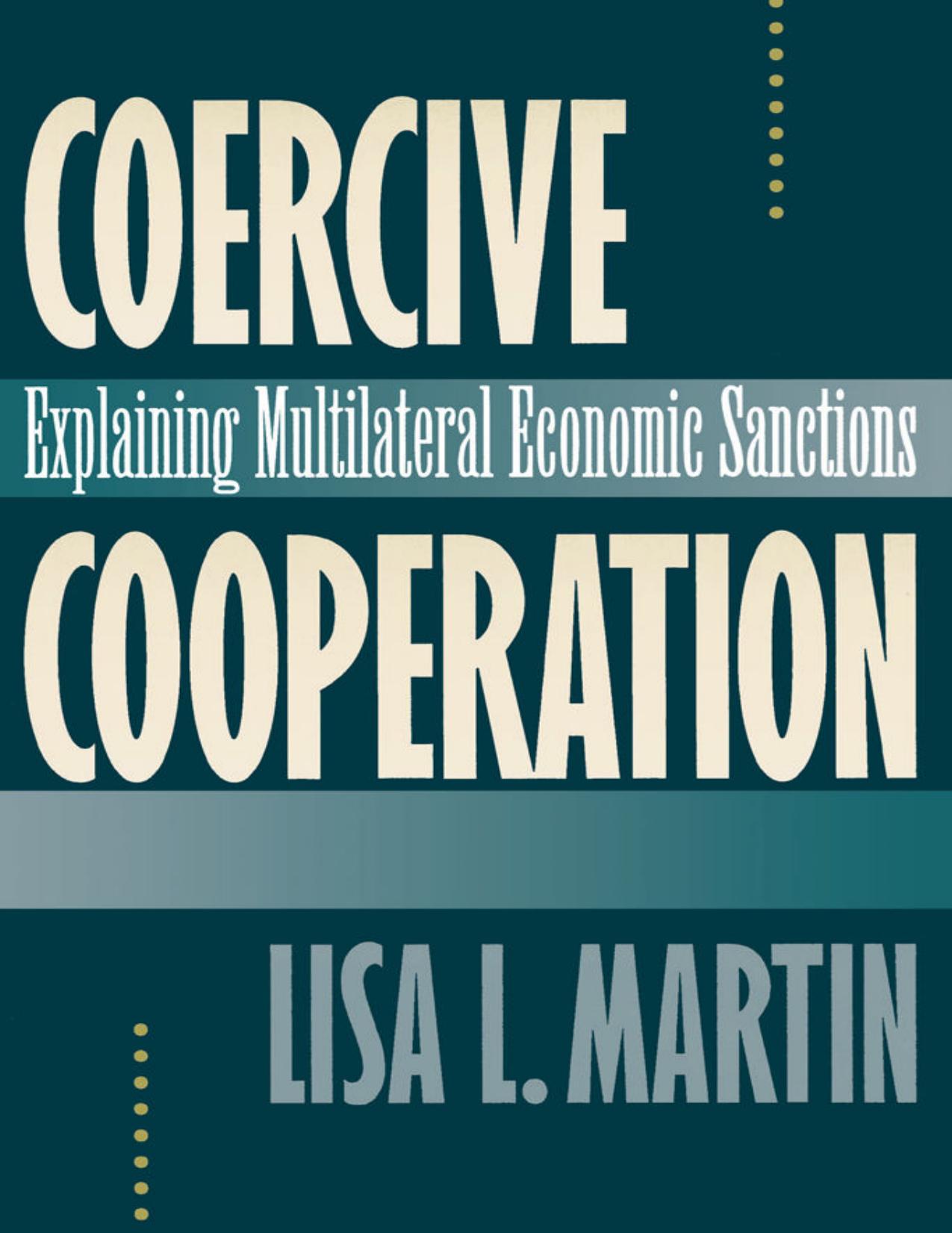
Coercive Cooperation Explaining Multilateral Economic Sanctions 1st edition by Lisa Martin ISBN 0691034761 978-0691034768
Original price was: $70.00.$35.00Current price is: $35.00.
Instant download Coercive Cooperation Explaining Multilateral Economic Sanctions Lisa L. Martin Lisa L. Martin after payment
Coercive Cooperation Explaining Multilateral Economic Sanctions 1st edition by Lisa Martin – Ebook PDF Instant Download/Delivery: 0691034761, 978-0691034768
Full download Coercive Cooperation Explaining Multilateral Economic Sanctions 1st edition after payment
Product details:
ISBN 10: 0691034761
ISBN 13: 978-0691034768
Author: Lisa Martin
This innovative study shows that multilateral sanctions are coercive in their pressure on their target and in their origin: the sanctions themselves frequently result from coercive policies, with one state attempting to coerce others through persuasion, threats, and promises. To analyze this process, Lisa Martin uses a novel methodology combining game-theoretic models, statistical analysis, and case studies. She emphasizes that credible commitments gain international cooperation, and concludes that the involvement of international institutions and the willingness of the main “sender” to bear heavy costs are the central factors influencing the sanction’s credibility.
Coercive Cooperation Explaining Multilateral Economic Sanctions 1st Table of contents:
1. Introduction
The Study of Economic Sanctions
The Study of International Cooperation
Methodology
Part One: Theory and Data
2. Model and Hypotheses
A Model of Economic Sanctions
Identifying Cooperation Problems
What Explains Cooperation?
Bandwagoning
Conclusion
3. Measuring Cooperation and Explanatory Variables
Measurement and Description: The Dependent Variable
Measurement and Description: Explanatory Variables
Conclusion
4. Estimating Models of Cooperation
Regression Analysis
Ordered-Probit Analysis
Event-Count Analysis
The Effect of Declining Hegemony
Conclusion
Part Two: Case Studies
5. Human Rights in Latin America: Explaining Unilateral U.S. Sanctions
Congress versus the President: U.S. Human-Rights Policy, 1973-76
The Carter Administration
Economic Sanctions and the Multilateral Development Banks
Attitudes and Responses to U.S. Human-Rights Sanctions
Pinochet’s Chile: U.S. Leadership or Resistance?
Conclusion
6. The Falkland Islands Conflict
The Falklands Crisis, 1982
The Falklands and the European Community
Sanctions and War: The Case of Ireland
Responses of the United States, Latin America, and Others
Conclusion
7. Western Technology-Export Controls
American, European, and Japanese Views on East-West Technology Transfer
Institutional Coordination of Export Controls: CoCom
Responding to the Soviet Invasion of Afghanistan, 1980
Responding to Dissident Trials, 1978
Conclusion
8. The Polish Crisis and Gas-Pipeline Sanctions
Martial Law in Poland and the Siberian Gas Pipeline
The Effect of Declining Hegemony
Siberian Gas and European Preferences
The Grain Embargo: Why It Mattered
Conclusion
9. Conclusion
Explaining International Cooperation on Economic Sanctions
Additional Findings
Implications for Theories of International Cooperation and Economic Sanctions
People also search for Coercive Cooperation Explaining Multilateral Economic Sanctions 1st:
coercive cooperation explaining multilateral economic sanctions
coercive cooperation
coercive cooperation explaining multilateral economic sanctions pdf
coercive economic diplomacy
coercion and cooperation
Tags: Lisa Martin, Coercive Cooperation, Explaining Multilateral