


Concepts in Thermal Physics 2nd edition by Stephen Blundell, Katherine Blundell – Ebook PDF Instant Download/Delivery: 0191574333, 9780191574337
Full download Concepts in Thermal Physics 2nd edition after payment
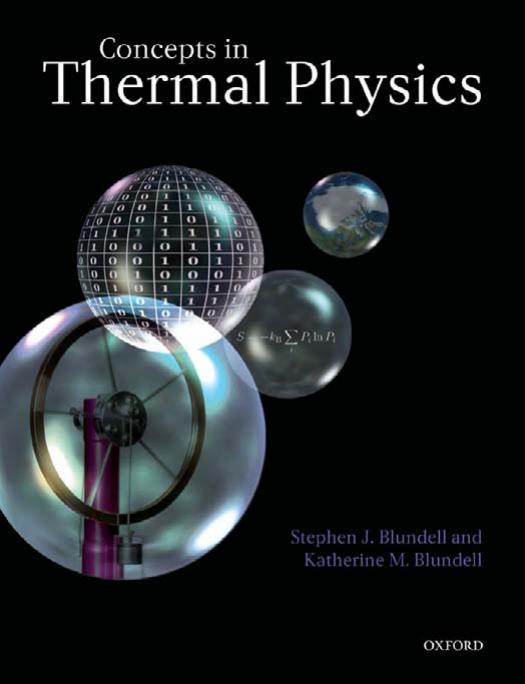
Product details:
ISBN 10: 0191574333
ISBN 13: 9780191574337
Author: Stephen Blundell, Katherine Blundell
An understanding of thermal physics is crucial to much of modern physics, chemistry and engineering. This book provides a modern introduction to the main principles that are foundational to thermal physics, thermodynamics and statistical mechanics. The key concepts are carefully presented in a clear way, and new ideas are illustrated with copious worked examples as well as a description of the historical background to their discovery. Applications are presented to subjects as diverse as stellar astrophysics, information and communication theory, condensed matter physics and climate change. Each chapter concludes with detailed exercises. The second edition of this popular textbook maintains the structure and lively style of the first edition but extends its coverage of thermodynamics and statistical mechanics to include several new topics, including osmosis, diffusion problems, Bayes theorem, radiative transfer, the Ising model and Monte Carlo methods. New examples and exercises have been added throughout.
Concepts in Thermal Physics 2nd Table of contents:
Part I: Preliminaries
1. Introduction
1.1 What is a mole?
1.2 The thermodynamic limit
1.3 The ideal gas
1.4 Combinatorial problems
1.5 Plan of the book
Exercises
2. Heat
2.1 A definition of heat
2.2 Heat capacity
Exercises
3. Probability
3.1 Discrete probability distributions
3.2 Continuous probability distributions
3.3 Linear transformation
3.4 Variance
3.5 Linear transformation and the variance
3.6 Independent variables
3.7 Binomial distribution
Further reading
Exercises
4. Temperature and the Boltzmann Factor
4.1 Thermal equilibrium
4.2 Thermometers
4.3 Microstates and macrostates
4.4 A statistical definition of temperature
4.5 Ensembles
4.6 Canonical ensemble
4.7 Applications of the Boltzmann distribution
Further reading
Exercises
Part II: Kinetic Theory of Gases
5. The Maxwell–Boltzmann Distribution
5.1 Velocity distribution
5.2 Speed distribution
5.3 Experimental justification
Exercises
6. Pressure
6.1 Molecular distributions
6.2 The ideal gas law
6.3 Dalton’s law
Exercises
7. Molecular Effusion
7.1 Flux
7.2 Effusion
Exercises
8. The Mean Free Path and Collisions
8.1 Mean collision time
8.2 Collision cross-section
8.3 Mean free path
Exercises
Part III: Transport and Thermal Diffusion
9. Transport Properties in Gases
9.1 Viscosity
9.2 Thermal conductivity
9.3 Diffusion
9.4 More detailed theory
Further reading
Exercises
10. The Thermal Diffusion Equation
10.1 Derivation
10.2 One-dimensional case
10.3 Steady state
10.4 Spherical case
10.5 Newton’s law of cooling
10.6 Prandtl number
10.7 Sources of heat
10.8 Particle diffusion
Exercises
Part IV: The First Law
11. Energy
11.1 Definitions
11.2 The first law of thermodynamics
11.3 Heat capacity
Exercises
12. Isothermal and Adiabatic Processes
12.1 Reversibility
12.2 Isothermal expansion
12.3 Adiabatic expansion
12.4 Adiabatic atmosphere
Exercises
Part V: The Second Law
13. Heat Engines and the Second Law
13.1 The second law of thermodynamics
13.2 The Carnot engine
13.3 Carnot’s theorem
13.4 Clausius’ and Kelvin’s statements
13.5 Examples of heat engines
13.6 Heat engines in reverse
13.7 Clausius’ theorem
Further reading
Exercises
14. Entropy
14.1 Definition
14.2 Irreversible change
14.3 First law revisited
14.4 Joule expansion
14.5 Statistical basis
14.6 Entropy of mixing
14.7 Maxwell’s demon
14.8 Entropy and probability
Exercises
15. Information Theory
15.1 Shannon entropy
15.2 Information and thermodynamics
15.3 Data compression
15.4 Quantum information
15.5 Conditional and joint probabilities
15.6 Bayes’ theorem
Further reading
Exercises
Part VI: Thermodynamics in Action
16. Thermodynamic Potentials
16.1 Internal energy, U
16.2 Enthalpy, H
16.3 Helmholtz function, F
16.4 Gibbs function, G
16.5 Constraints
16.6 Maxwell’s relations
Exercises
17. Rods, Bubbles, and Magnets
17.1 Elastic rod
17.2 Surface tension
17.3 Electric and magnetic dipoles
17.4 Paramagnetism
Exercises
18. The Third Law
18.1 Statements of the third law
18.2 Consequences
Exercises
Part VII: Statistical Mechanics
19. Equipartition of Energy
19.1 Equipartition theorem
19.2 Applications
19.3 Assumptions
19.4 Brownian motion
Exercises
20. The Partition Function
20.1 Writing it down
20.2 Functions of state
20.3 The big idea
20.4 Combining functions
Exercises
21. Ideal Gas Statistical Mechanics
21.1 Density of states
21.2 Quantum concentration
21.3 Distinguishability
21.4 State functions
21.5 Gibbs paradox
21.6 Diatomic gas heat capacity
Exercises
22. The Chemical Potential
22.1 Definitions
22.2 Interpretations
22.3 Grand partition function
22.4 Grand potential
22.5 Chemical potential and Gibbs function
22.6 Multiple particle types
22.7 Conservation laws
22.8 Reactions and equilibrium
22.9 Osmosis
Further reading
Exercises
23. Photons
23.1 Thermodynamics of EM radiation
23.2 Spectral energy density
23.3 Kirchhoff’s law
23.4 Radiation pressure
23.5 Photon gas
23.6 Black-body radiation
23.7 CMB radiation
23.8 Einstein A and B coefficients
Further reading
Exercises
24. Phonons
24.1 Einstein model
24.2 Debye model
24.3 Phonon dispersion
Further reading
Exercises
Part VIII: Beyond the Ideal Gas
25. Relativistic Gases
25.1 Relativistic dispersion
25.2 Ultrarelativistic gas
25.3 Adiabatic expansion
Exercises
26. Real Gases
26.1 van der Waals equation
26.2 Dieterici equation
26.3 Virial expansion
26.4 Law of corresponding states
Exercises
27. Cooling Real Gases
27.1 Joule expansion
27.2 Isothermal expansion
27.3 Joule–Kelvin expansion
27.4 Liquefaction
Exercises
28. Phase Transitions
28.1 Latent heat
28.2 Phase change and chemical potential
28.3 Clausius–Clapeyron equation
28.4 Stability and metastability
28.5 Gibbs phase rule
28.6 Colligative properties
28.7 Classification of phase transitions
28.8 The Ising model
Further reading
Exercises
29. Quantum Distributions
29.1 Exchange and symmetry
29.2 Identical particle wave functions
29.3 Fermi–Dirac and Bose–Einstein statistics
Further reading
Exercises
30. Quantum Gases and Condensates
30.1 Quantum fluid overview
30.2 The Fermi gas
30.3 The Bose gas
30.4 Bose–Einstein condensation
Further reading
Exercises
Part IX: Special Topics
31. Sound Waves
31.1 Isothermal vs adiabatic
31.2 Derivation of speed of sound
Further reading
Exercises
32. Shock Waves
32.1 The Mach number
32.2 Shock wave structure
32.3 Conservation laws
32.4 Rankine–Hugoniot conditions
Further reading
Exercises
33. Brownian Motion and Fluctuations
33.1 Brownian motion
33.2 Johnson noise
33.3 Fluctuations and availability
33.4 Linear response
33.5 Correlation functions
Further reading
Exercises
34. Non-Equilibrium Thermodynamics
34.1 Entropy production
34.2 Kinetic coefficients
34.3 Onsager relations
34.4 Thermoelectric effects
34.5 Time reversal and entropy
Further reading
Exercises
35. Stars
35.1 Gravity
35.2 Nuclear processes
35.3 Heat transfer
Further reading
Exercises
36. Compact Objects
36.1 Degeneracy pressure
36.2 White dwarfs
36.3 Neutron stars
36.4 Black holes
36.5 Accretion and entropy
36.6 Life and entropy
Further reading
Exercises
37. Earth’s Atmosphere
37.1 Solar input
37.2 Atmospheric temperature profile
37.3 Radiative transfer
37.4 Greenhouse effect
37.5 Global warming
Further reading
Exercises
Appendices
A. Fundamental Constants
B. Useful Formulae
C. Useful Mathematics
C.1 Factorial integral
C.2 Gaussian integral
C.3 Stirling’s formula
C.4 Riemann zeta function
C.5 Polylogarithm
C.6 Partial derivatives
C.7 Exact differentials
C.8 Hypersphere volume
C.9 Jacobians
C.10 Dirac delta function
C.11 Fourier transforms
C.12 Diffusion equation
C.13 Lagrange multipliers
D. Electromagnetic Spectrum
E. Thermodynamic Definitions
F. Thermodynamic Expansion Formulae
G. Reduced Mass
H. Glossary of Symbols
Bibliography
Index
People also search for Concepts in Thermal Physics 2nd :
concepts in thermal physics solutions
concepts in thermal physics blundell solutions
concepts in thermal physics second edition pdf
concepts in thermal physics solutions manual pdf
concepts in thermal physics 2nd edition
Tags: Stephen Blundell, Katherine Blundell, Thermal Physics