

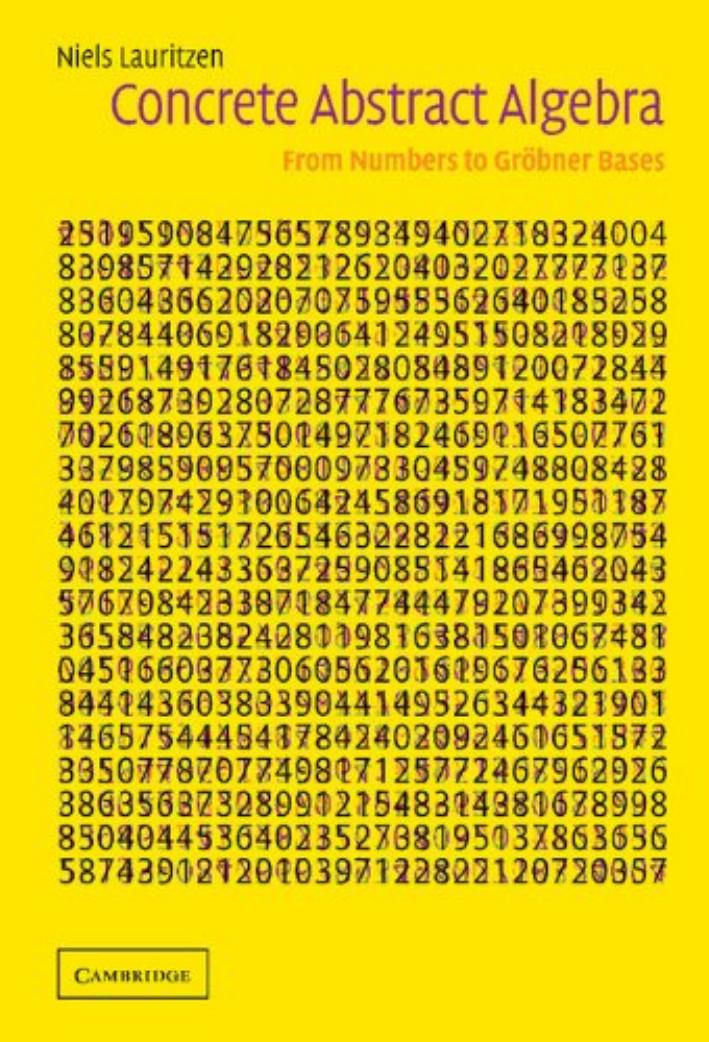
Concrete Abstract Algebra From Numbers to Grobner Bases 1st edition by Niels Lauritzen – Ebook PDF Instant Download/Delivery: 0521534100 , 978-0521534109
Full download Concrete Abstract Algebra From Numbers to Grobner Bases 1st edition after payment
Product details:
ISBN 10: 0521534100
ISBN 13: 978-0521534109
Author: Niels Lauritzen
Concrete Abstract Algebra develops the theory of abstract algebra from numbers to Gr”obner bases, while takin in all the usual material of a traditional introductory course. In addition, there is a rich supply of topics such as cryptography, factoring algorithms for integers, quadratic residues, finite fields, factoring algorithms for polynomials, and systems of non-linear equations. A special feature is that Gr”obner bases do not appear as an isolated example. They are fully integrated as a subject that can be successfully taught in an undergraduate context. Lauritzen’s approach to teaching abstract algebra is based on an extensive use of examples, applications, and exercises. The basic philosophy is that inspiring, non-trivial applications and examples give motivation and ease the learning of abstract concepts. This book is built on several years of experienced teaching introductory abstract algebra at Aarhus, where the emphasis on concrete and inspiring examples has improved student performance significantly.
Concrete Abstract Algebra From Numbers to Grobner Bases 1st Table of contents:
1. Numbers
1.1 The natural numbers and the integers
1.1.1 Well ordering and mathematical induction
1.2 Division with remainder
1.3 Congruences
1.3.1 Repeated squaring – an example
1.4 Greatest common divisor
1.5 The Euclidean algorithm
1.6 The Chinese remainder theorem
1.7 Euler’s theorem
1.8 Prime numbers
1.8.1 There are infinitely many prime numbers
1.8.2 Unique factorization
1.8.3 How to compute φ(n)
1.9 RSA explained
1.9.1 Encryption and decryption exponents
1.9.2 Finding astronomical prime numbers
1.10 Algorithms for prime factorization
1.10.1 The birthday problem
1.10.2 Pollard’s ρ-algorithm
1.10.3 Pollard’s (p − 1)-algorithm
1.10.4 The Fermat–Kraitchik algorithm
1.11 Quadratic residues
1.12 Exercises
2. Groups
2.1 Definition
2.1.1 Groups and congruences
2.1.2 The composition table
2.1.3 Associativity
2.1.4 The first non-abelian group
2.1.5 Uniqueness of neutral and inverse elements
2.1.6 Multiplication by g ∈ G is bijective
2.1.7 More examples of groups
2.2 Subgroups and cosets
2.2.1 Subgroups of Z
2.2.2 Cosets
2.3 Normal subgroups
2.3.1 Quotient groups of the integers
2.3.2 The multiplicative group of prime residue classes
2.4 Group homomorphisms
2.5 The isomorphism theorem
2.6 Order of a group element
2.7 Cyclic groups
2.8 Groups and numbers
2.8.1 Euler’s theorem
2.8.2 Product groups
2.8.3 The Chinese remainder theorem
2.9 Symmetric and alternating groups
2.9.1 Cycles
2.9.2 Simple transpositions and “bubble” sort
2.9.3 The alternating group
2.9.4 Simple groups
2.9.5 The 15-puzzle
2.10 Actions of groups
2.10.1 Conjugacy classes
2.10.2 Conjugacy classes in the symmetric group
2.10.3 Groups of order p[sup(r)]
2.10.4 The Sylow theorems
2.11 Exercises
3. Rings
3.1 Definition
3.1.1 Ideals
3.2 Quotient rings
3.2.1 Quotient rings of Z
3.2.2 Prime ideals
3.2.3 Maximal ideals
3.3 Ring homomorphisms
3.3.1 The unique ring homomorphism from Z
3.3.2 Freshman’s Dream
3.4 Fields of fractions
3.5 Unique factorization
3.5.1 Divisibility and greatest common divisor
3.5.2 Irreducible elements
3.5.3 Prime elements
3.5.4 Euclidean domains
3.5.5 Fermat’s two-square theorem
3.5.6 The Euclidean algorithm strikes again
3.5.7 Prime numbers congruent to 1 modulo 4
3.5.8 Fermat’s last theorem
3.6 Exercises
4. Polynomials
4.1 Polynomial rings
4.1.1 Binomial coefficients modulo a prime number
4.2 Division of polynomials
4.3 Roots of polynomials
4.3.1 Differentiation of polynomials
4.4 Cyclotomic polynomials
4.5 Primitive roots
4.5.1 Decimal expansions and primitive roots
4.5.2 Primitive roots and public key cryptography
4.5.3 Yet another application of cyclotomic polynomials
4.6 Ideals in polynomial rings
4.6.1 Polynomial rings modulo ideals
4.7 Theorema Aureum: the law of quadratic reciprocity
4.8 Finite fields
4.8.1 Existence of finite fields
4.8.2 Uniqueness of finite fields
4.8.3 A beautiful identity
4.9 Berlekamp’s algorithm
4.10 Exercises
5. Gröbner bases
5.1 Polynomials in several variables
5.1.1 Term orderings
5.2 The initial term of a polynomial
5.3 The division algorithm
5.4 Gröbner bases
5.4.1 Hilbert’s basis theorem
5.5 Newton revisited
5.6 Buchberger’s S-criterion
5.6.1 The S-polynomials
5.6.2 The S-criterion
5.7 Buchberger’s algorithm
5.8 The reduced Gröbner basis
5.9 Solving equations using Gröbner bases
5.10 Exercises
Appendix A: Relations
A.1 Basic definitions and properties
A.2 Equivalence relations
A.2.1 Construction of the integers Z
A.2.2 Construction of the rational numbers Q
A.3 Partial orderings
Appendix B: Linear algebra
B.1 Linear independence
B.2 Dimension
References
Index
People also search for Concrete Abstract Algebra From Numbers to Grobner Bases 1st :
concrete abstract algebra from numbers to gröbner bases
history of abstract algebra
what is abstract algebra
what is abstract algebra in mathematics
whats abstract algebra