


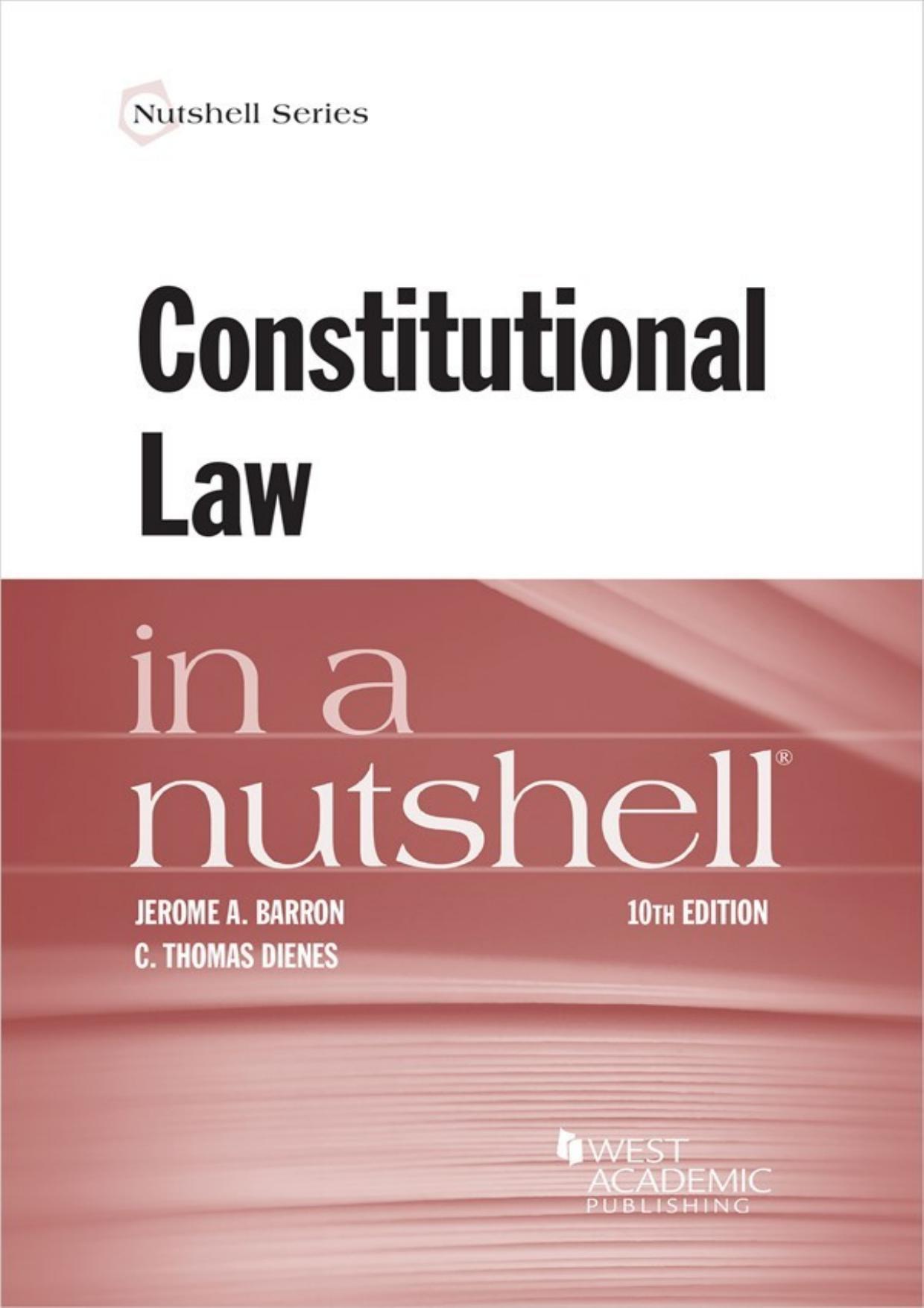
Constitutional Law in a Nutshell 10th edition by Jerome Barron, Dienes – Ebook PDF Instant Download/Delivery: 1684673283 , 978-1684673285
Full download Constitutional Law in a Nutshell 10th edition after payment
Product details:
ISBN 10: 1684673283
ISBN 13: 978-1684673285
Author: Jerome Barron, Dienes
This 10th edition of Constitutional Law in a Nutshell summarizes constitutional law from Marbury v. Madison (1803), to the present. The goal has been to discuss the Supreme Court’s cases in enough detail to be helpful but not to be verbose in doing so. In this edition we feature thirty new cases. Some of the highlights include Rucho v. Common Cause (2-10) where the Court held 5-4, per Chief Justice Roberts, that partisan gerrymandering is a non-justiciable issue beyond the competence of the federal judiciary. In Department of Commerce v. New York (2019), although the Court ruled that the Enumeration Clause of the Constitution grants authority to Congress and “by extension” to the Secretary of Commerce to include a question about citizenship on the 2020 Census questionnaire, the Court could not approve it because the rationale presented to the Court was contrived and was based on a pretext. In Timbs v. Indiana (2019), the Court demonstrated that there still is vitality in the incorporation doctrine and held that the Excessive Fines Clause of the Eighth Amendment is an “incorporated” protection applicable to the States under the Due Process Clause of the Fourteenth Amendment.
As ever, the free expression area is once again fertile ground for generating Supreme Court case law. In Janus v. American Federation of State, County and Municipal Employees (2018), the Supreme Court, per Justice Alito, 5-4, reversed the 40 year old Abood v. Detroit Board of Education (1977) precedent and held that its ruling requiring non-union members of a public sector union to pay for the collective bargaining of the union is a violation of the First Amendment. In Matal v.Tam (2017), the Court unanimously held that a Lanham Act provision prohibiting the registration of trademarks that “disparage–or bring–into contempt or disrepute” any persons living or dead is a violation of the First Amendment. In the area of freedom of religion, the Court in Trump v. Hawaii (2018), held, 5-4, per Chief Justice Roberts, that a Proclamation prohibiting or limiting the entry into the United States of nationals from seven countries with Muslim majorities did not violate the Establishment Clause. The Proclamation could reasonably be justified on grounds of national security rather than religious hostility. In American Legion v. American Humanist Association (2019), the Court held, 7-2, per Justice Alito, that the Bladensburg Peace Cross, erected in 1925 on public land in Maryland as a memorial to veterans of World War I did not constitute a violation of the Establishment Clause. Government action which removes monuments that have religious symbolism and that have long been on public land could be seen as “aggressively hostile to religion.” Finally, in this edition, as in previous ones, the goal has been to present the essence of the Court’s decisions in a concise, readable and understandable way.
Constitutional Law in a Nutshell 10th Table of contents:
Introduction. Constitutional Principles
Part 1. The Allocation of Powers
Chapter 1. Judicial Review and Its Limits
A. Foundations of Judicial Review
1. Review of Federal Actions
2. Review of State Actions
B. Foundations of Federal Jurisdiction
1. The Constitutional Basis of Federal Jurisdiction
2. Bases of Federal Court Jurisdiction
3. Statutory Forms of Review
C. Constitutional and Policy Limitations on Judicial Review
1. Constitutional Limitations
2. Policy Limitations
D. Specific Doctrines Limiting Judicial Review
1. Who May Litigate?—The Problem of Standing
2. When Can Constitutional Litigation Be Brought? The Problem of Timing
3. What Can Be Litigated? The Political Question Doctrine
Chapter 2. National Legislative Powers
A. Scope of Congressional Power
B. The Commerce Power
1. Establishing the Foundations
2. Using the Commerce Clause for Police Power Ends
3. The Stream of Commerce
4. The Affectation Doctrine
C. The Taxing Power
D. The Spending Power
E. Intergovernmental Immunities
F. The Enumeration Clause and the Decennial Census
Chapter 3. State Power in American Federalism
A. State Power to Regulate Commerce
1. The Nature of the Power
2. The Subject of the Regulation: The Cooley Doctrine
3. The Modern Approach: The Balancing of Interests
4. State as Market Participant
5. Interstate Privileges and Immunities
B. When Congress Speaks
1. Preemption
2. Legitimization
Chapter 4. Congress and the Executive Power
A. The Domestic Arena
1. Executive Lawmaking
2. Executive Impoundment
3. Delegation, the Legislative Veto, and the Line Item Veto
4. Appointment and Removal
5. Separation of Powers Generally
B. The Foreign Arena
1. Allocating the Foreign Relations Power
2. Treaties and Executive Agreements
3. Allocating the War Power
C. Promoting Executive Responsibility
1. Executive Privilege
2. Executive Immunity
Part 2. Individual Rights and Liberties
Chapter 5. Due Process of Law
A. The Process of Incorporation
B. Substantive Due Process
1. Traditional Substantive Due Process
2. Substantive Due Process Revisited: Fundamental Personal Rights
C. Procedural Due Process
1. Life, Liberty, and Property Interests
2. The Process That Is Due
Chapter 6. Equal Protection
A. Traditional Equal Protection
B. The New Equal Protection
1. Classifying Traits
2. Fundamental Rights
Chapter 7. Freedom of Expression
A. The Basic Doctrine
1. The Rationale of Speech Protection
2. A Doctrinal Overview
3. The Clear and Present Danger Doctrine
4. Symbolic Conduct
5. Freedom of Association and Belief
B. The Doctrine Applied
1. Expression in the Local Forum
2. Commercial Speech
3. Defamation and Privacy
4. Obscenity and Indecency
5. Freedom of the Press
6. Speech in the Electoral Process
7. Government-Funded Speech
Chapter 8. Freedom of Religion
A. The Establishment Clause
1. Public Aid to Religion
2. Religion in the Schools
3. Establishment Outside the Schools
B. Free Exercise of Religion
Chapter 9. State Action
A. Introduction
B. Framing the State Action Doctrine
C. Finding State Action
1. Public Functions
2. Significant Involvement/Joint Participation
3. Encouragement, Authorization, and Approval
Chapter 10. Congressional Legislation in Aid of Civil Rights and Liberties
A. Sources of Congressional Power
B. Enforcing the Thirteenth Amendment
C. Enforcing the Fourteenth Amendment
1. Congress’ Remedial Powers
2. Congress’ Substantive Powers
3. Reaching Private Conduct
D. Enforcing the Fifteenth Amendment
Index
People also search for Constitutional Law in a Nutshell 10th:
canada’s constitutional law in a nutshell
florida constitutional law in a nutshell
constitutional law in a nutshell pdf
constitutional law in a nutshell 11th edition
constitutional law in a nutshell engin saygın
Tags: Jerome Barron, Dienes, Constitutional Law