


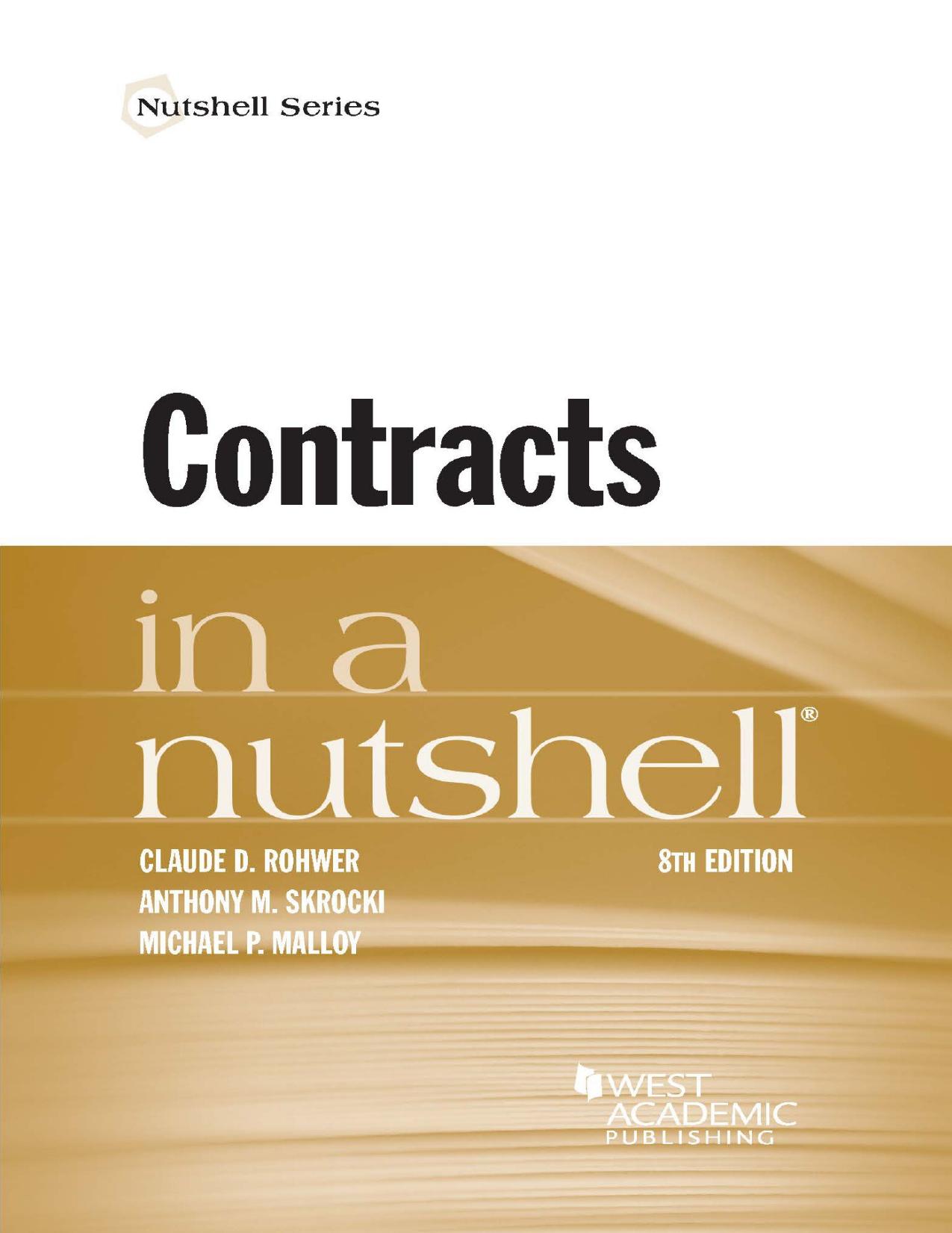
Contracts in a Nutshell 8th edition by Claude Rohwer, Anthony Skrocki, Michael Malloy ISBN B01MTOMK20 978-1683283492
Original price was: $70.00.$35.00Current price is: $35.00.
Instant download Contracts in a Nutshell (Nutshells) 8th Edition Claude D Rohwer & Anthony M Skrocki & Michael P Malloy after payment
Contracts in a Nutshell 8th edition by Claude Rohwer, Anthony Skrocki, Michael Malloy – Ebook PDF Instant Download/Delivery: B01MTOMK20,978-1683283492
Full download Contracts in a Nutshell 8th edition after payment
Product details:
ISBN 10: B01MTOMK20
ISBN 13: 978-1683283492
Author: Claude Rohwer, Anthony Skrocki, Michael Malloy
This Nutshell provides a comprehensive guide to the law of contracts. It contains expert explanations of contract concepts under both the common law and Article 2 of the Uniform Commercial Code. It also includes the basics of the Law of Restitution and an introduction to digital contracting.
Contracts in a Nutshell 8th Table of contents:
Chapter 1 Introduction
§ 1.1 Scope of This Nutshell—Contract Law and Sales Law
§ 1.2 Public Policy Underlying Contract Law and Sales Law
§ 1.3 Basis for Enforcement of Promises
§ 1.4 Restitution—Unjust Enrichment—Quasi-Contract
§ 1.5 Sale of Goods and the Uniform Commercial Code
§ 1.6 The United Nations Convention on Contracts for the International Sale of Goods (CISG)
Chapter 2 Contract Formation
A. Mutual Assent to a Bargain
§ 2.1 Contracts Which Constitute a Bargained Exchange
§ 2.2 Objective and Subjective Intent
§ 2.3 Offer as a Manifestation of Assent to Be Bound
§ 2.4 Certainty of Terms—As Found in the Offer, the Acceptance and by Implication
§ 2.5 Advertisements, Mass Mailings, and Price Quotations
§ 2.6 Receipt of the Offer
§ 2.7 Duration of an Offer
§ 2.8 Irrevocability of Offers
§ 2.9 Offeror’s Control over Manner and Medium of Acceptance
§ 2.10 Manner of Acceptance (by Promise or by Conduct): Alternative Approaches
§ 2.11 Acceptance by Promise or by Performance; When the Parties Are Bound
§ 2.12 Common Law Requirement That an Acceptance Must Conform to the Terms of the Offer
§ 2.13 Impact of the UCC upon Contract Formation
§ 2.14 Contracts Resulting from an Exchange of Communications—UCC 2–207(1)
§ 2.15 Contract Formed by Conduct—UCC 2–207(3)
§ 2.16 Acceptance by Shipment of Goods—UCC 2–206
§ 2.17 Effect of Confirming Memoranda Sent After an Informal Contract Is Formed
§ 2.18 Impact of UCC upon Common Law Rules of Contract Formation
§ 2.19 Time When Communications Are Effective
§ 2.20 What Constitutes “Receipt” of Communications
§ 2.21 Acceptance by Silence
§ 2.22 Acceptance by Exercise of Dominion and Control over Goods or by Receipt of Benefits or Services
§ 2.23 Auctions: Finding the Offer and Acceptance
B. Consideration
§ 2.24 Consideration: An Introduction
§ 2.25 Requirement of a Bargained Exchange
§ 2.26 Compromise of Disputed Claims
§ 2.27 Payment or Promise to Pay a Lesser Sum in Discharge of a Claim
§ 2.28 Condition to Gift and Bargained Exchange Compared
§ 2.29 Alternative Promises; Multiple Promises
§ 2.30 Illusory Promises
§ 2.31 Implied Promise to Use Best Efforts or to Act in Good Faith
§ 2.32 Requirements Contracts and Output Contracts
§ 2.33 To Whom and from Whom Consideration Must Be Given
§ 2.34 Adequacy of Consideration
§ 2.35 Non-Bargained Detriment
§ 2.36 Nominal Consideration: Sham Bargains
§ 2.37 False Recitals of Consideration
§ 2.38 Option Contracts: Nominal Consideration or False Recitals of Consideration
§ 2.39 Subsequent Promises to Perform Unenforceable Contracts
§ 2.40 Promise to Pay for Benefits Previously Conferred
C. Promissory Estoppel
§ 2.41 Enforcement of Promises That Induce Reliance
§ 2.42 Reliance as a Basis for Holding Offers to Be Irrevocable
§ 2.43 Remedies for Reliance in a Commercial Context
D. Contracts in a Digital Age
§ 2.44 Electronic Contracting: An Introduction
§ 2.45 Medium of Acceptance: Electronic Communications
§ 2.46 Digital Contracts and the Impact of UCC § 2–207
§ 2.47 Sale of Software; Licensing Terms
Chapter 3 Statute of Frauds
A. Contracts Within the Statute
§ 3.1 Statute of Frauds
§ 3.2 Contracts Within the Statute of Frauds
B. Satisfaction of the Writing Requirement
§ 3.3 Sufficiency of the Writing
§ 3.4 The Signature
§ 3.5 Signed Confirmation Sent by One Merchant to Another Merchant
C. Avoidance of the Writing Requirement
§ 3.6 Basis for Avoidance of Writing Requirement
§ 3.7 Judicial Approach to Enforcement of the Statute of Frauds
Chapter 4 Contract Interpretation
A. General Interpretation Problems
§ 4.1 Basic Considerations: Subjective and Objective Intent
§ 4.2 Objective Intent: The Search for Some Answers
§ 4.3 Course of Performance; Course of Dealing, and Usage of Trade (Custom)
§ 4.4 Interpretation Against Drafter; Adhesion Contracts
B. Parol Evidence Rule
§ 4.5 When the Parol Evidence Rule Applies
§ 4.6 Use of Parol Evidence to Supplement (Add to) the Terms of a Writing
§ 4.7 Use of Parol Evidence to Interpret (Explain) the Meaning of the Words Contained in the Writing
§ 4.8 Merger Clauses (Integration Clauses)
C. Implied Terms and Terms Imposed by Law
§ 4.9 Terms Found by Implication or Construction
§ 4.10 Mandatory Terms, Permissive Terms, and Default Rules
§ 4.11 Duty of Good Faith and Fair Dealing
§ 4.12 Carrying out the Parties’ Intentions or Imposing Obligations
Chapter 5 Defenses
A. Defenses Affecting Assent
§ 5.1 Defenses Affecting Assent to Be Bound
§ 5.2 Capacity to Contract
§ 5.3 Duress; What Must Be Threatened
§ 5.4 Undue Influence
§ 5.5 Mistake
§ 5.6 Mistakes or Misunderstandings That Prevent Formation of a Contract (as Distinguished from Merely Providing Grounds to Rescind or Reform a Contract)
§ 5.7 Avoidance of Contract on Basis of Misrepresentation; Misrepresentation Defined
§ 5.8 Misrepresentation, Duress or Undue Influence by a Third Party
§ 5.9 Misrepresentation That Prevents Formation of a Contract
B. Defenses Based upon Policy
§ 5.10 Unconscionability as a Defense; Procedural and Substantive
§ 5.11 Public Policy or Illegality as a Defense
Chapter 6 Events That Excuse Performance
A. Impossibility or Impracticability
§ 6.1 Impossibility of Performance
§ 6.2 Factors Necessary to Support Impracticability as a Defense
B. Frustration of Purpose
§ 6.3 Frustration of Purpose; “Economic Frustration” Distinguished
§ 6.4 Relief Afforded in Cases of Impracticability or Frustration
Chapter 7 Contract Modification
§ 7.1 Requirements for Modifying a Contract
§ 7.2 Consent Required for Modification
§ 7.3 The Consideration Requirement
§ 7.4 Promissory Estoppel as a Basis for Enforcement Despite Absence of Consideration
§ 7.5 Writing Requirements: Imposed by Statute or by Agreement of the Parties
§ 7.6 If the Modification Is Required to Be in Writing, Does a Sufficient Writing Exist or Is There an Exception?
§ 7.7 Promissory Estoppel as a Basis for Enforcing Oral Modifications
§ 7.8 Ineffective Attempt to Modify; Operation as a Waiver
§ 7.9 Retraction of a Waiver
Chapter 8 Performance
A. Promises and Conditions
§ 8.1 Introduction; Promises and Conditions
§ 8.2 Substantial Performance; Effect of Breach
§ 8.3 Enforcement of Conditions (Examples)
§ 8.4 Guidelines to Identify Promises and Different Types of Conditions
§ 8.5 Conditions Subsequent
§ 8.6 Excuse of Conditions
§ 8.7 Effect of Severability
§ 8.8 The Condition of Approval by a Third Party or by a Principal Party to the Contract
§ 8.9 Performance of Contracts for the Sale of Goods
C. Warranties
§ 8.10 Warranties Arising from the Sale of Goods and from the Sale of Other Property
§ 8.11 Warranties in Non-Goods Transactions
§ 8.12 Disclaimer of Warranties
D. Good Faith Affecting Performance
§ 8.13 Good Faith and Contract Performance
Chapter 9 Remedies
A. Remedies Available at Common Law
§ 9.1 An Overview of Possible Remedies for Breach of Contract
§ 9.2 Expectation Damages (Benefit of the Bargain)
§ 9.3 Reliance Damages
§ 9.4 Measuring Recovery in Restitution
§ 9.5 Liquidated Damages (Stipulated Damages)
§ 9.6 Specific Performance
§ 9.7 Remedies Available in Actions Based upon Promissory Estoppel
B. Remedies in Sales of Goods
§ 9.8 Buyer’s Rejection, Acceptance, and Revocation of Acceptance of Goods
§ 9.9 Sequence of Rights and Duties; Tender, Rejection, etc.
§ 9.10 Seller’s Remedies for Breach
§ 9.11 Buyer’s Remedies for Breach
Chapter 10 Restitution (Unjust Enrichment)
§ 10.1 Restitution
§ 10.2 Measure of Recovery in Restitution
Chapter 11 Third Party Beneficiaries
A. What Parties May Assert Contract Rights
§ 11.1 Third Party Beneficiary Contracts
§ 11.2 Identification of the Third Party
§ 11.3 Intended Beneficiaries in Special Situations: Government Contracts and Assumption of Secured Indebtedness
§ 11.4 Rights of the Promisee Against the Promisor
B. Promisors’ Defenses Against Third Parties’ Claims
§ 11.5 Contract Modification or Rescission; Vesting of Third Party’s Rights
§ 11.6 Defenses Assertable Against the Third Party Beneficiary
Chapter 12 Assignment of Rights and Delegation of Duties
A. Assignment of Rights
§ 12.1 Assignment of Rights; Delegation of Duties Distinguished
§ 12.2 Impact of UCC Article 9
§ 12.3 Requisites of an Assignment
§ 12.4 Assignment of Rights Embodied in a Tangible Object
§ 12.5 Revocability of Gratuitous Assignments: Events That Revoke
§ 12.6 Partial Assignments
B. Delegation of Duties
§ 12.7 Delegation of Duties: What Is Delegable
§ 12.8 Liability of Delegator and Delegatee
§ 12.9 Assuming Delegated Duties; Resolving Ambiguities
Chapter 13 Discharge
Discharge by Performance, Rescission, Release or Contract Not to Sue
Discharge by Substitute Contract or by Satisfaction of an Accord Agreement
Discharge by Novation
Discharge by Account Stated
Discharge by Tender and Acceptance of Part—Payment of a Disputed Claim
Miscellaneous Concepts That May Serve as Methods of Discharge
Chapter 14 Contracts Questions
Chapter 15 A Framework for Review
Index
People also search for Contracts in a Nutshell 8th:
contracts in a nutshell
contracts in a nutshell pdf
making contracts in a nutshell
nutshell contracts
government contracts in a nutshell
Tags: Claude Rohwer, Anthony Skrocki, Michael Malloy, a Nutshell