


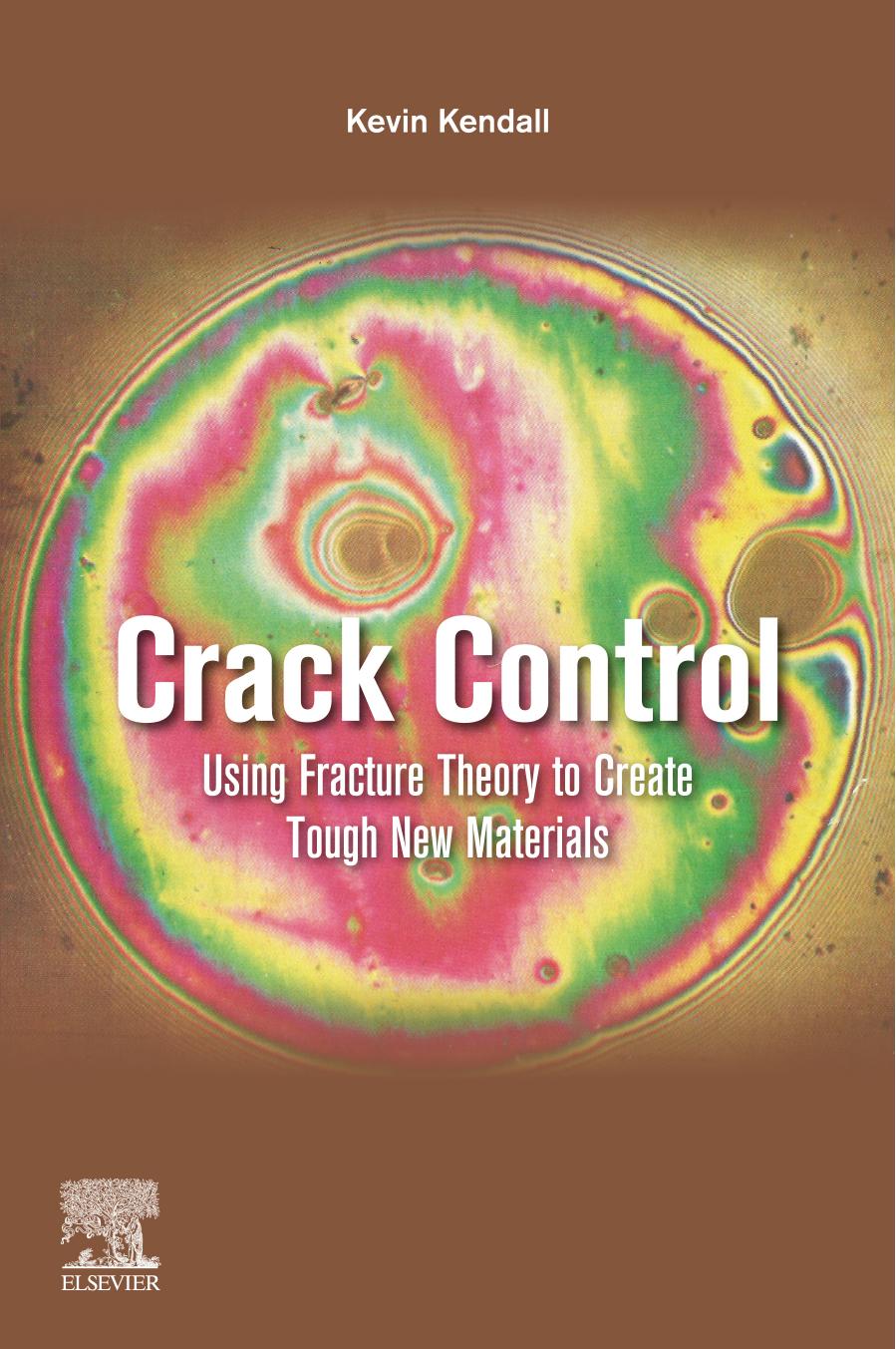
Crack Control Using Fracture Theory to Create Tough New Materials 1st edition by Kevin Kendall- Ebook PDF Instant Download/Delivery: 0128215070, 9780128215074
Full download Crack Control Using Fracture Theory to Create Tough New Materials 1st edition after payment
Product details:
ISBN 10: 0128215070
ISBN 13: 9780128215074
Author: Kevin Kendall
Crack Control: Using Fracture Theory to Create Tough New Materials goes beyond just trying to understand the origin of cracks and fracture in materials by also providing readers with the knowledge and techniques required to stop cracks at the nano- and micro-levels, covering the fundamentals of crack propagation, prevention, and healing. The book starts by providing a concise foundational overview of cracks and fracture mechanics, then looks at real-life ways that new tougher materials have been developed via crack inhibition. Topics such as crack equilibrium, stress criterion, and stress equations are then outlined, as are methods for inventing new crack-resistant materials. The importance of crack healing is emphasized and cracks that grow under tension, bending, compression, crazing, and adhesion are discussed at length as well
- Provides a better understanding of crack formation in various materials allowing for more efficient investigations of crack-based material or structural failure
- Demonstrates how to prevent cracks by arresting them at the nano- and micro-levels
- Looks at methods for developing new tougher and stronger materials through crack inhibition
- Emphasizes the importance of crack healing and explains crack stopping through changing the peel shape in various ways
Crack Control Using Fracture Theory to Create Tough New Materials 1st Table of contents:
Chapter 1 – Cracks: a century of toughness
1.1 – Seeing cracks
1.2 – Cracks: toughness versus strength
1.3 – How tough is tough enough?
1.4 – History of cracking and Galilean heresy
1.5 – Problem: is a crack in static or dynamic equilibrium?
1.6 – Empirical control of cracks
1.7 – The 1920 revolution: inventing a new material
1.8 – The simplicity of the energy approach
1.9 – The trouble with fracture mechanics
1.10 – Discovery of true crack equilibrium
1.11 – Crack-stopping effects
1.12 – A range of crack equations
1.13 – Deflecting cracks in laminates
1.14 – Reversible fracture in nature: nanocracks
1.15 – Manufacturing graphene: toughening glass
1.16 – One atom layer from disastrous fracture
1.17 – Future of cracks
1.18 – Existing literature
References
Chapter 2 – Using the Griffith defect idea to invent a new tougher material
2.1 – Griffith invention of fine glass fiber
2.2 – Cement and concrete
2.3 – Why is concrete so brittle?
2.4 – Large defects are the problem in cement cracking
2.5 – Empirical process improvements
2.6 – Perfect brittle gel concept
2.7 – Finding the optimal cement–polymer formulation
2.8 – Extending results on macro-defect-free cement
2.9 – Fiber-reinforced cement/concrete composites
2.10 – Further advances in cement crack prevention
2.11 – Extending to ceramic processing
2.12 – Gel formation produces defects
2.13 – Crack healing in space
2.14 – Introducing defects to improve toughness
2.15 – Creating new materials by studying cracks
References
Chapter 3 – Cracking observations: does stress or energy control a crack?
3.1 – Seeing effects of cracks
3.2 – Newton’s early cracking tests, “two polish’d marbles,…by immediate contact stick toget
3.3 – Griffith, Obreimoff, and attractive surface forces
3.4 – The contact crack between two spheres
3.5 – Eureka moment
3.6 – Benefits of smooth rubber sphere experiments
3.7 – Distinguishing surface and bulk effects
3.8 – Peeling crack simplifies the understanding of mechanisms
3.9 – Effect of film thickness
3.10 – Proof that cracks can move differently at the same stress
3.11 – Hyperbolic crack slowing for viscoelastic material
3.12 – Fatigue: repeated crack stopping
3.13 – Conclusions
References
Chapter 4 – Cracking equilibrium means low toughness
4.1 – The ideal crack
4.2 – A van der Waals bond model: breaking bonds to create new surface energy
4.3 – Range of surface energies at equilibrium
4.4 – Problem of narrow range of ideal fracture energies
4.5 – How to get large fracture energies
4.6 – Relaxations in metals, ceramics, and plastics
4.7 – Fracture energy spectrometer
4.8 – Does plastic relaxation blunt the crack?
4.9 – Crack deflection: peeling and healing
4.10 – Convincing experiment and theory: JKR
4.11 – No equilibrium in “Fracture Mechanics”
4.12 – Continuing issues of Fracture Mechanics solutions
4.13 – Conclusions
References
Chapter 5 – Bending history: from Greece thro Galileo to Griffith and beyond
5.1 – Evolution of the size effect concept
5.2 – Galileo and the stress criterion
5.3 – Griffith contrasted with Obreimoff
5.4 – The fracture mechanics fudge
5.5 – Comparing bending with tension cracks
5.6 – Bending cracks in long beams
5.7 – Why did Griffith theory show no sample size effect on fracture stress
5.8 – Correcting Griffith to obtain a size effect for finite samples
5.9 – Double cantilever beam testing as enduring homage to Obreimoff
5.10 – Thermoplastic CFRPs
5.11 – Testing thermoplastic welds
5.12 – Conclusions on bending cracks
References
Chapter 6 – Improving Fracture Mechanics (FM): let’s get back to energy
6.1 – The idea of minimizing defects is fundamental to Fracture Mechanics
6.2 – An example of fracture analysis: the comet disaster
6.3 – Challenging statements on fracture textbooks
6.4 – A cracking example: lap-joint failure
6.5 – Benefit in Fracture Mechanics calculations
6.6 – Plasticity affecting cracks: further fudging
6.7 – Barenblatt and Dugdale
6.8 – Cavitation viewed as a cracking process
6.9 – Theoretical advances in recent books
6.10 – Size effect in fuel cell application
6.11 – The energy concept and its demonstration by Tipper
6.12 – The Tipper transition and its effect
6.13 – Ultimate metal: single crystal turbine blade fracture
6.14 – Smart structure to inhibit cracks at micro and nano-level
6.15 – Conclusions
References
Chapter 7 – Crack equations: sidestepping complex stress analysis
7.1 – Old and new equations
7.2 – Starting with the simplest cracks
7.3 – Effect of angle on peel cracks
7.4 – Effect of elastic stretching on peel cracks
7.5 – Spontaneous peeling due to shrinkage
7.6 – Changes in crack shape as peeling develops
7.7 – Stopping cracks by changing peel shape
7.8 – Example of plastic flow stopping cracks in compression
7.9 – Elastic changes stopping cracks
7.10 – Crack stopping by peeling and healing
7.11 – Two new cracks discovered
7.12 – JKR energy balance
7.13 – Tied crack: triumph of energy over stress
7.14 – Closed-form solution for edge-cracked disc
7.15 – Cantilever beam tests: a tribute to Obreimoff
7.16 – Conclusions
References
Chapter 8 – Tough laminates: a lesson in brittle interfaces
8.1 – Laminate materials
8.2 – Theoretical problems of interface cracks
8.3 – How the stress analysts confused us
8.4 – Theoretical argument for energetics of crack deflection by brittle interface
8.5 – Experimental testing of interface deflecting a crack
8.6 – Mother of pearl and interface dislocation model
8.7 – Effect of a high modulus interface in laminated glass
8.8 – Proof of interface crack stopping due to modulus increase
8.9 – Does this idea apply to other types of crack?
8.10 – Application to ceramic laminates
8.11 – Graphene providing suitable interface fracture energy
8.12 – Conclusions
References
Chapter 9 – Nanocracks in nature: reversible adhesion
9.1 – Gecko climbing is a peeling-healing issue
9.2 – Glue not necessary for the gecko
9.3 – Size effect: large creatures need smaller contacts
9.4 – Theoretical arguments for size effect
9.5 – Getting the foot on and off the sticking surface
9.6 – Subdividing the contact spot stops the crack
9.7 – Gecko-tape
9.8 – Micropatterning
9.9 – Fracture and healing of bone
9.10 – Cancer as a toughness problem
9.11 – JKR extended to molecules at the crack surfaces
9.12 – Conclusions
References
Chapter 10 – Inventing a new tough material: tough glass through smart interfaces
10.1 – Glass: the archetypal brittle material
10.2 – Toughness studies on glass
10.3 – Tougher ceramic composites: various matrices
10.4 – Glass and ceramic matrices with fiber reinforcement
10.5 – New process introducing nanoscale interfaces
10.6 – Experiment illustrating the invention
10.7 – Measuring the glass–graphene interface energy
10.8 – Alternate interfaces
10.9 – Conclusions
References
Chapter 11 – Cracking future: new tougher materials in our lifetime
11.1 – Improved materials after a century of Griffith
11.2 – Crack problems defined and solved
11.3 – Ignoring the crack-tip stress
11.4 – Demonstrating crack equilibrium with JKR
11.5 – Chemistry and nonequilibrium experiments
11.6 – Understanding cracks at interfaces
11.7 – New studies needed at interfaces
11.8 – Size effect in fracture of brittle materials
11.9 – Wide range of crack configurations
11.10 – New crack developments: experiments and theory
11.11 – Invention of new tough materials
11.12 – Conclusions
References
Index
People also search for Crack Control Using Fracture Theory to Create Tough New Materials 1st :
fracture control
fracture crack
fracture theory
crack control joints
a crack or break
Tags: Kevin Kendall, Crack Control, New Materials, Using Fracture