


Database Concepts 9th edition by David Kroenke, David Auer, Scott Vandenberg, Robert Yoder – Ebook PDF Instant Download/Delivery: 0135188148 , 978-0135188149
Full download Database Concepts 9th edition after payment
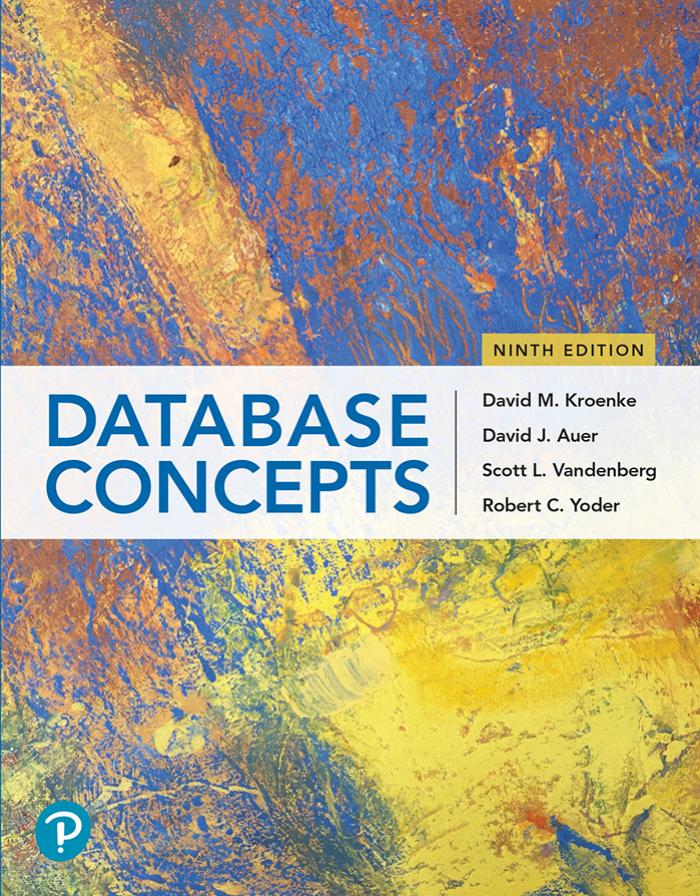
Product details:
ISBN 10: 0135188148
ISBN 13: 978-0135188149
Author: David Kroenke, David Auer, Scott Vandenberg, Robert Yoder
For courses in database management.
Hands-on exploration of database fundamentals
Database Concepts offers students practical help creating and managing small databases, from two of the world’s leading database authorities. The text focuses on database concepts, rather than features and functions of a particular product, making it flexible enough to work with the instructor’s preferred software. Data sets for three sample databases run throughout portions of the text so students can practice working with complete databases. Three running projects challenge learners to apply concepts and techniques to real business situations. In the 9th edition, Microsoft® Office 2019, and particularly Microsoft Access™ 2019, is now the basic software used and is shown running on Microsoft Windows™ 10.
Also available as an easy-to-use, standalone Pearson eText
Pearson eText is a simple-to-use, mobile-optimized, personalized reading experience that can be adopted on its own as the main course material. It lets students highlight, take notes, and review key vocabulary all in one place, even when offline. Seamlessly integrated videos and other rich media engage students and give them access to the help they need, when they need it. Educators can easily customize the table of contents and share their own notes with students so they see the connection between their eText and what they learn in class ― motivating them to keep reading, and keep learning.
Database Concepts 9th Table of contents:
Part 1 Database Fundamentals
Chapter 1 Getting Started
Chapter Objectives
The Importance of Databases in the Internet and Mobile App World
Why Use a Database?
What are the Problems with Using Lists?
Using Relational Database Tables
A Relational Design for the Student with Adviser List
A Relational Design for the Student with Adviser and Department List
A Relational Design for Art Course Enrollments
A Relational Design for Parts and Prices
How do I Process Relational Tables Using SQL?
What is a Database System?
The Database
The DBMS
Application Programs
Personal Versus Enterprise-Class Database Systems
MySQL Community Server 8.0
Microsoft SQL Server 2017
Oracle Database XE
What is a Web Database Application?
What are Data Warehouses and Business Intelligence (BI) Systems?
What is Big Data?
What is Cloud Computing?
Summary
Key Terms
Review Questions
Exercises
Case Questions
San Juan Sailboat Charters
Garden Glory Project Questions
James River Jewelry Project Questions
The Queen Anne Curiosity Shop Project Questions
Chapter 2 The Relational Model
Chapter Objectives
Relations
A Sample Relation and Two Nonrelations
A Note on Presenting Relation Structures
A Note on Terminology
Types of Keys
Composite Keys
Candidate and Primary Keys
Surrogate Keys
Foreign Keys and Referential Integrity
The Problem of Null Values
To Key or Not to Key—That Is the Question!
Functional Dependencies and Normalization
Functional Dependencies
Primary and Candidate Keys Revisited
Normalization
Relational Design Principles
The Normalization Process
Step 1 of the Normalization Process
Step 2 of the Normalization Process
Step 3 of the Normalization Process
Normalization Examples
Normalization Example 1
Normalization Example 2
Normalization Example 3
Normalization Example 4
Eliminating Anomalies from Multivalued Dependencies
Summary
Key Terms
Review Questions
Exercises
Case Questions
Regional Labs
Garden Glory Project Questions
James River Jewelry Project Questions
The Queen Anne Curiosity Shop Project Questions
Chapter 3 Structured Query Language
Chapter Objectives
Wedgewood Pacific
“Does Not Work with Microsoft Access ANSI-89 SQL”
SQL for Data Definition (DDL)—Creating Tables and Relationships
Defining Primary Keys with Table Constraints
Defining Foreign Keys with the Table Constraints
Submitting SQL to the DBMS
SQL for Data Manipulation (DML)—Inserting Data
Inserting Data
SQL for Data Manipulation (DML)—Single Table Queries
The SQL SELECT/FROM/WHERE Framework
Reading Specified Columns from a Single Table
Specifying Column Order in SQL Queries from a Single Table
Submitting SQL Statements to the DBMS
SQL Enhancements for Single Table Queries
Reading Specified Rows from a Single Table
Reading Specified Columns and Rows from a Single Table
Sorting the Results of a Query
SQL WHERE Clause Options
Compound SQL WHERE Clauses Using Logical Operators
SQL WHERE Clauses Using Sets of Values
SQL WHERE Clauses Using Ranges of Values
SQL WHERE Clauses That Use Character String Patterns
SQL WHERE Clauses That Use NULL Values
SQL Queries that Perform Calculations
Using SQL Built-in Aggregate Functions
Using SQL Expressions in SQL SELECT Statements
Grouping Rows using SQL SELECT Statements
SQL for Data Manipulation (DML)—Multiple Table Queries
Querying Multiple Tables with Subqueries
Querying Multiple Tables with Joins
The SQL JOIN ON Syntax
Comparing Subqueries and Joins
Inner Joins and Outer Joins
Using SQL Set Operators
SQL for Data Manipulation (DML)—Data Modification and Deletion
Modifying Data
Deleting Data
SQL for Data Definition (DDL)—Table and Constraint Modification and Deletion
The SQL DROP TABLE Statement
The SQL ALTER TABLE Statement
The SQL TRUNCATE TABLE Statement
SQL Views
Summary
Key Terms
Review Questions
Exercises
Case Questions
Heather Sweeney Designs
Garden Glory Project Questions
James River Jewelry Project Questions
The Queen Anne Curiosity Shop Project Questions
Part 2 Database Design
Chapter 4 Data Modeling and the Entity-Relationship Model
Chapter Objectives
Systems Development and Analysis
What is an Information System?
What is a Business Process?
How Do Information Systems Support Business Processes?
What Is Systems Analysis and Design?
What Are the Steps in the SDLC?
The System Definition Step
The Requirements Analysis Step
The Component Design Step
The Implementation Step
The System Maintenance Step
What are the Steps in the Database Development Process?
Requirements Analysis
The Entity-Relationship Data Model
Entities
Attributes
Identifiers
Relationships
Three Types of Binary Relationships
Maximum Cardinality
Minimum Cardinality
Entity-Relationship Diagrams
Variations of the E-R Model
The IE Crow’s Foot E-R Model
Weak Entities
ID-Dependent Entities
Non–ID-Dependent Weak Entities
Associative Entities
Subtype Entities
Recursive Relationships
Developing an Example E-R Diagram
Heather Sweeney Designs
The Seminar Customer List
The Customer Form Letter
The Sales Invoice
Attribute Specifications
Business Rules
Validating the Data Model
Summary
Key Terms
Review Questions
Exercises
Case Questions
Highline University Mentor Program
Writer’s Patrol
Garden Glory Project Questions
James River Jewelry Project Questions
The Queen Anne Curiosity Shop Project Questions
Chapter 5 Database Design
Chapter Objectives
The Purpose of a Database Design
Transforming a Data Model into a Database Design
Representing Entities with the Relational Model
Representing the ITEM Entity
Surrogate Keys
Column Properties
Data Types
NULL Status
Default Values
Data Constraints
Verifying Normalization
Representing the CUSTOMER Entity
Denormalization
A Relational Design for the SALES_COMMISSION Entity
Representing Weak Entities
Representing Relationships
Relationships Between Strong Entities
Representing 1:1 Strong Entity Relationships
Representing 1:N Strong Entity Relationships
Representing N:M Strong Entity Relationships
Relationships Using Weak Entities
Relationships with Subtypes
Representing Recursive Relationships
Database Design at Heather Sweeney Designs
Weak Entities
Verifying Normalization
Specifying Column Properties
Relationships
Enforcing Referential Integrity
Summary
Key Terms
Review Questions
Exercises
Case Questions
Writer’s Patrol
Garden Glory Project Questions
James River Jewelry Project Questions
The Queen Anne Curiosity Shop Project Questions
Part 3 Database Management
Chapter 6 Database Administration
Chapter Objectives
The Heather Sweeney Designs Database
The Need for Control, Security, and Reliability
Concurrency Control
The Need for Atomic Transactions
Concurrent Transaction Processing
The Lost Update Problem
Resource Locking
Serializable Transactions
Deadlock
Optimistic Versus Pessimistic Locking
SQL Transaction Control Language and Declaring Lock Characteristics
Consistent Transactions
Transaction Isolation Level
Cursor Types
Database Security
User Accounts
User Processing Rights and Responsibilities
DBMS-Level Security
Application-Level Security
Database Backup and Recovery
Recovery via Reprocessing
Recovery via Rollback and Rollforward
Physical Database Design and Optimization
Additional DBA Responsibilities
Summary
Key Terms
Review Questions
Exercises
Case Questions
Marcia’s Dry Cleaning
Garden Glory Project Questions
James River Jewelry Project Questions
The Queen Anne Curiosity Shop Project Questions
Chapter 7 Data Warehouses, Business Intelligence Systems, and Big Data
Chapter Objectives
Business Intelligence Systems
The Relationship Between Operational and BI Systems
Reporting Systems and Data Mining Applications
Reporting Systems
Data Mining Applications
Data Warehouses and Data Marts
The Components of a Data Warehouse
Data Warehouses Versus Data Marts
Dimensional Databases
The Star Schema
Illustrating the Dimensional Model
Multiple Fact Tables and Conformed Dimensions
OLAP
Distributed Database Processing
Types of Distributed Databases
Challenges of Distributed Databases
Object-Relational Databases
Virtualization
Cloud Computing
Big Data and the not only SQL Movement
Design Decisions and the CAP Theorem
Categories of NoSQL Database Management Systems
Document Databases and JSON
MapReduce
Hadoop
Summary
Key Terms
Review Questions
Exercises
Case Questions
Marcia’s Dry Cleaning
Garden Glory Project Questions
James River Jewelry Project Questions
The Queen Anne Curiosity Shop Project Questions
Online Extensions
Glossary
Index
Symbols
Database Concepts
Extension A Working with MySQL
Chapter Objectives
What is the Purpose of this Extension?
Why Should I Learn to Use MySQL?
What Will This Extension Teach Me?
What Won’t This Extension Teach Me?
How Should I Use This Extension?
Section 1 – Installing MySQL Community Server 8.0
How Do I Create a Workspace for the MySQL Workbench Files?
How Do I Start the MySQL Workbench?
Section 2 – Creating and Using a MySQL Database
How do I Create a MySQL Database?
How Do I Set the Active Database in MySQL?
How Do I Work with SQL Statements and SQL Scripts in MySQL?
How Can I Use Existing SQL Scripts?
Section 3 – Using SQL in MySQL
Setting the Default Schema:
How do I use SQL Statements to Create Table and Relationship Structures?
How Do I Use SQL Statements to Insert Data?
What Is Transaction COMMIT in MySQL?
How Do I Work with SQL Queries in MySQL?
Additional Documentation for MySQL
Closing MySQL Workbench:
Section 4 – Importing Microsoft Excel Data into a MySQL Database
Preparing the Microsoft Excel Data for Import into a Database Table
Importing the Microsoft Excel Data into a MySQL 8.0 Database Table
Section 5 – Creating a Database Design in MySQL Workbench
How Do I Create Database Designs in the MySQL Workbench?
Creating a New MySQL E-R (EER) Diagram:
Creating a Table in the MySQL E-R (EER) Diagram:
Creating the DEPARTMENT Table Columns in the MySQL E-R (EER) Diagram:
Creating a 1:N Nonidentifying Relationship Between Two Tables:
Closing the MySQL Relationship Editor:
Section 6 – Database Administration in MySQL
How Do I Create User Accounts in MySQL 8.0?
How Do I Grant Users Permissions in MySQL 8.0?
How Do I Create Database Backups in MySQL 8.0?
Backing Up the WMCRM Database:
Section 7 – Business Intelligence Systems Using MySQL
Creating a Microsoft Excel OLAP Report
Structuring the OLAP Report
Modifying an OLAP Report
Section B – Advanced SQL in MySQL
Working with the SQL ALTER TABLE Statement in MySQL
How Do I Create a Recursive Relationship within the CUSTOMER Table in MySQL 8.0?
How Do I Run a Query on a Recursive Relationship in MySQL 8.0?
How Do I Create SQL Views in MySQL 8.0?
Section C – Advanced BI and Big Data
What Is Open Database Connectivity (ODBC)?
ODBC Architecture
Establishing an ODBC Data Source Name
How Do I Create an ODBC System Data Source for MySQL 8.0?
How Do I Create an ODBC Connection from Microsoft Access 2019 to a MySQL 8.0 Database?
Summary
Key Terms
Review Questions
Exercises
Marcia’s Dry Cleaning Case Questions
Garden Glory Project Questions
James River Jewelry Project Questions
The Queen Anne Curiosity Shop Project Questions
Database Concepts
Extension B Advanced SQL
Chapter Objectives
What Is the Purpose of This EXTENSION?
Extending the WP Database
Using the SQL ALTER TABLE Statement
Modifying the MySQL AUTO_INCREMENT Starting Value
Adding a Column to an Existing Table
Adding a NOT NULL Column to the PRODUCTION_ITEM Table
Adding a Table Constraint to an Existing Table
Adding a Referential Integrity Constraint to an Existing Table
Removing a Table Column from an Existing Table
Removing a Table Constraint from an Existing Table
Using the SQL MERGE Statement
Extensions to SQL Query Techniques
Using Outer Join Queries
Using Correlated Subqueries
Searching for Multiple Rows with a Given Value
A Correlated Subquery That Finds Rows with the Same Value
A Common Trap
SQL Correlated Subqueries Using the EXISTS and NOT EXISTS Comparison Operators
SQL Queries on Recursive Relationships
Using SQL Set Operators
Creating and Working with SQL Views
Using SQL Views
Using Views to Hide Columns or Rows
Using Views to Display Results of Computed Columns
Using Views to Hide Complicated SQL Syntax
Layering Computations and Built-In Functions
SQL/Persistent Stored Modules (SQL/PSM)
SQL/PSM User-Defined Functions
SQL/PSM Triggers
SQL/PSM Stored Procedures
Importing Microsoft Excel Data into a Database Table
Using Microsoft Access 2019 as a Development Platform
Summary
Key Terms
Review Questions
Exercises
Heather Sweeney Designs Case Questions
Garden Glory Project Questions
James River Jewelry Project Questions
The Queen Anne Curiosity Shop Project Questions
Database Concepts
Extension C Advanced Business Intelligence and Big Data
Extension Objectives
Reporting Systems
RFM Analysis
Reporting System Components
Report Types
Report Media
Report Modes
Report System Functions
Data Mining
Unsupervised Data Mining
Market Basket Analysis
Supervised Data Mining
Decision Trees
What is Big Data?
The Three Vs
Volume
Velocity
Variety
Big Data and NoSQL Systems
Aggregates
Extensible Markup Language (XML)
XML as a Markup Language
Materializing XML Documents with XSLT
XML Document Type Declarations and XML Schema
XML Schema Validation
Elements (and a Little About Attributes)
Creating XML Documents from Database Data
Using XPath and XQuery to Query XML Documents
Why Is XML Important?
Additional XML Standards
NoSQL Database Management Systems
Key-Value Databases
Column Family Databases
Graph Databases
Document Databases
ArangoDB and the CAP Theorem
Using the Database Features of Microsoft Azure
Connecting to the Microsoft Azure Home Page
Creating a New SQL Database
Setting up Our Database Server Firewall Rules
Migrating Our Existing Local HSD Database to Azure
Cloud Reflections
Summary
Key Terms
People also search for Database Concepts 9th:
relational database concepts
basic database concepts
distributed database concepts
oracle database concepts
advanced database concepts
Tags: David Kroenke, David Auer, Scott Vandenberg, Robert Yoder, Database Concepts