


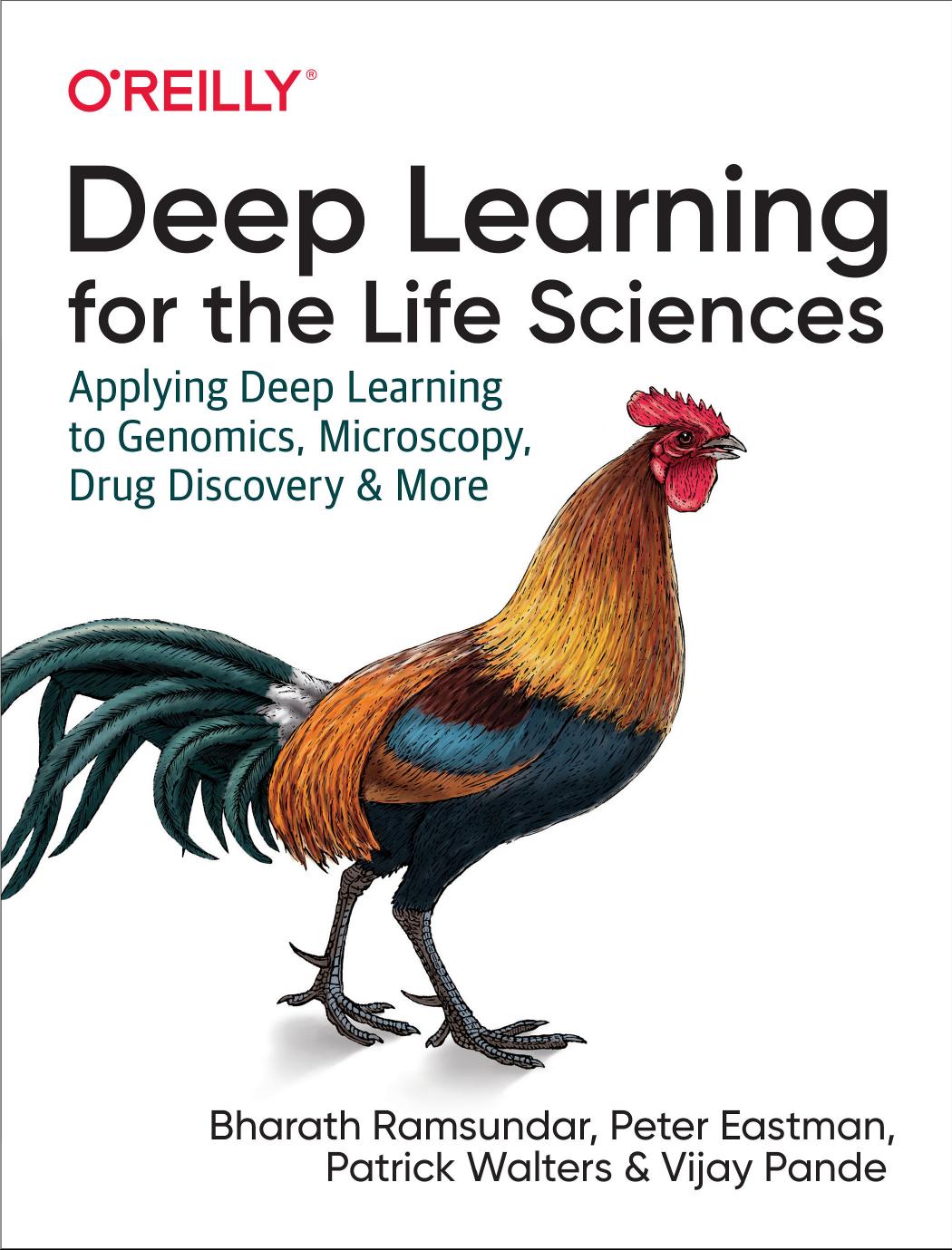
Deep Learning for the Life Sciences 1st edition by Bharath Ramsundar, Peter Eastman, Pat Walters, Vijay Pande ISBN 1492039839 9781492039839
Original price was: $70.00.$35.00Current price is: $35.00.
Instant download Deep Learning for the Life Sciences Bharath Ramsundar Peter & Eastman Vijay & Pande & Patrick Walters after payment
Deep Learning for the Life Sciences 1st edition by Bharath Ramsundar, Peter Eastman, Pat Walters, Vijay Pande – Ebook PDF Instant Download/Delivery: 1492039839 , 9781492039839
Full download Deep Learning for the Life Sciences 1st edition after payment
Product details:
ISBN 10: 1492039839
ISBN 13: 9781492039839
Author: Bharath Ramsundar, Peter Eastman, Pat Walters, Vijay Pande
Deep learning has already achieved remarkable results in many fields. Now it’s making waves throughout the sciences broadly and the life sciences in particular. This practical book teaches developers and scientists how to use deep learning for genomics, chemistry, biophysics, microscopy, medical analysis, and other fields. Ideal for practicing developers and scientists ready to apply their skills to scientific applications such as biology, genetics, and drug discovery, this book introduces several deep network primitives. You’ll follow a case study on the problem of designing new therapeutics that ties together physics, chemistry, biology, and medicine—an example that represents one of science’s greatest challenges. Learn the basics of performing machine learning on molecular data Understand why deep learning is a powerful tool for genetics and genomics Apply deep learning to understand biophysical systems Get a brief introduction to machine learning with DeepChem Use deep learning to analyze microscopic images Analyze medical scans using deep learning techniques Learn about variational autoencoders and generative adversarial networks Interpret what your model is doing and how it’s working
Deep Learning for the Life Sciences 1st Table of contents:
1. Why Life Science?
Why Deep Learning?
Contemporary Life Science Is About Data
What Will You Learn?
2. Introduction to Deep Learning
Linear Models
Multilayer Perceptrons
Training Models
Validation
Regularization
Hyperparameter Optimization
Other Types of Models
Convolutional Neural Networks
Recurrent Neural Networks
Further Reading
3. Machine Learning with DeepChem
DeepChem Datasets
Training a Model to Predict Toxicity of Molecules
Case Study: Training an MNIST Model
The MNIST Digit Recognition Dataset
A Convolutional Architecture for MNIST
Conclusion
4. Machine Learning for Molecules
What Is a Molecule?
What Are Molecular Bonds?
Molecular Graphs
Molecular Conformations
Chirality of Molecules
Featurizing a Molecule
SMILES Strings and RDKit
Extended-Connectivity Fingerprints
Molecular Descriptors
Graph Convolutions
Training a Model to Predict Solubility
MoleculeNet
SMARTS Strings
Conclusion
5. Biophysical Machine Learning
Protein Structures
Protein Sequences
A Short Primer on Protein Binding
Biophysical Featurizations
Grid Featurization
Atomic Featurization
The PDBBind Case Study
PDBBind Dataset
Featurizing the PDBBind Dataset
Conclusion
6. Deep Learning for Genomics
DNA, RNA, and Proteins
And Now for the Real World
Transcription Factor Binding
A Convolutional Model for TF Binding
Chromatin Accessibility
RNA Interference
Conclusion
7. Machine Learning for Microscopy
A Brief Introduction to Microscopy
Modern Optical Microscopy
The Diffraction Limit
Electron and Atomic Force Microscopy
Super-Resolution Microscopy
Deep Learning and the Diffraction Limit?
Preparing Biological Samples for Microscopy
Staining
Sample Fixation
Sectioning Samples
Fluorescence Microscopy
Sample Preparation Artifacts
Deep Learning Applications
Cell Counting
Cell Segmentation
Computational Assays
Conclusion
8. Deep Learning for Medicine
Computer-Aided Diagnostics
Probabilistic Diagnoses with Bayesian Networks
Electronic Health Record Data
The Dangers of Large Patient EHR Databases?
Deep Radiology
X-Ray Scans and CT Scans
Histology
MRI Scans
Learning Models as Therapeutics
Diabetic Retinopathy
Conclusion
Ethical Considerations
Job Losses
Summary
9. Generative Models
Variational Autoencoders
Generative Adversarial Networks
Applications of Generative Models in the Life Sciences
Generating New Ideas for Lead Compounds
Protein Design
A Tool for Scientific Discovery
The Future of Generative Modeling
Working with Generative Models
Analyzing the Generative Model’s Output
Conclusion
10. Interpretation of Deep Models
Explaining Predictions
Optimizing Inputs
Predicting Uncertainty
Interpretability, Explainability, and Real-World Consequences
Conclusion
11. A Virtual Screening Workflow Example
Preparing a Dataset for Predictive Modeling
Training a Predictive Model
Preparing a Dataset for Model Prediction
Applying a Predictive Model
Conclusion
12. Prospects and Perspectives
Medical Diagnosis
Personalized Medicine
Pharmaceutical Development
Biology Research
Conclusion
Index
People also search for Deep Learning for the Life Sciences 1st :
deep learning for the life sciences
bharath ramsundar
bharath ramsundar google scholar
deep learning for the life sciences review
deep learning for life science
Tags: Bharath Ramsundar, Peter Eastman, Pat Walters, Vijay Pande, Deep Learning, Life Sciences