


Derivatives Algorithms Volume 1 Bones 1st edition by Thomas Hyer – Ebook PDF Instant Download/Delivery: 9814289809 , 978-9814289801
Full download Derivatives Algorithms Volume 1 Bones 1st edition after payment
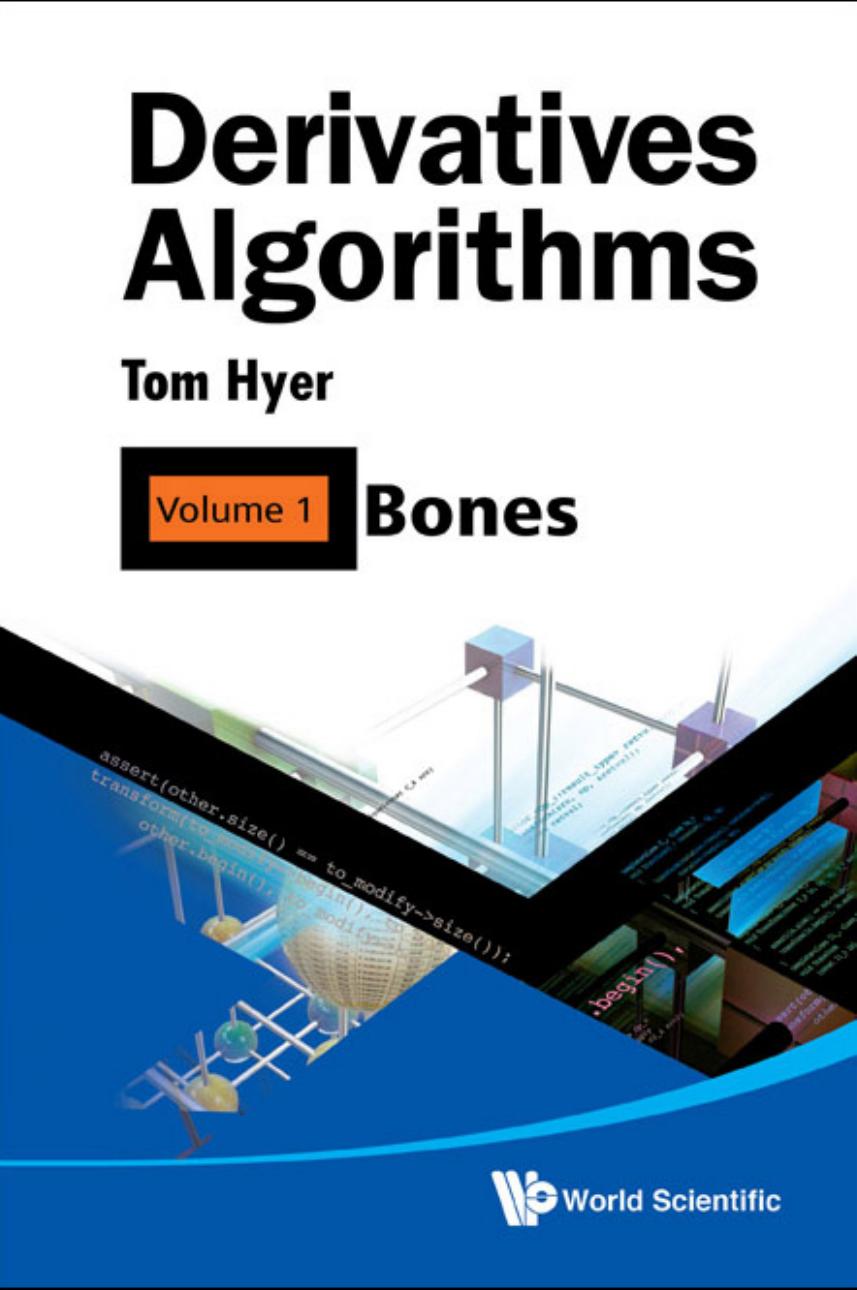
Product details:
ISBN 10: 9814289809
ISBN 13: 978-9814289801
Author: Thomas Hyer
Derivatives Algorithms provides a unique expert overview of the abstractions and coding methods which support real-world derivatives trading. Written by an industry professional with extensive experience in large-scale trading operations, it describes the fundamentals of library code structure, and innovative advanced solutions to thorny issues in implementation. For the reader already familiar with C++ and arbitrage-free pricing, the book offers an invaluable glimpse of how they combine on an industrial scale. Topics range from interface design through code generation to the protocols that support ever more complex trades and models.
Derivatives Algorithms Volume 1 Bones 1st Table of contents:
1. Introduction
2. Principles
2.1 Our Code
2.1.1 auto
2.2 Functional Programming
2.3 Type and State
2.4 Physical Code Structure
2.4.1 Facts
2.5 Platform
2.6 Some Design Patterns
2.6.1 Factory Method
2.6.2 Decorator
2.6.3 Singleton
2.7 Optimization
2.7.1 Calibration
2.7.2 map
2.8 Threads
3. Types and Interfaces
3.1 The User Base
3.2 A Public Example
3.3 Interface Generation
3.4 Interface Types
3.4.1 Tables and Cells
3.5 Interface Code
3.5.1 Customization Directives
3.6 Other Containers
3.7 Environment
3.7.1 Exception Messaging
3.7.2 Fast-Path Optimization
3.7.3 Macro Hackery
3.7.4 Repository Access
3.8 Enumerated Types
4. Vector and Matrix Computations
4.1 Customizing Vectors
4.2 Algorithms
4.2.1 Join
4.3 Matrices and Square Matrices
4.3.1 Internal Layout
4.3.2 Pasting and Formatting
4.4 Matrix Multiplication
4.4.1 Inheritance and Substitutability
4.5 Decompositions (Square)
4.6 Decompositions (Symmetric)
4.7 Decompositions (Sparse)
4.7.1 Tridiagonal Matrices
4.7.2 Band Diagonal Matrices
4.7.3 SLAP Format
4.7.4 The Symmetric Case
4.8 Decompositions (Other)
5. Persistence and Memory
5.1 Storage
5.2 Extraction
5.2.1 Public Types
5.2.2 Example: Linear Interpolant
5.2.3 Reader Registry
5.3 Rebuilding
5.3.1 Some Syntactic Sugar
5.4 Code Generation
5.5 A Display Interface
5.5.1 Storage
5.5.2 Extraction
5.5.3 Refinements
5.6 Auditing
5.6.1 Bag
5.6.2 Filling Up
5.6.3 Audit Types
5.7 More on Repositories
5.7.1 Unique Objects
5.7.2 Naming
5.7.3 Matching
6. Testing Framework
6.1 Component Tests
6.1.1 Physical Structure
6.1.2 Reuse
6.2 Regression Tests
6.2.1 Repository Instrumentation
6.3 No Silver Bullet
7. Further Maths
7.1 Interpolation
7.2 Special Functions
7.2.1 The Normal Distribution
7.3 Root Solvers
7.4 Underdetermined Search
7.4.1 Function and Jacobian
7.4.2 Weights and Smoothing
7.4.3 Monitoring Progress
7.5 Quadrature
7.5.1 Gaussian Quadrature
7.5.2 Adaptive Quadrature
7.6 Distributions
7.6.1 Implied Vol
7.7 Baskets
7.7.1 Whole-Basket Moment Matching
7.7.2 Taylor Expansion of Projected Vols
7.7.3 Midpoint Variance
7.8 Random and Quasi-Random Numbers
7.8.1 Random Deviate Streams
7.8.2 Generator Implementation
7.8.3 Transforms
7.8.4 Low-Discrepancy Sequences
7.8.5 Spectral and Spining Methods
7.9 PDE Solvers
7.9.1 Cube
7.9.2 Coordinate Mapping
7.9.3 Coefficient Calculators
7.9.4 Forward Induction
7.10 American Monte Carlo
7.10.1 Recursive Partitioning
7.10.2 Biases
8. Schedules
8.1 Enumerated Switches
8.1.1 Groundwork for Extensibility
8.1.2 30E/360 ISDA, ACT/ACT ISMA
8.1.3 BUS/252
8.1.4 Other Enumerations
8.2 Holidays
8.2.1 Cities
8.2.2 Holiday Sets
8.3 Currencies
8.3.1 Internals
8.4 Increments
8.5 Legs
8.5.1 Stubs
8.5.2 Build from Parameters
8.5.3 CDS
8.5.4 Inflation Instruments
9. Indices
9.1 Naming and Parsing
9.1.1 Short Names
9.1.2 Nonstandard Indices
9.2 Fixings
9.2.1 Composites
9.3 Sorting and Hashing
9.4 Implied Vol
10. Pricing Protocols
10.0.1 Which is a Model?
10.1 Past and Future
10.2 Underlyings
10.3 Payments and Streams
10.3.1 Payment Reporting
10.3.2 Commitment to Streams
10.3.3 Destinations
10.4 Index Paths
10.4.1 Historical Paths
10.5 Defaults and Contingent Payments
10.5.1 Immediate Payments
10.5.2 Viewing Indices
10.6 Requests and Promises
10.6.1 Help for Models
10.6.2 Destinations
10.7 Bermudans and Barriers
10.8 Payouts
10.8.1 Trade State
10.8.2 Values Store
10.9 Steps
10.9.1 Valuation and Reevaluation
10.10 Use Case Review: PDE
10.11 Use Case Review: Monte Carlo and Hedge
10.11.1 Causality
10.12 Costs and Benefits
10.13 Assembling the Class Hierarchy
10.13.1 Stepper
10.13.2 Asset Values and Tokens
10.13.3 SDE
10.13.4 Model
10.13.5 Trade
10.13.6 Historical Data Access
10.13.7 Assets
10.13.8 Solvers
11. Standardized Trades
11.1 Trade Classes
11.2 Cash
11.3 Equity and FX
11.3.1 Equity Forward Payout
11.3.2 Equity Index
11.3.3 Equity Forward Data
11.3.4 FX Option
11.3.5 Forcing Backward Induction
11.4 Legs and Swaps
11.4.1 Putting it Together
11.5 Caps
11.6 Swaps and Swaptions
11.7 Bermudans
11.7.1 Two Views
11.8 Composites
11.8.1 Rescaled Trades
11.8.2 Sums and Collections
12. Curves
12.1 Risk
12.2 Libor and Funding
12.3 Build Instruments
12.3.1 Tenor
12.4 Dividend
12.5 Hazard
13. Models
13.1 Vasicek-Hull-White
13.1.1 Parametrization
13.1.2 Model Contents
13.2 Interface to Numerical Pricing
13.3 Interface to Valuation Requests
13.3.1 Index Paths
13.3.2 Efficiency
13.3.3 Back to Libor
13.4 Cox-Ingersoll-Ross
13.5 Black-Karasinski
13.5.1 Forward Induction PDE Sweep
13.6 Single Equity with Local Vol
13.6.1 Interpolated Vol
13.6.2 Derivation from Implied Vol
13.6.3 Model and SDE
13.7 A Simple Hybrid Model
13.7.1 The Case for Components
13.7.2 State Bounds Checks
14. Semianalytic Pricers
14.1 A Moment-Matching Pricer
14.2 Multimethod Objects
14.3 Method Registry
14.4 Interaction with Re-evaluator
14.5 Interaction with Composites
14.6 Pure Pricers
14.7 Trade-Dependent Calibration
14.7.1 Stabilization
15. Risk
15.1 Slides and Bumps
15.2 Mutants
15.3 Reports
15.3.1 Barewords
15.4 Portfolios
15.5 Tasks
15.6 Slide Utilities
15.7 Conclusions
16. Additional Code
16.1 Add Multiple
16.2 ArrayFunctor
16.3 Boolean
16.4 Composite
16.5 Cube
16.6 Handle
16.7 Matrix
16.8 Maybe
16.9 PWC (Piecewise Constant)
16.10 Vector
16. Acknowledgements and Further Reading
Index
People also search for Derivatives Algorithms Volume 1 Bones 1st:
derivatives algorithms
derivatives professor leonard
derivatives and optimization
derivatives principles and practice pdf
a derivative