


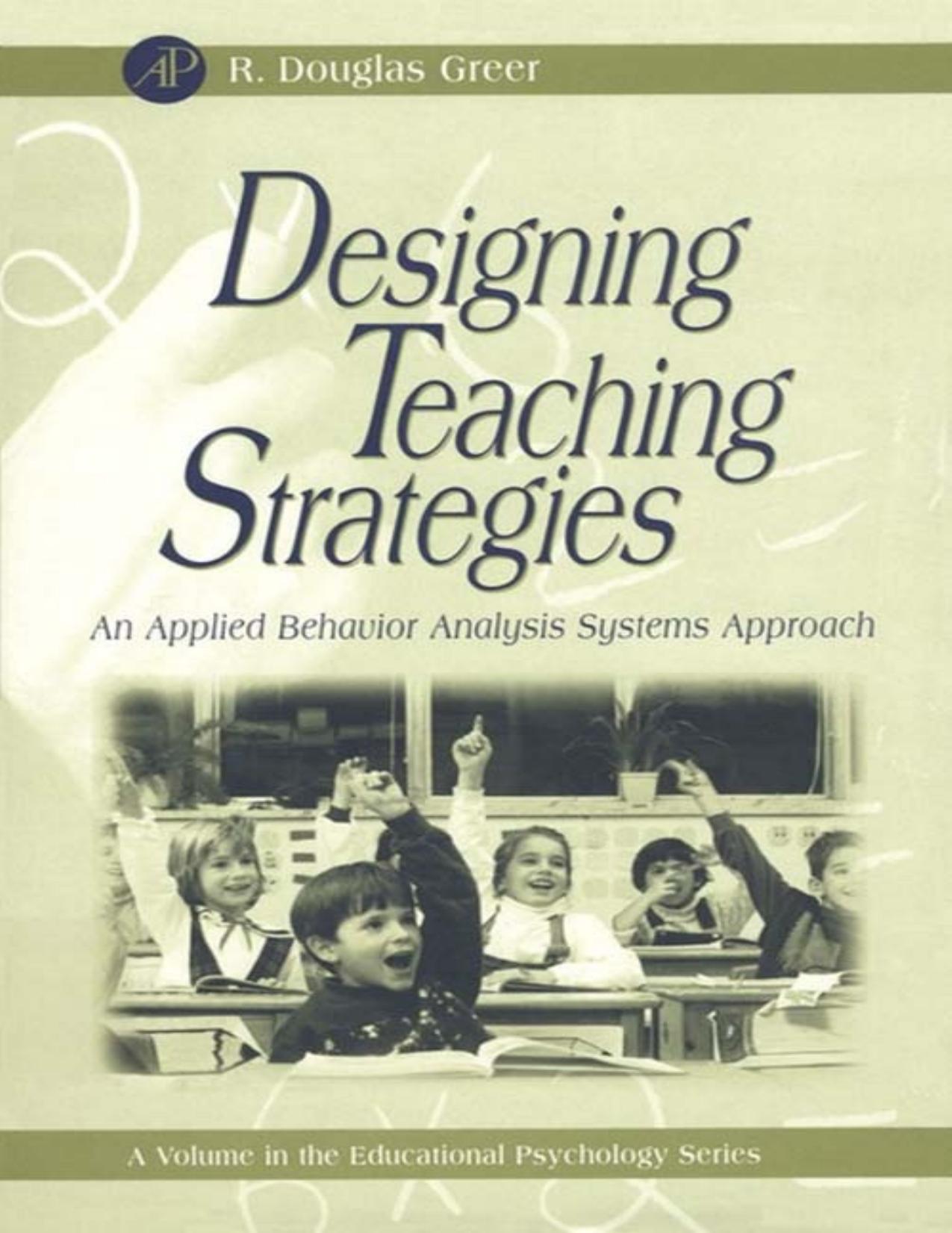
Designing Teaching Strategies An Applied Behavior Anas Approach 1st edition by Douglas Greer – Ebook PDF Instant Download/Delivery: 1493300547 , 978-1493300549
Full download Designing Teaching Strategies An Applied Behavior Anas Approach 1st edition after payment
Product details:
ISBN 10: 1493300547
ISBN 13: 978-1493300549
Author: Douglas Greer
The US Dept. of Education, in conjunction with the US Dept. of Health and Human Services, recently unveiled a $50 million effort to expand research on early childhood cognitive development. A key issue identified requiring more information and research was the education and professional development of educators. Along these lines, Doug Greer has prepared a book discussing how best to teach, how to design functional curricula, and how to support teachers in using state-of-the-art science instruction materials.
The book provides important information both to trainers of future teachers, current teachers, and to supervisors and policy makers in education. To trainers there is information on how to motivate, mentor, and instruct in-service teachers to use the best scientifically based teaching strategies and tactics. To in-service teachers, there is information on how to provide individualized instruction in classrooms with multiple learning and behavior problems, school interventions to help prevent vandalism and truancy, and how curricula and instruction can be designed to teach functional repetoirs rather than inert ideas. To policy makers and supervisors, the book discusses how to determine the effectiveness of curricular innitiatives toward meeting mandated standards in national assessments.
Doug Greer was recently awarded the Fred S. Keller Award for Distinguished Contributions to Education by APA for the research and application of the material covered in this book. School programs incorporating the material used in this book have produced 4-7 times more learning outcomes for students than control and baseline educational programs (see www.cabas.com)
The book provides research-based and field-tested procedures for:
* Teaching students of all ability levels ranging from preschool to secondary school
* How to teach special education students in the context of a regular classroom
* Best practices for all teachers to teach more effectively
* Means of monitoring and motivating teachers’ practices
* A comprehensive and system-wide science of teaching―post modern-postmodern!
* Tested procedures that result in four to seven times more learning for all
students
* Tested procedures for supervisors to use with teachers that result in
significant student learning
* Tested procedures for providing the highest accountability
* A systems approach for schooling problems that provide solutions rather
than blame
* Parent approved and parent requested educational practices
* Means for psychologists to work with teachers and students to solve
behavior and learning problems
* A comprehensive systems science of schooling
* An advanced and sophisticated science of pedagogy and curriculum design
* Students who are not being served with traditional education can meet or
exceed the performance of their more fortunate peers,
* Supervisors can mentor teachers and therapists to provide state of the
science instruction
* Parent education can create a professional setting for parents, educators,
and therapists to work together in the best interests of the student,
* Teachers and supervisors who measure as they teach produce significantly
better outcomes for students,
* Systemic solutions to instructional and behavioral problems involving
teachers, parents, supervisors provide means to pursue problems to their
solution,
* A science of teaching, as opposed to an art of teaching, can provide an
educational system that treats the students and the parents as the clients.
Designing Teaching Strategies An Applied Behavior Anas Approach 1st Table of contents:
Part I: Advanced Applications of Applied Behavior Analysis to Teaching
Chapter 1. Teaching as Applied Behavior Analysis: A Professional Difference
A definition of teaching and Padegogy
Teaching as a Scientifically Based Profession
Characteristic Practices of Teaching as Applied Behavior Analysis
The Organization of the Text
References
Chapter 2. The Learn Unit: A Natural Fracture of Teaching
A Measure for Teaching
The Basic Unit of Pedagogy
The Research Base
Analysis of the Components of the Student’s Three-Term Cotingency in the Learn Unit
The Presence and Absence of Learn Units in Educational Practice
Other Literature on Operant Episodes
The Converging Literature
Student Progress and Changes in the Location and Frequency of Learn Units
The Learn Unit as an Analytic Tool
Functions of Learn Units
References
Chapter 3. The Repertoires of Teachers Who Are Behavior Analysts
The Repertoires of the Teacher as Startegic Scientist
References
Chapter 4. The Strategic Analysis of Instruction and Learning
Verbally Mediated Repertoires
Strategic Questions
Summary of Applications of the Verbally Mediated Repertoire
References
Chapter 5. Teacher Repertoires for Students from Prelistener to Early Reader Status
The Target Instructional Stages That Determinne Teaching Repertoires
Sample Instructional Goals for the Learning Stages for Foundational Communication
Why Learn Units Are So Teacher-Intensive
Teaching Operations Needed
Managing Individualized Instruction in a Classroom Setting: What to Do with the Other Students
Individualized Interactions between Teacher and Student
Tacting the Events in the Classroom as a Scientist: Toward Analytic Expertise
Examples of Tactic Selection Operations
Summary
References
Chapter 6. Teaching Practices for Students With Advanced Repertoires of Verbal Behavior (Reader to E
Repertoires for 2000
Design and Teaching Operations for Academic Literacy
Design and Teaching Operations for Discipline-Based Problem Solving
Learner-Cotrolled Instruction and Time Management
Desing and Teaching Operations for Expanding the Students’ Community of Reinforcers
Summary
Appendix: Tactics for Teaching Advanced Verbal Repertoires
References
Part II: Functional Repertoires: Curricula from the Perspective of Behavior Selection and Verbal Beh
Chapter 7. Behavioral Selection and the Content of Curriculum
Behavior Selection and Curriculum Analysis
Functions Versus Structure
The Functions of Academic Responses
Curriculum Design for Complex Human Behavior
Contributions of Verbal Behavior to Curriculum Design
Individual versus Group Instruction: A Functional Perspective
Natural Fractures in the Educational Curriculum
Summary and Conclusions
References
Chapter 8. Writing and Designing Curricula
Curricula as Repertoires
Modes of Curriculum
Writing Programs of Instruction in Scripted or Automated Formats
Writing as a Problem-Solving Repertoire
Programming for Individualization and Independence with Groups of Students
Summary
References
Part III: Organizational Behavior Analysis: A Support System for Expert Pedagogy and Curricular Desi
Chapter 9. Teaching and Mentoring Teachers
Supportive Training and Supervision of Teachers in the Classroom
Teaching, Maintaining, and Expanding Teacher Repertoires through PSI-Based Procedures
References
Chapter 10. The School Psychologist and Other Supportive Personnel: A Contemporary Behavioral Perspe
Treatment of “Bad Behavior”
Parent Education
Teaching Students Behavioral Skills
Assisting Related Services Personnel
Assisiting Teachers to Become Strategic Scientists of Instruction
Portofolio and Inventory Assessments: Archival Records
Norm-Referenced and Projective Tests
Summary
References
Glossary
Index
People also search for Designing Teaching Strategies An Applied Behavior Anas Approach 1st:
what are the 5 teaching strategies
designing lesson plans
what are good teaching strategies
designing lessons
a teaching strategy is