


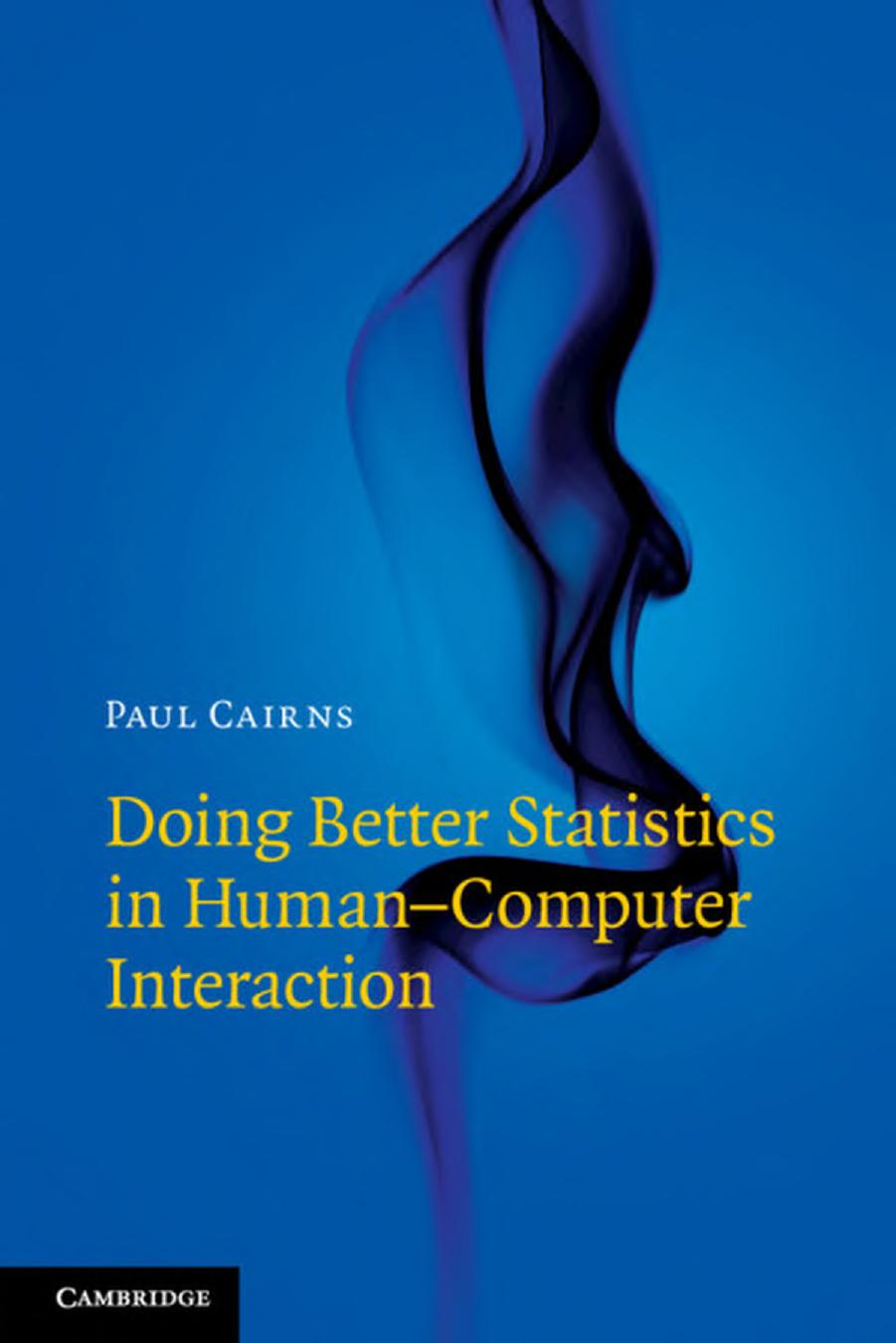
Doing Better Statistics in Human Computer Interaction 1st edition by Paul Cairns – Ebook PDF Instant Download/Delivery: 110848252X, 978-1108482523
Full download Doing Better Statistics in Human Computer Interaction 1st edition after payment
Product details:
ISBN 10: 110848252X
ISBN 13: 978-1108482523
Author: Paul Cairns
Each chapter of this book covers specific topics in statistical analysis, such as robust alternatives to t-tests or how to develop a questionnaire. They also address particular questions on these topics, which are commonly asked by human-computer interaction (HCI) researchers when planning or completing the analysis of their data. The book presents the current best practice in statistics, drawing on the state-of-the-art literature that is rarely presented in HCI. This is achieved by providing strong arguments that support good statistical analysis without relying on mathematical explanations. It additionally offers some philosophical underpinnings for statistics, so that readers can see how statistics fit with experimental design and the fundamental goal of discovering new HCI knowledge.
Doing Better Statistics in Human Computer Interaction 1st Table of contents:
Part I Why We Use Statistics
1 How Statistics Support Science
1.1 The Problem of Induction
1.2 Severe Testing
1.3 Evidence in HCI
1.4 New Experimentalism in HCI
1.5 Big Data
1.6 Conclusions
2 Testing the Null
2.1 The Basics of NHST
2.2 Going beyond p-Values
2.3 NHST and Severe Testing
2.4 Honesty in Statistics
3 Constraining Bayes
3.1 Defining Probability
3.2 Plausibility
3.3 Unconstrained Bayes
3.4 The Bayesian Critique of Frequentism
3.5 Being Careful: A Response to the Critique
3.6 So, Frequentist or Bayesian?
4 Effects: What Tests Test
4.1 Location
4.2 Dominance
4.3 Variation
4.4 Estimation and Significance
4.5 Big, Small and Zero Effects
4.6 Choosing Tests to See Effects
Part II How to Use Statistics
5 Planning Your Statistical Analysis
5.1 Principle 1: Articulation
5.2 Principle 2: Simplicity
5.3 Principle 3: Honesty
5.4 Conclusions
6 A Cautionary Tail: Why You Should Not Do a One-Tailed Test
6.1 A Tale of Two Tails
6.2 One-Tail Bad, Two-Tails Better
7 Is This Normal?
7.1 What Makes Data Normal?
7.2 The Problems of Non-normal Data
7.3 Testing for Normality
7.4 Implications
8 Sorting Out Outliers
8.1 Detecting Outliers
8.2 Sources and Remedies for Outliers
8.2.1 Errors in Data
8.2.2 Mischievous Participants
8.2.3 Faulty Study Design
8.2.4 Natural Variation
8.3 Conclusions
9 Power and Two Types of Error
9.1 Type I and Type II Errors
9.2 Defining Power
9.3 Power and Sample Sizes
9.4 Power and the Quality of Tests
9.5 Summary
10 Using Non-Parametric Tests
10.1 The Mechanics of Ranks
10.2 Analysing Errors
10.2.1 Type I Errors
10.2.2 Type II Errors
10.3 Practical Use
10.4 Reporting Non-Parametric Tests
10.5 Summary
11 A Robust t-Test
11.1 A Traditional t-Test
11.2 Simple Solutions?
11.3 Location, Location, Location
11.4 Trimmed and Winsorized Means
11.5 M-Estimators
11.6 Back to t-Tests
11.7 Overall Advice
12 The ANOVA Family and Friends
12.1 What ANOVA Does
12.2 Is ANOVA Robust?
12.3 Robust Alternatives to ANOVA
12.3.1 Non-Parametric Alternatives
12.3.2 Changes of Location
12.3.3 Do Something Else
12.4 Summary
13 Exploring, Over-Testing and Fishing
13.1 Exploring After a Severe Test
13.2 Exploratory Studies
13.3 Over-Testing
13.3.1 ANOVA Can (Sometimes) Help
13.3.2 Planned Comparisons
13.3.3 The Bonferroni Correction
13.3.4 Bayesian Methods Can Over-Test Too
13.4 Fishing
13.5 Some Rules of Exploration
14 When Is a Correlation Not a Correlation?
14.1 Defining Correlation
14.2 Outlying Points
14.3 Clusters
14.4 Avoiding Problems
14.5 A Final Warning
15 What Makes a Good Likert Item?
15.1 Some Important Context
15.2 Should Items Have a Midpoint?
15.3 How Many Options?
15.4 Label All Options or Just End-Points?
15.5 The Final Story?
16 The Meaning of Factors
16.1 From Concepts to Items
16.2 From Items to Factors
16.2.1 The Methods of Factor Analysis
16.2.2 Finding Factors
16.3 From Factors to Concepts?
16.4 What Does It Mean?
17 Unreliable Reliability: The Problem of Cronbach’s Alpha
17.1 Reliability and Validity
17.2 A Simple Model
17.3 When α Is Low
17.4 When α Is Too High
17.5 Beyond α
18 Tests for Questionnaires
18.1 Testing Likert Items
18.1.1 Type I Analysis
18.1.2 Power Analysis
18.1.3 Which Test for Likert Items?
18.2 Questionnaire Data
18.2.1 Type I Analysis
18.2.2 Power Analysis
18.2.3 Which Test for Questionnaires?
18.3 One Final Observation
People also search for Doing Better Statistics in Human Computer Interaction 1st :
doing better statistics in human computer interaction
human interaction statistics
human-computer interaction in a sentence
human-computer interaction used in a sentence
human-computer interaction meaning
Tags: Paul Cairns, Doing Better, Human Computer