


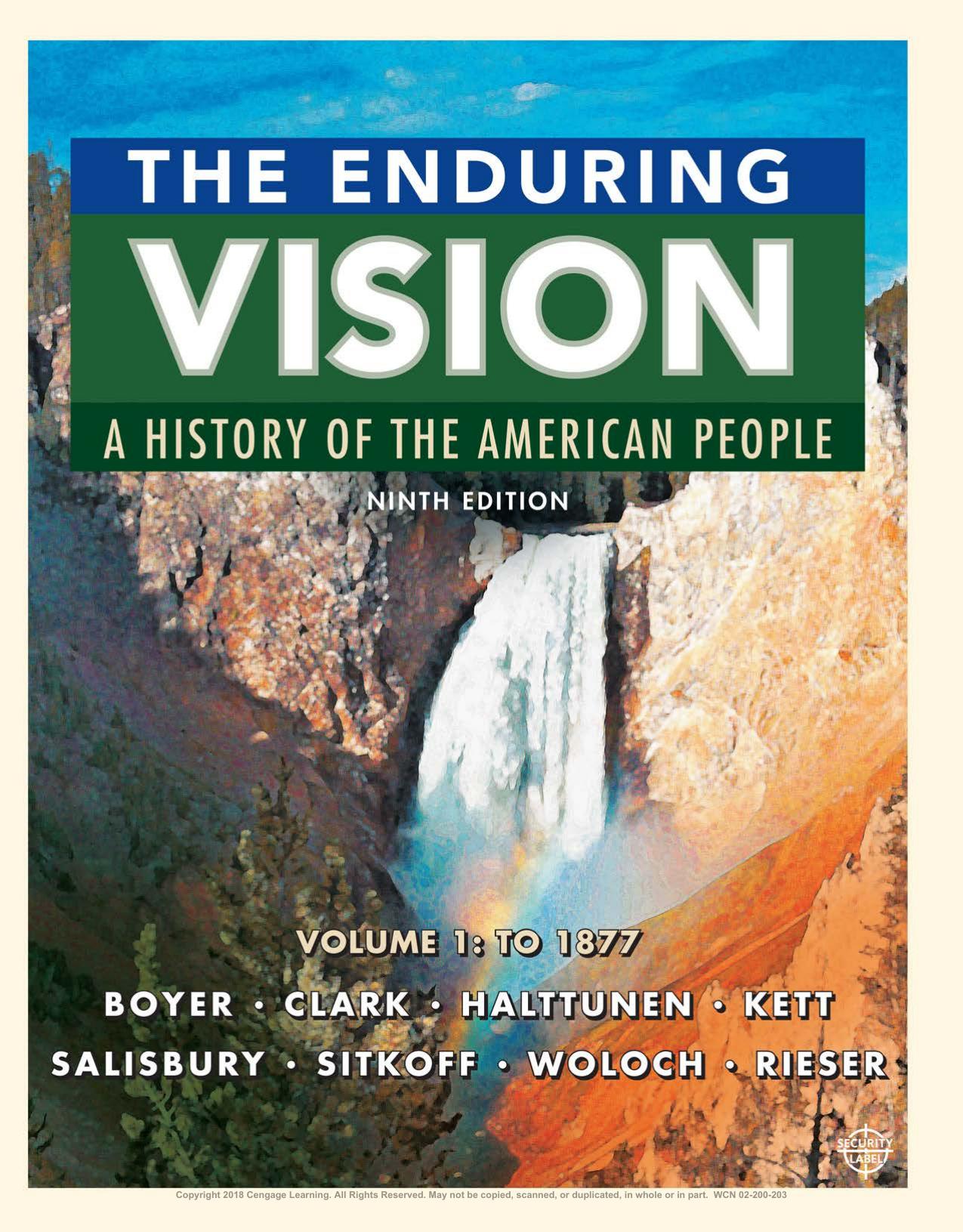
The Enduring Vision Volume 1 To 1877 9th edition by Paul Boyer, Clifford Clark, Karen Halttunen, Joseph Kett, Neal Salisbury – Ebook PDF Instant Download/Delivery: 133711376X , 978-1337113762
Full download The Enduring Vision Volume 1 To 1877 9th edition after payment
Product details:
ISBN 10: 1337 11376X
ISBN 13: 978-1337113762
Author: Paul Boyer, Clifford Clark, Karen Halttunen, Joseph Kett, Neal Salisbury
THE ENDURING VISION’s engaging narrative integrates political, social, and cultural history within a chronological framework. Known for its focus on the environment and the land, the text is also praised for its innovative coverage of cultural history, public health and medicine, and the West — including Native American history. The ninth edition incorporates new scholarship throughout, includes a variety of new photos, and brings the discussion fully up to date with coverage of the 2016 presidential campaign.
The Enduring Vision Volume 1 To 1877 9th Table of contents:
Unit 1. Introducing the Land and the People
1. The Enduring Vision
1-1. The First Americans, ca. 13,000–2500 b.c.e.
1-1.1. Peopling New Worlds
1-1.2. Archaic Societies
1-2. The Emergence of Tribal Societies, ca. 2500 b.c.e.–c.e. 1500
1-2.1. Mesoamerica and South America
1-2.2. The Southwest
1-2.3. The Eastern Woodlands
1-2.4. Nonfarming Societies
1-3. Native American Kinship, Gender, and Culture, ca. 1500 c.e.
1-3.1. Kinship and Marriage
1.3.2. Gender and Work
1-3.3. Spirituality, Rituals, and Beliefs
1-3.4. Native American Social Values
Going to the Source. A Cherokee Oral Tradition
The Whole Vision
Key Terms
2. The Rise of the Atlantic World, 1400–1625
2-1. The Context for European Exploration
2-1.1. European Culture and Society
2-1.2. Traditional Values in Flux
2-1.3. Religious Fractures
2-1.4. The Impact of the Reformation in England, 1533–1625
2-2. Exploration, Interaction, and Early Contact in the Atlantic World, 1400–1600
2-2.1. Portugal and the Atlantic, 1400–1500
2-2.2. African Trade, the “New Slavery,” and Racism
2-2.3. To the Americas and Beyond, 1492–1522
2-2.4. Spain’s Conquistadors, 1492–1536
Going to the Source. First Encounter
2-2.5. The Columbian Exchange
2-3. Footholds in North America, 1512–1625
2-3.1. Spain’s Northern Frontier
2-3.2. France: Colonizing Canada
2-3.3. England and the Atlantic World, 1558–1603
2-3.4 . Failure and Success in Virginia, 1603–1625
2-3.5. New England Begins, 1614–1625
2-3.6. A “New Netherland” on the Hudson, 1609–1625
The Whole Vision
Key Terms
3. The Emergence of Colonial Societies, 1625–1700
3-1. Chesapeake Society
3-1.1. State and Church in Virginia
3-1.2. State and Church in Maryland
3-1.3. Gender, Kinship, and Demographics in the Chesapeake
3-1.4. Social Life in Tobacco Country, 1630–1675
3-1.5. Bacon’s Rebellion, 1676
3-1.6. From Servitude to Slavery: Racializing the Chesapeake
3-2. New England: Puritanism and Its Decline
3-2.1. A City upon a Hill
3-2.2. New England Ways
3-2.3. Towns, Families, and Farm Life
Going to the Source. Chesapeake Society Anne Hutchinson versus John Winthrop
3-2.4. Economic and Religious Tensions
3-2.5. Expansion and Native Americans
3-2.6. Salem Witchcraft, 1691–1693
3-3. The Spread of Slavery: The Caribbean and Carolina
3-3.1. Sugar and Slaves: The West Indies
3-3.2. Rice and Slaves: Carolina
3-4. The Middle Colonies: Ethnic and Religious Diversity
3-4.1. Precursors: New Netherland and New Sweden
3-4.2. English Conquests: New York and New Jersey
3-4.3. Quaker Pennsylvania
3-5. Rivals for North America: France and Spain
3-5.1. France Claims a Continent
3-5.2. New Mexico: The Pueblo Revolt
3-5.3. Florida and Texas
The Whole Vision
Key Terms
4. The Bonds of Empire, 1660–1750
4-1. England’s Wars and Colonial Reverberations, 1660–1713
4-1.1. Royal Centralization, 1660–1688
4-1.2. The Glorious Revolution, 1688–1689
4-1.3. A Generation of War, 1689–1713
4-2. Colonial Economies and Societies, 1660–1750
4-2.1. England’s Mercantilist Empires in America
4-2.2. Mercantilism in the Hands of France and Spain
4-2.3. Population Growth and Diversity
4-2.4. New Arrivals—Free and Unfree—to the British Colonies
4-2.5. Rural White Men and Women
4-2.6. Colonial Farmers and the Environment
4-2.7. The Urban Paradox
4-2.8. Slavery
Going to the Source. A Planter Describes the Task System
4-2.9. The Rise of Colonial Elites
4-3. Competing for a Continent, 1713–1750
4-3.1. France and the American Heartland
4-3.2. Native Americans and British Expansion
4-3.3. British Expansion in the South: Georgia
4-3.4. Spain’s Borderlands
4-3.5. The Return of War, 1739–1748
4-4. Public Life in British America, 1689–1750
4-4.1. Colonial Politics
4-4.2. The Enlightenment
4-4.3. The Great Awakening
The Whole Vision
Key Terms
5. Roads to Revolution, 1750–1776
5-1. Triumph and Tensions: The British Empire, 1750–1763
5-1.1. A Fragile Peace, 1750–1754
5-1.2. The Seven Years’ War in America, 1754–1760
5-1.3. The End of French North America, 1760–1763
5-1.4. Anglo-American Friction
5-1.5. Frontier Tensions
Going to the Source. Pontiac Recounts a Prophet’s Vision
5-2. Imperial Authority, Colonial Opposition, 1760–1766
5-2.1. Writs of Assistance, 1760–1761
5-2.2. The Sugar Act, 1764
5-2.3. The Stamp Act Crisis, 1765–1766
5-2.4. Ideology, Religion, and Resistance
5-3. Resistance Resumes, 1766–1770
5-3.1. Opposing the Quartering Act, 1766–1767
5-3.2. Crisis over the Townshend Acts, 1767–1770
5-3.3. Women and Colonial Resistance
5-3.4. Customs “Racketeering,” 1767–1770
5-3.5. “Wilkes and Liberty,” 1768–1770
5-4. The Deepening Crisis, 1770–1774
5-4.1. The Boston Massacre, 1770
5-4.2. The Committees of Correspondence, 1772–1773
5-4.3. Conflicts in the Colonial West
5-4.4. The Tea Act, 1773
5-5. Toward Independence, 1774–1776
5-5.1. Liberty for African Americans
5-5.2. The “Intolerable Acts”
5-5.3. The Continental Congress
5-5.4. From Resistance to Rebellion
5-5.5. Common Sense
5-5.6. Declaring Independence
The Whole Vision
Key Terms
6. Securing Independence, Defining Nationhood, 1776–1788
6-1. The Prospects of War
6-1.1. Loyalists and Other British Sympathizers
6-1.2. Slaves and Native Americans During the War
6-1.3. Military Preparedness on Both Sides
6-2. War and Peace, 1776–1783
6-2.1. Shifting Fortunes in the North, 1776–1778
6-2.2. The War in the West, 1776–1782
6-2.3. Victory in the South, 1778–1781
6-2.4. Peace at Last, 1782–1783
6-3. The Revolution and Social Change
6-3.1. Egalitarianism Among White Men
6-3.2. White Women in Wartime
6-3.3. A Revolution for African Americans
6-3.4. Native Americans and the Revolution
6-4. Forging New Governments, 1776–1787
6-4.1. From Colonies to States
6-4.2. Formalizing a Confederation, 1776–1781
6-4.3. Finance, Trade, and the Economy, 1781–1786
6-4.4. The Confederation and the West
Going to the Source. The Northwest Ordinance
6-5. Toward a New Constitution, 1786–1788
6-5.1. Shays’s Rebellion, 1786–1787
6-5.2. The Philadelphia Convention, 1787
6-5.3. The Struggle over Ratification, 1787–1788
The Whole Vision
Key Terms
Cultural Exchange in the Atlantic World
Unit 2. Setting America’s Vision
7. Launching the New Republic, 1788–1800
7-1. Economic and Social Change
7-1.1. Producing for Markets
7-1.2. White Women in the Republic
7-1.3. Land and Culture: Native Americans
7-1.4. African American Struggles
Going to the Source. Two African American Assertions of Equality: Benjamin Banneker to Thomas Jefferson and the Quock Walker Case
7-2. Constitutional Government and New Domestic Policies, 1788–1794
7-2.1. Implementing Government
7-2.2. The Federal Judiciary and the Bill of Rights
7-2.3. Establishing the Nation’s Credit
7-2.4. Creating a National Bank
7-2.5. Emerging Partisanship
7-2.6. The Whiskey Rebellion
7-3. The United States in a Wider World, 1789–1796
7-3.1. Spanish Power in Western North America
7-3.2. Challenging American Expansion, 1789–1792
7-3.3. France and Factional Politics, 1793
7-3.4. Diplomacy and War, 1793–1796
7-4. Parties and Politics, 1793–1800
7-4.1. Ideological Confrontation, 1793–1794
7-4.2. The Republican Party, 1794–1796
7-4.3. The Election of 1796
7-4.4. The French Crisis, 1798–1799
7-4.5. The Alien and Sedition Acts, 1798
7-4.6. The Election of 1800
The Whole Vision
Key Terms
8. America at War and Peace, 1801–1824
8-1. The Age of Jefferson
8-1.1. Jefferson and Jeffersonianism
8-1.2. Jefferson’s “Revolution”
8-1.3. Jefferson and the Judiciary
8-1.4. Extending the Land: The Louisiana Purchase, 1803
8-1.5. The Election of 1804
8-1.6. Exploring the Land: The Lewis and Clark Expedition
8-2. The Gathering Storm
8-2.1. Challenges on the Home Front
Going to the Source. Meriwether Lewis’s Journal
8-2.2. The Suppression of American Trade and Impressment
8-2.3. The Embargo Act of 1807
8-2.4. James Madison and the Failure of Peaceable Coercion
8-2.5. Tecumseh and the Prophet
8-2.6. Congress Votes for War
8-3. The War of 1812
8-3.1. On to Canada
8-3.2. The British Offensive
8-3.3. The Treaty of Ghent, 1814
8-3.4. The Hartford Convention
8-4. The Awakening of American Nationalism
8-4.1. Madison’s Nationalism and the Era of Good Feelings, 1817–1824
8-4.2. John Marshall and the Supreme Court
8-4.3. The Missouri Compromise, 1820–1821
8-4.4. Foreign Policy Under Monroe
8-4.5. The Monroe Doctrine, 1823
The Whole Vision
Key Terms
9. The Transformation of American Society, 1815–1840
9-1. Westward Expansion
9-1.1. Western Society and Customs
9-1.2. The Far West
9-1.3. The Federal Government and the West
9-1.4. The Removal of the Indians
9-1.5. Working the Land: The Agricultural Boom
9-2. The Growth of the Market Economy
9-2.1. Federal Land Policy, Speculators, and Squatters
9-2.2. The Panic of 1819
9-2.3. The Transportation Revolution
9-2.4. The Growth of the Cities
9-3. Industrial Beginnings
9-3.1. Causes of Industrialization
9-3.2. Women and Textile Towns in New England
9-3.3. Artisans and Workers in Mid-Atlantic Cities
9-4. The Revolution in Social Relationships
9-4.1. Urban Inequality: The Rich and the Poor
9-4.2. Free Blacks in the North
9-4.3. The “Middling Classes”
9-4.4. The Challenge to Family Authority
9-4.5. Wives and Husbands
Going to the Source. Tocqueville on American Democracy
The Whole Vision
Key Terms
10. Democratic Politics, Religious Revival, and Reform, 1824–1840
10-1. The Rise of Democratic Politics, 1824–1832
10-1.1. Democratic Ferment
10-1.2. The Election of 1824 and the Adams Presidency
10-1.3. The Rise of Andrew Jackson and the Election of 1828
10-1.4. Jackson in Office
10-1.5. Nullification
10-1.6. The Bank Veto and the Election of 1832
10-2. The Bank Controversy and the Second Party System, 1833–1840
10-2.1. The War on the Bank
10-2.2. The Rise of Whig Opposition
10-2.3. The 1836 Election and the Panic of 1837
10-2.4. Log Cabins, Hard Cider, and a Maturing Second Party System
10-3. The Rise of Popular Religion
10-3.1. The Second Great Awakening
10-3.2. The Burned-Over District
10-3.3. Critics of Revivals: The Unitarians
10-3.4. Mormonism
10-3.5. The Shakers
10-4. The Age of Reform
10-4.1. The War on Liquor
10-4.2. Public-School Reform
10-4.3. Abolition
10-4.4. Woman’s Rights
Going to the Source. The Declaration of Sentiments
10-4.5. Penitentiaries and Asylums
10-4.6. Utopian Communities
The Whole Vision
Key Terms
11. Technology, Culture, and Everyday Life, 1840–1860
11-1. Technology and Economic Growth
11.1-1. Agricultural Advancement
11-1.2. Technology and Industrial Progress
11-1.3. The Railroad Boom
11-1.4. Rising Prosperity
11-2. The Quality of Life
11-2.1. Dwellings
11-2.2. Conveniences and Inconveniences
11-2.3. Disease and Medicine
11-2.4. Popular Health Movements
11-2.5. Phrenology
11-3. Commercializing Leisure
11-3.1. Newspapers
11-3.2. The Theater
11.3-3. Minstrel Shows
11-3.4. P. T. Barnum
11-4. The American Renaissance in Literature and Art
11-4.1. Roots of the American Renaissance
11-4.2. Cooper, Emerson, Thoreau, Fuller, and Whitman
Going to the Source. Henry David Thoreau, “Walking” (1862)
11-4.3. Hawthorne, Poe, and Melville
11-4.4. Literature in the Marketplace
11-4.5. American Landscape Painting
The Whole Vision
Key Terms
12. The Old South and Slavery, 1830–1860
12-1. King Cotton
12-1.1. The Lure of Cotton
12-1.2. Ties Between the Lower and Upper South
12-1.3. The North and South Diverge
12-2. The White South
12-2.1. Planters and Plantation Mistresses
12-2.2. The Small Slaveholders
12-2.3. The Yeomen and Pine Barrens Whites
12-2.4. Conflict and Consensus in the White South
12-2.5. The Proslavery Argument
12-3. Life under Slavery
12-3.1. Work and Discipline of Plantation Slaves
12-3.2. The Slave Family
12-3.3. The Longevity, Diet, and Health of Slaves
12-3.4. Away from the Plantation: Town Slaves and Free Blacks
12-3.5. Slave Resistance
12-4. The Emergence of African American Culture
12-4.1. The Language of Slaves
12-4.2. African American Religion
Going to the Source. Henry Bibb on Slave Resistance
12-4.3. Black Music and Dance
The Whole Vision
Key Terms
Politics or Reform? Shaping Democracy in the New American Republic
Unit 3. Testing America’s Endurance
13. Immigration, Expansion, and Sectional Conflict, 1840–1848
13-1. Newcomers and Natives
13-1.1. Expectations and Realities
13-1.2. The Germans
13-1.3. The Irish
13-1.4. Anti-Catholicism, Nativism, and Labor Protest
13-1.5. Immigrant Politics
13-2. The West and Beyond
13-2.1. The Far West
13-2.2. Far Western Trade
13-2.3. Mexican Government in the Far West and the Texas Revolution of 1836
13-2.4. The Overland Trail to California, New Mexico, and Oregon
13-3. The Politics of Expansion, 1840–1846
13-3.1. The Whig Ascendancy
13-3.2. Tyler and the Annexation of Texas
13-3.3. The Election of 1844
13-3.4. Manifest Destiny, 1845
13-3.5. Polk and Oregon
13-4. The U.S. War with Mexico and Its Aftermath, 1846–1848
13-4.1. The Origins of the U.S. War with Mexico
13-4.2. The U.S. War with Mexico
13-4.3. The War’s Effects on Sectional Conflict
13-4.4. The Wilmot Proviso and the Election of 1848
Going to the Source. Polk on Texas and Oregon
13-4.5. The California Gold Rush
The Whole Vision
Key Terms
14. From Compromise to Secession, 1850–1861
14-1. The Compromise of 1850
14-1.1. Taylor’s and Clay’s Strategies for Compromise
14-1.2. Assessing the Compromise and the Fugitive Slave Act
14-1.3. Uncle Tom’s Cabin
14-2. The Collapse of the Second Party System, 1853–1856
14-2.1. The Kansas-Nebraska Act
14-2.2. The Surge of Free Soil
14-2.3. The Whigs and the Know-Nothings, 1853–1856
14-2.4. The Republican Party and the Crisis in Kansas, 1855–1856
14-2.5. The Election of 1856
14-3. The Crisis of the Union, 1857–1860
14-3.1. The Dred Scott Case, 1857
14-3.2. The Lecompton Constitution, 1857
14-3.3. The Lincoln-Douglas Debates, 1858
14-3.4. The Legacy of Harpers Ferry
14-4. The Union Fragments, 1860–1861
14-4.1. The Election of 1860
14-4.2. The Gospel of Disunion
Going to the Source. Lincoln at Cooper Union
14-4.3. The Upper South and the Coming of War
The Whole Vision
Key Terms
15. Crucible of Freedom: Civil War, 1861–1865
15-1. Mobilizing for War
15-1.1. Recruitment and Conscription
15-1.2. Financing the War
15-1.3. Political Leadership in Wartime
15-1.4. Securing the Union’s Borders
15-2. In Battle, 1861–1862
15-2.1. Armies, Weapons, and Strategies
15-2.2. Stalemate in the East
15-2.3. The War in the West
15-2.4. The Soldiers’ War
15-2.5. Ironclads and Cruisers: The Naval War
15-2.6. The Diplomatic War
15-3. Emancipation Transforms the War, 1863
15-3.1. From Confiscation to Emancipation
15-3.2. Crossing Union Lines
15-3.3. The Black Experience: Union Soldiers and Wartime Slavery
Going to the Source. Frederick Douglass Calls for Black Troops
15-3.4. The Turning Point of 1863
15-4. War and Society, North and South
15-4.1. The War’s Economic Impact: The North
15-4.2. The War’s Economic Impact: The South
15-4.3. Dealing with Dissent
15-4.4. Women and the War
15-5. The Union Victorious, 1864–1865
15-5.1. The Eastern Theater in 1864
15-5.2. Lincoln’s Reelection and Sherman’s Total War
15-5.3. Toward Appomattox
15-5.4. The Impact of the War
The Whole Vision
Key Terms
16. Reconstruction and Resistance, 1865–1877
16-1. Reconstruction Politics, 1865–1868
16-1.1. Lincoln’s Plan
16-1.2. Presidential Reconstruction
16-1.3. Congress versus Johnson
16-1.4. The Fourteenth Amendment, 1866
16-1.5. Congressional Reconstruction, 1866–1867
16-1.6. The Impeachment Crisis, 1867–1868
16-1.7. The Fifteenth Amendment and the Question of Woman Suffrage, 1869–1870
16-2. Reconstruction Governments
16-2.1. A New Electorate
16-2.2. Republican Rule
16-2.3. Counterattacks
16-3. The Impact of Emancipation
16-3.1. Confronting Freedom
16-3.2. African American Institutions
16-3.3. Land, Labor, and Sharecropping
16-3.4. Toward a Crop-Lien Economy
Going to the Source. The Barrow Plantation
16-4. New Concerns in the North, 1868–1876
16-4.1. Grantism
16-4.2. The Liberals’ Revolt
16-4.3. The Panic of 1873
16-4.4. Reconstruction and the Constitution
16-4.5. Republicans in Retreat
16-5. Reconstruction Abandoned, 1876–1877
16-5.1. “Redeeming” the South
16-5.2. The Election of 1876
16-5.3. Reconstruction: Success or Failure?
The Whole Vision
Key Terms
The Civil War in History and Memory
Creating the Atlantic World: Creating an Historical Exhibit
Part I. Information for Instructors
Activity Overview
Pedagogical Goals
Sample
Tips for Instructors
Part II. Information for Students
Background
Activity Description
Appendix
People also search for The Enduring Vision Volume 1 To 1877 9th:
the enduring vision volume 1 to 1877 10th edition boyer
the enduring vision volume ii since 1865 9th edition
the enduring vision volume ii since 1865
the enduring vision volume i to 1877 10th edition
the enduring vision chapters
Tags: Paul Boyer, Clifford Clark, Karen Halttunen, Joseph Kett, Neal Salisbury, The Enduring