


Engineering Dynamics 3rd Edition by Jerry Ginsberg – Ebook PDF Instant Download/Delivery: 0521883032 , 978-0521883030
Full download Engineering Dynamics 3rd edition after payment
Product details:
ISBN 10: 0521883032
ISBN 13: 978-0521883030
Author: Jerry Ginsberg
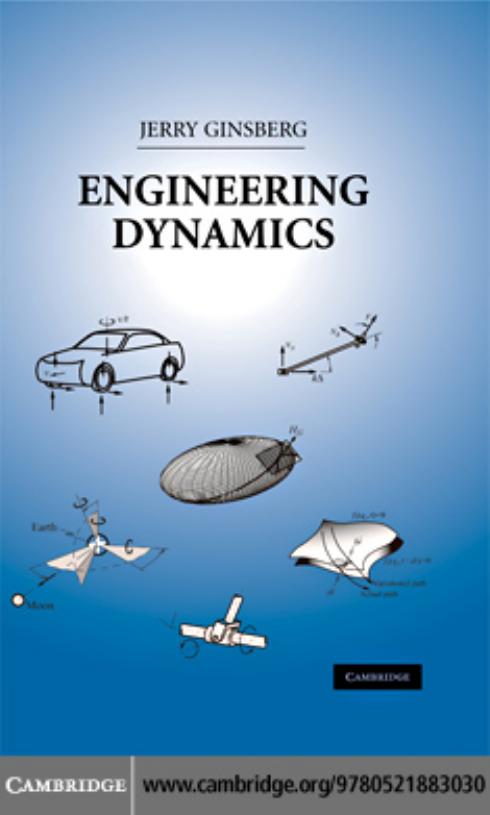
This text is a modern vector oriented treatment of classical dynamics and its application to engineering problems. Based on Ginsberg’s Advanced Engineering Dynamics Second Edition, it develops a broad spectrum of kinematical concepts, which provide the framework for formulations of kinetics principles following the Newton-Euler and analytical approaches. This fresh treatment features many expanded and new derivations, with an emphasis on both breadth and depth and a focus on making the subject accessible to individuals from a broad range of backgrounds.
Engineering Dynamics 3rd Table of contents:
CHAPTER 1 Basic Considerations
1.1 Vector Operations
1.1.1 Algebra and Computations
1.1.2 Vector Calculus-Velocity and Acceleration
1.2 Newtonian Mechanics
1.2.1 Newton’s Laws
1.2.2 Systems of Units
1.2.3 Energy and Momentum
1.3 Biographical Perspective
Galileo Galilei
Sir Isaac Newton
Leonhard Euler
Jean Le Rond d’Alembert
Joseph-Louis Lagrange
Gaspard Gustave de Coriolis
Sir William Rowan Hamilton
Edward John Routh
Josiah Williard Gibbs
Paul Emile Appell
Walther Ritz
SELECTED REFERENCES
HOMEWORK PROBLEMS
CHAPTER 2 Particle Kinematics
2.1 Path Variables
2.1.1 Tangent and Normal Components
2.1.2 Parametric Description of Curves
2.1.3 Binormal Direction and Torsion of a Curve
2.2 Rectangular Cartesian Coordinates
2.3 Curvilinear Coordinates
2.3.1 Cylindrical and Polar Coordinates
2.3.2 Spherical Coordinates
2.3.3 Arbitrary Curvilinear Coordinates
Coordinates and Unit Vectors
Kinematical Formulas
2.4 Mixed Kinematical Descriptions
SELECTED REFERENCES
HOMEWORK PROBLEMS
CHAPTER 3 Relative Motion
3.1 Coordinate Transformations
3.1.1 Rotation Transformations
3.1.2 Rotation Sequences
Simple Rotations
Body-Fixed Rotations
Space-Fixed Rotations
Rotation About an Arbitrary Axis
3.2 Displacement
3.3 Time Derivatives
3.4 Angular Velocity and Acceleration
3.4.1 Analytical Description
3.4.2 Procedure
3.5 Velocity and Acceleration Analysis Using a Moving Reference Frame
3.6 Observations from a Moving Reference Frame
SELECTED REFERENCES
HOMEWORK PROBLEMS
CHAPTER 4 Kinematics of Constrained Rigid Bodies
4.1 General Equations
4.2 Eulerian Angles
4.3 Interconnections and Linkages
4.4 Rolling
SELECTED REFERENCES
HOMEWORK PROBLEMS
CHAPTER 5 Inertial Effects for a Rigid Body
5.1 Linear and Angular Momentum
5.1.1 System of Particles
5.1.2 Rigid Body-Basic Equations
5.1.3 Kinetic Energy
5.2 Inertia Properties
5.2.1 Moments and Products of Inertia
5.2.2 Transformations
Parallel Axis Transformation
Rotational Transformation
5.2.3 Inertia Ellipsoid
5.2.4 Principal Axes
5.3 Rate of Change of Angular Momentum
SELECTED REFERENCES
HOMEWORK PROBLEMS
CHAPTER 6 Newton-Euler Equations of Motion
6.1 Fundamental Equations
6.1.1 Basic Considerations
6.1.2 Procedural Steps
6.2 Planar Motion
6.3 Newton-Euler Equations for a System
6.4 Momentum and Energy Principles
6.4.1 Impulse-Momentum Principles
6.4.2 Work-Energy Principles
6.4.3 Collisions of Rigid Bodies
SELECTED REFERENCES
HOMEWORK PROBLEMS
CHAPTER 7 Introduction to Analytical Mechanics
7.1 Background
7.1.1 Principle of Virtual Work
7.1.2 Principle of Dynamic Virtual Work
7.2 Generalized Coordinates and Kinematical Constraints
7.2.1 Selection of Generalized Coordinates
7.2.2 Constraint Equations
7.2.3 Configuration Space
7.3 Evaluation of Virtual Displacements
7.3.1 Analytical Method
7.3.2 Kinematical Method
7.4 Generalized Forces
7.4.1 Definition of Generalized Forces
7.4.2 Relation Between Constraint Forces and Conditions
7.4.3 Conservative Forces
7.5 Lagrange’s Equations
7.6 Solution of Equations for Holonomic Systems
SELECTED REFERENCES
HOMEWORK PROBLEMS
CHAPTER 8 Constrained Generalized Coordinates
8.1 Lagrange’s Equations–Constrained Case
8.2 Computational Methods
8.2.1 Algorithms
8.2.2 Numerical Error Checking
8.2.3 Initial Conditions
8.2.4 Analysis of Coulomb Friction
SELECTED REFERENCES
HOMEWORK PROBLEMS
CHAPTER 9 Alternative Formulations
9.1 Hamilton’s Principle
9.1.1 Derivation
9.1.2 Calculus of Variations
9.1.3 Ritz Series Method
9.2 Generalized Momentum Principles
9.2.1 Hamilton’s Equations
9.2.2 Conservation of the Hamiltonian
9.2.3 Ignorable Coordinates and Routh’s Method
9.3 Formulations with Quasi-Coordinates
9.3.1 Quasi-Velocities and Quasi-Coordinates
9.3.2 Gibbs–Appell Equations
9.3.3 Kane’s Equations
9.3.4 Relationship of the Formulations
SELECTED REFERENCES
HOMEWORK PROBLEMS
CHAPTER 10 Gyroscopic Effects
10.1 Free Motion
10.1.1 Axisymmetric Bodies
10.1.2 Arbitrary Bodies
10.1.3 Poinsot’s Construction for Arbitrary Bodies
10.2 Spinning Top
10.3 Gyroscopes for Inertial Guidance
10.3.1 Free Gyroscope
10.3.2 Gyrocompass
10.3.3 Single-Axis Gyroscope
SELECTED REFERENCES
HOMEWORK PROBLEMS
Appendix
CENTROIDAL INERTIA PROPERTIES
Answers to Selected Homework Problems
Index
People also search for Engineering Dynamics 3rd:
engineering dynamics jerry ginsberg
jerry ginsberg engineering dynamics solutions pdf
engineering dynamics ginsberg
advanced engineering dynamics jerry h ginsberg pdf
advanced engineering dynamics ginsberg pdf
Tags: Jerry Ginsberg, Engineering Dynamics