


Engineering Electromagnetics 9th edition by William Hayt, John Buck – Ebook PDF Instant Download/Delivery: 1260084566, 978-1260084566
Full download Engineering Electromagnetics 9th edition after payment
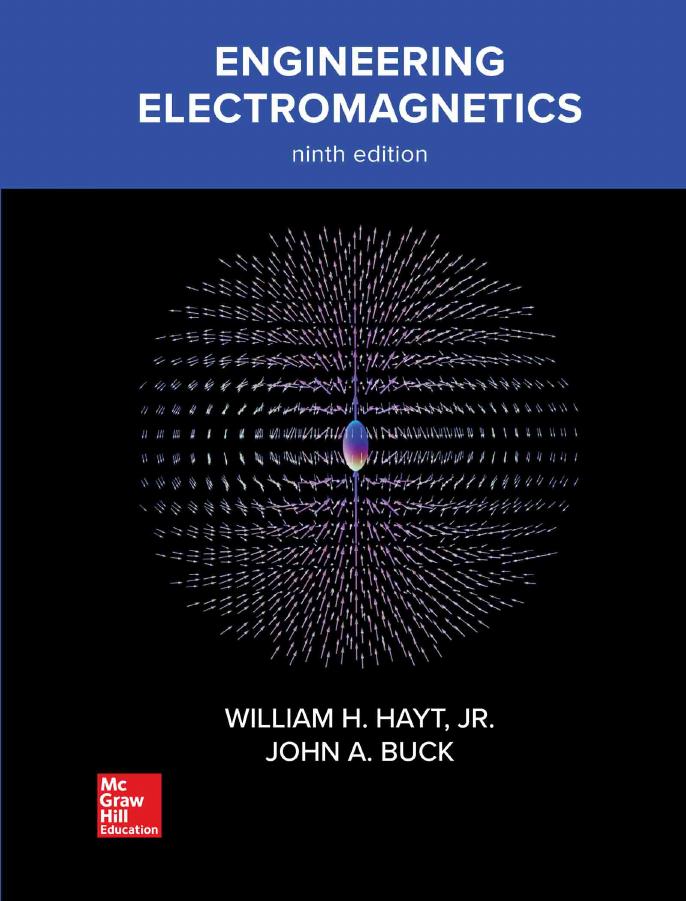
Product details:
ISBN 10: 1260084566
ISBN 13: 978-1260084566
Author: William Hayt, John Buck
Engineering Electromagnetics 9th Edition
by William H. Hayt, John A. Buck
This ISBN 9781260084566 is Textbook only. It will not come with online access code.
The content of of this title on all formats are the same.
First published just over 50 years ago and now in its Eighth Edition, Bill Hayt and John Buck’s Engineering Electromagnetics is a classic text that has been updated for electromagnetics education today. This widely-respected book stresses fundamental concepts and problem solving, and discusses the material in an understandable and readable way. Numerous illustrations and analogies are provided to aid the reader in grasping the difficult concepts. In addition, independent learning is facilitated by the presence of many examples and problems. Important updates and revisions have been included in this edition. One of the most significant is a new chapter on electromagnetic radiation and antennas. This chapter covers the basic principles of radiation, wire antennas, simple arrays, and transmit-receive systems.
Engineering Electromagnetics 9th Table of contents:
Chapter 1: Vector Analysis
1.1 Scalars and Vectors
1.2 Vector Algebra
1.3 The Rectangular Coordinate System
1.4 Vector Components and Unit Vectors
1.5 The Vector Field
1.6 The Dot Product
1.7 The Cross Product
1.8 Other Coordinate Systems: Circular Cylindrical Coordinates
1.9 The Spherical Coordinate System
References
Chapter 1 Problems
Chapter 2: Coulomb’s Law and Electric Field Intensity
2.1 The Experimental Law of Coulomb
2.2 Electric Field Intensity
2.3 Field Arising from a Continuous Volume Charge Distribution
2.4 Field of a Line Charge
2.5 Field of a Sheet of Charge
2.6 Streamlines and Sketches of Fields
References
Chapter 2 Problems
Chapter 3: Electric Flux Density, Gauss’s Law, and Divergence
3.1 Electric Flux Density
3.2 Gauss’s Law
3.3 Application of Gauss’s Law: Some Symmetrical Charge Distributions
3.4 Gauss’s Law in Differential Form: Divergence
3.5 Divergence Theorem
References
Chapter 3 Problems
Chapter 4: Energy and Potential
4.1 Energy Expended in Moving a Point Charge in an Electric Field
4.2 The Line Integral
4.3 Definition of Potential Difference and Potential
4.4 The Potential Field of a Point Charge
4.5 The Potential Field of a System of Charges: Conservative Property
4.6 Potential Gradient
4.7 The Electric Dipole
4.8 Electrostatic Energy
References
Chapter 4 Problems
Chapter 5: Conductors and Dielectrics
5.1 Current and Current Density
5.2 Continuity of Current
5.3 Metallic Conductors
5.4 Conductor Properties and Boundary Conditions
5.5 The Method of Images
5.6 Semiconductors
5.7 The Nature of Dielectric Materials
5.8 Boundary Conditions for Perfect Dielectric Materials
References
Chapter 5 Problems
Chapter 6: Capacitance
6.1 Capacitance Defined
6.2 Parallel-Plate Capacitor
6.3 Several Capacitance Examples
6.4 Capacitance of a Two-Wire Line
6.5 Using Field Sketches to Estimate Capacitance in Two-Dimensional Problems
6.6 Poisson’s and Laplace’s Equations
6.7 Examples of the Solution of Laplace’s Equation
6.8 Example of the Solution of Poisson’s Equation: The p-n Junction Capacitance
References
Chapter 6 Problems
Chapter 7: The Steady Magnetic Field
7.1 Biot-Savart Law
7.2 Ampère’s Circuital Law
7.3 Curl
7.4 Stokes’ Theorem
7.5 Magnetic Flux and Magnetic Flux Density
7.6 The Scalar and Vector Magnetic Potentials
7.7 Derivation of the Steady-Magnetic-Field Laws
References
Chapter 7 Problems
Chapter 8: Magnetic Forces, Materials, and Inductance
8.1 Force on a Moving Charge
8.2 Force on a Differential Current Element
8.3 Force between Differential Current Elements
8.4 Force and Torque on a Closed Circuit
8.5 The Nature of Magnetic Materials
8.6 Magnetization and Permeability
8.7 Magnetic Boundary Conditions
8.8 The Magnetic Circuit
8.9 Potential Energy and Forces on Magnetic Materials
8.10 Inductance and Mutual Inductance
References
Chapter 8 Problems
Chapter 9: Time-Varying Fields and Maxwell’s Equations
9.1 Faraday’s Law
9.2 Displacement Current
9.3 Maxwell’s Equations in Point Form
9.4 Maxwell’s Equations in Integral Form
9.5 The Retarded Potentials
References
Chapter 9 Problems
Chapter 10: Transmission Lines
10.1 Physical Description of Transmission Line Propagation
10.2 The Transmission Line Equations
10.3 Lossless Propagation
10.4 Lossless Propagation of Sinusoidal Voltages
10.5 Complex Analysis of Sinusoidal Waves
10.6 Transmission Line Equations and Their Solutions in Phasor Form
10.7 Low-Loss Propagation
10.8 Power Transmission and the Use of Decibels in Loss Characterization
10.9 Wave Reflection at Discontinuities
10.10 Voltage Standing Wave Ratio
10.11 Transmission Lines of Finite Length
10.12 Some Transmission Line Examples
10.13 Graphical Methods: The Smith Chart
10.14 Transient Analysis
References
Chapter 10 Problems
Chapter 11: The Uniform Plane Wave
11.1 Wave Propagation in Free Space
11.2 Wave Propagation in Dielectrics
11.3 Poynting’s Theorem and Wave Power
11.4 Propagation in Good Conductors
11.5 Wave Polarization
References
Chapter 11 Problems
Chapter 12: Plane Wave Reflection and Dispersion
12.1 Reflection of Uniform Plane Waves at Normal Incidence
12.2 Standing Wave Ratio
12.3 Wave Reflection from Multiple Interfaces
12.4 Plane Wave Propagation in General Directions
12.5 Plane Wave Reflection at Oblique Incidence Angles
12.6 Total Reflection and Total Transmission of Obliquely Incident Waves
12.7 Wave Propagation in Dispersive Media
12.8 Pulse Broadening in Dispersive Media
References
Chapter 12 Problems
Chapter 13: Guided Waves
13.1 Transmission Line Fields and Primary Constants
13.2 Basic Waveguide Operation
13.3 Plane Wave Analysis of the Parallel-Plate Waveguide
13.4 Parallel-Plate Guide Analysis Using the Wave Equation
13.5 Rectangular Waveguides
13.6 Planar Dielectric Waveguides
13.7 Optical Fiber
References
Chapter 13 Problems
Chapter 14: Electromagnetic Radiation and Antennas
14.1 Basic Radiation Principles: The Hertzian Dipole
14.2 Antenna Specifications
14.3 Magnetic Dipole
14.4 Thin Wire Antennas
14.5 Arrays of Two Elements
14.6 Uniform Linear Arrays
14.7 Antennas as Receivers
People also search for Engineering Electromagnetics 9th:
hayt engineering electromagnetics 9th
hayt and buck engineering electromagnetics (9th)
engineering electromagnetics hayt 9th solution
engineering electromagnetics 9th edition solution
engineering electromagnetics 9th solution