


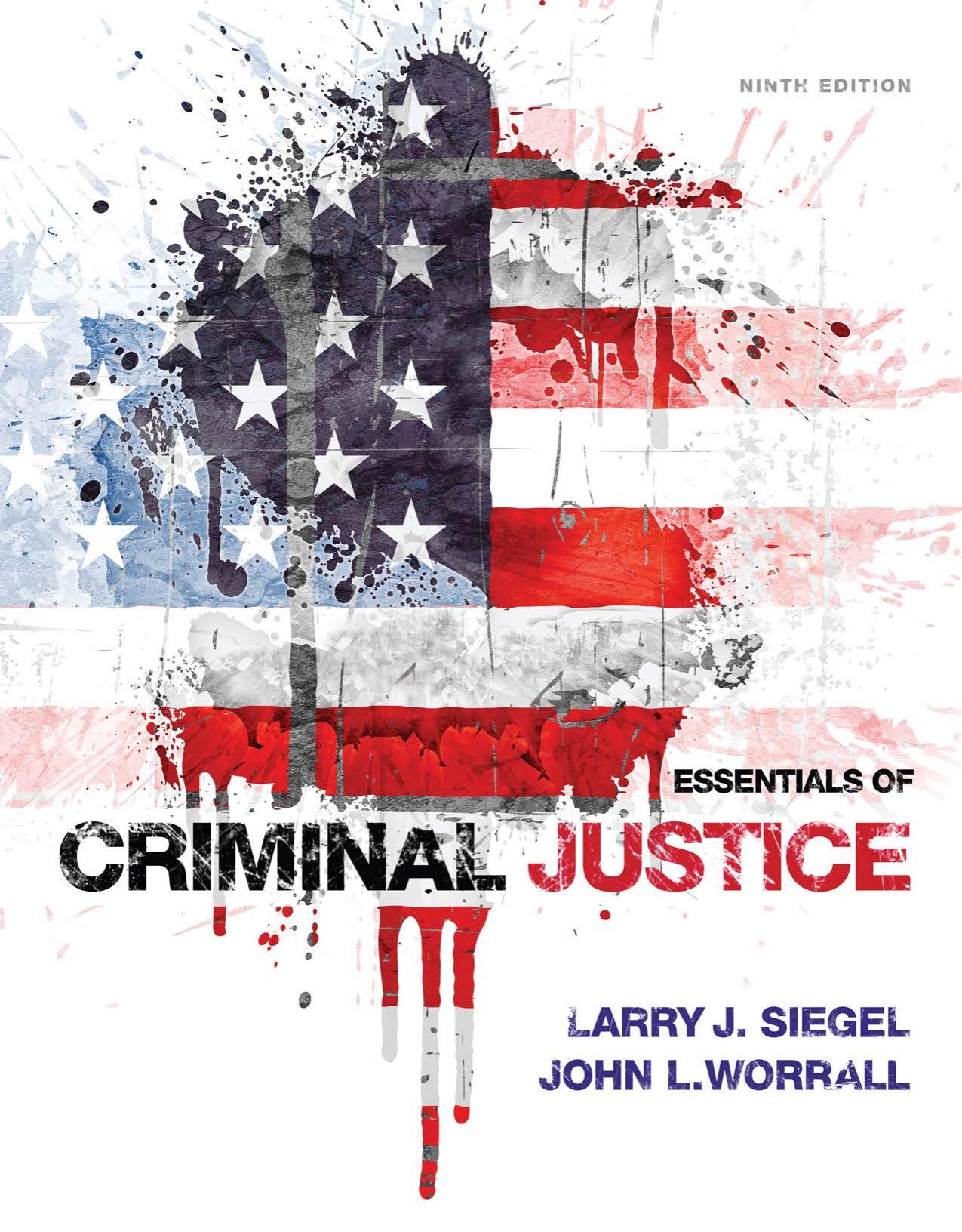
Essentials of Criminal Justice 9th Edition by Larry Siegel, John Worrall – Ebook PDF Instant Download/Delivery: 1285441524 , 9781285441528
Full download Essentials of Criminal Justice 9th edition after payment
Product details:
ISBN 10: 1285441524
ISBN 13: 9781285441528
Author: Larry Siegel, John Worrall
Are you an unsuspecting “victim” of the “CSI effect”? Master the ins and outs of the criminal justice system with ESSENTIALS OF CRIMINAL JUSTICE, Ninth Edition. With its cutting-edge high-profile cases, current research, detailed career information, and unique myth-busting theme, this bestseller equips you with a solid understanding of the modern criminal justice system.
Sample questions asked in the 9th edition of Essentials of Criminal Justice:
It was a despicable scheme—stealing identities of terminally ill individuals to fraudulently obtain millions of dollars from insurance companies and bond issuers. Attorney Joseph Caramadre, president and CEO of his own estate planning company in Rhode Island—along with Raymour Radhakrishnan, an employee—pleaded guilty in federal court to conspiracy to commit identity theft and wire fraud. In exchange for the pleas, the US Attorney’s Office recommended that the court give the two men prison terms of no longer than 10 years. Each faced a maximum sentence of 25 years in prison and $500,000 in fines. Caramadre’s investment strategies depended on lying to terminally ill individuals and their loved ones to obtain identity information. He abused two financial instruments—variable annuities and death put bonds (corporate bonds with survivor options purchased through a brokerage account) to carry out these strategies. The owner of a death put bond is able to redeem it at face value years or even decades prior to the bond’s maturity date upon the death of the bond’s co-owner. In addition to buying annuities from insurance companies listing terminally ill individuals as annuitants, he also purchased bonds of distressed companies for significantly less than face value, listing terminally ill individuals as co-owners. When the terminally ill person died days or weeks later, he would exercise the death benefits associated with the investments. Caramadre recruited investors by falsely telling them he found a loophole that permitted the use of terminally ill patients as annuitants on annuities and co-owners on brokerage accounts used to purchase death put bonds. He then entered into profit-sharing agreements with them but received a significant percentage of the profits himself. In recruiting terminally ill individuals for his scheme, Caramadre was only interested in those with a life expectancy of six months or less. He looked for victims in several ways: visiting AIDS facilities, putting ads in a local religious newspaper offering cash to terminally ill individuals, and even looking through his own company files. Ads purchased by Caramadre were especially fruitful: he claimed to be a philanthropist and offered the terminally ill a few thousand dollars to assist with their funeral expenses. The ads also got him access to hospice care facilities, nurses, and social workers who could spread the word about his offer. Radhakrishnan would visit patients and their families to supposedly determine whether they qualified for the donation, but he was actually assessing their life expectancies—the shorter the time, the better for the scheme. Patients who accepted Caramadre’s cash offer were asked to sign a document, because the philanthropist supposedly needed it for tax records, but in reality it was so their signatures could be forged later on. Sometimes they were asked to sign signature pages from actual annuity and brokerage account applications that were disguised as something else. Other times they were told that actual accounts would be open, but that all profits would go to other terminally ill people. And they were always asked for personal information, such as Social Security number, birthdates, and driver’s license numbers. Once armed with the fraudulently obtained identity information, Caramadre purchased annuities and death put bonds. Both he and Radhakrishnan took numerous steps to deceive the insurance companies and brokerage houses to hide Caramadre’s true ownership interest. Caramadre’s scheme went on for 15 years—from 1995 to 2010—until some of the insurance companies and brokerage houses he defrauded filed complaints, and investigators with the FBI, US Postal Inspection Service, Internal Revenue Service, and US Attorney’s Office began looking into the matter. Ethical Challenge Write an essay on the ethics of allowing criminals like Caramadre and Radhakrishnan to plead guilty to escape the full extent of the law. On the one hand, their actions defrauding the terminally ill seem horrendous. On the other hand, they presented no threat to society once their scheme was uncovered. Before you make a judgment, read this article by Mark Gibbs at Forbes magazine: http://www.forbes.com/sites/markgibbs/ 2012/08/25/making-a-business-out-of-death/ ThÁ
It seems logical that biological and psychological factors might explain why some people commit crime. But if crime is based on individual traits, how would we explain the fact that crime rates are higher in the West and South than the Midwest and East?
Which would be more effective: telling inmates that they have to earn the right to be paroled, or giving inmates their parole date in advance and telling them they will lose it for misbehavior?
Gun Control and the Constitution To millions of Americans, the Second Amendment to the US Constitution protects the right to bear arms, and the average American has a right to buy and possess rifles and handguns. The Second Amendment states that “a well-regulated Militia, being necessary to the security of a free State, the right of the people to keep and bear Arms, shall not be infringed.” What exactly does this mean? Seventy years ago, in United States v. Miller (307 U.S. 174 [1939]), the Supreme Court ruled that the Second Amendment must be interpreted as intending to guarantee the states’ rights to maintain and train a militia, and not a personal right to bear arms. Miller had wanted to avoid registering a “sawed-off shotgun,” which he possessed for personal use. The Court ruled, “In the absence of any evidence tending to show that possession or use of a shotgun having a barrel of less than 18 inches in length at this time has some reasonable relationship to the preservation or efficiency of a well-regulated militia, we cannot say that the Second Amendment guarantees the right to keep and bear such an instrument.” The Court’s decision also mentioned that weapons appropriate for the militia at the time were in “common use” and that a sawed-off shotgun was not a weapon that was commonly used or widely possessed. Because the Miller case applied only to sawed-off shotguns, it left the gun possession issue unsettled for seven decades. Then, in the landmark 2008 case District of Columbia v. Heller, the Supreme Court put this issue to rest when it held that the Second Amendment protects an individual’s right to possess a firearm for private use. Its decision ruled that Washington, DC’s Firearms Control Regulations Act of 1975, which banned handgun possession, was unconstitutional and determined that handguns are “arms” that may not be banned by a local jurisdiction. It also struck down the portion of the law that required that all firearms, including rifles and shotguns, be kept “unloaded and disassembled or bound by a trigger lock.” The decision clearly declares the Second Amendment protection of “an individual right to possess a firearm unconnected with service in a militia, and to use that arm for traditionally lawful purposes, such as self-defense within the home.” It goes on to clarify specific limitations on those Second Amendment protections, and it concludes with a characterization of the District’s “total ban on handgun possession in the home (as) amount(ing) to a prohibition on an entire class of ‘arms’ that Americans overwhelmingly choose for the lawful purpose of selfdefense.” Because handguns are commonly used, the Heller decision does not conflict with the Miller decision’s ban on sawed-off shotguns. Although the Heller decision prohibits governmental jurisdictions from banning guns outright, the ruling does not prohibit the state and federal governments from regulating gun use and possession. The decision stated: . . . nothing in our opinion should be taken to cast doubt on longstanding prohibitions on the possession of firearms by felons and the mentally ill, or laws forbidding the carrying of firearms in sensitive places such as schools and government buildings, or laws imposing conditions on the commercial sale of arms. This paragraph has been interpreted by the courts as suggesting that although governments cannot ban gun ownership, they are still entitled to its regulation. The Heller ruling helps answer the question of whether gun ownership is a constitutional right (it is); it does not shut the door on governmental regulation and control of that right. Gun Control Laws There have been a number of legal attempts to control and regulate gun ownership. The Federal Assault Weapons Ban, enacted in 1994, prohibited the possession and manufacturing of semiautomatic assault weapons that were capable of holding more than 10 rounds of ammunition; it did not restrict semiautomatic assault weapons that had been legally obtained before the ban went into effect. The law had a 10-year sunset clause so it expired in 2004, once again allowing the possession of automatic weapons like the one used in the Newtown murders. After the expiration of the assault rifle ban, the major federal statutes that regulate the sale and possession of guns were the 1934 National Firearms Act and the Gun Control Act of 1968. The National Firearms Act taxes the manufacturing and sale of guns, and it requires that gun distributors register all guns with the attorney general. The Gun Control Act of 1968 added the requirement that gun makers and sellers be federally licensed; it prohibits the interstate sale of guns. It also prohibits the direct mail order of firearms (except antique firearms) by consumers and mandates that anyone who wants to buy a gun from a source other than a private individual must do so through a federally licensed firearms dealer. It requires that all dealers be licensed, fill out forms detailing each trade, and avoid selling to people prohibited from owning guns, such as minors, ex-felons, and drug users. Dealers must record the source and properties of all guns they sell and carefully account for their purchase. Gun buyers must provide identification and sign waivers attesting to their ability to possess guns. The act also bans unlicensed individuals from acquiring handguns outside their state of residence, although long guns, such as rifles and shotguns, may be acquired from federally licensed firearms dealers located in other states, provided this is allowed by both the state of purchase and the state of residence. The Brady Handgun Violence Prevention Act of 1993, amending the Gun Control Act of 1968, imposed a waiting period of five days before a licensed importer, manufacturer, or dealer may sell, deliver, or transfer a handgun to an unlicensed individual. On November 30, 1998, the Brady Law changed, substituting an instant check based on the FBI’s National Instant Criminal Background Check System (NICS) on whether a prospective buyer is prohibited from purchasing a weapon. Gun purchases by people convicted of or under indictment for felony charges, fugitives, the mentally ill, those with dishonorable military discharges, those who have renounced US citizenship, undocumented aliens, and illegal drug users, and those who have been convicted of domestic violence misdemeanors or are under domestic violence restraining orders are prohibited. In addition to the federal controls, a number of states have instituted laws restricting access to firearms by individuals who are subject to a restraining order or have been convicted of a domestic violence misdemeanor, or allowing law enforcement officers to confiscate firearms at a domestic violence scene. States also vary in their control of concealed handguns. All 50 states make some provision for legal concealed carry via a permit or license. Most states have “shall-issue” statutes which allow people to carry guns if they can meet requirements to obtain a permit; some states, including California, New Jersey, New York, and Massachusetts, have “may-issue” statutes which typically will issue permits if the applicant provides a documented need for a concealed weapon, such as working in the security industry. In the wake of the recent spate of mass shootings, gun control and/or restriction has become a hot topic. Those who seek control call for a ban on assault weapons, tightening of background checks, and so on. They note that gun control is an extremely difficult enterprise. Take for instance the 2,500 gun shows in which private sellers are able to buy and sell firearms for their personal collections or as a hobby. During these shows, sellers are not required to have a federal firearms license, and private sellers are under no legal obligation to ask purchasers whether they are eligible to buy guns or to verify purchasers’ legal status through background checks. Guns are part of American life: there are already an estimated 300 million guns in America, and more than 50 million households contain guns. So despite the fact that two-thirds of all murders involve firearms and half by handguns, this problem will not be easily solved. CRITICAL THINKING Despite the Heller ruling, do you believe that the sale and possession of handguns should be banned outright? Remember, drugs are illegal and yet are commonly possessed. Would a ban on guns take them out of the hands of citizens and place them in the hands of criminals?
Essentials of Criminal Justice 9th Table of contents:
Chapter1 : Introduction
Chapter 2: Content
Chapter 3: Conclusion
Chapter 4: Appendices
Chapter 5: Glossary
Chapter 6: References
Chapter 7: Index
People also search for Essentials of Criminal Justice 9th :
essentials of criminal justice 10th edition
essentials of criminal justice pdf
essentials of criminal justice chapter 1
essentials of criminal justice 10th edition pdf
essentials of criminal justice quizlet
Tags: Larry Siegel, John Worrall, Criminal Justice