

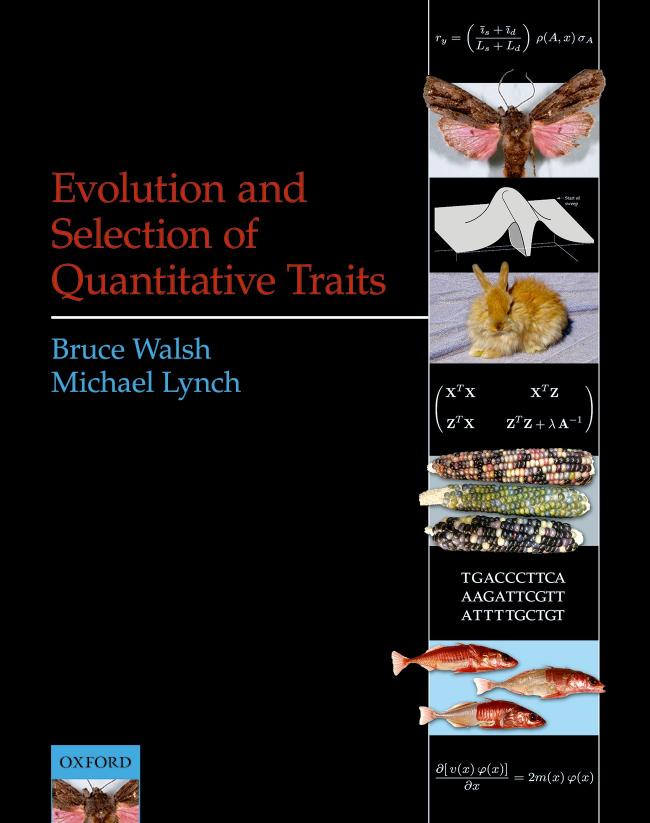
Evolution and Selection of Quantitative Traits 1st edition by Bruce Walsh, Michael Lynch – Ebook PDF Instant Download/Delivery: 0192566645, 9780192566645
Full download Evolution and Selection of Quantitative Traits 1st edition after payment
Product details:
ISBN 10: 0192566645
ISBN 13: 9780192566645
Author: Bruce Walsh, Michael Lynch
Quantitative traits-be they morphological or physiological characters, aspects of behavior, or genome-level features such as the amount of RNA or protein expression for a specific gene-usually show considerable variation within and among populations. Quantitative genetics, also referred to as the genetics of complex traits, is the study of such characters and is based on mathematical models of evolution in which many genes influence the trait and in which non-genetic factors may also be important. Evolution and Selection of Quantitative Traits presents a holistic treatment of the subject, showing the interplay between theory and data with extensive discussions on statistical issues relating to the estimation of the biologically relevant parameters for these models. Quantitative genetics is viewed as the bridge between complex mathematical models of trait evolution and real-world data, and the authors have clearly framed their treatment as such. This is the second volume in a planned trilogy that summarizes the modern field of quantitative genetics, informed by empirical observations from wide-ranging fields (agriculture, evolution, ecology, and human biology) as well as population genetics, statistical theory, mathematical modeling, genetics, and genomics. Whilst volume 1 (1998) dealt with the genetics of such traits, the main focus of volume 2 is on their evolution, with a special emphasis on detecting selection (ranging from the use of genomic and historical data through to ecological field data) and examining its consequences.
Evolution and Selection of Quantitative Traits 1st Table of contents:
UNIT 1: Foundations of Quantitative Evolutionary Genetics
Chapter 1: Historical and Theoretical Foundations
-
The development of population and quantitative genetics
-
Integration of molecular and classical approaches
-
Significance of quantitative traits in evolutionary biology
Chapter 2: Evolution at One and Two Loci
-
Dynamics of allele frequency change
-
Selection models for single-locus and multi-locus systems
-
Linkage disequilibrium and its evolutionary implications
Chapter 3: Genetic Drift and Nonadaptive Forces
-
The role of stochastic processes in evolution
-
Interaction between drift, mutation, and selection
-
Implications for genetic variation in natural populations
UNIT 2: Measuring and Modeling Selection
Chapter 4: The Breeder’s Equation and Evolutionary Prediction
-
Derivation and application of the breeder’s equation
-
Estimating heritability and response to selection
-
Use in artificial and natural selection studies
Chapter 5: Empirical Challenges in Natural Populations
-
Measuring selection in the wild
-
Importance of long-term datasets
-
Statistical approaches for evolutionary inference
Chapter 6: Multivariate and Individual-Level Approaches
-
Individual versus trait-group selection models
-
Multivariate selection gradients and responses
-
Experimental design and statistical rigor in selection studies
UNIT 3: Maintenance and Modifiers of Genetic Variation
Chapter 7: Maintenance of Genetic Variation
-
Balancing selection and mutation-selection balance
-
Role of environmental heterogeneity
-
Constraints on adaptation
Chapter 8: Environmental and Genetic Influences on Trait Response
-
Genotype-environment interactions
-
Phenotypic plasticity and evolutionary potential
-
Measuring environmental impacts on trait variance
Chapter 9: Family-Based Selection and Associative Effects
-
Kin selection and inclusive fitness
-
Associative overdominance and indirect selection
-
Social and demographic structure in trait evolution
Chapter 10: Inbreeding and Evolutionary Outcomes
-
Effects of inbreeding on genetic load
-
Inbreeding depression and adaptive potential
-
Management implications for small or isolated populations
UNIT 4: Methodological Frameworks in Evolutionary Genetics
Chapter 11: Statistical Models in Evolutionary Genetics
-
Quantitative trait locus (QTL) mapping
-
Mixed models and animal models
-
Model selection and inference in evolutionary studies
Chapter 12: Experimental Design and Research Best Practices
-
Designing robust selection experiments
-
Sampling strategies and replication
-
Interpreting complex evolutionary data sets
People also search for Evolution and Selection of Quantitative Traits 1st :
evolution and selection of quantitative traits pdf
evolution of traits
what kind of traits evolve through natural selection
quantitative traits evolution
quantitative selection evolution
Tags: Bruce Walsh, Michael Lynch, Quantitative Traits, Evolution and Selection