


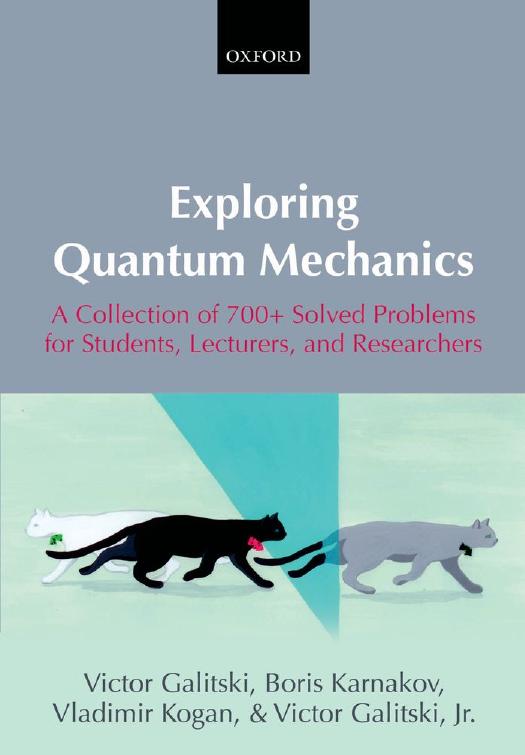
Exploring Quantum Mechanics 1st edition by Victor Galitski, Boris Karnakov, Vladimir Kogan, Victor Galitski Jr ISBN 0199232725 978-0199232727
Original price was: $70.00.$35.00Current price is: $35.00.
Instant download Exploring Quantum Mechanics A Collection of 700 Solved Problems for Students Lecturers and Researchers after payment
Exploring Quantum Mechanics 1st edition by Victor Galitski, Boris Karnakov, Vladimir Kogan, Victor Galitski Jr – Ebook PDF Instant Download/Delivery: 0199232725, 978-0199232727
Full download Exploring Quantum Mechanics 1st edition after payment
Product details:
ISBN 10: 0199232725
ISBN 13: 978-0199232727
Author: Victor Galitski, Boris Karnakov, Vladimir Kogan, Victor Galitski Jr
A series of seminal technological revolutions has led to a new generation of electronic devices miniaturized to such tiny scales where the strange laws of quantum physics come into play. There is no doubt that, unlike scientists and engineers of the past, technology leaders of the future will have to rely on quantum mechanics in their everyday work. This makes teaching and learning the subject of paramount importance for further progress. Mastering quantum physics is a very non-trivial task and its deep understanding can only be achieved through working out real-life problems and examples. It is notoriously difficult to come up with new quantum-mechanical problems that would be solvable with a pencil and paper, and within a finite amount of time. This book remarkably presents some 700+ original problems in quantum mechanics together with detailed solutions covering nearly 1000 pages on all aspects of quantum science. The material is largely new to the English-speaking audience.
The problems have been collected over about 60 years, first by the lead author, the late Prof. Victor Galitski, Sr. Over the years, new problems were added and the material polished by Prof. Boris Karnakov. Finally, Prof. Victor Galitski, Jr., has extended the material with new problems particularly relevant to modern science.
Exploring Quantum Mechanics 1st Table of contents:
1 Operators in quantum mechanics
1.1 Basic concepts of the theory of linear operators
1.2 Eigenfunctions, eigenvalues, mean values
1.3 The projection operators
1.4 Quantum-mechanical representations of operators and wave-functions; Unitary operators
2 One-dimensional motion
2.1 Stationary states in discrete spectrum
2.2 The Schrödinger equation in momentum space; The Green function and integral form of the Schrödinger equation
2.3 The continuous spectrum; Reflection from and transmission through potential barriers
2.4 Systems with several degrees of freedom; Particle in a periodic potential
3 Orbital angular momentum
3.1 General properties of angular momentum
3.2 Angular momentum, l = 1
3.3 Addition of angular momenta
3.4 Tensor formalism in angular momentum theory
4 Motion in a spherically-symmetric potential
4.1 Discrete spectrum states in central fields
4.2 Low-energy states
4.3 Symmetries of the Coulomb problem
4.4 Systems with axial symmetry
5 Spin
5.1 Spin s = 1/2
5.2 Spin-orbital states with spin s = 1/2; Higher spins
5.3 Spin density matrix; Angular distributions in decays
5.4 Bound states of spin-orbit-coupled particles
5.5 Coherent-state spin path-integral
6 Time-dependent quantum mechanics
6.1 The Schrödinger representation; The motion of wave packets
6.2 Time-dependent observables; Constants of motion
6.3 Time-dependent unitary transformations; The Heisenberg picture of motion
6.4 The time-dependent Green function
6.5 Quasistationary and quasi-energy states; Berry phase
7 Motion in a magnetic field
7.1 Stationary states in a magnetic field
7.2 Time-dependent quantum mechanics in a magnetic field
7.3 Magnetic field of the orbital currents and spin magnetic moment
8 Perturbation theory; Variational method; Sudden and adiabatic theory
8.1 Stationary perturbation theory (discrete spectrum)
8.2 Variational method
8.3 Stationary perturbation theory (continuous spectrum)
8.4 Non-stationary perturbation theory; Transitions in continuous spectrum
8.5 Sudden perturbations
8.6 Adiabatic approximation
9 Quasi-classical approximation; 1/N-expansion in quantum mechanics
9.1 Quasi-classical energy quantization
9.2 Quasi-classical wavefunctions, probabilities, and mean values
9.3 Penetration through potential barriers
9.4 1/N-expansion in quantum mechanics
10 Identical particles; Second quantization
10.1 Quantum statistics; Symmetry of wavefunctions
10.2 Elements of the second quantization formalism (the occupation-number representation)
10.3 The simplest systems with a large number of particles (N ≫ 1)
11 Atoms and molecules
11.1 Stationary states of one-electron and two-electron atoms
11.2 Many-electron atoms; Statistical atomic model
11.3 Principles of two-atom-molecule theory
11.4 Atoms and molecules in external fields; Interaction of atomic systems
11.5 Non-stationary phenomena in atomic systems
12 Atomic nucleus
12.1 Nuclear forces—the fundamentals; The deuteron
12.2 The shell model
12.3 Isotopic invariance
13 Particle collisions
13.1 Born approximation
13.2 Scattering theory: partial-wave analysis
13.3 Low-energy scattering; Resonant scattering
13.4 Scattering of fast particles; Eikonal approximation
13.5 Scattering of particles with spin
13.6 Analytic properties of the scattering amplitude
13.7 Scattering of composite quantum particles; Inelastic collisions
14 Quantum radiation theory
14.1 Photon emission
14.2 Photon scattering; Photon emission in collisions
15 Relativistic wave equations
15.1 The Klein–Gordon equation
15.2 The Dirac equation
16 Appendix
16.1 App.1. Integrals and integral relations
16.2 App.2. Cylinder functions
Index
Footnotes
People also search for Exploring Quantum Mechanics 1st:
need of quantum mechanics
quantum physics time travel theory
what is quantum mechanics in physics
quantum mechanics in everyday life
exploring quantum physics through hands-on projects
Tags: Victor Galitski, Boris Karnakov, Vladimir Kogan, Victor Galitski Jr, Exploring Quantum Mechanics