


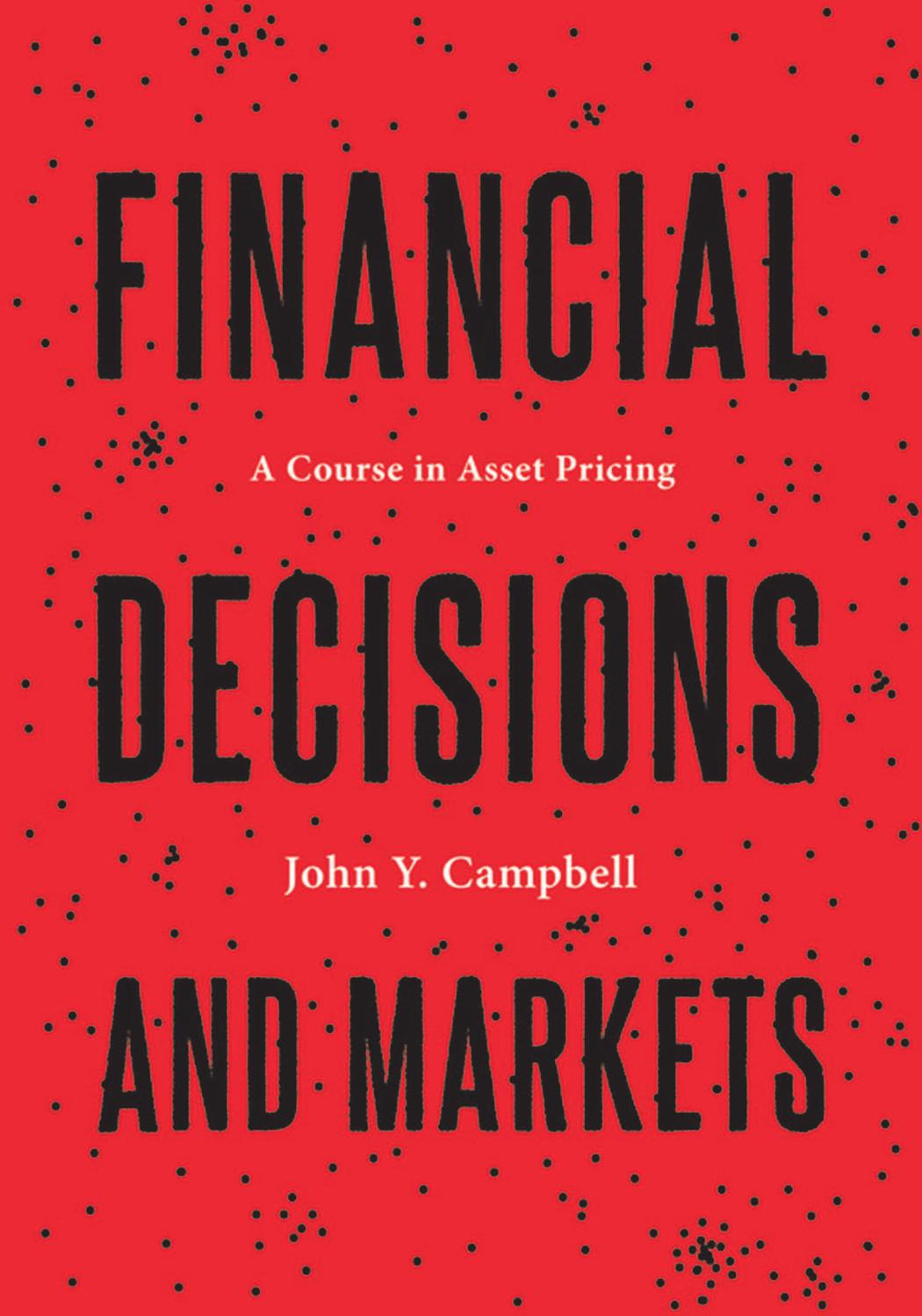
Financial Decisions and Markets A Course in Asset Pricing 1st edition by John Campbell – Ebook PDF Instant Download/Delivery: 1400888221, 9781400888221
Full download Financial Decisions and Markets A Course in Asset Pricing 1st edition after payment
Product details:
ISBN 10: 1400888221
ISBN 13: 9781400888221
Author: John Campbell
From the field’s leading authority, the most authoritative and comprehensive advanced-level textbook on asset pricing In Financial Decisions and Markets, John Campbell, one of the field’s most respected authorities, provides a broad graduate-level overview of asset pricing. He introduces students to leading theories of portfolio choice, their implications for asset prices, and empirical patterns of risk and return in financial markets. Campbell emphasizes the interplay of theory and evidence, as theorists respond to empirical puzzles by developing models with new testable implications. The book shows how models make predictions not only about asset prices but also about investors’ financial positions, and how they often draw on insights from behavioral economics. After a careful introduction to single-period models, Campbell develops multiperiod models with time-varying discount rates, reviews the leading approaches to consumption-based asset pricing, and integrates the study of equities and fixed-income securities. He discusses models with heterogeneous agents who use financial markets to share their risks, but also may speculate against one another on the basis of different beliefs or private information. Campbell takes a broad view of the field, linking asset pricing to related areas, including financial econometrics, household finance, and macroeconomics. The textbook works in discrete time throughout, and does not require stochastic calculus. Problems are provided at the end of each chapter to challenge students to develop their understanding of the main issues in financial economics. The most comprehensive and balanced textbook on asset pricing available, Financial Decisions and Markets is an essential resource for all graduate students and practitioners in finance and related fields. Integrated treatment of asset pricing theory and empirical evidence Emphasis on investors’ decisions Broad view linking the field to financial econometrics, household finance, and macroeconomics Topics treated in discrete time, with no requirement for stochastic calculus Forthcoming solutions manual for problems available to professors
Financial Decisions and Markets A Course in Asset Pricing 1st Table of contents:
Part I Static Portfolio Choice and Asset Pricing
1 Choice under Uncertainty
1.1 Expected Utility
1.1.1 Sketch of von Neumann-Morgenstern Theory
1.2 Risk Aversion
1.2.1 Jensen’s Inequality and Risk Aversion
1.2.2 Comparing Risk Aversion
1.2.3 The Arrow-Pratt Approximation
1.3 Tractable Utility Functions
1.4 Critiques of Expected Utility Theory
1.4.1 Allais Paradox
1.4.2 Rabin Critique
1.4.3 First-Order Risk Aversion and Prospect Theory
1.5 Comparing Risks
1.5.1 Comparing Risks with the Same Mean
1.5.2 Comparing Risks with Different Means
1.5.3 The Principle of Diversification
1.6 Solution and Further Problems
2 Static Portfolio Choice
2.1 Choosing Risk Exposure
2.1.1 The Principle of Participation
2.1.2 A Small Reward for Risk
2.1.3 The CARA-Normal Case
2.1.4 The CRRA-Lognormal Case
2.1.5 The Growth-Optimal Portfolio
2.2 Combining Risky Assets
2.2.1 Two Risky Assets
2.2.2 One Risky and One Safe Asset
2.2.3 N Risky Assets
2.2.4 The Global Minimum-Variance Portfolio
2.2.5 The Mutual Fund Theorem
2.2.6 One Riskless Asset and N Risky Assets
2.2.7 Practical Difficulties
2.3 Solutions and Further Problems
3 Static Equilibrium Asset Pricing
3.1 The Capital Asset Pricing Model (CAPM)
3.1.1 Asset Pricing Implications of the Sharpe-Lintner CAPM
3.1.2 The Black CAPM
3.1.3 Beta Pricing and Portfolio Choice
3.1.4 The Black-Litterman Model
3.2 Arbitrage Pricing and Multifactor Models
3.2.1 Arbitrage Pricing in a Single-Factor Model
3.2.2 Multifactor Models
3.2.3 The Conditional CAPM as a Multifactor Model
3.3 Empirical Evidence
3.3.1 Test Methodology
3.3.2 The CAPM and the Cross-Section of Stock Returns
3.3.3 Alternative Responses to the Evidence
3.4 Solution and Further Problems
4 The Stochastic Discount Factor
4.1 Complete Markets
4.1.1 The SDF in a Complete Market
4.1.2 The Riskless Asset and Risk-Neutral Probabilities
4.1.3 Utility Maximization and the SDF
4.1.4 The Growth-Optimal Portfolio and the SDF
4.1.5 Solving Portfolio Choice Problems
4.1.6 Perfect Risksharing
4.1.7 Existence of a Representative Agent
4.1.8 Heterogeneous Beliefs
4.2 Incomplete Markets
4.2.1 Constructing an SDF in the Payoff Space
4.2.2 Existence of a Positive SDF
4.3 Properties of the SDF
4.3.1 Risk Premia and the SDF
4.3.2 Volatility Bounds
4.3.3 Entropy Bound
4.3.4 Factor Structure
4.3.5 Time-Series Properties
4.4 Generalized Method of Moments
4.4.1 Asymptotic Theory
4.4.2 Important GMM Estimators
4.4.3 Traditional Tests in the GMM Framework
4.4.4 GMM in Practice
4.5 Limits of Arbitrage
4.6 Solutions and Further Problems
Part II Intertemporal Portfolio Choice and Asset Pricing
5 Present Value Relations
5.1 Market Efficiency
5.1.1 Tests of Autocorrelation in Stock Returns
5.1.2 Empirical Evidence on Autocorrelation in Stock Returns
5.2 Present Value Models with Constant Discount Rates
5.2.1 Dividend-Based Models
5.2.2 Earnings-Based Models
5.2.3 Rational Bubbles
5.3 Present Value Models with Time-Varying Discount Rates
5.3.1 The Campbell-Shiller Approximation
5.3.2 Short- and Long-Term Return Predictability
5.3.3 Interpreting US Stock Market History
5.3.4 VAR Analysis of Returns
5.4 Predictive Return Regressions
5.4.1 Stambaugh Bias
5.4.2 Recent Responses Using Financial Theory
5.4.3 Other Predictors
5.5 Drifting Steady-State Models
5.5.1 Volatility and Valuation
5.5.2 Drifting Steady-State Valuation Model
5.5.3 Inflation and the Fed Model
5.6 Present Value Logic and the Cross-Section of Stock Returns
5.6.1 Quality as a Risk Factor
5.6.2 Cross-Sectional Measures of the Equity Premium
5.7 Solution and Further Problems
6 Consumption-Based Asset Pricing
6.1 Lognormal Consumption with Power Utility
6.2 Three Puzzles
6.2.1 Responses to the Puzzles
6.3 Beyond Lognormality
6.3.1 Time-Varying Disaster Risk
6.4 Epstein-Zin Preferences
6.4.1 Deriving the SDF for Epstein-Zin Preferences
6.5 Long-Run Risk Models
6.5.1 Predictable Consumption Growth
6.5.2 Heteroskedastic Consumption
6.5.3 Empirical Specification
6.6 Ambiguity Aversion
6.7 Habit Formation
6.7.1 A Ratio Model of Habit
6.7.2 The Campbell-Cochrane Model
6.7.3 Alternative Models of Time-Varying Risk Aversion
6.8 Durable Goods
6.9 Solutions and Further Problems
7 Production-Based Asset Pricing
7.1 Physical Investment with Adjustment Costs
7.1.1 A q-Theory Model of Investment
7.1.2 Investment Returns
7.1.3 Explaining Firms’ Betas
7.2 General Equilibrium with Production
7.2.1 Long-Run Consumption Risk in General Equilibrium
7.2.2 Variable Labor Supply
7.2.3 Habit Formation in General Equilibrium
7.3 Marginal Rate of Transformation and the SDF
7.4 Solution and Further Problem
8 Fixed-Income Securities
8.1 Basic Concepts
8.1.1 Yields and Holding-Period Returns
8.1.2 Forward Rates
8.1.3 Coupon Bonds
8.2 The Expectations Hypothesis of the Term Structure
8.2.1 Restrictions on Interest Rate Dynamics
8.2.2 Empirical Evidence
8.3 Affine Term Structure Models
8.3.1 Completely Affine Homoskedastic Single-Factor Model
8.3.2 Completely Affine Heteroskedastic Single-Factor Model
8.3.3 Essentially Affine Models
8.3.4 Strong Restrictions and Hidden Factors
8.4 Bond Pricing and the Dynamics of Consumption Growth and Inflation
8.4.1 Real Bonds and Consumption Dynamics
8.4.2 Permanent and Transitory Shocks to Marginal Utility
8.4.3 Real Bonds, Nominal Bonds, and Inflation
8.5 Interest Rates and Exchange Rates
8.5.1 Interest Parity and the Carry Trade
8.5.2 The Domestic and Foreign SDF
8.6 Solution and Further Problems
9 Intertemporal Risk
9.1 Myopic Portfolio Choice
9.2 Intertemporal Hedging
9.2.1 A Simple Example
9.2.2 Hedging Interest Rates
9.2.3 Hedging Risk Premia
9.2.4 Alternative Approaches
9.3 The Intertemporal CAPM
9.3.1 A Two-Beta Model
9.3.2 Hedging Volatility: A Three-Beta Model
9.4 The Term Structure of Risky Assets
9.4.1 Stylized Facts
9.4.2 Asset Pricing Theory and the Risky TermStructure
9.5 Learning
9.6 Solutions and Further Problems
Part III Heterogeneous Investors
10 Household Finance
10.1 Labor Income and Portfolio Choice
10.1.1 Static Portfolio Choice Models
10.1.2 Multiperiod Portfolio Choice Models
10.1.3 Labor Income and Asset Pricing
10.2 Limited Participation
10.2.1 Wealth, Participation, and Risktaking
10.2.2 Asset Pricing Implications of Limited Participation
10.3 Underdiversification
10.3.1 Empirical Evidence
10.3.2 Effects on the Wealth Distribution
10.3.3 Asset Pricing Implications of Underdiversification
10.4 Responses to Changing Market Conditions
10.5 Policy Responses
10.6 Solutions and Further Problems
11 Risksharing and Speculation
11.1 Incomplete Markets
11.1.1 Asset Pricing with Uninsurable Income Risk
11.1.2 Market Design with Incomplete Markets
11.1.3 General Equilibrium with Imperfect Risksharing
11.2 Private Information
11.3 Default
11.3.1 Punishment by Exclusion
11.3.2 Punishment by Seizure of Collateral
11.4 Heterogeneous Beliefs
11.4.1 Noise Traders
11.4.2 The Harrison-Kreps Model
11.4.3 Endogenou Margin Requirements
11.5 Solution and Further Problems
12 Asymmetric Information and Liquidity
12.1 Rational Expectations Equilibrium
12.1.1 Fully Revealing Equilibrium
12.1.2 Partially Revealing Equilibrium
12.1.3 News, Trading Volume, and Returns
12.1.4 Equilibrium with Costly Information
12.1.5 Higher-Order Expectations
12.2 Market Microstructure
12.2.1 Information and the Bid-Ask Spread
12.2.2 Information and Market Impact
12.2.3 Diminishing Returns in Active Asset Management
12.3 Liquidity and Asset Pricing
12.3.1 Constant Trading Costs and Asset Prices
12.3.2 Random Trading Costs and Asset Prices
12.3.3 Margins and Asset Prices
12.3.4 Margins and Trading Costs
12.4 Solution and Further Problems
References
Index
People also search for Financial Decisions and Markets A Course in Asset Pricing 1st:
financial markets and decisions 1 exeter
financial markets and decisions exeter
financial markets and decisions 2 exeter
financial markets and decisions 2
traders risks decisions and management in financial markets
Tags: John Campbell, Financial Decisions, A Course, Asset Pricing