


FinFET Modeling for IC Simulation and Design Using the BSIM CMG Standard 1st edition by Yogesh Singh Chauhan, Darsen Lu, Sriramkumar Vanugopalan, Sourabh Khandelwal, Juan Pablo Duarte ISBN 0124200852 9780124200852
Original price was: $70.00.$35.00Current price is: $35.00.
Instant download FinFET Modeling for IC Simulation and Design Using the BSIM CMG Standard 4 8=8AB@0B @ after payment
FinFET Modeling for IC Simulation and Design Using the BSIM CMG Standard 1st edition by Yogesh Singh Chauhan, Darsen Lu, Sriramkumar Vanugopalan, Sourabh Khandelwal, Juan Pablo Duarte – Ebook PDF Instant Download/Delivery: 0124200852 , 9780124200852
Full download FinFET Modeling for IC Simulation and Design Using the BSIM CMG Standard 1st edition after payment
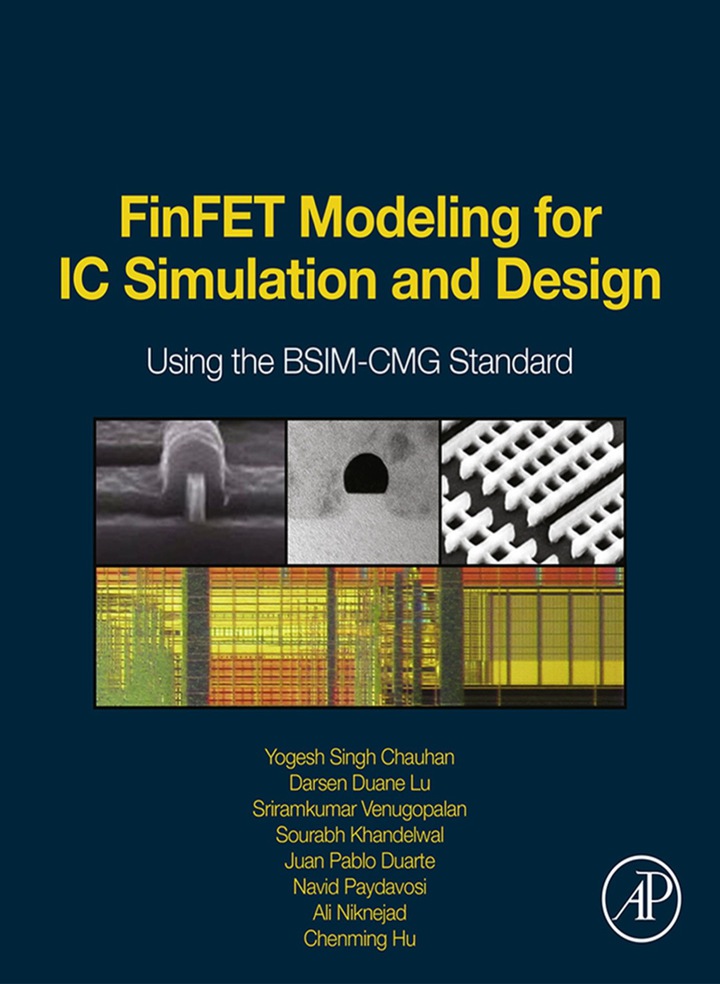
Product details:
ISBN 10: 0124200852
ISBN 13: 9780124200852
Author: Yogesh Singh Chauhan, Darsen Lu, Sriramkumar Vanugopalan, Sourabh Khandelwal, Juan Pablo Duarte
This book is the first to explain FinFET modeling for IC simulation and the industry standard – BSIM-CMG – describing the rush in demand for advancing the technology from planar to 3D architecture, as now enabled by the approved industry standard.
The book gives a strong foundation on the physics and operation of FinFET, details aspects of the BSIM-CMG model such as surface potential, charge and current calculations, and includes a dedicated chapter on parameter extraction procedures, providing a step-by-step approach for the efficient extraction of model parameters.
With this book you will learn:
- Why you should use FinFET
- The physics and operation of FinFET
- Details of the FinFET standard model (BSIM-CMG)
- Parameter extraction in BSIM-CMG
- FinFET circuit design and simulation
- Authored by the lead inventor and developer of FinFET, and developers of the BSIM-CM standard model, providing an experts’ insight into the specifications of the standard
- The first book on the industry-standard FinFET model – BSIM-CMG
FinFET Modeling for IC Simulation and Design Using the BSIM CMG Standard 1st Table of contents:
Chapter 1: FinFET—From device concept to standard compact model
1.1 The root cause of short-channel effects in the twenty-first century MOSFETs
1.2 The thin-body MOSFET concept
1.3 The FinFET and a new scaling path for MOSFETs
1.4 Ultra-thin-body FET
1.5 FinFET compact model—the bridge between FinFET technology and IC design
1.6 A brief history of the first standard compact model, BSIM
1.7 Core and real-device models
1.8 The industry standard FinFET compact model
References
Chapter 2: Compact models for analog and RF applications
2.1 Introduction
2.2 Important Compact Model Metrics
2.3 Analog Metrics
2.3.1 Quiescent Operating Point
2.3.2 Geometric Scalability
2.3.3 Variability Model
2.3.4 Intrinsic Voltage Gain
2.3.5 Speed: Unity Gain Frequency
2.3.6 Noise
2.3.7 Linearity and Symmetry
Harmonic distortion
Gain compression
Memory effects
Intermodulation distortion
2.3.8 Symmetry
2.4 RF Metrics
2.4.1 Two-Port Parameters
2.4.2 The Need for Speed
The maximum unity power gain frequency (fmax)
Mason’s unilateral gain U
2.4.3 Non-Quasi-Static Model
2.4.4 Noise
Minimum achievable noise figure (Fmin)
Simple model for FET noise
Phase noise
Phase noise derivation: Lorentzian spectrum
Phase noise and flicker noise
2.4.5 Linearity
Memory effects
Other distortion metrics
2.5 Conclusion
References
Chapter 3: Core model for FinFETs
3.1 Core Model for Double-Gate FinFETs
3.2 Unified FinFET Compact Model
Chapter 3 Appendix: Explicit surface potential model
3A.1 Continuous Starting Function
3A.2 Quartic Modified Iteration: Implementation and Evaluation
References
Chapter 4: Channel current and real device effects
4.1 Introduction
4.2 Threshold Voltage Roll-Off
4.3 Subthreshold Slope Degradation
4.4 Quantum Mechanical Vth Correction
4.5 Vertical-Field Mobility Degradation
4.6 Drain Saturation Voltage, Vdsat
4.6.1 Extrinsic Case (RDSMOD=1 and 2)
4.6.2 Intrinsic Case (RDSMOD = 0)
4.7 Velocity Saturation Model
4.8 Quantum Mechanical Effects
4.8.1 Effective Width Model
4.8.2 Effective Oxide Thickness/Effective Capacitance
4.8.3 Charge Centroid Calculation for Accumulation
4.9 Lateral Nonuniform Doping Model
4.10 Body Effect Model for a Bulk FinFET (BULKMOD=1)
4.11 Output Resistance Model
4.11.1 Channel-Length Modulation
4.11.2 Drain-Induced Barrier Lowering
4.12 Channel Current
References
Chapter 5: Leakage currents
5.1 Weak-Inversion Current
5.2 Gate-Induced Source and Drain Leakages
5.2.1 GIDL/GISL Current Formulation in BSIM-CMG
5.3 Gate Oxide Tunneling
5.3.1 Gate Oxide Tunneling Formulation in BSIM-CMG
5.3.2 Gate-to-Body Tunneling Current in Depletion/Inversion
5.3.3 Gate-to-Body Tunneling Current in Accumulation
5.3.4 Gate-to-Channel Tunneling Current in Inversion
5.3.5 Gate-to-Source/Drain tunneling Current
5.4 Impact Ionization
References
Chapter 6: Charge, capacitance, and non-quasi-static effects
6.1 Terminal Charges
6.1.1 Gate Charge
6.1.2 Drain Charge
6.1.3 Source Charge
6.2 Transcapacitances
6.3 Non-quasi-Static Effects Models
6.3.1 Relaxation Time Approximation Model
6.3.2 Channel-Induced Gate Resistance Model
6.3.3 Charge Segmentation Model
References
Chapter 7: Parasitic resistances and capacitances
7.1 FinFET Device Structure and Symbol Definitions
7.2 Modeling of Geometry-Dependent Source/Drain Resistances in FinFETs
7.2.1 Contact Resistance
7.2.2 Spreading Resistance
7.2.3 Extension Resistance
7.3 Parasitic Resistance Model Verification
7.3.1 TCAD Simulation Setup
7.3.2 Device Optimization
7.3.3 Extraction of Source and Drain Resistances
7.3.4 Discussion
7.4 Implementation Considerations of the Parasitic Resistance Model
7.4.1 Physical Parameters
7.4.2 Resistance Components
7.5 Gate Electrode Resistance Model
7.6 FinFET Parasitic Capacitance Models
7.6.1 Connection of Parasitic Capacitance Components
7.6.2 Derivation of Two-Dimensional Fringe Capacitance
7.7 Modeling of FinFET Fringe Capacitance in Three Dimensions: CGEOMOD=2
7.8 Parasitic Capacitance Model Verification
7.9 Summary
References
Chapter 8: Noise
8.1 Introduction
8.2 Thermal noise
8.3 Flicker noise
8.4 Other noise components
8.5 Summary
References
Chapter 9: Junction diode I-V and C-V models
9.1 Junction diode current model
9.1.1 Reverse-bias additional leakage model
9.2 Junction diode charge/capacitance model
9.2.1 Reverse-bias model
9.2.2 Forward-bias model
References
Chapter 10: Benchmark tests for compact models
10.1 Asymptotic Correctness
10.2 Benchmark Tests
10.2.1 Tests for Checking Physical Behavior in Weak-Inversion and Strong-Inversion Regions
Slope ratio test
Conductance test
Volume inversion test
10.2.2 Symmetry Tests
Gummel symmetry test
Harmonic balance simulation test
AC symmetry test
10.2.3 Reciprocity Test for Capacitances in a Compact Model
10.2.4 Test for the Self-Heating Effect Model
10.2.5 Tests for the Thermal Noise Model
References
Chapter 11: BSIM-CMG model parameter extraction
11.1 Parameter extraction background
11.2 BSIM-CMG parameter extraction strategy
11.3 Conclusion
References
Chapter 12: Temperature dependence
12.1 Semiconductor properties
12.1.1 Band gap temperature dependence
12.1.2 Temperature dependence of NC, Vbi, and B
12.1.3 Temperature dependence of the intrinsic carrier concentration
12.2 Temperature dependence of the threshold voltage
12.2.1 Temperature dependence of drain-induced barrier lowering
12.2.2 Temperature dependence of the body effect
12.2.3 Subthreshold swing
12.3 Temperature dependence of mobility
12.4 Temperature dependence of velocity saturation
12.4.1 Temperature dependence of the nonsaturation effect
12.5 Temperature dependence of leakage currents
12.5.1 Gate current
12.5.2 Gate-induced drain/source leakage
12.5.3 Impact ionization
12.6 Temperature dependence of parasitic source/drain resistances
12.7 Temperature dependence of source/drain diode characteristics
12.7.1 Direct current model
12.7.2 Capacitance
12.7.3 Trap-assisted tunneling current
12.8 Self-heating effect
12.9 Validation range
12.10 Model validation on measured data
References
Appendix: Parameter List
A.1 Model Controllers
A.2 Instance Parameters
A.3 Process Parameters
A.4 Basic Model Parameters
A.5 Parameters for Geometry-Dependent Parasitics
A.6 Parameters for Temperature Dependence Andself-Heating
A.7 Parameters for Variability Modeling
Index
People also search for FinFET Modeling for IC Simulation and Design Using the BSIM CMG Standard 1st :
Finfet modeling for ic simulation and design pdf
finfet gaa modeling for ic simulation and design pdf
what is simulation in simulation and modeling
finfet tutorial
finfet devices for vlsi circuits and systems pdf
Tags: Yogesh Singh Chauhan, Darsen Lu, Sriramkumar Vanugopalan, Sourabh Khandelwal, Juan Pablo Duarte, FinFET Modeling, BSIM CMG